



Nová radnice (Milevsko) Town hall
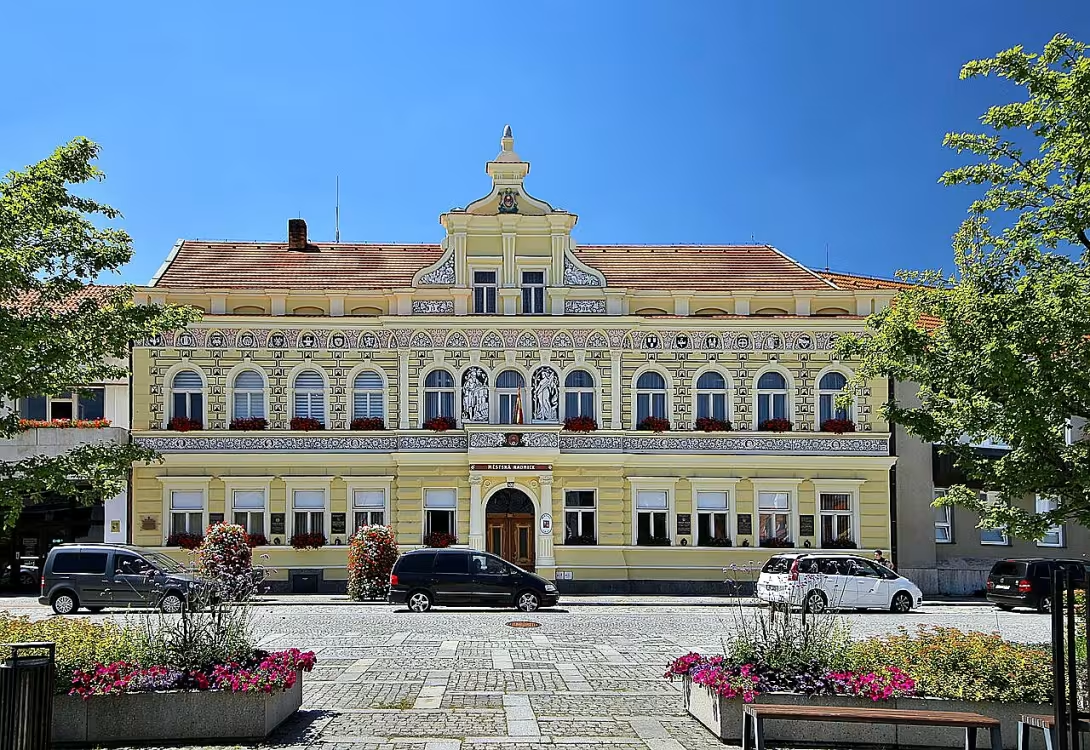
The new town hall in Milevsko is a representative one-storey building in a neo-Renaissance style, built at the turn of the 19th and 20th centuries. The building is located on the main square and forms an important element of the urban monument zone. Since 16 June 2012 it has been registered in the register of cultural monuments.
The town hall was built between 1900 and 1902. It was created during the flowering period of urban culture under Austria-Hungary, when self-government used historic styles to express its prosperity and confidence. The construction replaced the older construction of eight meat shops, which have been operating here since 1749.
Architecturally, the object belongs to the neo-Renaissance. A significant element of the square-oriented facade is the sgraffiti decoration created by the local painter Oldřich Pejša in 1936. During the 20th century, the building underwent construction modifications. Around 1980 an extension was realized on the south side and a restaurant was added on the north side.
An interesting thing is the inconsistency between the year on the shield and the actual date of completion. Although the year 1900 is marked on the facade, the construction itself was completed only in 1902. This is evidenced by the change in the commercial character of the square, when the original artisanal background gave way to a representative administrative building.
Today, the New Town Hall is part of the historical centre of Milevska, in which there is also a major Premonstrati monastery. The building is evidence of the building development of the city and its historical value is underlined by its historical protection. Visiting this place offers the opportunity to know the architecture of the turn of the century in the context of the Milev City Monument Zone.
Historical milestones
- 1749
- Eight meat shops were created at the site of the building.
- 1902
- Completion of the construction of a new city hall building.
- 1936
- Creating a sgraphite decoration on the facade by the painter Oldřich Pejša.
- 2012
- The building was listed in the state list of cultural monuments.
Architectural development
The building was built in Neo-Renaissance style in place of former meat shops. During the 20th century it underwent modifications, specifically in 1936 it was supplemented with sgraffiti decoration. Around 1980, an extension was carried out on the south side and a restaurant on the north side was added.
Historical events
A number of meat shops were built on site in 1749. In the years 1900- 1902 the current town hall building was built. In 1936 sgraffiti decoration of the facade was realized. On 16 June 2012, the building was declared a cultural monument.
Points of interest
- The building was built at the turn of the nineteenth and twentieth centuries in a place where there were previously eight meat shops operating since 1749. - On the front of the building there is a sgraphite decoration created by the local painter Oldřich Pejša in 1936. - The building shield is marked in 1900, although the construction itself was completed only in 1902. - The building has been registered in the register of cultural monuments since 16 June 2012. - The southern part was added to the building around 1980 and a restaurant was built on the north side.
Guide
Show guide text
This text was created by artificial intelligence and has not been editorially reviewed. It may contain inaccuracies.
Welcome to the heart of Milevsko. You are standing in the main square, in a place where the day-to-day life of the city meets its rich history. In front of your eyes is a building that, by its presence, determines the nature of this entire space. It's New Town Hall. Although its name may seem modern, this representative one-storey building has been a solid part of the local lace for many years. Look at her as a whole, perceive her calm dominance and the security she brings to this open square. It is a place that was designed to serve citizens and represent the city.
However, in order to understand why this building is standing here and why it has such an important role, we must go back deep into the past with you. Imagine this square at a time when no town hall has ever stood here. If we go back to the mid-eighteenth century, namely seven hundred and forty-nine, you will see a whole other world here. There were eight small meat shops at the place where this magnificent building is now standing. It was a place of busy, full of people coming to buy food, and the air was probably filled with the smell of fresh meat and the daily noise of trade negotiations. These small shops were the basic part of the square for many decades, until the city began to change and modernise.
Over time, the city's needs developed. The old building was no longer sufficient to meet the ambitions and needs of a growing town. It was clear that something new needed to be created, something that would be more important and serve as a centre of governance. So it was decided that the old meat shop would give way to a new, representative building. So at the turn of the nineteenth and twentieth centuries, a building was built to change the face of this square. The whole construction process took place between a thousand and nine hundred and zero and a thousand nine hundred and two. When the building was completed, it became a symbol of a new era for Milevsko.
Now pay attention to the architecture of the building that is surrounding you. If you look at its overall form, you can see some order and elegance. The building was built in a neo-Renaissance style. This style seeks to link to the classic ideals of beauty and harmony, which is also evident on this one-story construction. Although the building is not high, its architecture is dignified and representative. Pay particular attention to what you see on her facade. The facade is not just a simple surface, but it is richly decorated.
This decoration is one of the most important elements that the city hall gives its unique character. It's sgraffiti decoration. If you approach the building, you can see how different patterns and shapes are created into the facade surface. This technique is very specific and requires great skill. And this is where we get to one of the most important characters associated with this place. Although the town hall itself was established at the beginning of the century, its visual wealth was supplemented much later. In the year one thousand nine hundred thirty-six, a local painter named Oldřich Pejša created a work of art here.
Oldřich Pejša was an artist who could bring a soul into architecture. His sgraffiti work on the front of the town hall is not just an ordinary decoration, but an artistic element that gives the building depth and interest. Thanks to his work, you look at the facade as a living story that changes depending on how the light hits the walls of the building. It is a combination of architecture and painting art, which creates a unique impression in Milevsko.
If you look at the building, you might be interested in one other thing that might seem a little strange. If you look at the building's shield, you can see a marked year of 1,000 nine hundred zero. You may think it's consistent with the time the town hall was built, but if you look at the historical records, you'll find that the entire construction was completed in a thousand and nine hundred and two. Why is he standing there two years early? It's one of those little mysteries that history often leaves behind. Maybe it was the year that the big preparations started or the year that the project was finally approved. This little discrepancy gives the building a hint of mystery and makes us think about how complicated the process of its creation was.
This building is truly an extraordinary place. Its importance for the city was so great that in the year two thousand and twelve it was officially included in the state list of cultural monuments. This means that it is protected as a valuable heritage to be preserved for future generations. It is a witness to the changes that the city has undergone, from simple meat shops to a representative center of administration.
I hope you were interested in this brief view of New Town Hall's history and that you could enjoy a moment of beauty looking at its facade and sgraffiti decoration. Don't forget to look at the details you may have missed at first glance. The town square in Milevsko has many other secrets and stories waiting for you. Continue to walk, discover further corners and enjoy the atmosphere of this historic place. Thank you for your time and have a pleasant rest of your trip.
Tips for visitors
The best time to visit is in the morning when the sun illuminates the facade of the building from the square, which allows you to take good quality pictures of Neo-Renaissance architectural details without disturbing shadows.
For photography I recommend to use the wide-angle lens from the opposite side of the square, where the overall composition and symmetry of the town hall building best excels.
When visiting with children, use the area of the square to walk where children can safely observe the excitement of the city and historical development while you appreciate the aesthetics of the construction from the turn of the nineteenth and twentieth centuries.
In the immediate vicinity of the town hall is located the historical core of the city, which is ideal for walking, and nearby you can visit the important premonstrati monastery, which complements the historical nature of the location.
Frequently asked questions
Can the monument be visited?
The building is in use (offices, a school, shops and the like). The interior is generally accessible only during operating hours and tours are not usually offered; we have not verified the details. You can see the exterior from the street.
Where is the monument?
Location: Milevsko. The map on this page shows the exact spot.
Why is the monument protected?
It is listed in the Central List of Cultural Monuments of the Czech Republic as a cultural monument (register no. 1450878574).
Businesses nearby
Do you run a restaurant, accommodation, shop, museum, rental, wellness or other visitor service near this monument? Show yourself directly to the people heading to it — this is how they will see you in the app and on the web:
Nearby
V blízkosti se nachází historické centrum města Milevsko a významný premonstrátský klášter.
Accommodation nearby
Themed route
1. Premonstrat monastery (monastery): An important historical building, which represents the spiritual centre of the area. 2. Historical center of the city Milevsko (city core): An ideal place to walk where the atmosphere of the old city can be perceived. 3. New Town Hall (Town Hall): The main destination of the trip, which serves as the administrative centre of the village.
Seasonal recommendations
Spring: In spring, the New Town Hall in Milevske appears in its most beautiful glow, when blooming trees and shrubs around the building add to the atmosphere of life. Sun rays create fine shadows on the facade, which increases the aesthetic value of the whole. When visiting, it is advisable to prepare your clothes with the possibility to put down any umbrella, because the weather can be variable and often sunny moments appear. The best thing is to visit city hall in the early afternoons, when the temperature is pleasant and the crowd is usually less.
Summer: In summer, the New Town Hall becomes an ideal place to relax in the sun. Long days allow a long time when the view and quiet surroundings can be used. When visiting, it is recommended to wear light clothes and a protective tie against the sun. In addition, you should take your drinking water supply with you, because temperatures may be high. Due to the possible increase in tourism, it is a good time to visit early morning or evening.
Autumn: Autumn season brings the New Town Hall in Milevske to a special, quiet light. Tree leaves turn into different colors and when it starts to cool, the atmosphere around the monument takes on a melancholy character. When visiting, it is advisable to prepare clothes that protect against cold blizzards and springs because autumn can be variable. The best time to visit is usually in the semi-room when the temperature is the hottest.
Winter: In the winter months, the New Town Hall appears in medieval peace when snow covers its surroundings and creates a quiet atmosphere. Light is softer and less intense, which contributes to a calm feeling. When visiting, it is important to equip yourself with warm clothes, a protective head and suitable shoes for cold conditions. The best time to visit is when the sun can illuminate the snow landscape most beautifully.
Visualizations and artistic views

The visualisations are generated by artificial intelligence and serve as inspiration.
Photos from the area
Real photos taken near the monument


Zdroj a licence jsou uvedeny u každého snímku.
Tips from visitors
No tips yet. Be the first!
Log in and add your tip.
Sources and literature
Photos: VitVit / CC BY-SA 4.0 — Wikimedia Commons. The author and licence also appear when you hover over the image.
Faktickým podkladem tohoto textu byl článek na Wikipedii, jehož autory jsou přispěvatelé Wikipedie. Článek je dostupný pod licencí CC BY-SA 4.0.
Location on the map



Příběhy a pověsti
Legendy, pověsti a příběhy spjaté s touto památkou
Fotografie návštěvníků
Zatím žádné fotografie. Buďte první, kdo přidá fotografii z návštěvy!
Log in a přidejte svou fotografii nebo hodnoťte.
Za ověřenou návštěvu v aplikaci získáte víc bodů — poznáme podle GPS, že jste na místě.
Reviews and comments