



Španělská synagoga Synagogue
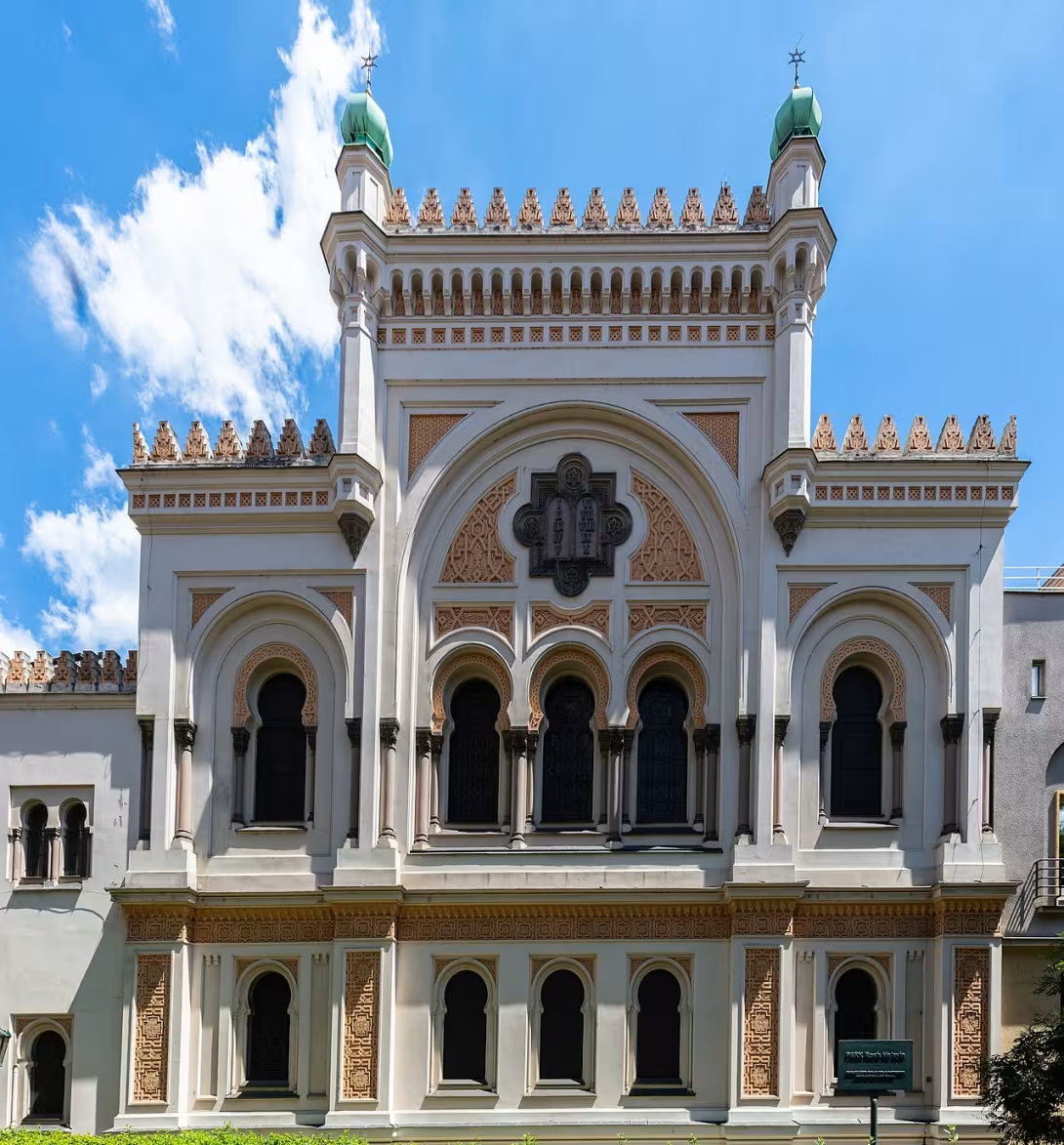
Španělská synagoga in Prague in Josefov is the youngest of the so-called Jewish city. It was built in Moorish style according to the model of Spanish architecture. Originally it was called Temple in Spiritual Street and was created in 1868 as a solution to the growing need of the reformist Jewish community, which used the older Old School (Altschul) inadequately.
The building is an important monument not only for its architecture, but also for the role in Jewish emancipation in Czech countries. The formation of the synagogue is linked to the development of the reform movement in the second half of the 19th century, when Jews began to integrate more into society. The construction was designed by architect Vojtěch Ignác Ullmann, along with Josef Niklas, builder Jan Belski and artists Antonín Baum and Bedřich Münzberger.
The interior is dominated by dome roof with built-in galleries and arabesque stucco decoration, which resembles Islamic decorative style. The main hall is designed for reform services, where Aron ha-kodesh is standing right at the east wall. In 1935 the functionalist part was added, which served as a hospital and delivered a lobby and a winter prayer house.
The synagogue served as a warehouse for confiscated items during World War II. After the war, it was acquired in 1955 by the State Jewish Museum. In the years 1958- 1959 the interior was reconstructed, preserving historical elements. In the 1970s, the synagogue was neglected until after 1989 it could be repaired. Since 1998 it has been part of the Jewish Museum, where the exhibition of Jewish emancipation and other topics is exhibited.
Today, the synagogue is open to visitors. It is an important place that connects the past to the present, and reminds us of the importance of Jewish culture in Czech countries.
Then and now
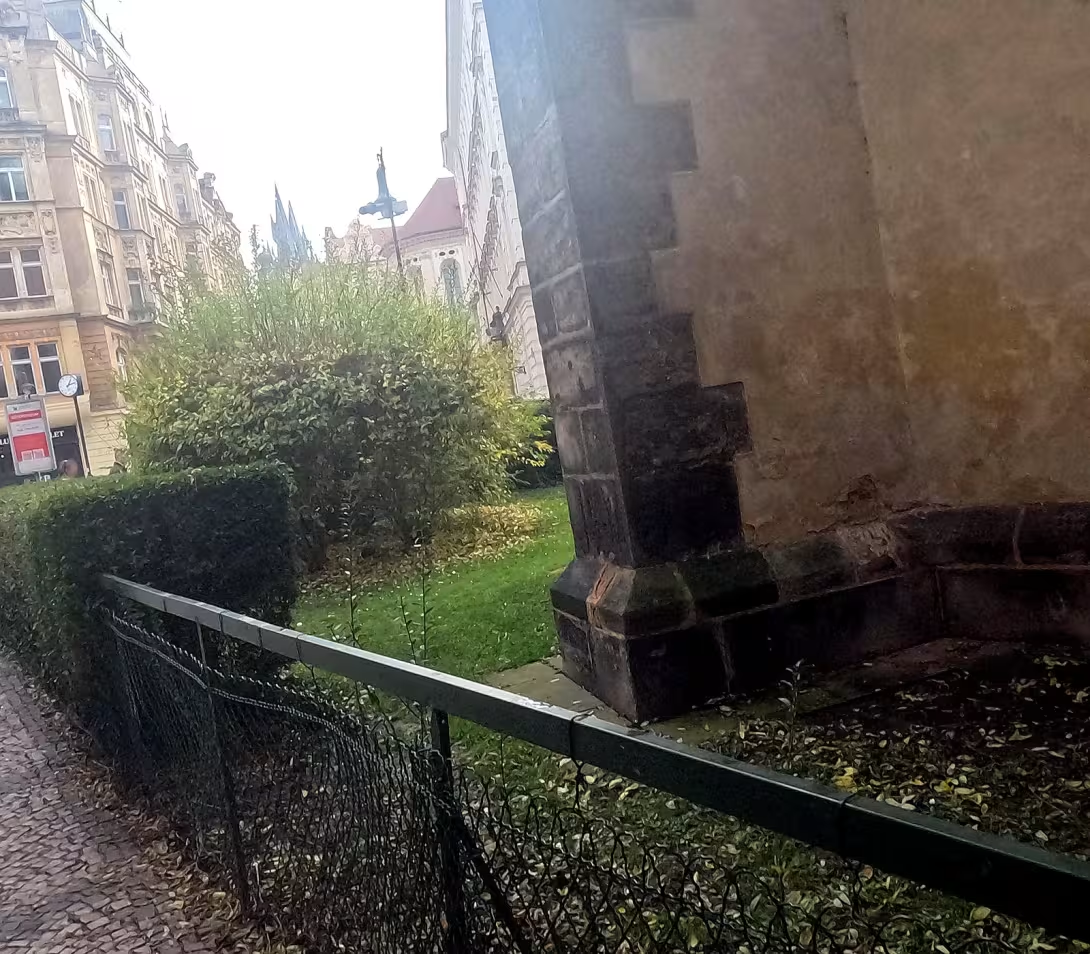
Drag the slider to compare how the landmark may have looked when it was built with the view today.

The historical appearance on the left is an AI-generated visualisation and serves as inspiration only.
Historical milestones
- 1867
- The destruction of the original synagogue Old School (Altschul) and the construction of the Spanish synagogue.
- 1882
- Decorating a circular window with a stained glass of six-pointed stars.
- 1935
- Rebuilding to a functionalist hospital building.
- 1958
- Reconstruction of the interior and opening the exposure of synagogue textiles.
Architectural development
The building was built in a Moorish style derived from medieval Spanish architecture. In 1935, the functionalist part of the hospital, which provided modern elements, was added. The interior was reconstructed in 1958-1959 and in the 1990s it underwent a complete reconstruction which preserved historical elements and added an exhibition of the Jewish Museum.
Historical events
- 1867
- The destruction of the original synagogue Old School (Altschul) due to the lack of capacity for the reformist Jewish community.
- 1868
- The position of the Spanish Synagogue in the Moorish style according to the plans of architects Ullmann and Niklas.
- 1935
- The reconstruction into a functionalist building for the hospital, which supplied the synagogue with a lobby and a winter prayer house.
- 1955
- The State Jewish Museum has taken custody of the synagogue.
Owners
Jewish Museum in Prague (from 1955)
Points of interest
- Španělská synagoga in Prague in Josefov is the youngest of the so-called Jewish city in Prague. - It was built in Moorish style in accordance with the model of architecture from Spain. - Originally it was called Temple in Spiritual Street and was founded in 1868. - The construction was designed by architect Vojtěch Ignác Ullmann along with other creators. - The interior is dominated by dome roof with arabesque decoration.
Guide
Show guide text
This text was created by artificial intelligence and has not been editorially reviewed. It may contain inaccuracies.
Welcome to the Spanish Synagogue - one of the youngest and most interesting monuments in Prague's Jewish town in Josefa. You are standing in front of a building that differs not only from other synagogues in the area but also from history. Its walls tell us about the time when people who wanted a new beginning prayed here, and about the architecture that brought the air of distant Spain to Prague.
Let's go together and see how this monument came to be. In the middle of the nineteenth century, the old synagogue, which stood in this place, was not enough for the growing Jewish community. They needed a more spacious place for worship, so in 1867 the decision was made to tear down the old building and build a new one. It was to be inspired by the Moorish architecture they knew from Spain - with charming arches, stucco decoration and elements that resemble ancient palaces on the Iberian peninsula. Originally, the synagogue was called Temple in Spiritual Street, but later, when its style became inseparable for the Pražani, it got the name it wears today - Španělská synagoga.
Look at the front of the building. Although time and various reconstructions have left traces, you can still see some of the original elements. Note the stucco decorations that resemble arabesque patterns - they were typical of the Moorish architecture. And if you look up, you will see a circular window that was decorated in 1882 with a stained glass with a six-pointed star - a symbol that is extremely important to the Jewish religion.
Now pay attention to the interior. Although the synagogue was transformed over time - for example in the 1950s, it served as a hospital - some original elements were preserved. After the reconstruction in 1958, an exposition of synagogue textile was set up to show you how Jewish ceremonies have evolved in the past. The dome roof, which was typical of the Moorish buildings, provided a special atmosphere - as if you had entered another world, where the traditions of two continents were mixed.
Who was behind this synagogue? Its main architect was Vojtěch Ignác Ullmann, but several other masters participated in the construction - Josef Niklas, Jan Bělský, Karel Pecánek, Antonín Baum and Bedřich Münzberger. Each of them contributed with his art to make this building not only a place of worship, but also a work that would appeal to those who did not directly encounter Judaism.
And now comes something that might surprise you. This synagogue is the youngest of all that survived in Prague's Jewish city. While other monuments stood here for centuries, Španělská synagoga is almost younger than the whole of Joseph. And yet it is she who brings something unique to this place - the combination of two cultures, two worlds that have met here in one architectural work.
Before you lies a place that tells a story not only about faith, but also about how people tried to find their place in a changing world. Look at every detail, feel the atmosphere and take a moment to understand what it was like to be a part of this community. If you continue your journey after Joseph, remember that each synagogue has its own story. And who knows, maybe one of them will interest you even more than this one.
Thank you for taking the time to visit the Spanish Synagogue. Let the next steps in Prague inspire you just like this monument inspired its creator. Good trip!
Tips for visitors
An ideal visit during the day when the sun is suitable but not too hot. The most suitable months are April to October, when the weather is pleasant. In winter it is advisable to visit when the light is sufficient, for example in the morning.
In summer the synagogue is warm and humid, which can be unpleasant. In winter, it is advisable when there is enough light outside to see the details of architecture.
The location is well accessible from the centre of Prague. It is recommended to check the current connection before the journey as the routes can change.
Take the appropriate clothes to allow you to move along the pavement and in the interior. In winter it is advisable to add warm clothes because the interior can be cold.
It is recommended to wear comfortable shoes because when visiting historical monuments it is often necessary to walk on uneven surfaces and climb stairs.
There's no way in synagogue to buy water or food.
Photography is allowed, but with regard to maintaining peace and respect for the memory. The best places for photos are the outdoor parts of the synagogue, especially the facade and windows. The inner parts are usually forbidden for photography.
It is advisable to take pictures at a time when the light is pleasant, for example in the morning or afternoon. In the interior the light is often artificial and can be imperfect for quality photography.
Church of the Holy Spirit
The church is old and interesting in historical terms. Located near the synagogue and is a good place to visit if you are interested in architecture and history. In the vicinity of the church there is also the possibility of relaxing in the park.
Park with memorial Franz Kafka
A small park is a quiet place where you can relax and admire the memorial of the writer Franz Kafka. It's a beautiful place for families with children who like to go through and observe the sights.
Jewish city in Josefov
The whole part of the Jewish city is nearby, which is full of historical monuments. You can see other synagogues and historical houses, which are an important part of Jewish history in Prague.
Families with children can enjoy a walk around the area where there are plenty of places to relax. Children can look at Franz Kafka's memorial and park, which is suitable for short breaks.
In synagogue you can get interesting information about Jewish history and culture that children may be interested in. Some parts may also be interesting for children in terms of artistic details.
It is recommended to visit at a time when the weather is pleasant outside and avoid periods when the synagogue is too hot or too wet in the interior. In winter it is advisable to bring warm clothes.
Frequently asked questions
Can the monument be visited?
Religious buildings are usually open mainly during services; at other times a visit is normally arranged with the parish or the operator. We have not verified specific times.
Where is the monument?
Location: Praha 1, Hlavní město Praha. The map on this page shows the exact spot.
Why is the monument protected?
It is listed in the Central List of Cultural Monuments of the Czech Republic as a cultural monument (register no. 1000150889).
Businesses nearby
Do you run a restaurant, accommodation, shop, museum, rental, wellness or other visitor service near this monument? Show yourself directly to the people heading to it — this is how they will see you in the app and on the web:
Events nearby

Zdroj akcí: otevřená data měst a obcí ČR (Národní katalog otevřených dat) a kalendář akcí Národního památkového ústavu.
Nearby
Nachází se v Dušní ulici v blízkosti kostela sv. Ducha a parčíku s pomníkem Franze Kafky od Jaroslava Róny. V okolí se nachází další historické památky, jako je Židovské město a synagogy v Josefově.
Accommodation nearby
Trips and activities nearby
Guided tours, tickets and activities nearby from GetYourGuide
Affiliate link: if you buy from the partner, we may receive a commission. The price for you does not change.
Search tours and activities →Themed route
Jewish City Type: Historical Quarter Why is it worth a visit: This site forms the historical core of Prague's Jewish life and offers a unique atmosphere of old streets. Here are other important sacral structures that complement the picture of Joseph's history.
Church of the Holy Spirit Type: Sacral monument Why is worth a visit: Located in the immediate vicinity of the main destination and serving as an important landmark in this part of Old Town. Its architecture contrasts with other Jewish monuments and enriches the cultural experience.
Španělská synagoga Type: Synagogue Why is it worth visiting: It is the main destination of the route and one of the most beautiful synagogue in Europe with rich decoration. The interior offers a view of the historical art and spiritual history of the Prague Jews.
Park with memorial Franz Kafka Type: Park and sculpture Why is it worth a visit: This quiet space with the work of Jaroslav Rony allows you to relax after a tour of historical monuments. The statue reminds of a famous writer who is inextricably connected to this part of Prague.
The route begins in the centre of the Jewish city, where the visitor can explore the historical background and atmosphere of Josef in peace. From there is a short distance to the Church of the Holy Spirit, which serves as a natural stop on the way to the main destination. After a short journey you can reach the Spanish Synagogue where you can admire its inner beauty and history. After a difficult tour of the synagogue, it is ideal to continue to the park with Franz Kafka's monument. This final point of the route offers a quiet environment for reflection and relaxation, while the statue by Jaroslav Rons closes the cultural circuit in the Spiritual Street area. The whole route is compact and focuses exclusively on the places listed in the description of the surroundings, which ensures a smooth and logical course without the need for long movements.
Seasonal recommendations
Spring brings fresh air and softer sunlight to the old part of the city, which beautifully highlights the details of interior decoration. The trees are beginning to awaken in the surroundings, which gives the way to the monument a more pleasant look. We recommend wearing layered clothes because the wounds can still be cold. It's the perfect time to visit, because people are still medium-sized and you can walk around in relative peace.
During the summer months, it is very hot in the center and the sun shines the strongest, creating the inner space with a very bright and radiant impression. The light falling through the windows highlights rich decorating. Because of the large number of people in the prime of summer, it is best to arrive at the beginning of the morning to avoid the biggest crowds. Dress lightly and don't forget enough water, because moving around the city can be exhausting in the heat.
Autumn offers a golden light and a calmer mood that is perfectly suited to tour historical sites. The colors in the surrounding alleys change and the air is crispy and clean. It's the best time for those who look for silence and want to see the memory without a big rush. Prepare your coat or scarf because the afternoon cold may be surprising, but the visit will probably be less burdened than at other times.
In winter, the light is weaker and there is a rather quiet and serious mood in the building. Days are short, so plan your visit earlier so that you have enough light. Due to lower temperatures and shorter opening times, it is necessary to carefully check the opening time before travelling. Dress very warmly and evenly, because even if it is pleasant inside, the journey to the monument in cold weather requires good preparation.
Visualizations and artistic views


The visualisations are generated by artificial intelligence and serve as inspiration.
Photos from the area
Real photos taken near the monument

Zdroj a licence jsou uvedeny u každého snímku.
Tips from visitors
No tips yet. Be the first!
Log in and add your tip.
Sources and literature
Photos: Diego Delso / CC BY-SA 4.0 — Wikimedia Commons. The author and licence also appear when you hover over the image.
Faktickým podkladem tohoto textu byl článek na Wikipedii, jehož autory jsou přispěvatelé Wikipedie. Článek je dostupný pod licencí CC BY-SA 4.0.
Location on the map
Příběhy a pověsti
Legendy, pověsti a příběhy spjaté s touto památkou
Fotografie návštěvníků
Zatím žádné fotografie. Buďte první, kdo přidá fotografii z návštěvy!
Log in a přidejte svou fotografii nebo hodnoťte.
Za ověřenou návštěvu v aplikaci získáte víc bodů — poznáme podle GPS, že jste na místě.
Reviews and comments