



Suchardova vila (Slavíčkova 15) Villa
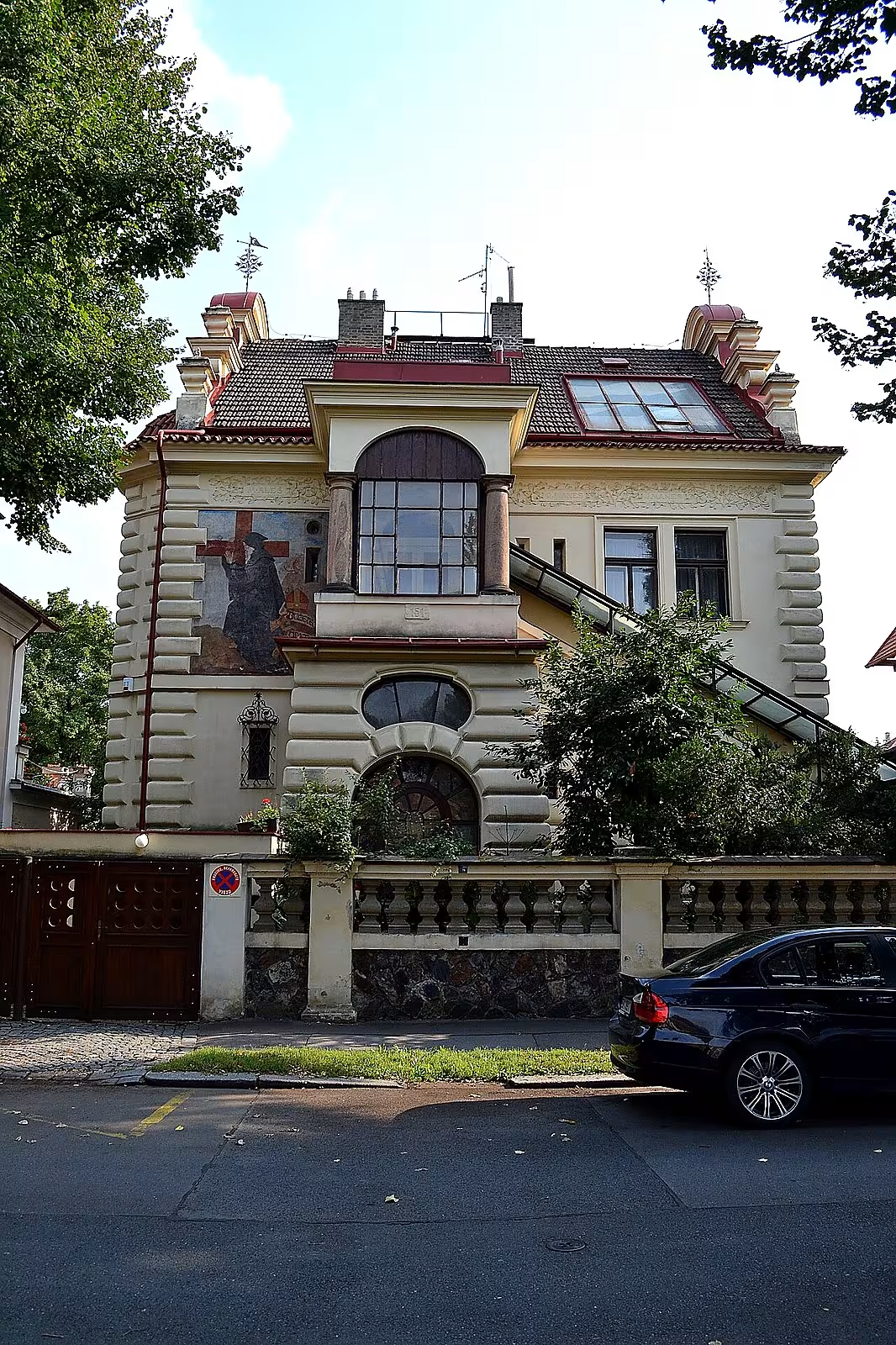
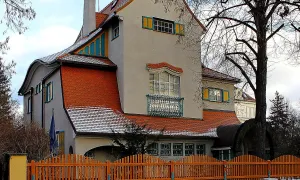
Suchardova villa in Prague-Drumenchi in Slavíčkov street 151 / 15 is a new Renaissance family villa with elements of Art Nouveau. It was built in 1895- 1896 and has been a protected cultural monument since 1964, including a garden and a fenced wall. This building is located in a residential area in the upper part of Bubenč. Its architecture combines elements of historical styles with the upcoming Art Nouveau and represents an important example of architectural development in the late nineteenth century.
The villa was built in 1895-1896 when it was built for sculptors Stanislav Suchard. The design was processed by architect Jan Koula. Project and construction were carried out by architect and builder František Schlaffer. The historical context of the time is marked by the development of new architectural styles, such as the Art Nouveau in Europe during the period of the so-called fin de siècle. In Bohemia this period was characterized by cultural and artistic revival. At the same time, the author of the Jan Koula also built his own villa on the adjacent parcel.
The building has a rectangular plan. On the north facade facing Slavíčková Street is located somewhat to the left of the centre a distinctive risalite with a wide arch of the main entrance on the ground floor. On the floor, the risalite passes into a hint of a tower that does not exceed the height of the crown ledge. From the right side, the outer staircase, lightened on the floor of the post with archivolta, leads into it. The shorter side sides of the building are finished with significant tiered shields resembling a late Renaissance. The ground floor of risality and corners covers barefoot. Under the crown ledge there is a frieze with stucco reliefs, on which are sectly decorated inscription tables with names of Czech painters, sculptors and architects. The right, western shield is decorated with a cartouche with the inscription "Elevated LP MDCCCXCV - Stan Cargo." The biscuits and his wife Anna. Similarly, on the left shield is the inscription made and built - by me Fr. Schlaffer - architect and builder. The most distinctive decorative element is the large wall painting on the north facade in the left corner of the building next to the risality. This painting was done in 1908 according to the carton of Mikolas Alš by painter Arnešt Hofbauer. The fresco depicts the bishops abbot of God in a black cape with a hood that carries a cross. The fresco on the south facade facing the garden dates back to 1909-1910 and was created by Anna Boudová. The ground floor interior consists of a large hall with entrance to the garden. There was originally a high studio on the floor, which was overpatted in 1905, and in 1935 the attic was adapted to the studios. The fence on the side of the street consists of a stone suspect with a baroque bowling ball in the upper part. On the right is an entrance two-winged gate in an arched portic with a canopy. Behind the south side of the villa lies a garden extending up to the railway track, dominated by a memorable oak set around 1860. The original appearance of the villa is somewhat spoiled by the garage with entrance doors and a protective roof above the staircase.
The first owner of the villa was the sculptor Stanislav Sucharda in 1895-1907. His younger siblings also lived and worked in the villa: brother Vojtěch Sucharda, who was also a sculptor, and sister Anna, married Boudová, who acted as a painter and a ceramic woman. In 1901 her son Cyril Bouda, also a famous artist, was born and raised here. When Sucharda's studio in the villa ceased to be sufficient to create an extensive monument by František Palacký, on which he worked with Alois Dryák, he bought a new plot at the end of the street in 1907. He then asked architect Jan Kotera to design a new villa with a studio. The original villa No. 151 Stanislav Sucharda was left to his siblings, who subsequently made some modifications in interior and facades.
The key moment in the history of the building was 1907 when Stanislav Sucharda bought another plot and built a new villa with a studio. A significant milestone was 1964, when the building, including the garden and the fenced walls, was declared a cultural monument. Among the interesting things are the fact that under the crown of the memorial oak in the garden was allegedly founded in 1897 by the Association of Fine Artists Manes.
Suchard's villa remains a valuable example of historical and Art Nouveau architecture associated with the significant personalities of Czech art at the turn of the 19th and 20th centuries. Visiting this location in Prague's Bubenč offers a unique opportunity to learn about the authentic environment, where it formed the leading generation of Czech sculptors and painters.
Historical milestones
- 1860
- Dropped a memorable oak tree in the village hall
- 1895-1896
- Construction of novorenesancni villas for the statue of Stanislav Suchard
- 1905
- Preparedness of a high studio in a building
- 1908
- Created by painting of raspberry Arnosti Hofbauer
- 1964
- The villa began to serve as the protection of the cultural mother
Architectural development
The villa was originally built as a family house with a garden. In 1905 there was an overthrow and in 1935 the attic was adapted for studios.
Historical events
- 1964
- The villa was declared a cultural monument.
- 1907
- Stanislav Sucharda bought another plot and built a new villa with a studio.
Owners
Stanislav Sucharda (1895-1907), then transferred to his siblings who made modifications.
Points of interest
- The construction was built from 1895 to 1896 for sculptors Stanislav Suchard according to the design of architect Jan Koula. - Since 1964 it serves as a protected cultural monument including a garden and a fenced wall. - Under the crown ledge there is a mould with stucco reliefs and Art Nouveau Designs with names of Czech painters, sculptors and architects. - There is a large wall painting on the northern facade, which was carried out in 1908 by the painter Arnešt Hofbauer according to the carton of Mikoláš Alš. - Behind the south side of the villa lies a garden with a memorable oak planted around 1860.
Guide
Show guide text
This text was created by artificial intelligence and has not been editorially reviewed. It may contain inaccuracies.
Welcome to Bubeneči, one of Prague's most beautiful and peaceful residential areas. You are standing in front of a building that is a silent but proud witness to Czech history and art. In front of you is Suchard's villa, a place where every detail combines a creative spirit with architectural precision. Stop for a moment, take a breath and feel the atmosphere of this place. Imagine how the most important artists of their time walked these streets over a century ago and how this villa formed the center of their social and working life. Let us now look at how this building was built and why it is so important to us today. The villa was built between 1895 and 1896. It wasn't just an ordinary residence, it was a house designed for a particular person, a respected sculptor of Stanislav Suchard. For the result to be perfect, architects František Schlaffer and Jan Koula were invited to work. Their task was to create a space that would also be a cozy home for the family and an inspiring place for artistic creation. When you look at the building, you see the result of their cooperation, which was able to combine functionality with high aesthetics. Now pay attention to the architecture itself, because it contains a fascinating story of crossing the epoch. The villa is built in a neo-Renaissance style, which means it draws on the elegance and balance of the Renaissance, but takes it in the spirit of the late nineteenth century. But if you look closely, you'll see that the neo-Renaissance base is not uniform. The elements of the Art Nouveau, i.e. the more modern, organic style, which at the time dominated the European art scene, were integrated into the building. It is a very fine connection that makes the house a unique bridge between historical styles and modern tendencies of the time. Now look up to the top of the facade. Notice what the architects placed under the crown ledge. You can see the frizz, which is the decorative horizontal belt. Here you will find fascinating details in the form of stucco reliefs. If you call for a little focus, you will see secestically decorated writing tables with names on them. These details are not just an ornament, they are like the author's signature and a testimony about who this house was dedicated to and who left their mark on it. It's basically a stone archive that tells us about the people who lived and created here. This place was connected by many important personalities who shaped Czech culture. Of course, in the first place Stanislav Sucharda, whose name bears the villa. Imagine him working on his big statues in the house. He was also associated with Vojtěch Sucharda. Names such as Anna Boudová, Cyril Bouda or Alois Dryák appear in connection with the villa. It is fascinating to think that there were people meeting in these areas who determined the direction of the development of Czech art. Among them was Jan Kotěra, one of the largest Czech architects whose influence on the construction at the time was unprecedented. The villa was not only a house, but a salon where the ideas, dreams and ambitions of the then intellectual elite intertwined. Now let's think about the time line of this place that starts before the villa itself is built. In a garden that you may now only see as a green cover of the house, a memorable oak tree grows. It was planted in 1860. Imagine, this tree stood here ten years before the first stone of the villa was laid. He watched as this Neo-Renaissance building grew out of empty space, saw the arrival of the first inhabitants and watched the Bubeneče area change. He's a silent guardian of memory who survived generations. What's interesting is how the villa evolved over time. In 1905 there was a significant change in the interior when a high studio on the floor of the building was overpatted. This shows that the needs of the sculptor changed and space had to follow his creation. And if we could see behind the walls, in 1908, painter Arnešt Hofbauer here created beautiful wall paintings that gave the house another layer of artistic value. The whole complex, including the garden and the wall, has been protected as a cultural monument since 1964. This means that the State has recognised that this villa is not only private property, but the common heritage of all of us, which must be preserved for future generations. If we were looking for something in this place that might interest us today as a mystery or an oddity, it is the harmony between privacy and public perception. The villa is situated in Slavíčkov Street, in an environment that still breathes luxury and calm, but at the same time the strict discipline of the Neo-Renaissance style is preserved. It's where time stopped. If you look at the Art Nouveau tables, maybe you'll think about how many stories, interviews, and maybe even art disputes happened in these walls. Which one of those names was closest to Stanislav? What dreams did Jan Koula have for this house? Now that you know the story of Suchard's villa, I suggest you observe it for a while. Walk slowly around the wall, perceive the texture of the facade and look again at the fine reliefs under the ledge. Try to imagine the contrast between the silence of the garden with a memorable oak tree and the creative energy that was boiling in the studio upstairs in 1905. This villa proves that architecture is not only about bricks and plaster, but about the people who put their soul and their work into it. Thank you for accompanying me on this short trip to Bubeneč history. I hope you've found time to appreciate the beauty of Suchard's villa. Now invited to further explore this neighborhood, where there is another architectural jewel at every corner. I wish you a pleasant continuation of your trip to Prague and enjoy every detail that comes your way. Goodbye.
Tips for visitors
The best time to visit Suchard's villa is in the morning, when the sunlight ideally irradiates the neo-Renaissance and Art Nouveau facades. At this time there is also the smallest traffic in the quiet residential district of Bubenče, which you will appreciate when admiring the details of the construction from 1895 to 1895. You can use a passenger car or public transport for transport to the memory; Check the exact connection in the current connection search engine. With you take comfortable shoes for longer walks along the surrounding residential areas, a camera to capture artistic details, and in warmer months also a supply of drinking water, as there may be no open refreshments in the immediate vicinity. It is best for photography to stand opposite the villa, where morning or late afternoon light will highlight the combination of historical styles and more modern elements of the building. In the immediate vicinity of the monument do not forget to visit the memorable oak under whose crown was historically founded the Association of Fine Artists Manes, which gives the place a strong artistic spirit. Families with children will appreciate a peaceful walk through the picturesque environment of Bubenče, where they can relax in the shade of trees and combine an educational trip with light activity in the fresh air.
Frequently asked questions
Can the monument be visited?
This is a residential or farm building, not a museum with opening hours. Please view it from public space and respect the owners' privacy. We have no information about access to the interior.
Where is the monument?
Location: Bubeneč, Hlavní město Praha. The map on this page shows the exact spot.
Why is the monument protected?
It is listed in the Central List of Cultural Monuments of the Czech Republic as a cultural monument (register no. 1000152530).
Businesses nearby
Do you run a restaurant, accommodation, shop, museum, rental, wellness or other visitor service near this monument? Show yourself directly to the people heading to it — this is how they will see you in the app and on the web:
Events nearby

Zdroj akcí: otevřená data měst a obcí ČR (Národní katalog otevřených dat) a kalendář akcí Národního památkového ústavu.
Nearby
V okolí se nachází památný dub, pod jehož korunou byl založen Spolek výtvarných umělců Mánes.
Accommodation nearby
Trips and activities nearby
Guided tours, tickets and activities nearby from GetYourGuide
Affiliate link: if you buy from the partner, we may receive a commission. The price for you does not change.
Search tours and activities →Themed route
Suchard's villa Type: villa Why is it worth a visit: This historic building at Slavíček's fifteen in the village Bubeneč served as a home and creative space of a famous sculptor. It excels in its artistic decoration and unique atmosphere associated with Czech art.
Memorial oak Type: natural monument Why is it worth a visit: In the immediate vicinity of the villa grows a significant tree, under whose crown was founded in the past a significant Association of Fine Artists Manes. This place bears the strong spirit of Czech art history.
Seasonal recommendations
Spring brings a awakening nature, when the surrounding trees and shrubs begin to bloom and the surrounding green gently contrasts with the historical facade of the house. The light is very pleasant for shooting details of architectural elements and stucco decoration thanks to the mild sun. There are no large crowds of people in this period, so you can enjoy the tour in complete peace. It is convenient to wear comfortable fixed shoes because after the rain the adjacent roads may be wet. The best time to visit is in the morning, when the sun warms pleasantly, but does not burn as much.
Summer offers lush vegetation, which partly surrounds the whole building and gives it shady corners ideal for hot days. The light is strong and sharp, which creates strong shadows on the facade, especially in the noon hours. Since it is the main tourist season, it is good to count on a slightly increased movement of curious pedestrians in the surrounding streets. We recommend light breathable clothes, headgear and a bottle of drinking water. The best time for a tour is either early in the morning or late in the afternoon when temperatures are most pleasant and the sun gives the place a golden touch.
Autumn turns the surrounding park and trees into a colorful palette of colors from yellow to orange to brown, creating a melancholy and very calm atmosphere. The sun's light is usually softer and the rays penetrate through the falling trees, which gives the building a unique character. Tourism in this neighborhood is failing significantly. Because the weather is variable and it often blows wind or rain, don't forget the waterproof jacket and warmer sweater. The ideal time for visiting is around noon, when there is the best chance of more pleasant temperatures and daylight.
Winter covers the whole memory of silence, which sometimes only breaks the snow cover on the roof and the ledge. Lighting is specific because the days are very short and the sun sets quickly, so soon afternoon comes the shadow. The crowds of tourists are falling apart in the winter, which guarantees maximum privacy while admiring exteriors. The need is quality winter clothes, warm gloves, hats and firm non-slip shoes due to freezing pavements. The best time for a tour is around noon, when there is maximum daylight and a little warmer than in the morning.
Visualizations and artistic views


The visualisations are generated by artificial intelligence and serve as inspiration.
Photos from the area
Real photos taken near the monument


Zdroj a licence jsou uvedeny u každého snímku.
Tips from visitors
No tips yet. Be the first!
Log in and add your tip.
Sources and literature
Photos: Sefjo / CC BY-SA 3.0 — Wikimedia Commons. The author and licence also appear when you hover over the image.
Faktickým podkladem tohoto textu byl článek na Wikipedii, jehož autory jsou přispěvatelé Wikipedie. Článek je dostupný pod licencí CC BY-SA 4.0.
Location on the map


Příběhy a pověsti
Legendy, pověsti a příběhy spjaté s touto památkou
Fotografie návštěvníků
Zatím žádné fotografie. Buďte první, kdo přidá fotografii z návštěvy!
Log in a přidejte svou fotografii nebo hodnoťte.
Za ověřenou návštěvu v aplikaci získáte víc bodů — poznáme podle GPS, že jste na místě.
Reviews and comments