



Synagoga v Hradci Králové Synagogue
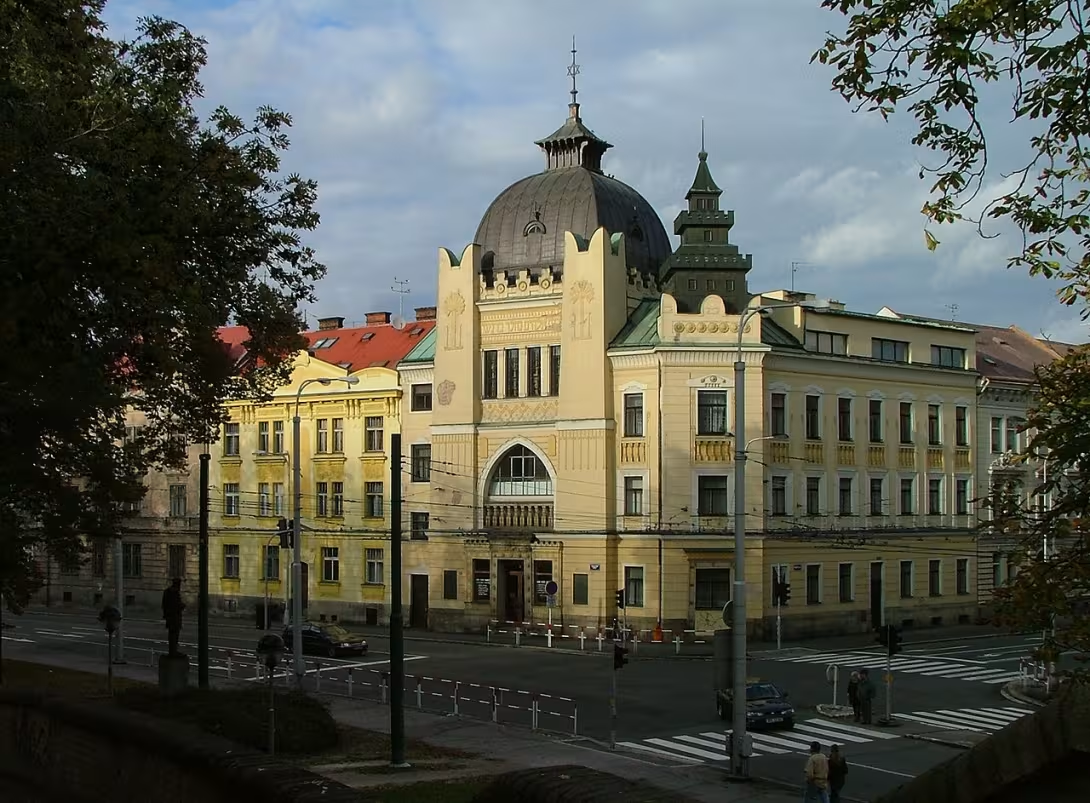
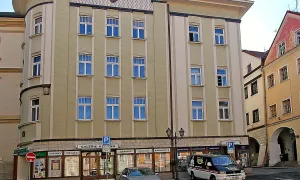
Synagoga v Hradci Králové is a Art Nouveau building built in 1904-1905, which served as a prayer house of the Jewish village. Located on the corner of today's Pospíšil class and the Czechoslovak Army class and is characterized by its period architectural style with Moorish elements.
The construction was created as a replacement for the older prayer house in No.67. It was designed by architect Václav Weinzettl and the builder was Karel Happy, while František Černý filled the position of masonry master. The building was ceremoniously consecrated on September 24, 1905. The formation of the synagogue corresponds to the era of the flowering of the Art Nouveau in Europe and the time of emancipation of Jewish communities in Czech cities.
Architecturally, it is a two-wing corner building with underground floors, ground floor and three floors. The contour of the building is the shape of a blunt angle. The wing next to the main prayer wing is entangled. The exterior is shown in Art Nouveau style with inspiration from the Moorish style. On the ground floor there is a brass commemorative plaque with David's star and "The people of the Jewish village served here." The interior of the synagogue was decorated by the painting by the painter Rudolf Tomášek from Horice and the carpentry work in the winter prayer house was carried out by Josef Hlavý. The organ for prayer was made by Jan Tučka from Kutná Hora.
Religious services in the synagogue took place in World War II. In 1939, attempts were made to blow up the building as part of the Czech anti-Semitism. After World War II, the synagogue was briefly used by a renewed Jewish religious community which was later abolished due to the loss of believers. In 1960, the building was purchased by the State Scientific Library, which reconstructed it and rebuilt the interior for its needs. In 1971, the building was collapsed as a bookstore. In 2007 the construction was returned to the Jewish village in Prague, which now uses it multifunctionally.
During operation, various technical and aesthetic modifications took place. In 1934, a bathroom was set up in the rabbi's apartment. From 1968 to 1970, extensive reconstruction of the interior and installation of the wiring took place. In 1985, the roof cover was replaced with a new copper. The roof and dome were reconstructed in 1997- 1998, while the street facade was restored in 2006.
Today the synagogue is owned by the Jewish village in Prague and serves various purposes. It is an important object that documents the history and fate of the Jewish population in the region. We recommend a visit for people interested in Art Nouveau architecture and the history of local communities.
Then and now
Drag the slider to compare how the landmark may have looked when it was built with the view today.

The historical appearance on the left is an AI-generated visualisation and serves as inspiration only.
Historical milestones
- 1905
- The ceremony of the synagogue on September 24.
- 1971
- To bring space together as a bookstore on January 15th.
- 2007
- Return to the Jewish village in Prague.
Architectural development
The building has an underground floor, a ground floor and three floors. The roof cover was replaced with copper in 1985 and the roof and dome were reconstructed between 1997- 1998. The street facade was restored in 2006.
Historical events
1905: The ceremonial consecration of the synagogue. 1939: Attempts to blow up the building within the waves of anti-Semitism. 1960: Purchase of a decrepit building by the State Scientific Library. 2007: Recovery of the Jewish village building in Prague.
Owners
Jewish village in Hradec Králové (until 1960), State Scientific Library (1960-2007), Jewish village in Prague (from 2007)
Points of interest
- Synagoga v Hradci Králové is a Art Nouveau building built in 1904-1905. - It was designed by architect Václav Weinzettl and the builder was Karel Happy. - The interior of the synagogue was decorated by the painting by the painter Rudolf Tomášek from Horice and the carpentry work in the winter prayer house was performed by Josef Hlavý. - After World War II, the synagogue was briefly used by a renewed Jewish religious community which was later abolished because of the loss of believers. - In 2007 the construction was returned to the Jewish village in Prague, which now uses it multifunctionally.
Guide
Show guide text
This text was created by artificial intelligence and has not been editorially reviewed. It may contain inaccuracies.
Welcome to Hradec Kralove. Right now, you're facing one of the most important and characteristic building units in this city. Before your eyes stands the synagogue, which with its presence in this city space brings a feeling of nobility and peace. Feel the atmosphere as this corner building wedges between the surrounding streets and how its two wings determine the rhythm of this whole place. There's something in her lines that makes you stop, look at her facade and start thinking about how many treasures and stories these walls have experienced.
Now let's go back to time together to understand why this building was created here. Imagine the beginning of the two centuries, a period of huge expansion and transformation. In 1904 and 1905, a major step for the local Jewish community was decided. The older prayer room was no longer enough for their needs, it was too small and it did not match the new ambitions of the community. They needed a place that was not only dignified, but functional. That's how the building you see before you started. This synagogue was not just a building for prayer, it was a symbol of the stability and cultural anchoring of the Jewish people in this city.
Now pay attention to the architecture itself, which is so unusual and fascinating. Look at her shape. It is a demanding, two-wing building, which, thanks to its location on the corner of the city, is very dominant. If you look at its overall form, you are immediately interested in the combination of two completely different worlds. Architect Václav Weinzettl, a man with an incredible sense of detail, created a work here in the contemporary Art Nouveau style. Notice the fluent lines and organic shapes that are so typical of this style. However, Weinzantl did not end only with a secession. He also breathed into the design an inspiration in Moorish style. This combination of European modern times and oriental elements creates a unique visual language that surrounds you at the moment. The whole ambitious project was carried out by the builder Karel Št'astá, who had to make huge efforts to actually materialise these complex shapes and details in stone and mortar.
You may now ask what life inside these walls looked like when the synagogue was full of life. It wasn't just a building with a large prayer hall where neologic rituals took place. The synagogue was basically a small world in itself. In addition to space for divine service there were also places for everyday life. People who were necessary to the community lived here. In these areas they had their homes a rabbi, shames and a janitor. Imagine those silent hours in the morning when life was awakening in these wings, when prayers were being prepared here, and when spiritual needs were being linked to ordinary human existence. It was a living part of the city, not just a monumental monument.
But the fate of this building has taken a much more complicated and sometimes sadder direction over the last century. After World War II, her function changed fundamentally. Instead of silence and prayer, another kind of human activity began to move here. In the second half of the twentieth century, the building was used as a warehouse for the State Scientific Library. In 1971, in the middle of January, the premises were officially shut down for this very purpose. Imagine the contrast - instead of sacred texts and spiritual excitement, thousands of books were stored here in the quiet shelves of the warehouse. The building survived, but her soul was oppressed for decades for a different purpose.
Still, even at these times, the building was preserved, which allows us to admire it today. And that is where one of the greatest attractions of this place lies. Even though her function was changing, her innermost artistic and artistic value remained hidden. If you ever get a look at her interiors, you'll see how great the work of the masters played. The paintings that decorated the space were the work of the painter Rudolf Tomášek from Horice. His work gave the place depth and spiritual dimension. The carpentry work carried out by Josef Hlavatý in the winter house is also a testament to the incredible precision of the time. These details, even though you may not see them directly today, are written up in the DNA of this building and make up what you see in front of you.
And then there came the angry moment that brought the synagogue back to its original dignity. After long years of waiting and transformations, there was an important milestone in 2007. The building was officially returned to the Jewish village in Prague. This moment was not just an administrative act, it was a return to identity, to original meaning and to the people for whom this building was built. The synagogue has once again become a place that has its own clear purpose and its own history, which we can now explore together.
Now that you know the story of this place, I suggest you stop for a little while and just take it easy. Look at those lines, the way the corner building goes into the surrounding space. Feel the weight of history radiating from every corner. This synagogue is not only a wall and a roof, it is a witness to the transformation that has endured the various ages, from the Art Nouveau blossom to the period of library warehouses to today's renewal.
Thank you for your time and for taking this short journey with us. We hope that this view of the synagogue in Hradec Králové helped you better understand its meaning. We wish you a beautiful and inspiring walk through the rest of the city. Please continue to explore and do not be tempted by just what you can see at first sight, because every historical monument has its hidden secrets waiting to be discovered. Goodbye.
Tips for visitors
The best time to visit is early morning after the opening, when fewer visitors are in the synagogue and natural light penetrates through high windows, allowing a more peaceful tour and better photographic conditions. What to take with you: comfortable shoes, bottle of water, or smaller guide or notes about the history of synagogue; ensure respect for the rest zones and any prayer spaces. Photography: The best places are the main entrance hall and side halls where natural light creates interesting shadows; Only ISO and open screen are recommended, avoid lightning to avoid damage to the exhibits. Tips for families with children: for younger visitors are prepared interactive exhibitions and short stories about the history of the site; after the tour you can use the relaxation zone in the area where children can relax and parents can replenish their energy.
Frequently asked questions
Can the monument be visited?
Religious buildings are usually open mainly during services; at other times a visit is normally arranged with the parish or the operator. We have not verified specific times.
Where is the monument?
Location: Hradec Králové, Královéhradecký kraj. The map on this page shows the exact spot.
Why is the monument protected?
It is listed in the Central List of Cultural Monuments of the Czech Republic as a cultural monument (register no. 1000126156).
Businesses nearby
Do you run a restaurant, accommodation, shop, museum, rental, wellness or other visitor service near this monument? Show yourself directly to the people heading to it — this is how they will see you in the app and on the web:
Nearby
🏰 Historic sites (337)
- Pomonník Ladislav Jan Pospíšil 0.1 km
- Statue of the German God 0.1 km
- Adolf Black (Jan Rokyta) 0.1 km
- Václav František Red 0.1 km
- Gallery Václav Havla 0.2 km
- Havl dvoorče 0.3 km
- Museum of Eastern Bohemia - building DOK 0.3 km Opletalova 334 / 2
- Museum of Eastern Bohemia 0.3 km
- Gallery of Modern Art 0.3 km
- Ophelia 0.3 km Klicperova
- Museum of Czech Pharmacy 0.3 km Grand Square 29 / 39
- Church of the Assumption P. Marie 0.4 km
- Jesuit track 0.4 km
- Judr. Josef Tausik 0.4 km
- Klara Tausik 0.4 km
- Marian Columns 0.5 km web
- Memorial to fallen legionaries of Prokop the Great's 4th Rifle Regiment. Jan Gayer (1885 - 1918) 0.5 km web
- Museum of Eastern Bohemia - building ARCHA 0.5 km Czechoslovak Army 333
- Museum of Eastern Bohemia 0.5 km
- Former Jesuit Seminar 0.5 km
🍽️ Restaurants and dining (395)
- Kebab Deluxe HK 0.1 km Czechoslovak Army 408 / 51 + 420 733 794 933
- Sushi box UA 0.1 km Czechoslovak Army 219 / 24
- Robin Kebab 0.2 km
- Ca Phe District HK 0.2 km
- Šatlava 0.2 km Long 101 / 13 + 420 776 817 856 web
- Café On kole 0.2 km Large square 24
- Na Uni 0.2 km Large square 16 / 26 web
- Theatre Klub 0.3 km
- QR bistro 0.3 km web
- Bohemia Sekt Club 0.3 km
- Putna 0.3 km Tomkova 139 / 140
- The Royal Maharaja 0.3 km Grand Square 22 + 420491617572 web
- Pedro Bar 0.3 km
- Brewery Domy 0.3 km
- Pasta Cook & Look 0.3 km web
- Pivnice U Pražské Groše 0.3 km Tomkova 178
- Dhaba Beas 0.3 km web
- U Golden Lva 0.3 km Grand Square 29 / 39
- Archway 0.4 km Large square 144 + 420773905875 web
- ROTUNDA 0.4 km
🏨 Accommodation (50)
- Guesthouse Amatka 0.1 km Small square 120 / 13 + 420 606 776 795 web
- Hotel U Queen Elishka 0.1 km Small Square 117 / 10 + 420 495 518 052 web
- Hnezdo sásásá 0.3 km + 420608024616 web
- U Czech Crown 0.4 km
- Teresian Court 0.4 km + 420495505111 web
- New Adalbertinum 0.4 km Large square 32 / 40
- Hotel Pod Turrets 0.5 km
- Hotel Grand 0.6 km + 420 491 514 999 web
- Hotel District House 0.6 km Palacký 6 + 420 495 054 300 web
- Hotel Stadion 0.8 km web
- Alessandria 1.1 km
- Hotel house Academic 1.2 km + 420 495 511 175 web
- Guesthouse - Hostel U Mlejna 1.3 km Zoblock 261 / 19
- Sasanka 1.4 km web
- Stulík 1.4 km web
- Guesthouse Pupendo 1.7 km
- Guesthouse MAR 1.7 km
- Chernigov 1.8 km
- Pension Lena 1.9 km
- Hertz 2.0 km Kydlinovská 335 / 46a
🚲 Rentals and sport (167)
- Nextbike 0.1 km web
- Nextbike 0.2 km web
- Nextbike 0.2 km web
- Nextbike 0.3 km web
- Nextbike 0.3 km web
- Nextbike 0.3 km web
- Nextbike 0.4 km web
- Sports Hall Slavia 0.4 km
- Nextbike 0.4 km web
- Nextbike 0.5 km web
- Kostka 0.5 km
- Nextbike 0.6 km web
- Nextbike 0.6 km web
- Nextbike 0.6 km web
- Nextbike 0.6 km web
- Nextbike 0.6 km web
- Sokol 0.6 km
- Swimming Pool 0.6 km
- Swimming pool HK 0.6 km
- Nextbike 0.7 km web
🥾 Hiking and nature (194)
- Kavcí sláče 0.1 km
- Žižek sets 0.2 km
- Kubišt sets 0.3 km
- ŠIMKOV Sady 0.4 km
- Vošek sets 0.5 km
- Bidl park 0.5 km
- Town Hall 0.5 km
- Přecholek batarda 0.7 km web
- Přecholek batarda 0.7 km web
- Reinforced pavements 0.8 km web
- Corridor 0.9 km web
- remains of the pontoon bridge 1.0 km web
- Jirask sets 1.0 km
- Square Václav Havla 1.1 km
- _ 1.2 km web
- Sets architect Lisky 1.2 km
- Sets architect Lisky 1.3 km
- Park Glass 1.4 km
- Borders of the strength 1.4 km web
- Vila Václav and Luisa carpentry 1.5 km web
Accommodation nearby
Themed route
Thematic cruise route: Synagoga v Hradci Králové
1.Synagoga v Hradci Králové * Type: * Historical landmark * Why is it worth a visit: * This synagogue, built in 1893 in Art Nouveau style, is one of the most beautiful and best preserved Jewish sacral buildings in the Czech Republic. It is a great opportunity to explore the rich history and architecture of synagogue in Bohemia.
2. Jewish cemetery * Type: * Historical site * Why is it worth visiting: * Located near the synagogue and is one of the oldest Jewish burial sites in Bohemia. The interesting thing is old graves with Hebrew inscriptions that bear witness to the long history of the Jewish community in Hradec Kralove.
3. Mikvas * Type: * Historical landmark * Why is it worth visiting: * Mikva, or ritual bath, is one of the few preserved in Bohemia and served for ritual washing. It is a rare example of Jewish cultural heritage and provides insight into religious practices.
4. Square of the Republic * Type: * Historical Town Square * Why is it worth a visit: * This central square in Hradec Kralove is famous for its history and architecture. It is an ideal place to relax after exploring the synagogue and surrounding monuments, where you can enjoy a view of Baroque buildings and occasional cultural events.
5. Medieval Square * Type: * Historical Town Square * Why is it worth a visit: * Located in the historic centre of Hradec Králové and is known for its original stone surface. The square has been an important place for markets and meetings since the Middle Ages, reflecting the rich history of the city.
This route will guide you through the historic Hradec Kralove centre, where you can learn more about Jewish heritage and cultural development of the city.
Seasonal recommendations
Spring in Hradec Kralove brings a fresh atmosphere of awakening nature to the surroundings of the synagogue. The sunlight penetrating the building's windows emphasizes architectural details and creates a calm, contemplative mood in the interior. There are trees and parks outside, which softens the impression of the historical center. This period is ideal for visitors due to mild weather, which allows walking around the city without fear of extreme temperature or freezing. I recommend wearing a light jacket and comfortable shoes, because spring rains can leave wet paving cubes. The tourist crowds are still sparse, allowing for a more private tour experience. It is best to visit the memory in the afternoon, when the sun hits the facade so that its contours stand out, and at the same time the evening darkness has not yet begun.
Summer brings maximum tourism to Hradec Králové, which will also be shown in the vicinity of the synagogue. Long days and bright skies create a lively atmosphere, but at the same time they carry higher temperatures and the risk of overheating. The interior is usually pleasantly cold thanks to air conditioning or ventilation, which provides relief from outdoor heat. It is necessary to bring with you enough drinking water and light, breathtaking clothes. Due to the dense crowds flooding the historic center in the main summer season, it is worth coming as early as possible in the morning, ideally right after opening to avoid queues and unnecessary rush. Afternoon hours can be difficult for outdoor tours due to the sun, so it is better to plan a visit for morning or late afternoon time.
Autumn in Hradec Kralove offers a unique atmosphere colored in warm shades of gold and red. The weaker sunlight at a lower angle creates dramatic shadows in the interior of the synagogue and underlines the mystical nature of space. Outside, the weather is colder and wetter, which requires layered clothing with wind-tight top. Tourism gradually retreats, bringing peace and quiet, ideal for deeper immersion in the history and spiritual heritage of the place. I recommend visiting a monument in the afternoon, when the sky often lights up and provides beautiful autumn light. Don't forget to take an umbrella because autumn showers are common and can disturb the comfort of outdoor walks between monuments.
Winter in Hradec Kralove brings the synagogue a strange, quiet and intimate atmosphere. Short days and frequent cold episodes require robust winter clothes, including warm shoes, gloves and scarf. The interior is warm and dry, which provides a pleasant contrast to the cold exterior. Tourism is the lowest during this period, allowing visitors to explore the memory without disturbing influences and calm. The best time to visit is in the morning when the outside is warmer and the sun, although weak, still provides enough light for orientation in the city centre. Winter walk through the square with coffee in hand before or after visiting the synagogue will complete the overall experience of this historic place.
Visualizations and artistic views


The visualisations are generated by artificial intelligence and serve as inspiration.
Photos from the area
Real photos taken near the monument


Zdroj a licence jsou uvedeny u každého snímku.
Tips from visitors
No tips yet. Be the first!
Log in and add your tip.
Sources and literature
Photos: Emmanuel DYAN / CC BY 2.0 — Wikimedia Commons. The author and licence also appear when you hover over the image.
Faktickým podkladem tohoto textu byl článek na Wikipedii, jehož autory jsou přispěvatelé Wikipedie. Článek je dostupný pod licencí CC BY-SA 4.0.
Location on the map
More monuments – Hradec Králové
Show all in the municipality
Příběhy a pověsti
Legendy, pověsti a příběhy spjaté s touto památkou
Fotografie návštěvníků
Zatím žádné fotografie. Buďte první, kdo přidá fotografii z návštěvy!
Log in a přidejte svou fotografii nebo hodnoťte.
Za ověřenou návštěvu v aplikaci získáte víc bodů — poznáme podle GPS, že jste na místě.
Reviews and comments