



Synagoga v Hranicích Synagogue
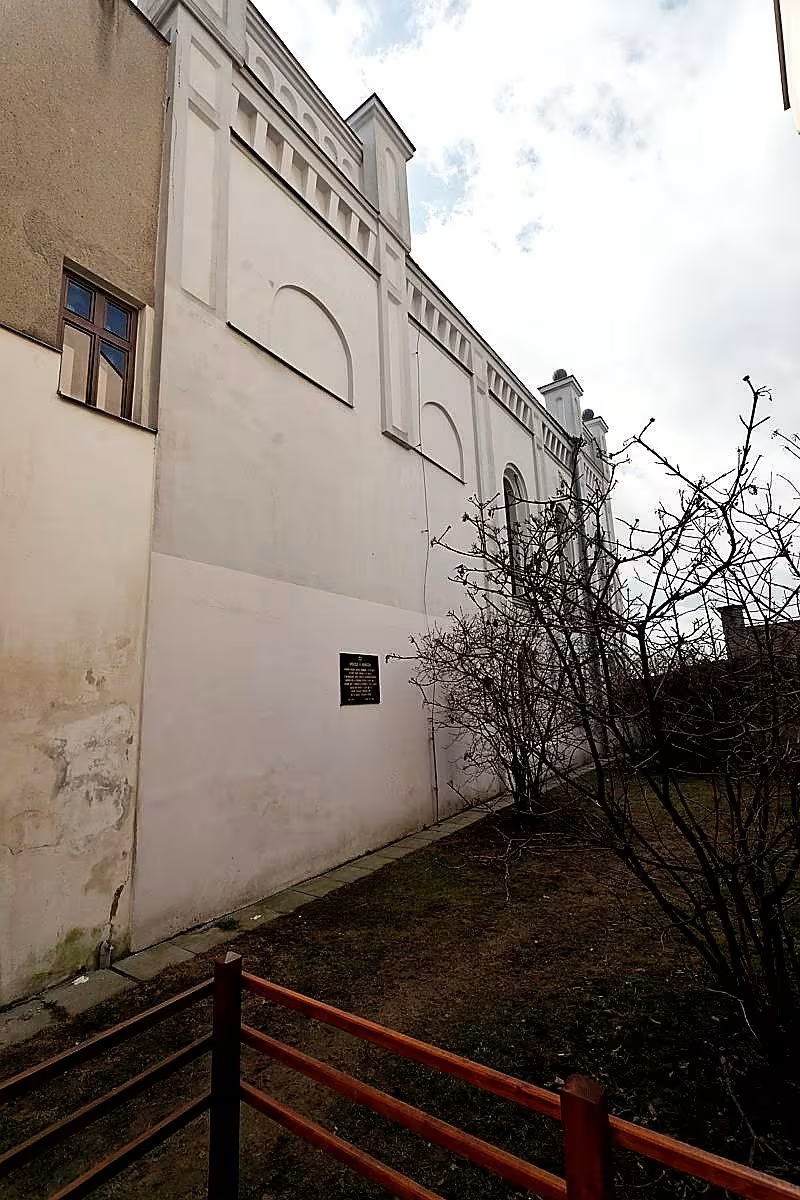
Synagoga v Hranicích is a historical building in Neo-Romanesque and Moorish-Byzantine style, completed in 1864. It is located in Hranice and represents an important part of the Jewish heritage in the region.
A wooden synagogue from the 1930s stood on the site of today's construction until 1863. After its demolishing, a new building was built according to the design of Austrian architect Franz Macher.
The architecture combines Neo-Romanesque style with Moorish-Byzantine elements. The building is characterized by a distinctive front shield above the painterly park bastion at the level of the city walls. The entrance to the synagogue leads through a narrow alley through the so-called Jewish stairs connecting Janáčková and Čechov Street.
During World War II, construction was planned to be demolished, but it did not. In 1939, a Hebrew inscription with a ten-letter mark was removed from the facade. The services here ended in 1940. The building remained unused until 1943 when it was renovated and converted into a city museum.
After the war, the administration of the building was taken care of by the Czechoslovak Hussite Church. Jewish services in this period took place in other premises, for example in the Mosque on Masaryk Square, which served until 1969. The synagogue died in 1975. Until 2023, the town of Hranice operated the exhibition hall.
Since 2023, the premises have been used as the Synagogue Gallery, which the church uses to organize exhibitions and other cultural events. The building is protected as a cultural monument of the Czech Republic.
Synagoga v Hranicích is an important historical place that links the past to contemporary cultural life. Its visit offers insight into the history of the region through architecture and current cultural program.
Then and now
Drag the slider to compare how the landmark may have looked when it was built with the view today.
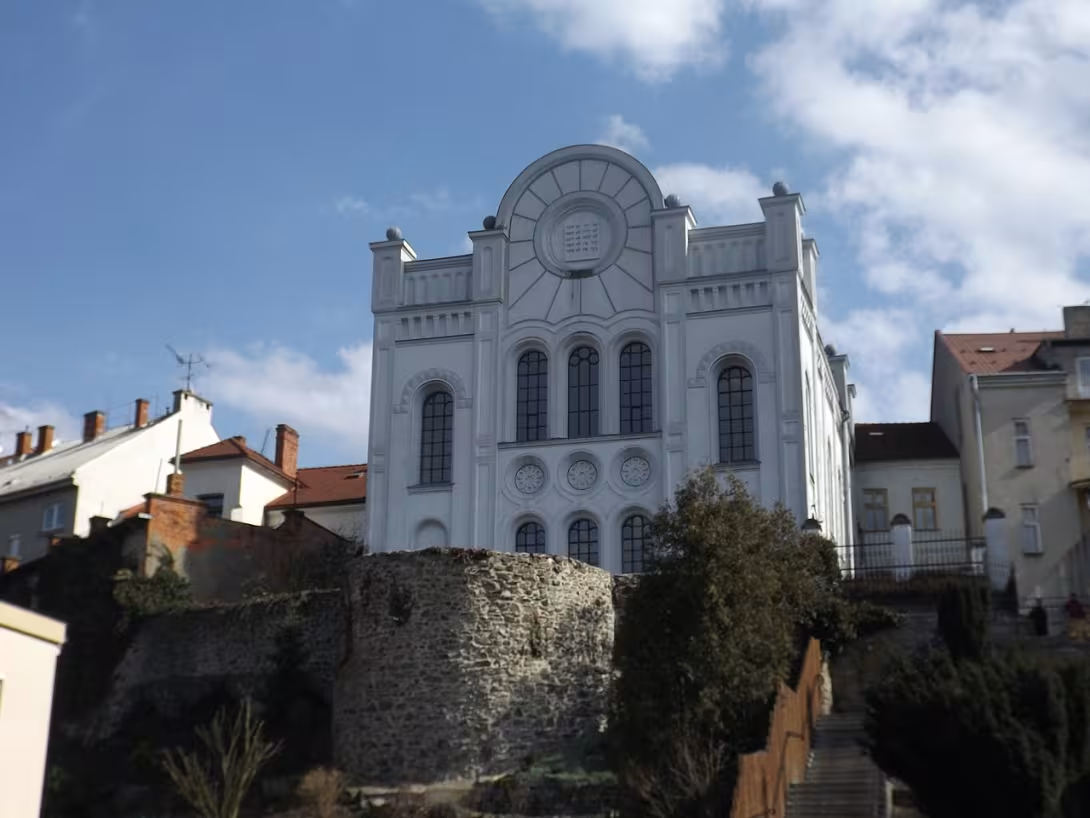

The historical appearance on the left is an AI-generated visualisation and serves as inspiration only.
Historical milestones
- 1864
- Completion of the synagogue according to the design of Franz Macher
- 1939
- Removing the Hebrew inscription with a ten-facade
- 1943
- Reconstruction and reconstruction of the building to the city museum
- 2023
- The premises are starting to be used for cultural events as Synagogue Gallery
Architectural development
On the site of the 17th century wooden synagogue was built a building in NeoRomanesque and Moorish-Byzantine style. The construction was completed in 1864. The museum was renovated in 1943.
Historical events
1864: Completion of the construction of the new synagogue. 1939: Removing Hebrew inscription from the facade. 1943: Reconstruction and reconstruction of the city museum. 2023: Start of operation Synagogue Gallery.
Owners
The Czechoslovak Hussite Church (after World War II), the city of Hranice (until 2023), the church (since 2023).
Points of interest
- Synagoga v Hranicích is a historical building in Neo-Romanesque and Moorish-Byzantine style, completed in 1864.
- A wooden synagogue from the 1930s stood in place of today's construction until 1863.
- The architecture combines Neo-Romanesque style with the Moorish-Byzantine elements and is characterized by a distinctive front shield over the polo park bastion.
- During World War II, the Hebrew inscription was removed from the facade and the building was rebuilt into a city museum in 1943.
- Since 2023 they have been serving premises like Synagogue Gallery, which the church uses to organize exhibitions and other cultural events.
Guide
Show guide text
This text was created by artificial intelligence and has not been editorially reviewed. It may contain inaccuracies.
Welcome to the Boundary. You are standing right in front of one of the most important building units in this city, the synagogue, which itself tells a fascinating story about transformations, faith and the fragility of human destiny. Look at this building and try to perceive its presence in space. It's not just an ordinary house, it's a silent witness for centuries who stands here and watches the changing world around him. Feel the weight of history that radiates from this building and the strange atmosphere that comes back to you when you stop and just let yourself watch.
To fully understand what you're seeing right now, we need to go back deep into the past together. Imagine this place in the seventeenth century. At that time, there was not this massive, stone structure that you are now observing. This place was a much more modest wooden synagogue. It was part of a vibrant, vibrant community life that's been going on for decades. It was a building that was part of the everyday life of the people at the time, but with time, the needs of the growing city and communities began to change.
The real breakthrough occurred in the middle of the nineteenth century. The need to have a place that was dignified, lasting and representative led to a decision to build a new, modern synagogue. Work on this ambitious project required expertise and vision, so Austrian architect Franz Macher was selected. Thanks to his efforts and planning the construction was completed in 1864. This new building was no longer just a simple gathering of people, but it became a symbol of identity and stability in the region. It became a key element of the Jewish heritage, which proudly represented the presence and culture of the local community.
Now pay attention to the very form of the building that is right before your eyes. When you look at her face, you can't overlook an unusual and rich style. Architect Macher put the courage in this work to combine different worlds that at first sight seem different. Feel the harmony between the neo-Romanesque style and the elements of the Moorish-Byzantine direction. The Neo-Romanesque elements add a sense of strength, stability and historical continuity to the construction, while the Moorish-Byzantine details bring into it a touch of exotic, mysterious and spiritual depth. This combination is absolutely characteristic and makes this building a unique jewel in the architecture of our region. Look at its facade and try to see how these different styles intertwine and create a whole that is visually rich and constantly offers new details to discover.
But the history of this building is not just a line of success and architectural flourishing. It's also a story about loss and painful changes. If you look at the facade, you might wonder what this facade has experienced. In 1939 something happened that changed the character of this place forever. A Hebrew inscription and a ten-star was removed from the facade. This act was not only a physical damage to the building, but a profound interference with its spiritual and cultural importance. It was a period when the world around it was changing in a dark direction and this building felt it in every stone.
Further interference in its operation followed. In 1943, the building was converted into a city museum. It's fascinating, but sad at the same time, how a place intended for prayer and spiritual life became a place for preserving history that seemed threatened at that time. Yet the building survived, stayed here and served as the memory of the city.
And yet, even after all these turbulent years, this building is constantly evolving and refinds its meaning. If you look at her current state today, you'll see a new energy in her. Since 2023, these premises have come back to life as the Synagogue Gallery. A place that once served as a place of meeting the community in prayer is now a place of meeting the community in culture and art. It is an incredible cycle - from wooden buildings, to monumental religious temple, to museum to modern gallery.
There's something mysterious about it that a building that's been through so many transformations is still standing here and still fascinating. Maybe it's the extraordinary architecture that holds so many layers of history, or it's the ability of a place to adapt to new times without losing its essence. Think about how many people came through this door, how many views of this facade have been exchanged and how many stories have taken place in these walls.
Now that you know the background of this place, I suggest you continue your search. Let yourself be carried away by the atmosphere that exists here. Feel the details you may have missed at first glance, and try to imagine what it was like when the sounds of new life spread out here for the first time in 1864. Whether you're attracted to art in the current gallery, or interested in history hidden in every corner, I believe this place will offer you experiences that you will remember for a long time.
Now let's move on to the next point of your research. I wish you a pleasant and inspiring encounter with history and the present. Thank you for spending this moment right here at the Hranice Synagogue.
Tips for visitors
The most suitable time for visiting is usually the late afternoon, when the facade of the synagogue, which combines neo-Romanesque and Moorish-Byzantine elements, is hit by softer light. This allows better capture of details of stone decoration and architectural elements from 1864 without sharp shadows, which can be created by the midday sun.
You can find the monument in the center of Hranice I-City, which simplifies the approach. If you come by public transport, the city is well available, however, it is always advisable to verify the specific connections and times of departure in the search engine or in the information terminal as the timetable can change.
For a comfortable tour take with you fixed shoes, as historical streets and squares can have uneven surfaces. We also recommend having water and a light snack if you plan to stay in the area longer. If it is cold, consider layered clothes, because an outdoor tour of historic buildings can take longer than you expect.
For photography it is ideal to walk around the building and look for angles that highlight the contrast between Neo-Romanesque arches and the Moorish-Byzantine ornament. The best light for detailed pictures of the facade occurs when the sun is not directly above the head. Avoid shooting into a sharp glare from the glass if the building is visible from the outside and focus on the texture of the stone and the architectural line.
In the immediate vicinity, just a few minutes' walk, there are city walls, Janáček Street, Chekhov Street and Masaryk Square. These locations form a continuous historical zone which can easily be connected to one walk. For families with children it is convenient that distances are short and environment quiet, allowing children to explore the surroundings without the need for long travel. You can show them how the city changed from the Middle Ages to the 19th century, thanks to these neighboring monuments.
Frequently asked questions
Can the monument be visited?
Religious buildings are usually open mainly during services; at other times a visit is normally arranged with the parish or the operator. We have not verified specific times.
Where is the monument?
Location: Hranice I-Město, Olomoucký kraj. The map on this page shows the exact spot.
Why is the monument protected?
It is listed in the Central List of Cultural Monuments of the Czech Republic as a cultural monument (register no. 1000147570).
Businesses nearby
Do you run a restaurant, accommodation, shop, museum, rental, wellness or other visitor service near this monument? Show yourself directly to the people heading to it — this is how they will see you in the app and on the web:
Nearby
City walls, Janáček Street, Chekhov Street, Masaryk Square.
Accommodation nearby
Themed route
1. Masaryk Square, Square: A great place to start a tour in the heart of the city. 2. Janáček street, street: Walk through this street will guide you through the historic environment. 3. Bohemia Street, Street: This road will lead you to the most important objects in the area. 4. City walls, landmark: Discover parts of the old fortifications that once protected the city. 5. Synagoga v Hranicích, synagogue: The main destination of the trip, representing an important cultural heritage.
Seasonal recommendations
In spring, the surroundings of the synagogue awaken to life and the city gains a fresh breath. The soft sunlight beautifully highlights the details of the historical building and the surrounding green begins to offer the first colours. For visitors it is ideal to choose walks in the morning when the air is freshest. We recommend you prepare layered clothes because spring weather can be variable and morning cold can be surprising.
Summer months bring intense sunlight to the Boundary and long days that allow you to plan a longer tour. The atmosphere is vibrant and full of energy, which complements the bright colour of the facade in full light. Due to the increased number of visitors in the main summer season, it is best to arrive early in the morning to enjoy peace and avoid the greatest heat. Don't forget light summer clothes and plenty of fluids.
The autumn season offers visitors a nostalgic and calm atmosphere, underlined by the colours of decaying leaves and often occurring morning fog. Golden light in the afternoon creates a very poetic appearance on historical walls. It is advisable to wear a practical jacket and comfortable shoes on reindeer, because wet walkways can be slippery. This time is ideal for those looking for a deeper perception of history without large crowds.
In winter, the synagogue acts in silence and calm, which increases the feeling of history and the duration of time. The light is weaker in this period and the days are shorter, so it is necessary to check the actual opening times in advance. For a pleasant experience we recommend choosing the hottest clothes and visiting the memory in a brighter part of the day. In advent time, the city's atmosphere is strange and quiet, which offers a unique tour experience.
Visualizations and artistic views


The visualisations are generated by artificial intelligence and serve as inspiration.
Photos from the area
Real photos taken near the monument


Zdroj a licence jsou uvedeny u každého snímku.
Tips from visitors
No tips yet. Be the first!
Log in and add your tip.
Sources and literature
Photos: T.Bednarz / CC BY-SA 4.0 — Wikimedia Commons. The author and licence also appear when you hover over the image.
Faktickým podkladem tohoto textu byl článek na Wikipedii, jehož autory jsou přispěvatelé Wikipedie. Článek je dostupný pod licencí CC BY-SA 4.0.
Location on the map
More monuments – Hranice I-Město
Show all in the municipality
Příběhy a pověsti
Legendy, pověsti a příběhy spjaté s touto památkou
Fotografie návštěvníků
Zatím žádné fotografie. Buďte první, kdo přidá fotografii z návštěvy!
Log in a přidejte svou fotografii nebo hodnoťte.
Za ověřenou návštěvu v aplikaci získáte víc bodů — poznáme podle GPS, že jste na místě.
Reviews and comments