



Synagoga v Mikulově Synagogue
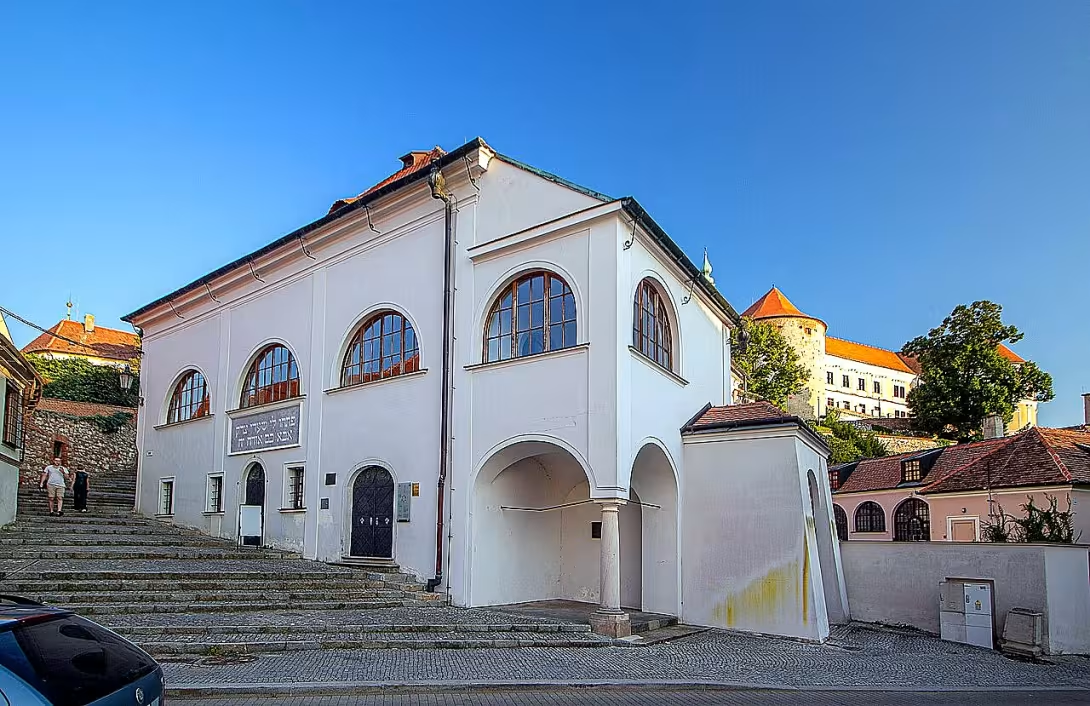
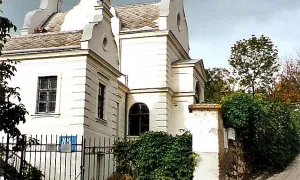
Synagoga v Mikulově, also known as the Upper or Dome Synagogue, is the only remnant of the city's rich Jewish history. It represents the oldest preserved Jewish shrine in Mikulov. It is located on Husova Street under lock and it is remarkable by its unique location of sloping, which dictated liturgical demands on the orientation of the world's parties. The construction has undergone many reconstructions that have transformed it from Renaissance to Baroque style. This reflects cultural ties with Eastern Europe.
The synagogue was originally founded in 1550 in Renaissance style. The previous construction in Mikulov has been standing since the mid-15th century, which shows a long tradition of Jewish population in the region. The first major change occurred after the fire in 1561, when a single column corner boat was added. Another significant adjustment was the addition of a triangular women's prayer house during the reconstruction in 1688-1689.
The most significant change passed through the synagogue after a devastating fire in 1719. He led to extensive Baroque reconstruction completed in 1723. The reconstruction brought a new schedule with a system of four pillars and four dome. These solutions were inspired by the shrines in Lvov and Rešov. The author of the reconstruction is attributed to Ignatius Lengelacher, an important Baroque sculptor.
The synagogue lost its religious purpose in 1938, when Mikulov was prevented by the Nazis and the local Jewish community disappeared. During and after the war, she served as a warehouse and was decaying. The reconstruction took place in 1977- 1989, but the Baroque shrine and the women's prayer room were not restored. Today, the object is used for cultural purposes.
Mikulov The upper synagogue is today the last preserved pace of the Polish or Ivova type in the Czech Republic and is protected as a cultural monument. Its history reflects the rich tradition of Jewish communities in Moravia. The city had more synagogue, of which only this has been preserved.
Today, the Upper Synagogue is accessible to visitors and serves as a place of cultural importance. Its history and architecture make it not only a monument, but also a witness to Mikulova's rich past. A visit to the synagogue is an opportunity to examine the unique testimony of the Jewish heritage and understand the influences that shaped its appearance.
Synagoga v Mikulově is not only a historical monument, but also a cultural meeting place. Location under lock and proximity to Husova Street makes it an ideal destination. Rich history and architectural changes are a fascinating chapter in the history of Mikulova and Moravian Jewish communities. A visit to the synagogue is a journey to the past, which offers a deep insight into the cultural and historical context of the region.
Then and now
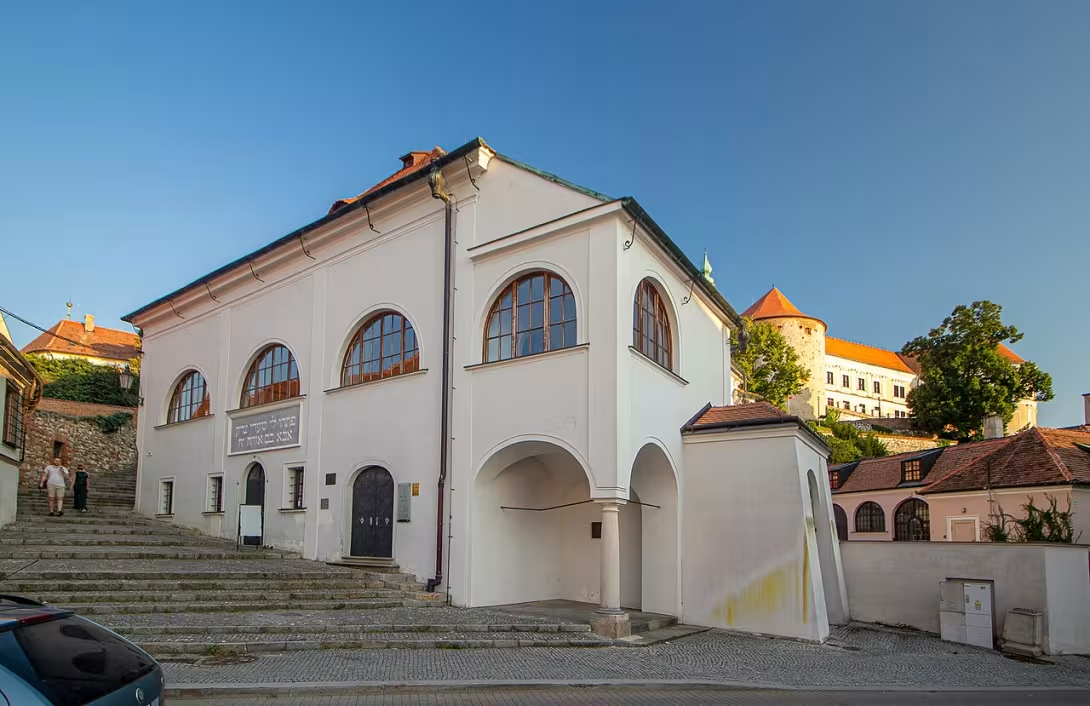
Drag the slider to compare how the landmark may have looked when it was built with the view today.
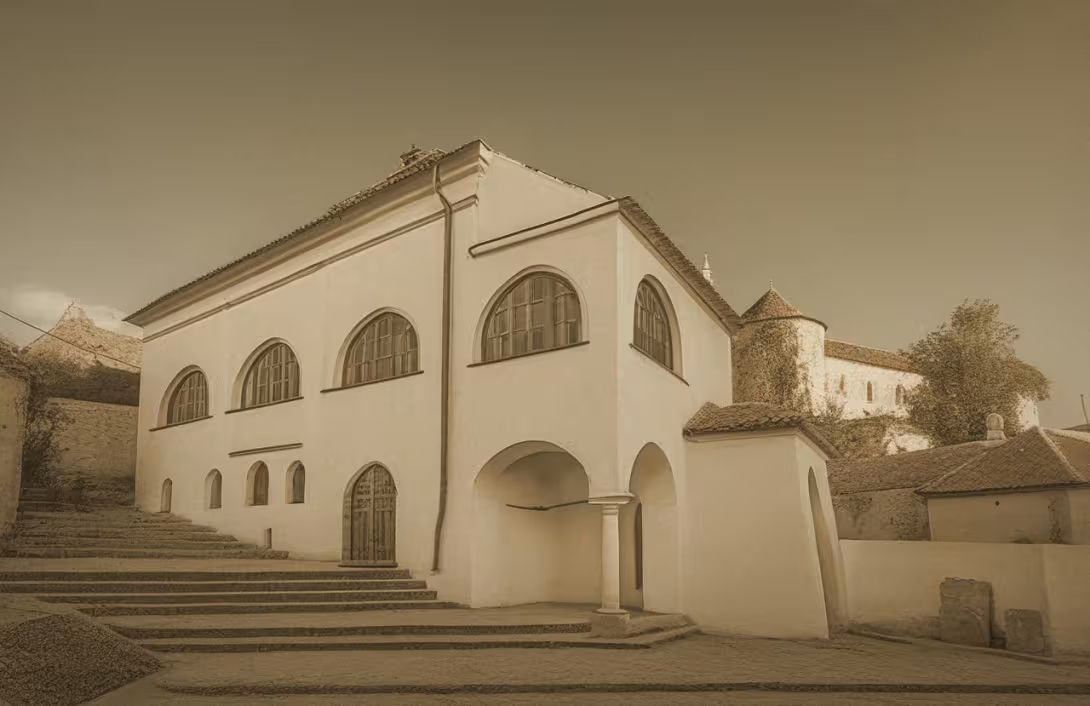
The historical appearance on the left is an AI-generated visualisation and serves as inspiration only.
Historical milestones
- 1550
- The establishment of the current building in the Renaissance style.
- 1561
- The first reconstruction after the fire and the addition of a single column corner ship.
- 1688
- An addition to an unusual triangular women's prayer room.
- 1719
- A devastating fire in the Jewish ghetto that led to a massive reconstruction.
- 1723
- Completion of the Baroque reconstruction with a new schedule based on eastern stimuli.
Architectural development
Originally a Renaissance building, which, after the fire in 1719, obtained a baroque schedule with a four-pillar pillar and dome. In 1819 empirical modifications were made to the windows and in 1688-1689 a triangular women's prayer hall was added.
Historical events
1938: The demise of the Jewish community as a result of the Nazi occupation and the demise of a religious purpose; 1977-1989: Extensive reconstruction of the building.
Owners
city of Mikulov
Points of interest
- It has a unique oblique position, dictated by liturgical demands for world-wide orientation. - The construction has changed over time from Renaissance to Baroque style, reflecting cultural ties with Eastern Europe. - Baroque reconstruction from 1723 brought a system of four pillars and four dome inspired by the shrines in Lvov and Rejov. - It is the last preserved Polish or Ivova type in the Czech Republic. - It's the only rest of the rich Jewish history of the city of Mikulov.
Guide
Show guide text
This text was created by artificial intelligence and has not been editorially reviewed. It may contain inaccuracies.
Welcome to Mikulov. You're standing in front of one of the most important and oldest places in this city. The Upper Synagogue stands before your eyes, representing the oldest preserved Jewish sanctuary in this location. Feel the strange atmosphere emanating from this building. It's a place that carries traces of centuries, stories of generations, and the constant movement of time. While you're looking at her face, try to imagine what this place looked like hundreds of years ago and how much it changed under the influence of fateful events.
Let's go back to history together to understand why this building is so special. The entire current form of the building has its roots in the 1550s. At that time, the synagogue was founded in the Renaissance style, which at the time meant an effort for harmony and a certain geometric balance. But the history of this place was not just a peaceful course of time. The building had to face many trials. In the year 1560, the first major reconstruction took place, which was a direct result of the fire. At that time, the main construction was built by a corner boat, which was characterized by being supported by a single pillar. This detail was the first step towards how the building began to gradually change and expand.
Now pay attention to the structure itself and how the building evolved over time. If you look at its overall composition, you can see in it the alternating of different architectural directions. In sixteen eighty-eight, another part was added to the whole, which is completely unusual - a triangular female prayer room. This geometric anomaly gives the place a unique character and shows how space had to adapt to the needs of the community.
But the history of this place is also linked to a great tragic moment. Seventeen hundred nineteen years ago, a devastating fire hit the Jewish ghetto. This fire was so destructive that it led to a large and necessary reconstruction of the entire space. It is this disaster that has become a catalyst for a new, more spectacular form of synagogue. Because of it, the building could transform from the original Renaissance style into Baroque style. This transition is not only a matter of aesthetics, but also reflects the broader cultural links that the local community had with Eastern Europe.
In the year seventeen twenty-three, this Baroque reconstruction was completed. This essential architectural work was behind Ignác Lengelacher. Thanks to his work, the synagogue has acquired its current, highly sophisticated character. If you could look inside now, you would realize that the Baroque reconstruction brought into space a fascinating system of four pillars and four dome. This element was not random, because it was inspired by shrines from the eastern regions, which again reminds of those deep links with the exit that are mirrored in the architecture of this place.
But now look at the very location of the building. You may notice that its location is acting unusually, as if it were erect, that is to say, on the scythe. That look doesn't have to confuse you. It's not a builder's fault or a coincidence. This unique location was dictated by very strict liturgical requirements. To be able to comply with religious rules, the shrine had to be oriented towards the world's parties exactly according to a pattern. This effort to connect the Earth building with the order of the universe and the religious sense is one of the most important reasons why this building is so special and why you will not find it similar in the vicinity.
Consider how fascinating it is that a building that began as a Renaissance building in the middle of the sixteenth century survived fires, reconstructions and changes of the whole epoch and thanks to the work of architects such as Lengelacher remained a living symbol of history. Every change of style, from the Renaissance to the Baroque to the unusual geometric elements such as the triangle prayer, forms layers that you can perceive here today.
It's a place where mathematics, faith, and destiny are met. The sloping orientation, the pillars inspired by the exit, and the ability of the building to come out of the ashes after the fire, it all creates a story of resilience and constant transformation.
Now please continue your search and feel the atmosphere of this place further. Let yourself be carried away by the beauty of the surroundings and try to find in every detail you can see the reflection of the centuries that were present here. Thank you for spending this moment with us in exploring the history of the Upper Synagogue. We wish you a beautiful and inspiring next trip to Mikulov.
Tips for visitors
For the best experience, we recommend a visit in the morning when the interior of the Renaissance synagogue is a calmer atmosphere for the perception of its unique style. You can easily reach the monument by foot or public transport; Please check the current connection in internet search engines.
Get comfortable shoes for the tour. If you plan to photograph, the most appropriate light to capture the unusual location of the building on the scythe is during the day when the light penetrates the space. However, before taking any pictures, always be aware of the current rules on site.
After visiting this oldest Jewish shrine, you can continue for a walk along Husova Street. As an ideal supplement to your visit Mikulova is the Mikulov Castle, located in close proximity.
For families with children, we recommend choosing a slower pace so that younger visitors can explore historical details in peace. Walking around is interesting for children thanks to the historical nature of the place and easy availability.
Frequently asked questions
Can the monument be visited?
Religious buildings are usually open mainly during services; at other times a visit is normally arranged with the parish or the operator. We have not verified specific times.
Where is the monument?
Location: Mikulov, Jihomoravský kraj. The map on this page shows the exact spot.
Why is the monument protected?
It is listed in the Central List of Cultural Monuments of the Czech Republic as a cultural monument (register no. 1000137763).
Businesses nearby
Do you run a restaurant, accommodation, shop, museum, rental, wellness or other visitor service near this monument? Show yourself directly to the people heading to it — this is how they will see you in the app and on the web:
Events nearby


Zdroj akcí: otevřená data měst a obcí ČR (Národní katalog otevřených dat) a kalendář akcí Národního památkového ústavu.
Nearby
Mikulovský zámek, Husova ulice.
Accommodation nearby
Themed route
Synagoga v Mikulově - historical synagogue, main destination trip. Take a look at the preserved Baroque interior, the original Jewish artifacts and the exhibition about the life of the local Jewish community.
Husova Street - main historic street of the city, type: city street. Walk along picturesque stone houses 5 minutes from the synagogue, admire the Renaissance facades and soak up the atmosphere of medieval Mikulova.
Mikulov castle - Renaissance castle overlooking vineyards, type: castle. From Husova Street you can walk up the hill for about 10 minutes to the majestic castle, where you can admire Baroque gardens, historical interiors and panoramic views of the city and surrounding countryside.
Seasonal recommendations
Spring: During the spring, a special atmosphere appears on the Synagogue in Mikulov, where the room is lit by sunlight, which penetrates through the windows and contributes to the living colour spectrum. Nature awakens from winter sleep, creating a harmonious connection to historical walls of the monument. It is advisable to visit the synagogue at the beginning of the spring season when the crowds are still mild and you can enjoy a quieter tour. It is recommended to wear clothes suitable for variable temperature - a durable coat for a cooler morning that can be cut out after the sun lining.
Summer: In the summer months Synagoga v Mikulově is lit with long days and warm sun, creating an attractive atmosphere for visitors. Nature around it offers mature trees and blooming grass that provide room life. In the main summer season it is recommended to visit the memory earlier on the day to avoid large crowds and long queues. Hot clothes with ties or cups are suitable for protection against sunlight as well as water for drinking during the visit.
Autumn: In the autumn months Synagoga v Mikulově becomes melancholic atmosphere when it is lit by darker light and tree leaves turn into vivid colors. This season brings a quieter attendance and allows you to enjoy the historic environment without excessive crowds. When visiting, it is advisable to wear warm clothes, because temperatures may fall rapidly and the attendance of local pilgrims often attracts more people. The best time for a tour is at the end of the day when the sun is already over the horizon.
Winter: In winter the Synagoga v Mikulově becomes a unique atmosphere, where it is lit by the soft light of the lamps and creates a calm and quiet mood. The room is colder because of winter weather, which contributes to the feeling of historical space. Visiting the synagogue during this period is suitable with warm clothes and the possibility to calm down in colder places. This season offers peaceful and intimate experiences without large crowds.
Visualizations and artistic views


The visualisations are generated by artificial intelligence and serve as inspiration.
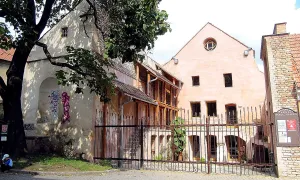
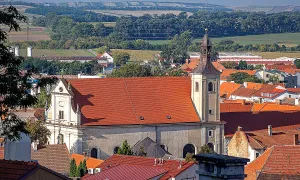
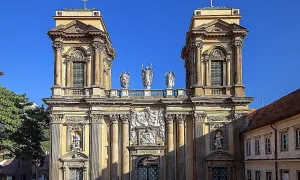
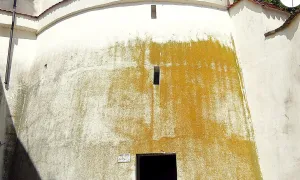
Photos from the area
Real photos taken near the monument


Zdroj a licence jsou uvedeny u každého snímku.
Tips from visitors
No tips yet. Be the first!
Log in and add your tip.
Sources and literature
Photos: VitVit / CC BY-SA 4.0 — Wikimedia Commons. The author and licence also appear when you hover over the image.
Faktickým podkladem tohoto textu byl článek na Wikipedii, jehož autory jsou přispěvatelé Wikipedie. Článek je dostupný pod licencí CC BY-SA 4.0.
Location on the map

Příběhy a pověsti
Legendy, pověsti a příběhy spjaté s touto památkou
Fotografie návštěvníků
Zatím žádné fotografie. Buďte první, kdo přidá fotografii z návštěvy!
Log in a přidejte svou fotografii nebo hodnoťte.
Za ověřenou návštěvu v aplikaci získáte víc bodů — poznáme podle GPS, že jste na místě.
Reviews and comments