






Židovský hřbitov v Mikulově Jewish cemetery
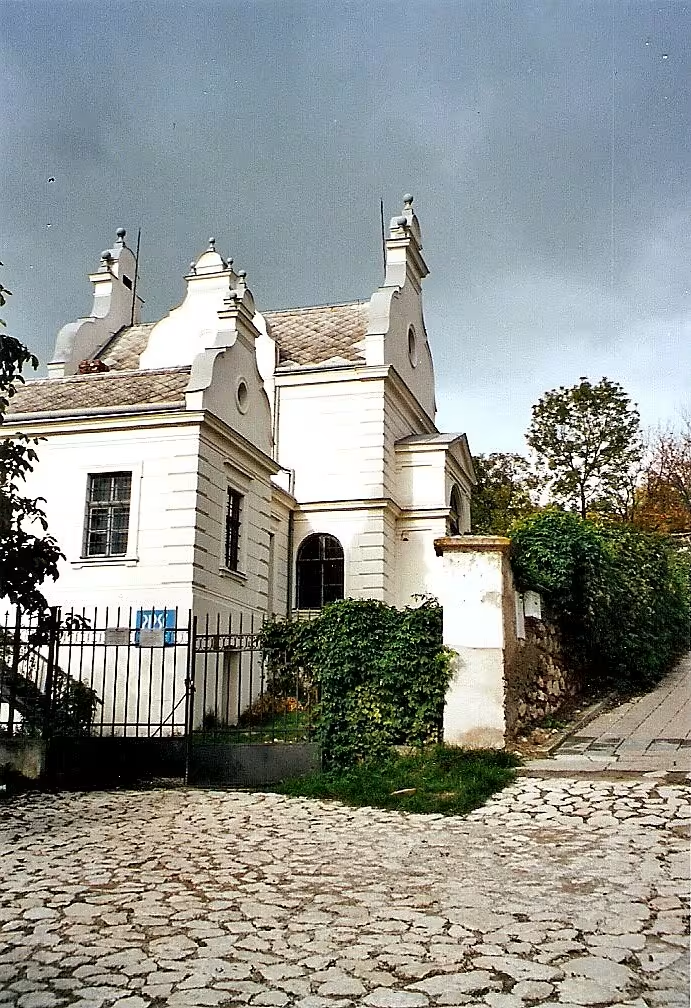
Židovský hřbitov v Mikulově is one of the oldest and most important Jewish burial sites in Moravia and the Czech Republic, comparable to the Old Town Cemetery in Prague and Cologne. This monument has been protected as a cultural monument since 3 May 1958 and bears witness to the existence and importance of the local Jewish village.
Established in the mid-15th century, the cemetery is located on the northwest edge of the former Jewish quarter near today's inner city. Its area is situated on the western slope of Goat Castle on an area of 19 180 m ², whose irregular shape reflects a complex history.
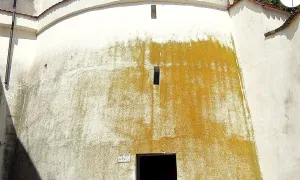
The whole area is surrounded by a high wall of white limestone and red bricks, typical of old Mikulov architecture. There is a single entrance in the southern part with a wall gate and bars.
Behind the gate is a ceremonial hall from 1898, built according to the design of Viennese architect Max Fleischer. In the interior there is a memorial with ceremonial items and documentation on the panels.
There are several thousand matrices in the cemetery, estimated between 2500 and 4000 pieces. The macevas are oriented east-west with inscriptions heading south. Mikulov is one of the cities where matrices dated before 1620 were preserved.
The central rise, known as the Rabbi top, is the most important part of the cemetery. There are about 80 significant tombstones, including the burial ground of Moravian and local rabbis and rich families.
The oldest types of tombstones from the first half of the 17th century are square or rectangular boards with relief, pilasters and arches. The decoration includes symbols such as Kohenian ironing hands and water pots. Since the middle of the 18th century comes Baroque style with rich plastic decoration, followed by rococo.
There is a road along the east wall leading to a children's burial site and north of the Rabbi hill is the youngest part of the cemetery. Here is the common grave of the Hungarian Jews from 1945, who were slaughtered by the Nazis and buried in the autumn of the same year.
The last persons buried in the cemetery were Hanuš Spielmann in April 1948 and Emil Stankiewicz in January 1949. Židovský hřbitov v Mikulově is a unique testimony of Jewish history in Moravia and an important artistic monument that deserves a visit.
Then and now
Drag the slider to compare how the landmark may have looked when it was built with the view today.
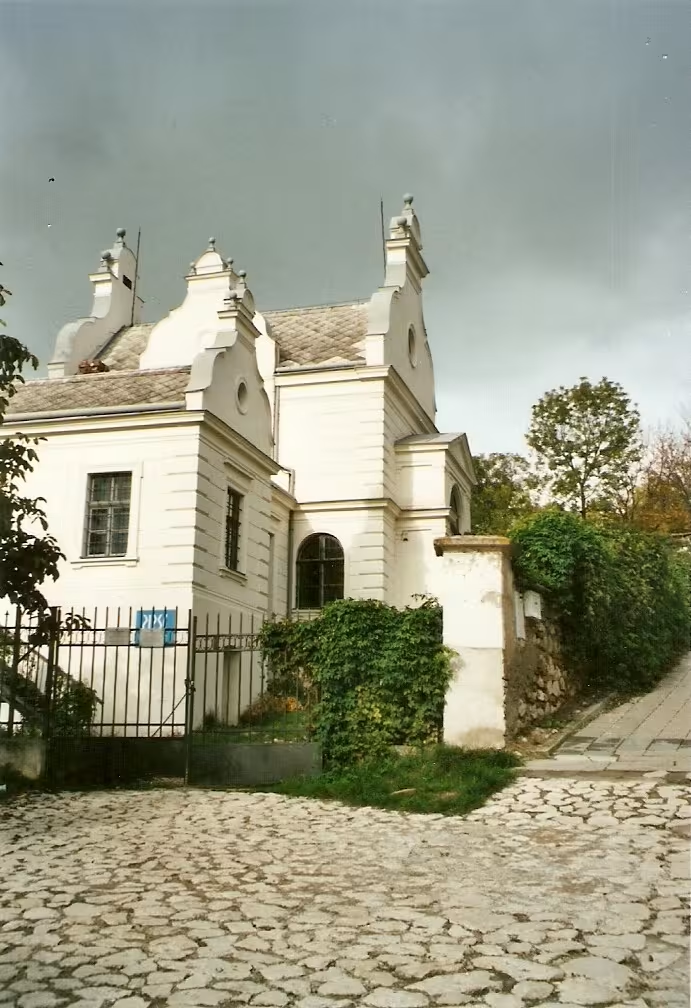
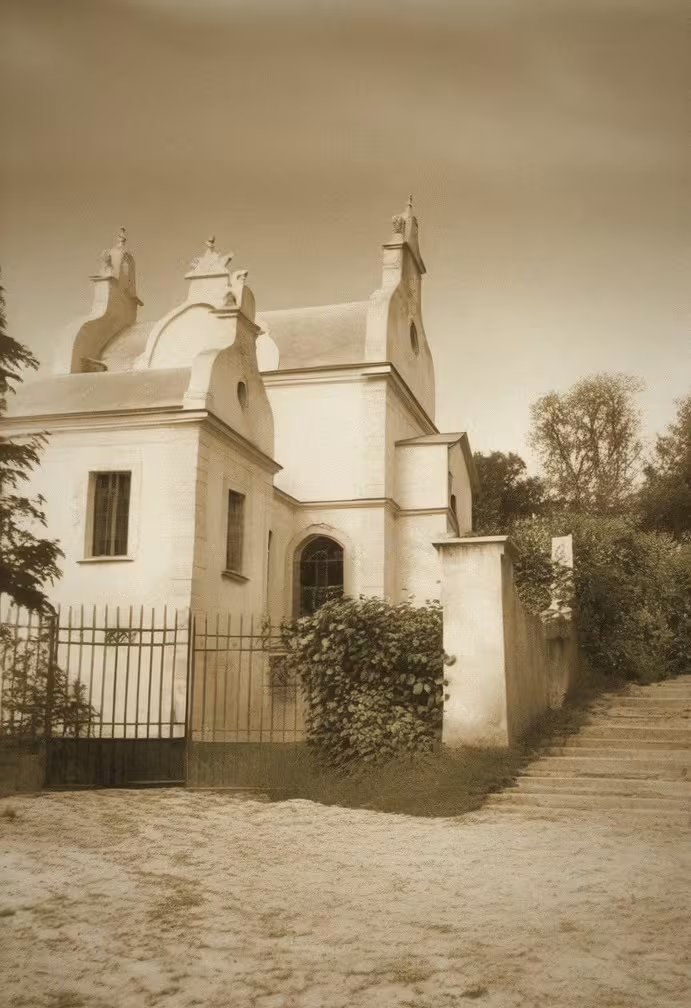
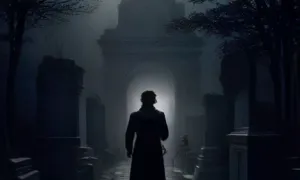
The historical appearance on the left is an AI-generated visualisation and serves as inspiration only.
Historical milestones
- 1450
- Establishing a cemetery in the middle of the 15th century
- 1898
- Position of the Neo-Renaissance ceremonial hall
- 1958
- Protection of the cemetery as cultural monuments
- 1949
- Last funeral in the cemetery
Architectural development
The cemetery shows irregular shape due to complex historical developments. In 1898, according to the Max Fleischer project, a three-space ceremonial hall was built in a non-Renaissance style. The border wall reaches 6 to 8 meters in some places and is a combination of white limestone and red bricks.
Historical events
In the middle of the 15th century a cemetery is established; 3.5.1958 the cemetery is declared a cultural monument; in 1898 a neoRenaissance ceremonial hall was built; The last funerals took place in 1948 and 1949.
Points of interest
- Židovský hřbitov v Mikulově is one of the oldest and most important Jewish burial sites in Moravia and the Czech Republic. - This monument is protected as cultural since 3 May 1958. - The cemetery is located on the northwest edge of the former Jewish quarter near today's inner city and extends over an area of 19 180 m ². - The ceremonial hall of 1898 was built according to the design of Viennese architect Max Fleischer. - Mikulov is one of the cities where matrices dated before 1620 were preserved.
Guide
Show guide text
This text was created by artificial intelligence and has not been editorially reviewed. It may contain inaccuracies.
Welcome to the place where time stops and where every stone whispers stories long ago up to the goner generations. Right now, when you're standing here, you perceive a strange silence and seriousness that radiates from this space. Before your eyes, there is a massive wall that forms an impenetrable interface between today's busy world and the sacred peace that extends beyond it. This wall, composed of limestone and bricks, is not just an ordinary building element. It's a symbol of protection, a fixed point that separates life from eternal rest for centuries. Feel the stability and strength of the material used here to maintain order and dignity in these places. You are on the west slope of Goat Castle, in a place where nature meets a deep human history.
Let's go deeper into the past together to understand why this place is so special. This cemetery is not just an ordinary burial ground; is one of the most important and oldest Jewish cemeteries in Moravia and within our country. To understand its meaning, we must return to the middle of the 15th century. Just around the year a thousand and four hundred and fifty began to grow in Mikulov local Jewish community. With the flourishing of this community, the need to have its own sacred place has naturally evolved. This cemetery became an integral part of the identity of the local people, a place where faith, family ties and social memory were connected. For centuries, this space has been the heart of a community that has been an important part of the city here.
Now pay attention to what you see around you when your eyes begin to move around the architecture of this complex. The whole cemetery is a fascinating example of how human work can adapt to the challenging terrain of the slope. If you look towards the buildings, you can see a non-Renaissance ceremonial hall. This building was built in the year one thousand eight hundred ninety-eight and adds architecture and nobility to the whole place. Her style reflects the effort to create a dignified space for the rituals that were taking place here. The architect Max Fleischer was behind her design, who had to take into account the demanding location on the slope in order to make the building harmonious and monumental.
Now, if you go down the road towards the higher parts of the slope, you will find a place that is absolutely crucial to this area. It's a rabbi top. As soon as you step on it, you'll see the oldest tombstones whose origins extend back to the early seventeenth century. These tombstones are silent witnesses of ancient times. Although many of them have been scraped by time and weather for centuries, they still carry incredible strength. Each one represents a particular person, a specific life and a specific story that has been honored here. Look at their shapes and textures, see the layer of history that's been gathering here for centuries.
There were people in these areas whose names are linked to Mikulova's history. Although they are unknown to many today, their existence was part of the rich cultural tissue that this city has been building for generations. Among the personalities associated with this place and its history, we can name Hanus Spielmann or Emil Stankiewicz, for example. Their lives, as well as the lives of thousands of other people, are now part of this unique cultural heritage that is being spread out before you.
You might find one interesting thing that links the sadness of the past to the respect of the present. Although this cemetery has served the community for hundreds of years, its era as an active burial site had its clear end in the mid-twentieth century. The last funeral took place here in the year one thousand nine hundred and fourteen nine. Since then, the place has become a silent memory that we must protect from oblivion. It was in the year one thousand nine hundred fifty-eight that the cemetery was officially recognised as a cultural monument, which ensured that its unique character and historical value would be preserved for future generations. It is a fascinating contrast - a place that once was full of human presence and ceremonies, became a protected space for silent meditation over history.
Now I'll let you continue your search. See the individual parts of the area, feel the atmosphere of this place, located on the northwest edge of the former Jewish quarter. Try to connect in spirit with those who rest here, and feel the silence that is so deep here. Let yourself be carried away by the history that is felt in every stone of limestone and in every shadow that throws down the slope of Goat Castle. Thank you for choosing to visit this place and pay your attention to it. I wish you a peaceful and inspiring walk between these historical monuments.
Tips for visitors
The best time to visit the Jewish cemetery in MikulovA is early spring or late autumn month, when the weather is pleasant and the cemetery is not crowded with tourists. This time of year also offers beautiful lighting conditions for photographing old tombstones.
Parking can be found near Goat Castles, located near the cemetery. For those travelling by public transport, Mikulov is well connected to the surrounding municipalities of buses. Check the current connection and parking possibilities before visiting.
During the proposed visit it is advisable to carry a water drink, sunglasses and protective clothing. If you are planning a photo shoot, consider bringing a stabilizer for the camera or the monopod, which is useful for detailed images.
For families with children it can be interesting to visit Goat Castle, located near the cemetery. This historic castle offers beautiful rooms and is suitable for a family walk with diverse activities.
Businesses nearby
Do you run a restaurant, accommodation, shop, museum, rental, wellness or other visitor service near this monument? Show yourself directly to the people heading to it — this is how they will see you in the app and on the web:
Events nearby



Zdroj akcí: otevřená data měst a obcí ČR (Národní katalog otevřených dat) a kalendář akcí Národního památkového ústavu.
Nearby
Goat peas
Accommodation nearby
Themed route
Thematic cruise route from Mikulova
1. Židovský hřbitov v Mikulově (cemetery) * Type: * Historical landmark * Why is it worth visiting: * This ancient cemetery is one of the oldest and best preserved Jewish burial sites in Moravia. It is an important architectural monument that resembles the rich history of the Mikulov Jewish population.
2. Goat Castle * Type: * Historical location * Why is it worth visiting: * Goat Castle is a small castle that boasts a charming location and history. Although it is now a ruin, it offers beautiful views of the surrounding landscape and offers the opportunity to explore part of the Moravian building heritage.
3.Mikulov * Type: * Urban location * Why is it worth a visit: * Mikulov is a small town with a rich history that boasts an impressive castle and beautiful streets. Visit the city centre for a walk along its historic streets and discover architectural quality.
4. Castle courtyard in Mikulov * Type: * Historical area * Why is it worth visiting: * The castle courtyard is a key part of Mikulov Castle. It is a place where you can appreciate elegant architecture and a beautiful garden that complements the overall view of the historical complex.
5. Park in Mikulov * Type: * Green oasis * Why is worth a visit: * Park is an ideal place to relax and relax after exploring historical monuments. Its quiet pavements and greenery offer an opportunity to walk in a pleasant environment.
This route offers a combination of history, architecture and nature, allowing a general view of the cultural heritage Mikulova.
Seasonal recommendations
Spring: In the spring period, Židovský hřbitov v Mikulově is transformed into a living garden where flowering shrubs and trees bring their colorful flower. The sunny days provide ideal conditions for walking between ancient graves, where the atmosphere is calm and fulfilling the feeling of a new beginning. Visitors should come dressed in light clothes with a warm jacket for any cold morning or evening, because spring weather can suddenly be variable. The best time to visit is in the early afternoon hours when the crowd rarely gets there.
Summer: The cemetery of life takes over summer with long sunny days and warm atmosphere. Here you can enjoy a quiet moment under the shadow of old trees that provide refuge from the sun. The number of visitors increases in the main summer season, so it is advisable to visit the cemetery earlier in the afternoon to avoid the hottest hours and crowds. The important thing is to carry sunglasses, UV protection and plenty of drinking water.
Autumn: In autumn Židovský hřbitov v Mikulově becomes melancholic charm. Tree leaves turn into a variety of colours and provide a fine curtain over historic tombstones. The atmosphere is calm, which allows for peaceful walks in pleasant temperatures. Visitors should be dressed in multiple layers because autumn weather can be variable and cooler evenings are common. The best times for visiting are early afternoon, when the temperature is most pleasant.
Winter: Winter visit to the Jewish cemetery in Mikulov offers a unique view of the historical monument under the cover of snow, adding peace and mystery. Sun rays can illuminate snowy graves, creating dramatic effects. Visitors should prepare for cold conditions with warm clothes and moisture protection. The opening hours of the cemetery are shorter in winter months, so it is advisable to come as soon as possible after opening. Visiting during the Advent or at the end of the year offers a quiet atmosphere without large crowds.
Visualizations and artistic views


The visualisations are generated by artificial intelligence and serve as inspiration.
Photos from the area
Real photos taken near the monument


Zdroj a licence jsou uvedeny u každého snímku.
Tips from visitors
No tips yet. Be the first!
Log in and add your tip.
Sources and literature
Fotografie: feťour / CC BY-SA 3.0 — Wikimedia Commons. The author and licence also appear when you hover over the image.
Faktickým podkladem tohoto textu byl článek na Wikipedii, jehož autory jsou přispěvatelé Wikipedie. Článek je dostupný pod licencí CC BY-SA 4.0.
Location on the map
Příběhy a pověsti
Legendy, pověsti a příběhy spjaté s touto památkou
Fotografie návštěvníků
Zatím žádné fotografie. Buďte první, kdo přidá fotografii z návštěvy!
Přihlaste se a přidejte svou fotografii nebo hodnoťte.
Za ověřenou návštěvu v aplikaci získáte víc bodů — poznáme podle GPS, že jste na místě.
Reviews and comments