



Sýpka - bývalá tvrz Granary
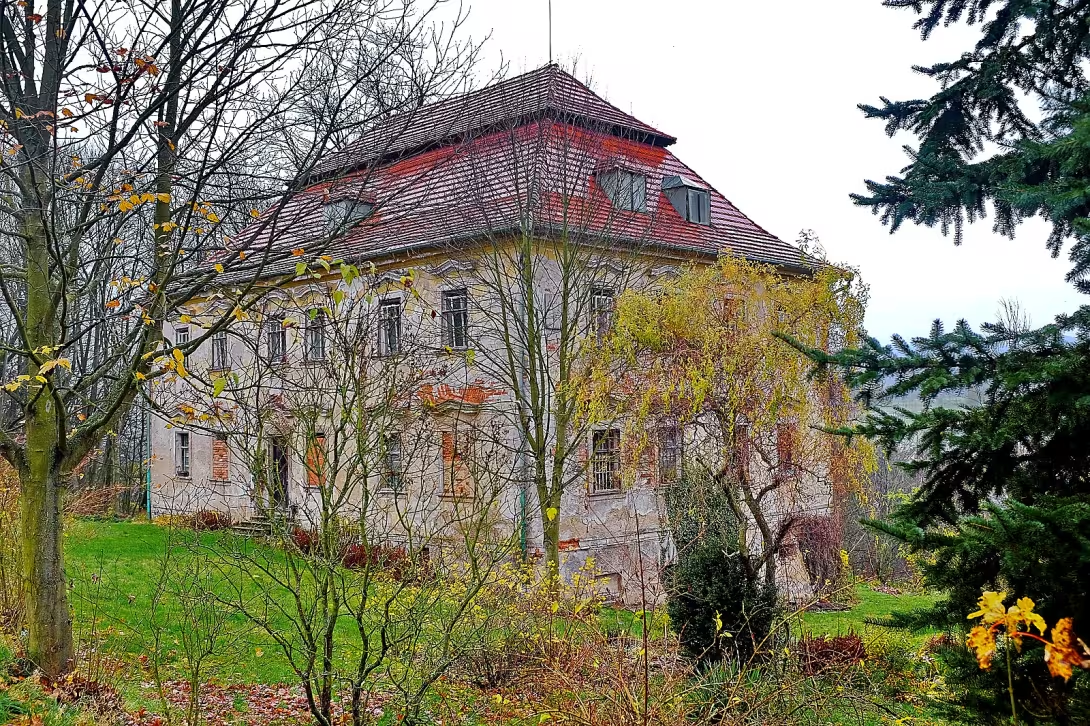
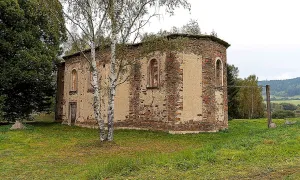
Hlumek is a former Renaissance fortress that was used as a granary in the 18th century after Baroque reconstruction. The building is located on the elevated terrace above the left bank of the river Ohře in the extinct village Chlumek, which was a settlement of the village Dasnice in the district of Sokolov in the Karlovy Vary region. Since 1963, this building has been protected as a cultural monument.
The fortress was built by Štolcové ze Simsdorfu in the 16th century, probably to replace the extinct Gothic residence of the Perglas family from Perglas. The exact location and appearance of the original structure are unknown. The stolls owned Hlumek until 1620, when the fortress was created under Jan Stolce.
The building form of the building is a corner rectangular brick building made of quarry stone with dimensions of approximately 11 × 21 meters. Its Renaissance origin is visible on the decorative element in the lining above the rear entrance, which bears the year 1570. Just above this element was later added their younger coat of arms under Nostic. In the middle of the 18th century, a Baroque rebuilding took place on the granary during which the original windows were replaced by rectangular holes and the interior was fundamentally changed: internal partitions were demolished and a wooden floor equipped with a staircase. The building has simple undivided facades with oblong windows, stone shambles and a valbé roof covered with burnt-out bags of the type of eska.
After the Battle of the White Mountain, Stolc property was prevented. In 1622 the farm was sold to Bartholomew Bräuner of Vildenava and was held by several different owners in the following centuries. In 1745 she purchased the property Hlumek and Shabina Veronika Dorota z Becku, which had the fort converted into a granary. In 1765, Hlumek was owned by Nosticové, who attached him to the Falknov estate. The object remained in their possession until 1945. After that year, the economic buildings were taken over by a local state farm that used the fort as a fertiliser warehouse.
Near the fortress was a Baroque castle, known as the Old Castle, to distinguish itself from the nearby New Castle built at the end of the 19th century. However, the new castle no longer exists, as it was demolished in May 1983. Hlumek himself went through a tragic fate in 1992 when the building burned down and only the perimeter walls remained from the building. After the fire, the construction was quickly repaired and remasked.
This monument is an interesting example of the transformation of the Renaissance residence into an economic building. It is an important witness to the history of the lost village of Hlumek and it is easier to understand the changes of the local estate.
Historical milestones
- 1570
- On the decorative lining above the rear entrance to the yard
- 1622
- Sale to Bartholomew Bräuner of Vildenava
- 1745
- Purchase of the estate by Veronica Dorota from Beck and conversion to granary
- 1765
- Connection to the Falknov estate by the Nostic family
- 1963
- Declaration of the claim for cultural monument
- 1992
- A building fire from which only the perimeter walls remained
Architectural development
The original Renaissance character resembles a decorative lining above the rear entrance with the year 1570. In the middle of the 18th century, a Baroque rebuilding was carried out on a granary, which created a corner brick building made of quarry stone. The building has a wall roof covered with burnt bags and simple facades with rectangular windows.
Historical events
1622: sale to Bartholomew Bräuner of Vildenava; 1745: purchase and conversion into a granary; 1992: building fire.
Owners
Štolcové ze Simsdorfu (until 1620), Bartoloměj Bräuner z Vildenavy (from 1622), Veronika Dorota z Becku (from 1745), Nosticové (from 1765 to 1945), state farm (after 1945).
Points of interest
- Hlumek is a former Renaissance fortress, which was used as a granary in the 18th century after Baroque reconstruction. - The fortress was built by Štolcové ze Simsdorfu in the 16th century, probably to replace the extinct Gothic residence of the Perglas family of Perglas. - The Renaissance origin of the building is visible on the decorative element in the lining above the rear entrance with the year 1570. - In 1992, the building burned down and only the perimeter walls remained. - There was a Baroque castle near the fort known as the Old Castle.
Guide
Show guide text
This text was created by artificial intelligence and has not been editorially reviewed. It may contain inaccuracies.
Welcome to the historic place of Dasnic, where you stand before the fascinating witness of the past - a granary that once was a fortress. Note how the building switches off on the elevated terrace above the river Ohře, surrounded by quiet greenery and vast landscape views. The original Renaissance fortress was converted into a granary in the 18th century, reflecting the changing history of this place.
The fortress was built by Štolcové ze Simsdorfu in the 16th century as a replacement for the extinct Gothic residence of the Perglas family. In 1622 the farm was sold to Bartholomew Bräuner of Vildenava, which predates the next stage of his history. The key moment was the purchase of Veronica Dorota from Beck in 1745, which converted the building into a granary. In 1765, the estate was connected to the Falknov estate by the Nostic family.
Look up and notice the decorative element above the rear entrance, which is 1570. This detail shows the Renaissance origin of the building, although its architects remain unknown. Even after the fire in 1992, which destroyed roofs and interiors, the perimeter walls are preserved as a testament to his historical wealth.
The interesting thing about this place is that Hlumek was once a Renaissance fortress that turned into a granary after Baroque reconstruction. This transformation process reflects wider historical and cultural changes in the region.
Now that you've looked at the key elements of this monument, we're going to invite you to dive further into her stories and look at the surrounding landscape. Every step here is like a page of history that can be read through your feeling and perception. We hope that this guide has been inspiring to you and has led you to explore this interesting place further. Thank you for your visit!
Tips for visitors
The best time to visit is in the early morning or late afternoon when the best light hits the raised terrace above the river Ohře, which creates ideal conditions for landscape observation.
In the way take comfortable shoes suitable for the field, because the monument is located in the area of the extinct village of Hlumek and near the river bank, where the surface may be uneven.
For the best photos we recommend using the location of the building on the terrace, which offers panoramic views of the left bank of the Ohře. Focus on the details of the original Renaissance building and its later conversion into a granary.
In the vicinity you can visit the Baroque Old Castle, instead of the demolished New Castle or explore the area of the extinct village Hlumek. For families with children is the ideal form of discovery in the form of finding traces of former fortress in nature.
Frequently asked questions
Can the monument be visited?
This is a residential or farm building, not a museum with opening hours. Please view it from public space and respect the owners' privacy. We have no information about access to the interior.
Where is the monument?
Location: Dasnice, Karlovarský kraj. The map on this page shows the exact spot.
Why is the monument protected?
It is listed in the Central List of Cultural Monuments of the Czech Republic as a cultural monument (register no. 1000125754).
Businesses nearby
Do you run a restaurant, accommodation, shop, museum, rental, wellness or other visitor service near this monument? Show yourself directly to the people heading to it — this is how they will see you in the app and on the web:
Events nearby


Zdroj akcí: otevřená data měst a obcí ČR (Národní katalog otevřených dat) a kalendář akcí Národního památkového ústavu.
Nearby
The left bank of the Ohře River, the extinct village of Hlumek, the Baroque Old Castle and the demolished New Castle.
Accommodation nearby
Trips and activities nearby
Guided tours, tickets and activities nearby from GetYourGuide
Affiliate link: if you buy from the partner, we may receive a commission. The price for you does not change.
Search tours and activities →Themed route
1. Baroque Old Castle (castle) - Admire the architecture of this historic mansion. 2. Broken New Castle (monument) - Explore where another important building once stood. 3. Grape - former fortress (fortress) - Visit the main destination of the trip, the historic fortified building. 4. Zaniklý vesce Hlumek (zaniklý vesci) - Visit the place where human settlements once existed. 5. Left bank of the river Ohře (river bank) - End the route near the water near the flow.
Seasonal recommendations
Spring: In spring the visit to Dasnice's granary is special because of changing nature and warm sunlight, which emphasizes historical architecture. Flowers are beginning to grow green shades of leaves and trees, adding landscape beauty around them. It is advisable to visit the memory early in the morning or later in the evening to avoid the middle classes that may be a little more busy due to tourist buses. A good selection of clothes would include a light hat and protective sunglasses as well as comfortable shoes to walk on the lawn.
Summer: Summer brings long days and warm sun, which makes visiting a granary in Dasnice an ideal experience. The atmosphere is full of life, with trees covering themselves with thick leaf crown and surrounding fields full of flowering plants. It is advisable to come in memory of earlier morning or late afternoon to escape the peak of summer attendance while enjoying long sunlight. Remember the protective hat, UV cream and plenty of drinking water, because temperatures can be higher.
Autumn: In the autumn period, the Dasnice granary offers a unique atmosphere with brighter and golden leaves of trees, which make a beautiful background for historical memory. The sun is less intense and the sunlight creates warm colors throughout the territory. This period is ideal for visiting, because there is a softer crowd traffic and nature offers beautiful landscapes. It is recommended to wear warmer clothes with the possibility to defer layers because temperatures can be variable and in the morning or evening can be colder.
Winter: Visiting a granary in Dasnice in the winter season offers a quiet atmosphere, where historical architecture is highlighted by cold colours and perhaps even snow covering the surroundings. Sunlight is less intense, but still creates magical flashes on the snowy background. The monument opens a shorter time during this period, so make sure you check the opening time before visiting. It is important to wear warm clothes, including hat and gloves, and suitable shoes for walking on possible snow or ice conditions.
Visualizations and artistic views


The visualisations are generated by artificial intelligence and serve as inspiration.
Photos from the area
Real photos taken near the monument


Zdroj a licence jsou uvedeny u každého snímku.
Tips from visitors
No tips yet. Be the first!
Log in and add your tip.
Sources and literature
Photos: Lubor Ferenc / CC BY-SA 3.0 — Wikimedia Commons. The author and licence also appear when you hover over the image.
Faktickým podkladem tohoto textu byl článek na Wikipedii, jehož autory jsou přispěvatelé Wikipedie. Článek je dostupný pod licencí CC BY-SA 4.0.
Location on the map
Příběhy a pověsti
Legendy, pověsti a příběhy spjaté s touto památkou
Fotografie návštěvníků
Zatím žádné fotografie. Buďte první, kdo přidá fotografii z návštěvy!
Log in a přidejte svou fotografii nebo hodnoťte.
Za ověřenou návštěvu v aplikaci získáte víc bodů — poznáme podle GPS, že jste na místě.
Reviews and comments