



Tvrz (1000148394) Fortress
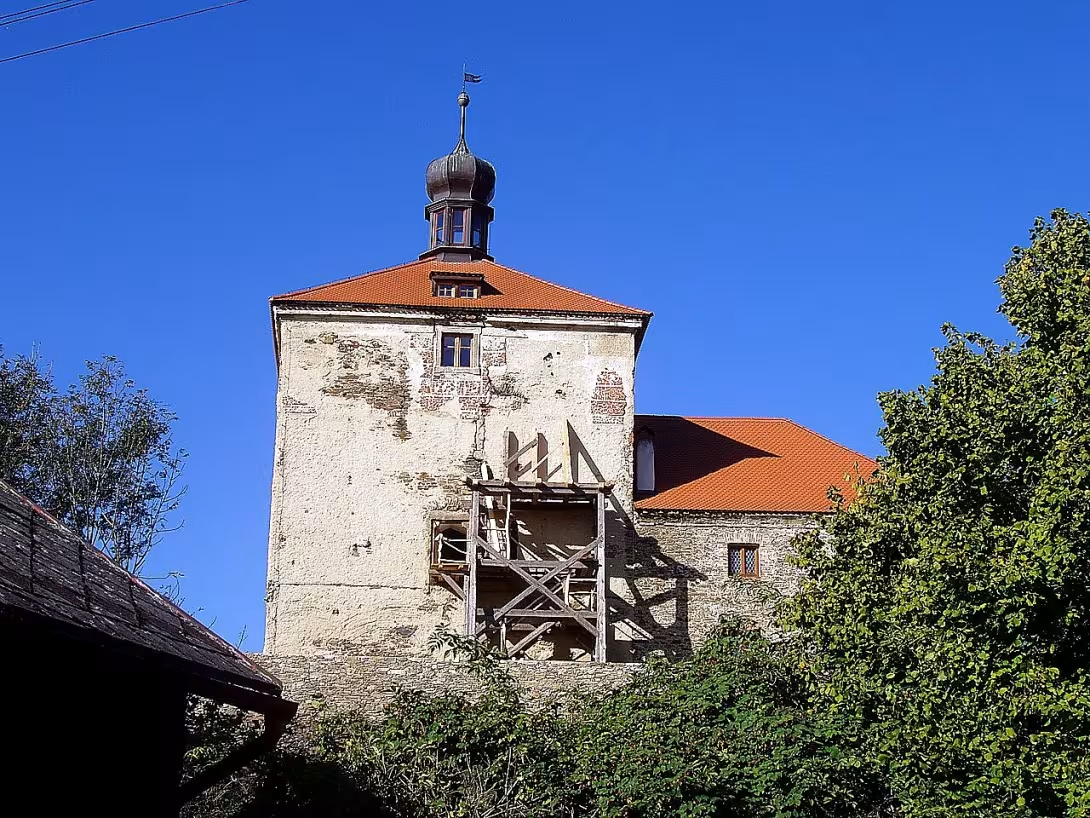
The fortress Malešov is located in the northwest part of the village Malešov nedle Kutná Hora. This historical object is significant in its long history dating back to the 14th century and the recent extensive reconstruction, thanks to which its present form returns to the period of peak Gothic.
The oldest historical mention of the mansion dates back to 1303, when it was owned by Přibyslav z Malešova. In 1359 the mansion was sold to the seventh monastery. Shortly afterwards, Ruthards, nobles of urban origin from Kutna Hora, became owners, who later accepted the nickname Malešova. The fort remained in their possession until 1411, when it was sold to Martin Kladna of Tìhovice, who was a supporter of King Wenceslas IV.
The original medieval building was built on a rocky edge and formed by a massive four-storey residential tower with wooden ceilings. The entrance to the tower was located on the first floor and was accessible on a wooden steeple from the east side. There were parks on the rock walls around the tower, which were accessible on wooden staircases at different heights. The fortifications included two circular towers: the northeast, which contained a well, and the southwest, which served as a prison. The northern part of the building was separated by a moat with a wooden bridge, separated from the residential tower.
At the end of the 15th and during the 16th century the tower passed through the reconstruction, when its floors were sealed and new Renaissance windows were created in the south wall. The tower also acquired a new Renaissance facade. A new one-storey residential building was built north of the tower, on the ground floor of which there was a horse-house and a passage into the courtyard, while on the first floor there were living rooms.
In the 17th century, the fort became an economic and administrative center of the estate. The southeast part of the ditch was bridged and used as a cellar for a local brewery. A rectangular building serving as a management of the estate and official apartments was built over this bridge. The former one-story building from the 16th century was converted into a retirement typist. The wooden bridge was replaced by stone and the residential tower was converted into a granary, which was equipped with a new roof, ended with a Baroque lantern. A two-story extension was added to the tower from the north side. In 1824-1827, the yard north of the main tower was united in the empirical style and two oblong buildings were attached to it, with the western one connected with the construction of an overarched moat and contained a passage. Around 1850, however, the southwest tower of the walls collapsed, which was subsequently replaced by a wall. In this period it was also abandoned and later at the end of the 19th century the original residential building from the 16th century was completely removed. The moat was taken and the passage to the courtyard was cancelled. The tower continued to be used as a granary until 1980.
The fate of the fort has been accompanied in the past by a number of owners and conflicts. In 1421, the fort was besieged by Hussites and her crew was forced to surrender. In 1424 there was a battle near Malešova, in which Jan Žižka defeated the Pražanis. After Hussite wars, the chateaux belonged to various nobles, such as Ondřej Kerský of Řimovice or Beneš of the House of Mokrovous of Hustřín. His son Jiřík was a supporter of Hungarian king Matthias Korvin, which led to Malešov being besieged and stripped of Hungarian crew in 1472. After the death of George in 1502, the fort fell to his daughters. In 1525, Jiřík Háša from Újezda bought it and in 1535 he gave it to his daughter, who married the knight Jan Salava. In 1576, the fort was sold to Jiřík Vodraradski of Hrušov. After 1580, Malešov entered the imperial administration. In 1620 he went to the administration of the Malovice brothers, but after the battle on White Mountain he returned again under imperial administration. The other owners were Eliška Žerotinská from Malešova and Henry Volf Berka from Dubé, who owned the estate in 1645. In 1666, Austrian general Jan Špork bought the property, followed by his son František Antonín Špork. In 1699, the chateau was sold by Count Antonín of Hailveill in Peshel and from 1710 it was owned by the family from Ostein until the 19th century.
In modern history, the Local National Committee Malešov took over the fort in 1985, but plans for its use were not implemented. The fort was sold to private property in 2002, which enabled the building to start a large reconstruction.
Today, the fortress Malešov represents a renewed form of the highest Gothic and is an important historical point in the vicinity of Kutná Hora. It is worth a visit to anyone who wants to see the detailed restoration of the medieval mansion and understand its complex fate.
Historical milestones
- 1303
- First mention of holder Pribyslav from Malešova
- 1359
- Sale of the mansion to the seventh monastery
- 1421
- Covering the Hussite Fortress
- 1424
- The Battle of Malešova in which Jan Žižka defeated the Pražans
- 1710
- Sale of the Ostein cress
Architectural development
Originally, the fortress was built on a rock edge as a massive four-story tower with parks and circular towers. During the Renaissance period, the tower was covered with new windows. After extensive reconstruction after 2002, the building was restored to the form of top Gothic.
Historical events
Year 1359 - sale of the mansion to the seventh monastery; 1421 - siege of the Hussite Fortress; 1424 - Battle of Malešova in which Jan Žižka defeated the Pražanis; 1472 - besieging Malešova and disposing of Hungarian crew.
Owners
Přibyslav z Malešova (1303), seventh monastery (1359), Ruthard, Martin Kladný of Těhovice (1411), Ondřej Kerský of Řimovice, Beneš of the genus Mokrovousé, Jiřík (supporter of Matyas Korvina), daughter of Jiřík (1502), Jiřík Háša of Újezda (1525), Jan Salava (1535), Jiří Vodráradský z Hrubov (1576), imperial administration (after 1580), brothers Malovci (1620), Elisabeth Žerotinská, Jindřich Volf Berka z Dubé (1645), Jan Špork (1666), František Antonín Špork, Count Antonín z Haillveillveille (1699), family of Osteina (1610).
Points of interest
- The original building on the rock edge included a four-story residential tower and two circular towers, one of which served as a prison. - In the 17th century part of the ditch was used as a cellar for a local brewery. - The living tower was later converted into a granary, which it served until 1980. - In 1421 the fortress was besieged by Hussites and in 1424 there was a battle in the surrounding area, in which Jan Žižka defeated the Pražanis. - The entrance to the original tower was located on the first floor and was accessible by a wooden bunk.
Guide
Show guide text
This text was created by artificial intelligence and has not been editorially reviewed. It may contain inaccuracies.
Welcome to Malešov. You stand before a monument that carries over seven centuries of history and is a silent witness to the stormy times of our ancestors. Before you, there is a fortress that tells the story of power, a defense strategy, but also of the gradual decline and subsequent rebirth. Feel the atmosphere of this place and imagine how the life of nobles, monks, soldiers and simple craftsmen has been blended in these spaces for centuries.
Let us return together in time to the very beginnings. The first written mention of this residence dates back to 1303. It is this year that the holder of Přibyslav z Malešova is appointed here. At that time, it was not a representative residence as we know it today, but a fortified space which was intended primarily to protect and control the surrounding territory. The strategic location on the rocky edge was not random. The rock provided a natural advantage in defence and gave a timely overview of the landscape around Kutna Hora. At that time, the fort was a symbol of local power and security.
Now pay attention to the overall layout of the object. Although it passed through many reconstructions over the centuries, its basic character remained preserved. The original medieval structure was designed to reflect any attack. Note that the foundation was a dominant four-story residential tower, which served as the last refuge in the event of a hostile attack. Two circular towers were attached to it. One of them had a very specific and dark function because it served as a prison. Imagine the people who were sealed up here, separated from the world by thick walls and deep cellars.
As time shifted, so did the fate of this place. In 1359 there was a significant change when the mansion was sold to the seventh monastery. The fortress thus came into the hands of one of the most powerful spiritual institutions of the time. With the coming of the Renaissance, however, the needs of the owners have changed. The defensive character began to give way to comfort and aesthetics, which led to Renaissance modifications that left their mark in the building.
But the key moments in Malešova's history are linked to the period of Hussite wars that rocked the country in the 15th century. The fortress was a strategic target because of its location. In 1421, she was the object of the Hussite siege. The atmosphere must have been tense at the time, full of fear and expectation. Just three years later, in 1424, there was one of the major events of that time, namely the battle of Malešova. This is where Jan Žižka, the legendary warlord, defeated the Prague army. When you stand in front of these walls today, try to imagine the noise of battle, horse-picking, and the impact of weapons that have been heard in this valley.
The names of other prominent personalities are linked to the fort. The owners or visitors included Matyáš Korvína or Jan Špork, a man known for his passion for gardening and collecting. In 1710 the seat was then taken into the hands of the family of Ostein. Each of these men brought a different influence and energy to Malešova, creating layers of history that you see today as one whole.
Now, I'd be happy to show you a few interesting things that you might be able to overlook when you look at them. Look around the building and think about the moat. In the seventeenth century, there was a very practical change. Part of the original defensive ditch was used as a cellar for a local brewery. It is fascinating how the space that was originally meant to be used to avert enemies turned into a place for storing beer, suggesting a change in priorities at a time of peace.
Another fascinating transformation was the fate of the residential tower. The one that was once the heart of the fortress and the symbol of noble power was later transformed into a granary. She served until 1980. Imagine the contrast where a grain was stored in the premises where knights once ruled and the fate of the surrounding villages was decided. Although this stage of the granary meant a certain decline of the original character, it also helped the building survive at a time when many similar harbours had completely disappeared.
But the Malešov fortress was not only a place of victory and power, but also a place of slow decay. At some point, the building began to crumble and its fame faded. The break came after 2002, when extensive and thorough reconstruction started. Thanks to it, we can now see an object in a form that returns respect for its history and allows us visitors to feel its size again.
Now, when you look around, think of this space as a book where each layer of masonry is a different side. From medieval fortification to Renaissance elegance to practical use at the time of granary. The fortress Malešov is not only a pile of stones, but a living proof of how people's needs changed, how epochs changed and how influence was fought in Czech countries.
Imagine the last moments of the prisoner in the circular tower, or the victory of the army of John Zizka after the battle in 1424. All of these stories are still present in these walls, all we have to do is lower our minds and listen.
Now I'm leaving you to look at the facade details in peace and feel the space around you. Take a look around, think about the strategic position on the rock, and let yourself be carried away by the images of the past. I hope this short trip over time has helped you better understand what you're seeing.
I wish you a pleasant exploration of this fascinating place and the beautiful rest of the day in Malešov. Goodbye.
Frequently asked questions
Can the monument be visited?
Some buildings of this kind are open for guided tours, others serve another purpose or are privately owned. We have not verified whether and when this monument is open – please ask the operator.
What are the opening hours and admission?
We have not verified the opening hours or admission. Current information is published by the operator. Official website: https://www.malesov.cz/
Where is the monument?
Location: Malešov, Středočeský kraj. The map on this page shows the exact spot.
Why is the monument protected?
It is listed in the Central List of Cultural Monuments of the Czech Republic as a cultural monument (register no. 1000148394).
Businesses nearby
Do you run a restaurant, accommodation, shop, museum, rental, wellness or other visitor service near this monument? Show yourself directly to the people heading to it — this is how they will see you in the app and on the web:
Nearby
Nedaleko Kutné Hory
Accommodation nearby
Trips and activities nearby
Guided tours, tickets and activities nearby from GetYourGuide
Affiliate link: if you buy from the partner, we may receive a commission. The price for you does not change.
Search tours and activities →Themed route
1. Fortress, Fortress: Discover the architecture of this historic building. 2. Tanks, area: Explore the atmosphere in the immediate vicinity of the monument. 3. Kutna Hora, city: Know the rich history of this important city.
Seasonal recommendations
Spring: In the spring the Malešov fortress comes alive together with the surrounding nature. Growing trees and lush greenery create a pleasant environment for a tour. The light is fine and does not shine during this period, which is ideal for observing the details of architecture. We recommend wearing layered clothes because the morning cold can be tight while the afternoon is warm. It's a great time to visit, because crowds of tourists aren't as big as summer.
Summer: Summer moons bring the biggest burden of visitors to the Malešov fortress. The sun hits the historic wall and dense vegetation around the monument provides pleasant shadows. Due to the main summer season, we recommend arriving as early as possible in the morning to avoid the biggest traffic and the highest heat. Don't forget light clothes, headgear and plenty of fluids.
Autumn: Autumn visit offers the most impressive visual experiences thanks to the golden and brown shades of surrounding vegetation. The morning mist brings a mysterious and melancholy atmosphere to the memory. It is advisable to carry a waterproof jacket and warmer clothing because the weather can change quickly. This time is great for peaceful photography and observation of the monument without unnecessary rush.
Winter: During winter, the fortress in MalešovA is very quiet and very rough, especially when the landscape is covered with snow. The day is short, which also affects the time when the memory can be viewed. It is necessary to prepare for frost and wear quality winter clothes, including hats and gloves. Watch out for any slippery surfaces around the object.
Visualizations and artistic views


The visualisations are generated by artificial intelligence and serve as inspiration.
Photos from the area
Real photos taken near the monument


Zdroj a licence jsou uvedeny u každého snímku.
Tips from visitors
No tips yet. Be the first!
Log in and add your tip.
Sources and literature
Photos: Jstojanov / CC BY-SA 3.0 — Wikimedia Commons. The author and licence also appear when you hover over the image.
Faktickým podkladem tohoto textu byl článek na Wikipedii, jehož autory jsou přispěvatelé Wikipedie. Článek je dostupný pod licencí CC BY-SA 4.0.
Location on the map





Příběhy a pověsti
Legendy, pověsti a příběhy spjaté s touto památkou
Fotografie návštěvníků
Zatím žádné fotografie. Buďte první, kdo přidá fotografii z návštěvy!
Log in a přidejte svou fotografii nebo hodnoťte.
Za ověřenou návštěvu v aplikaci získáte víc bodů — poznáme podle GPS, že jste na místě.
Reviews and comments