






Týnská škola House
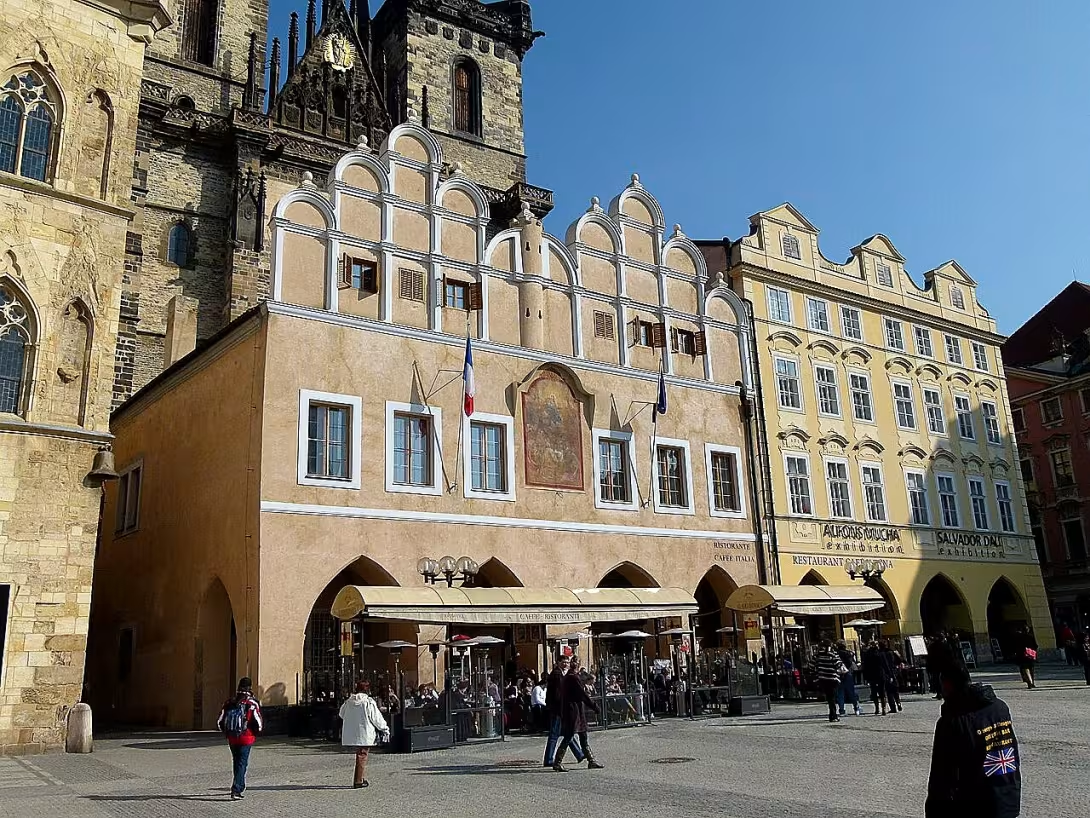
Týnská škola, located on Old Town Square 14 in Prague 1, is a historical monument with a rich past. She was originally a parochial high school at the Týnské Temple and was also a residential house. Its history dates back to the 13th century, when there were cellars showing its origin. In 1394, King Václav IV transformed it into a school that worked until the first third of the 19th century.
The history of the Týn School is closely linked to the political events of that time. After 1381 there was a purkmaster who helped capture King Wenceslas IV, which led to him ordering the conversion of the house into a school in 1394. This could have been a response to political conflicts and an effort to increase control over the city. Teaching was done in Latin at the time, which was known for education and humanism.
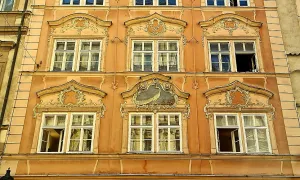
Architectural Týnská škola is a fascinating blend of medieval and Renaissance elements. The building has medieval cellars, ground floor with cross vaults and sharp arches. The reconstruction in the Renaissance style took place first around the middle of the 16th century and again around 1612. From the first stage of the reconstruction comes a symmetrical facade with tiered shields, while on the floor it is divided by windows with Renaissance edge. In the 18th century a Baroque fresco with the theme of the Assumption of the Virgin Mary was added to the facade.
The ownership and administration of the building changed its functions over the years. After the school was founded, the vacant premises were adapted to flats. In 1842, the school was moved to a former minority monastery, allowing further use of the original building.
Among the personalities associated with the Týnská school were students as builder of Matěj Rejsek and brothers Jan and Louis Granovský of Granov. Teachers included Chinese priests, including Bishop John Rokycana, and humanist Mark Bydjovský of Florentine.
Today Týnská škola is an important part of the cultural heritage of Prague. Its architecture and history attract many visitors who are interested in the past of the city. Although the school no longer works in its original role, its importance as a monument is undeniable.
Týnská škola presents an interesting chapter of Czech history and architecture. Its rich past and unique construction make it an important monument worth visiting. By exploring its rooms and architectural details, we can better understand the history and culture of Prague.
Historical milestones
- 1359
- The first preserved written mention of the house.
- 1394
- Establishment of the school by King Wenceslas IV.
- 1842
- Moving school from a building to the Old Town Square to a former monastery of minorities.
Architectural development
The building has medieval cellars and ground floor with cross vaults and sharp arches. It was rebuilt in the Renaissance style in the middle of the 16th century and again around 1612, while gaining symmetrical tiered shields. In the 18th century a Baroque fresco with the theme of the Assumption of the Virgin Mary was added to the facade.
Historical events
In 1394, King Václav founded the IV School; In 1842, the school was moved to a former minority monastery at St. Jacob's Church.
Owners
After 1381 there was a purkmaster living in the house, followed by the building being used as a school.
Points of interest
- Týnská škola is located in Old Town Square 14 in Prague 1 and is a historical monument with a rich past. - Originally served as a parish high school at the Týnské Temple and was also a residential house, its history dates back to the 13th century. - After 1381 there was a purkmaster who helped capture King Wenceslas IV, which led to him ordering the conversion of the house into a school in 1394. - Architecturally Týnská škola is a fascinating blend of medieval and Renaissance elements, with a symmetrical facade from the first stage of reconstruction in the Renaissance style. - Among the personalities associated with the Týnská school were students as builder of Matěj Rejsek and brothers Jan and Louis Granovský of Granov.
Guide
Show guide text
This text was created by artificial intelligence and has not been editorially reviewed. It may contain inaccuracies.
Welcome to the heart of old Prague. You're standing right in one of the most important places in the city, in the Old Town Square, and right in front of your eyes is a building that carries an enormous number of ages. Týnská škola. At first glance, you may think it's just another historical house in a row, but trust me, if you stop and listen to what this place wants to tell us, you'll see a lot more. Feel the atmosphere, the movement of people around you, the noise of the city, and try to return for a moment to the time when the history of the whole country was written here.
Let's look together at how this house actually came into being. Its roots are not shallow, they extend deep into the 13th century. This is the time when Prague has only just formed into what we know today. If today you could descend deep under the tile and beneath the very foundation of this building, you would encounter the original medieval cellars. They are still preserved and are a silent, immobile witness of the oldest years. In the year thirteen-fifty-nine, this house was written in the first preserved report, which tells us how long people lived and worked here.
But now pay attention to a crucial turning point. Imagine the year thirteen hundred and ninety-four. At that time, King Wenceslas's great power was fourth. This monarch decided that this house would not only serve as an ordinary living place, but that there would be a school. She became a parochial high school that was closely linked to the nearby Týnský Temple. This change defined the fate of the building for several centuries. The school worked here as a centre of knowledge and education, at a time when the world around it began to change very quickly.
Now, if you look at the construction itself, try to see how the present history lives in it. This architecture is not a one-time piece, it is rather a layered book. You can see here a combination of different styles that are going into each other. The foundations are the oldest, medieval, firm and firm. But if you look at the higher parts and how the building operates in its entirety, you will see traces of Renaissance reconstructions that took place in the 16th and 17th centuries. It is a fascinating view of how people in different epoch took old buildings and adapted them to their times, their beauty and their needs.
And what happened in these premises? Imagine the voices, the debates and the young people trying to understand the world. One of the most important elements of this school was language. No, it wasn't Czech as we know it today. These rooms were taught in Latin. Latin was the language of the scholars, the language of the church, and the language of science. And you know what the weirdest part is? This tradition of learning in the Latin language lasted incredibly long here until the first third of the nineteenth century. Imagine the constant presence of old words and Latin sentences that have been echoing through the corridors of this building for hundreds of years.
In this school or in its immediate surroundings, people whose names are still arousing. They were people who formed the minds of their times. Here we can remember Jan Rokycan, a great personality that has had a huge influence on both religious and political events. Names like Matěj Rejsek or Marek Bydžovský z Florentina appear in the history of this place. Let us not forget the family of Granovsky, namely John and Louis, who were part of this living environment. Each of these names represents a different chapter, a different story that took place right here in these walls.
Now I want to take you to something that may not be so obvious at first glance, but it's very interesting. This building wasn't just a school. It was also a place to live. It was a residential building where people were looking for their home and safety. For example, after the year thirteen hundred and eighty one even lived here. Imagine the power that was in these rooms. The Purkmaster, the man who decided on things important to the whole city, had his home right here, in the heart of old Prague, close to the school and temple. This gives this place a completely different dimension, not just a place of study, but a place of real, everyday life.
Over time, however, the city's needs have changed. The school, which was so important here, had to leave in '18, 42. She moved to a former minority monastery, closing down one of the longest and most important chapters in the history of this house. Since then, the building has never returned to its original purpose, but it still stands here and reminds us of its great past.
Now, if you look at her facade and perceive the overall atmosphere, try to realize how resistant this building is. The king, the purkmasters, the changes in religion, and the whole new ways of life. It is a monument that is not just a dead object, but a living witness to everything our city has been through.
Thank you for stopping by and paying attention to Týnsky School. We hope that this view of her hidden history has helped you better understand what you see before you. Prague is filled with places that are waiting to be discovered. So continue with your passage through the city, look up at the facades, look into the details, and let yourself be carried away by stories that are still hidden here. We wish you a wonderful journey and other interesting discoveries. Goodbye.
Tips for visitors
A tour of the Týnská School in Old Town in Prague is best planned for early morning hours, with the least people flowing in the surrounding streets and the historic atmosphere of the place best stands out. You can admire the exterior of the building in peace, the foundation of which dates back to the 13th century.
The location is located in the historic centre of the metropolis where it is best to take a walk from any nearby metro station or tram. Car entry to this pedestrian zone is severely restricted, so we recommend using public transport and checking the current connection in a common connection search engine.
Take your comfortable shoes for a walk on uneven historic tiles, a camera to capture gothic details and a headgear in case of sunny weather. A small bottle of drinking water will also be useful in the summer months.
For the best pictures of the Týnská School and the adjacent temple, use the morning side light to beautifully draw the ancient facade and texture of the masonry. A great general view is offered directly from the open area of the Old Town Square.
In the immediate vicinity within 30 minutes walk you can visit the wonderful Church of the Virgin Mary in front of Tyn, which forms an historical whole with this school, and of course the entire famous Old Town Square with its many sights suitable even for curious children.
Businesses nearby
Do you run a restaurant, accommodation, shop, museum, rental, wellness or other visitor service near this monument? Show yourself directly to the people heading to it — this is how they will see you in the app and on the web:
Events nearby

Zdroj akcí: otevřená data měst a obcí ČR (Národní katalog otevřených dat) a kalendář akcí Národního památkového ústavu.
Nearby
Kostel Panny Marie před Týnem, Staroměstské náměstí.
Accommodation nearby
Trips and activities nearby
Guided tours, tickets and activities nearby from GetYourGuide
Affiliate link: if you buy from the partner, we may receive a commission. The price for you does not change.
Search tours and activities →Themed route
1. Old Town Square Type: Public spaces Why is it worth a visit: This historic area consists of the heart of the whole site and offers a unique view of the ancient building. The walk through this centre represents the ideal beginning of the whole journey.
2. Church of the Virgin Mary before Tyn Type: Sacral construction Why is it worth a visit: The impressive temple with a pair of high towers dominating the panorama of the whole area attracts the admiration of Gothic architecture. Its richly decorated interior hides precious works of art near our main destination.
3.Týnská škola Type: Historical building Why it is worth a visit: This important monument located in close proximity to the temple captures its picturesque historical facade and interesting past. The building forms an integral part of the ancient nature of the whole area.
Seasonal recommendations
Spring: In the spring period Týnská škola will turn into a room, lit by sunlight, which penetrates through windows and decorates architecture. Flowers begin to bloom around the monument, which adds colour and durability to the atmosphere. At this time the weather can be variable, so we recommend wearing layered clothes to adapt to both warm and cold moments. Spring is also a period of increase of tourist visitors, so we recommend visiting a monument in the early afternoon when crowds are less intense.
Summer: Summer brings long sunny days and warm weather, which makes visiting the Týnská School an ideal way to enjoy the outdoor environment of Prague. The sun illuminates the interior with its long rays and creates attractive shadows in the old rooms. At this time it is best to visit the memory quickly in the morning because temperatures are rising and crowds of tourists are large in the main season of the summer season. Do not forget the protective sunglasses and enough drinking to enjoy a visit.
Autumn: In autumn, Týnská škola becomes a place with melancholy atmosphere when the leaves fall and shine in fine colours. Sun rays are shorter, which creates a quiet and quiet environment suitable for a moment of rest from peak temperatures. The weather can be variable, so it is advisable to prepare for the possibility of rain or wind. At this time the crowds of visitors are usually smaller and you can enjoy a quieter tour, so there is no need to push into the first rows.
Winter: Winter moons bring cold weather and shorter days, creating a specific atmosphere around the Týnská school. The sun's rays become even rarer, but when they shine, they light the interior in a fascinating way. At this time it is important to wear warm clothes and durable shoes because the corridor can be sticky or snowy. The opening hours of the monument may be shortened, so it is advisable to visit it in the early afternoon and enjoy a quiet tour without overloading.
Visualizations and artistic views

The visualisations are generated by artificial intelligence and serve as inspiration.
Photos from the area
Real photos taken near the monument


Zdroj a licence jsou uvedeny u každého snímku.
Tips from visitors
No tips yet. Be the first!
Log in and add your tip.
Sources and literature
Photos: Imani / CC BY-SA 3.0 — Wikimedia Commons. The author and licence also appear when you hover over the image.
Faktickým podkladem tohoto textu byl článek na Wikipedii, jehož autory jsou přispěvatelé Wikipedie. Článek je dostupný pod licencí CC BY-SA 4.0.
Location on the map
Příběhy a pověsti
Legendy, pověsti a příběhy spjaté s touto památkou
Fotografie návštěvníků
Zatím žádné fotografie. Buďte první, kdo přidá fotografii z návštěvy!
Log in a přidejte svou fotografii nebo hodnoťte.
Za ověřenou návštěvu v aplikaci získáte víc bodů — poznáme podle GPS, že jste na místě.
Reviews and comments