






větrný mlýn (Donín) Windmill
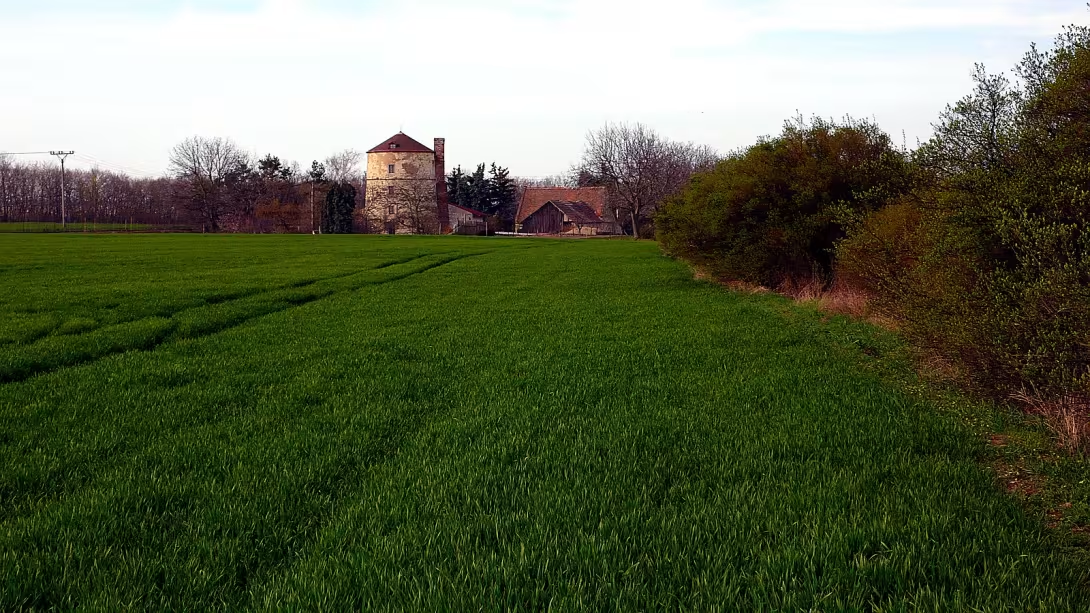
The Dutch-type windmill in the part of Donín the municipality Toužetín in the Louny district is a registered cultural monument of the Czech Republic. This four-storey building from the middle of the 19th century is remarkable by its shape of a chamber cone and the history of technological change of drive.
The mill stands on the hill at an altitude of 370 meters at the site of the original leech quarry. At the date of its creation, there are two sources: the municipal chronicle states the year 1846 and the builder Rudolf Nitku, while the Journal of Czech tourists from 1928 presents the year 1851 and Josef Nitku. The project of the building was developed by the Lounian city architect Emilián Chládek.
It is a plastered brick structure on a circular plan in the shape of a chamber cone. The building is 15 metres high with a diameter of 9.5 metres and has a basement with foundations of 4 metres deep. The construction used sandstone, quarry stone and opka. The thickness of the walls falls from 1.3 meters in the heel to 80 centimeters at the top, where the walls are divided by the ledge. The building ends with a conical roof, now covered by Canadian shingles. There is a square brick chimney between the main building and the adjacent one-storey building with a valence vault.
The wind drive stopped serving in 1879 after the storm broke the wind wheel. The mill was subsequently converted into a steam engine. The building was hit by fires in 1894 and 1898; After the second, the steam engine was dismantled and sold. Between 1928 and 1940, the mill used electric power and served as a granary and warehouse. In 1940, the electric motor was dismantled and sold.
In 1960 the mill was reconstructed and rebuilt for residential purposes. Thanks to its architectural value and history, it is today protected as a cultural monument.
The construction represents a rare example of the transformation of technological equipment into residential space. It is an interesting goal for all those interested in industrial architecture and local history of the Lounian region.
Historical milestones
- 1846
- Estimated year of construction according to municipal chronicles (Rudolf Nitka).
- 1851
- Estimated year of construction according to the Journal of Czech tourists (Josef Nitka).
- 1879
- The storm broke the wind wheel, the mill was converted into steam engine.
- 1894
- The mill fire.
- 1898
- Second fire and dismantling of steam engine.
- 1928
- The beginning of electric propulsion.
- 1940
- Electrical engine dismantling.
- 1960
- Reconstruction of the mill for living.
Architectural development
The building is four-storey, underlaid and has a circular plan in the shape of a chamber cone. A quarry stone, sandstone and opaka were used for its construction. During history, reconstructions took place from wind to steam and then on electric power.
Historical events
1879: The whirlwind broke the wind wheel and the mill was converted into steam engine. 1894: Fire mill. 1898: Second fire and dismantling of steam engine. 1960: Reconstruction of the mill for housing.
Points of interest
- The windmill is a registered cultural monument of the Czech Republic.
- The mill is standing on a hill at an altitude of 370 meters, where the original opal quarry was.
- There are two different sources regarding the date of its creation: 1846 according to the municipal chronicle and 1851 according to the Journal of Czech tourists.
- The project of the building was developed by the Lounian city architect Emilián Chládek.
- The wind drive stopped serving in 1879 after the storm broke the wind wheel.
Guide
Show guide text
This text was created by artificial intelligence and has not been editorially reviewed. It may contain inaccuracies.
Welcome to the village Toužetín, specifically in its part of Donín. You stand on a hill at an altitude of three hundred seventy meters and one of the most prominent local dominant stands before you. Take a look at this structure that rises from the landscape like a massive, walled organism. It's a Dutch-type windmill, a four-storey building on a circular plan, shaped like a chamber cone. Its total height is 15 meters, which gives it an impressive and firm character, as the building that has faced the forces of nature for centuries deserves. This monument is registered as a cultural monument of the Czech Republic and its presence here is not random. It stands at a place where mining operations once took place, specifically on the remains of the original quarry on the spur. It is this geological mat that has enabled the construction of such a massive structure, which has been preserved in relatively good condition to date.
Let's move forward in time and think about who and why had this building built. The history of this mill is not entirely clear, which gives it a certain hint of mystery. There are two main sources indicating the different years of its creation. The municipal chronicle, which is based on records linked to Rudolf Nitka, is supposed to be 1846. On the other hand, Czech Tourist Magazine, which refers to Josef Nitku, presents the year 1851. This contradiction in data is typical of many historical buildings in this region, where written records often differ. Regardless of the exact year of construction, the project was developed by the Lounian city builder Emilián Chládek. His name is associated with an architectural intention, which was intended to serve practical purposes, but at the same time he should have stood in the test of time and weather. The mill was built at a time when agricultural production in the region developed intensively and the need for grain milk grew. The Dutch type of mill was a modern solution at the time, which enabled the efficient use of wind energy.
Now pay attention to the architectural details that are right in front of your eyes. Notice the wall structure that forms the body of the mill. This building is not only about the external appearance, but also about the technological development that took place in its walls. Originally, the mill was equipped with a wind wheel that was driven by wind. However, this system has not always been reliable. In 1879, a tragedy happened when the storm broke the wind wheel. This incident meant the end of an era of purely wind propulsion for this particular construction. The mill was then converted into a steam engine, which was a great technological leap at the time. The steam engine allowed the mill to operate independently of weather and wind, which was a huge advantage for the provosters. However, the steam season was not without problems. In 1894 there was a fire mill which caused considerable damage. And that wasn't all. In 1898 a second fire broke out, which was so severe that it led to the dismantling of a steam engine. These events show how fragile the existence of such industrial structures in the past was, where there was a constant risk of fire and mechanical disturbances.
After losing steam engine, the mill had to be redesigned to continue its function. Until 1928, when the electric drive started to be used. This shift to electricity meant further modernisation and extension of the life of this building. The electric drive was more reliable and easier to maintain than previous systems. The mill thus survived several technological revolutions. From wind to steam to electricity. Each of these editions left traces in the history of the building. Today, when you look at her, you can imagine how these changes took place in her walls. How the equipment changed, how they adapted to the new machines. The mill was not only a milk machine, but also a place of life and work for many generations.
The interesting thing that can work out is the year of construction dispute. Why are there two different sources? It is a consequence that historical records from the 19th century often differ in detail. The municipal chronicles and specialist magazines could draw from various primary sources that do not match. This detail shows how important a critical analysis of historical sources is. The truth is not always black and white and unambiguous. Sometimes we have to accept uncertainty and acknowledge that history has more layers. Another interesting fact is that the mill stands at the site of the former quarry. This means that beneath its foundations there are layers of rock that were once extracted. This geological past also affected the construction of the building itself, which had to be stabilised on this specific terrain.
The mill was renovated in 1960, which was intended to turn it into a residential house. This change in function was crucial. The mill stopped being an industrial building and became a home for the family. This reconstruction preserved the original structure but adapted it to modern housing needs. Today, when you look at the mill, you see a building that served many purposes. It was a machine, it was a house, and it's a cultural monument. His existence reminds us of how the role of construction in our lives changed. The workplaces have become objects that we protect and admire for their historical and architectural value.
Persons associated with this place, such as Rudolf Nitka and Josef Nitka, play an important role in its history. Their names are given in relation to the construction date, indicating that they may have been involved in its creation or operation. Without their contribution, this building could wait for another fate. Historical personalities are often the key to understanding the context in which the buildings were created. Their decisions and actions affected not only the mill itself, but also the wider community that lived around it.
In conclusion, I would like to tell you that this wind mill in Donín is more than just a brick building. He's a witness to history, technology, and human endeavor. His story is full of twists, from the winds and fires to technological innovation and reconstruction. You're standing on a hill where the layers of time intersect. Underneath you is an opus quarry, ahead is a mill that survived the century. Look at his facade, see the atmosphere of the place, and think about how the life of people who had something to do with this construction was changing. The mill offers you the opportunity to stop and think about the past that surrounds us. It's a place where history isn't just in books, but it's visible and tangible. I hope this audio guide helped you better understand the importance of this monument. Look around, enjoy the silence of the hill and let your mouse escape
Tips for visitors
For the best visual experience we recommend a visit during the late afternoon, when sunlight highlights the unique shape of the chamber cone and the walled structure of the mill. The quieter atmosphere offers a visit outside the main season.
Traffic to the monument is possible by car and public transport. Parking in the village Toužetín is possible, but for current options we recommend to follow local signs. Check the exact connection of means of transport in internet search engines.
For a comfortable trip remember to take with you enough drinking water and clothes suitable for outdoor conditions. We also recommend to carry comfortable shoes.
For families with children, the surroundings are suitable for free movement in nature and for exploring the surrounding terrain. It's an ideal target for a short family trip.
When shooting, focus on angles that capture the entire height of the four-storey structure. In the nearby area you can visit the quarry on the optics, which represents an interesting contrast to historical construction.
Businesses nearby
Do you run a restaurant, accommodation, shop, museum, rental, wellness or other visitor service near this monument? Show yourself directly to the people heading to it — this is how they will see you in the app and on the web:
Nearby
Lom on the opus nearby.
Accommodation nearby
Themed route
1. Wind Mill (Donín) (courtyard) Type: Area A place for first familiarization with the monument and a view of the overall construction.
2. Wind Mill (Donín) (Tower) Type: Architectural element Possibility to look into the design of the mill and observe the surrounding landscape.
3. Wind Mill (Donín) (Exposure) Type: Technical equipment A tour of the internal mechanisms used to grind.
4. Lom on the Opposite Type: Natural location A short walk to the quarry nearby for the knowledge of local geology.
Seasonal recommendations
Spring: During the spring season, the wind mill in Donín offers unique experiences where nature awakens from its winter sleep. The forests around the monument begin to bloom and the surrounding countryside calls for beautiful walks. Sunshine days are ideal for visiting when the mill lights up with spring sun and the trees start to green. When planning a trip, it is advisable to come to the place already in the afternoon to enjoy warm sunlight without heat and stress from transport. Thanks to the weaker return of tourists, it is a good time to explore the sights more calmly.
Summer: Summer brings full sun and warm days that increase the attractiveness of the wind mill in Donín. Surrounded forests offer shade comfort before heat and are an ideal place to relax on outdoor platforms. In the main summer season, it is recommended to come earlier to avoid the peak of crowds. Don't forget to wear sun protection and plenty of drinking water. Summer also offers a beautiful background for photos of the mill when surrounded by flowering bushes and trees.
Autumn: Autumn visit to the wind mill in Donín offers a completely different atmosphere. The woods around the monument are colored in pink, yellow and orange shades, creating unforgettable landscapes. The sunny days are ideal for walking along the paths around the monument. Due to the smaller return of tourists, it is a good time to explore the mill more calmly. Early arrival can also be useful because autumn day is shortening and later begins to shadow.
Winter: Winter visit to the windmill offers a unique atmosphere. When the forests are liberated from the leaves, it is possible to see the structure of the monument and its location in the landscape quite differently. Sunshine days may be a beautiful opportunity to visit, but you need to remember shorter opening times and warm clothes. In winter weather may be irregular, so it is advisable to prepare for the possibility of snow or rain. At the same time, winter offers a quieter environment without large crowds of tourists and thus a better atmosphere to explore the sights.
Visualizations and artistic views

The visualisations are generated by artificial intelligence and serve as inspiration.
Photos from the area
Real photos taken near the monument

Zdroj a licence jsou uvedeny u každého snímku.
Tips from visitors
No tips yet. Be the first!
Log in and add your tip.
Sources and literature
Fotografie: Gortyna / CC BY-SA 3.0 — Wikimedia Commons. The author and licence also appear when you hover over the image.
Faktickým podkladem tohoto textu byl článek na Wikipedii, jehož autory jsou přispěvatelé Wikipedie. Článek je dostupný pod licencí CC BY-SA 4.0.
Location on the map
Příběhy a pověsti
Legendy, pověsti a příběhy spjaté s touto památkou
Fotografie návštěvníků
Zatím žádné fotografie. Buďte první, kdo přidá fotografii z návštěvy!
Přihlaste se a přidejte svou fotografii nebo hodnoťte.
Za ověřenou návštěvu v aplikaci získáte víc bodů — poznáme podle GPS, že jste na místě.
Reviews and comments