



vila Antona Münzberga Villa
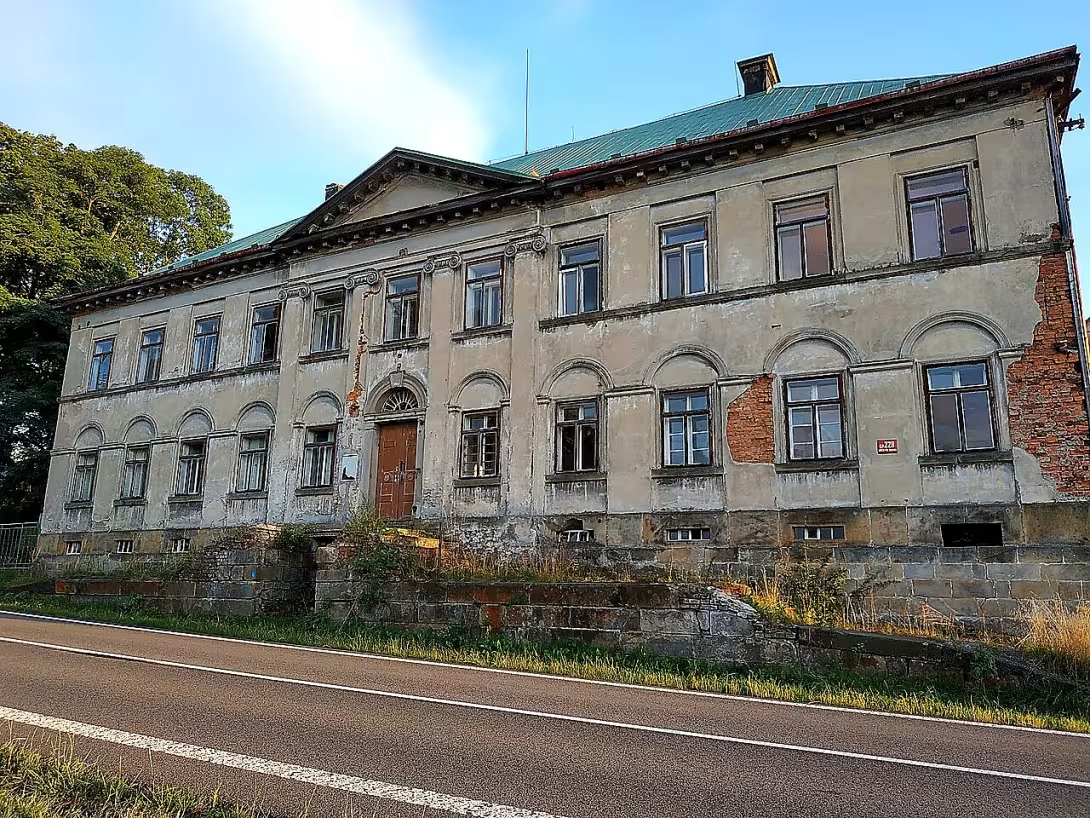
Villa Anton Münzberg in Jiřetín pod Jedlová (Děčín district) is a historical proof of the way of life and business in the Czech countries of the 19th century. The area includes residential and production buildings with adjacent garden. It is part of the Protected Landscape Region of Lusatian Mountains and has been protected as a cultural monument since 2018. Anton Münzberg built a villa in 1820 as part of a larger industrial complex with textile manufacturing.
The history of Jiřetín under Jedlová is closely linked to the development of the textile industry. At the turn of the 18th and 19th centuries, this sector grew significantly, which was supported by a patent from 1786 allowing cotton to be imported. Thanks to this, Jiřetín started to prosper in textile production. Anton Münzberg, founder of the factory and owner of the villa, built the first production building in 1816 and built its private residence in 1820. Other workshops were created in 1835 and in the second half of the 19th century, which shows the gradual development of the complex.
The villa is performed in a classical style with symmetrical facades and shallow risalite. The building has a valb roof, two tracts and was originally supplemented with courtyard wings. The interior retains a number of original details, such as the begging of ceilings, the printed window frames and ceramic tiles in some rooms. The garden that once had a park design with a swimming pool is now merely a remnant of the original arrangement.
Owning and managing the factory has changed over time. After Anton Münzberg's death, his sons founded the company Anton Münzberg's Söhne, which specialized in the production of coloured and printed materials. In the 1980s the company bought Peregrin Worm. His descendants led the factory until the beginning of World War II when textile production ended. After the war there were components for aircraft.
The key personality associated with the monument is Marie Münzberg, the daughter of the founder who married Johann Liebig. This marriage has contributed to the development of textiles beyond Jiřetín. An important milestone was the mechanisation of production after the abolition of the import duty on machinery in 1857, which enabled the factory to modernize.
Today the premises are privately owned and remain empty. Although buildings are unusable, their historical value and architectural elements from the complex make it an interesting destination for visitors. The Villa Anton Münzberg resembles the time of the flowering of Jiřetín thanks to the textile industry and its historical values are an important testament to the history of the region. Visiting this place allows you to explore the rich past and understand the development of industrial life in the Czech countries of the 19th century.
Historical milestones
- 1816
- Position of the first production building No I.
- 1820
- Construction of the Villa Anton Münzberg.
Architectural development
The industrial complex began to be developed in the late 18th century with a cotton factory and bleach based by Anton May. Anton Münzberg gradually built large factory buildings, including a villa in 1820. Another production building No II was built in 1835 and the third production building in the second half of the 19th century.
Historical events
- 1806
- Anton Münzberg bought land for future industrial premises.
- 1816
- Position of the first production building No I.
- 1820
- Construction of the Villa Anton Münzberg.
Owners
Anton Münzberg (beginning of the 19th century), Anton Münzberg's Söhne, Peregrin Worm (1980s of the 19th century), sons of Peregrin and Josef Worm, grandson of Peregrin Rudolf Worm.
Points of interest
- Villa Anton Münzberg is part of the Protected Landscape Region of Lusatian Mountains and since 2018 it has been protected as a cultural monument. - Anton Münzberg built a villa in 1820 as part of a larger industrial complex with textile manufacturing. - The villa is shown in a classical style with symmetrical facades and shallow risalite, has a valb roof and two tracts. - The interior retains original details such as begging ceilings and ceramic tiles in some rooms. - Marie Münzberg, the founder's daughter, married Johann Liebig, which contributed to the development of textiles outside Jiřetín.
Guide
Show guide text
This text was created by artificial intelligence and has not been editorially reviewed. It may contain inaccuracies.
Welcome to Jiřetín under Jedlová. Right now, standing in front of this impressive building, stop for a moment and feel the atmosphere. You are in the heart of the Protected Landscape Area of Lusatian Mountains, where history combines itself with beautiful, peaceful nature. The vila Antona Münzberga stands before your milestones, which in itself acts as a silent witness of ancient times. Feel the harmony between human work and surrounding landscape paradise. This building is not just an ordinary house, it's part of something much bigger that once formed the artery of this place.
Let us now return together in time and understand why this villa stands here. To understand its meaning, we need to look at the nineteenth century period. This was the time of huge changes when traditional production methods began to turn into modern industrial business. This villa was not only built as a private residence, but was deliberately incorporated into a larger building. This whole complex was once part of a large industrial complex, namely textile manufacturing. Imagine the excitement, the constant movement of people and machines that existed here in the past. The whole process of building this place was gradual. Already in 1816 the first production building was built here, which laid the foundations for the future flourishing of the whole complex. Four years later, in 1820, Anton Münzberg built this very villa to serve as its seat and symbol of its success. The villa thus represents an important proof of how the then Czech countries lived and how business took place at the time of the starting industry.
Now pay attention to the construction itself and to what you see right in front of you. Although we do not know the name of the particular architect who designed this project, his vision is clearly legible in every detail. The villa is performed in a classical style. This style is characterized by the pursuit of peace, order and harmony. Notice the symmetry that dominates the facade of the building. This balance of lines and shapes is meant to create a sense of stability and dignity. When you look at a building, you have no sense of chaos, but rather of order that corresponds to the ideal of beauty and reason at the time. See how the building floats in this space, how its shapes match the surrounding greenery, and how its presence dominates the surrounding buildings without being foreign. It's an architecture that's supposed to last and that's supposed to express the status of its owner.
Behind this facade are the stories of the people who shaped this place. The main character is undoubtedly Anton Münzberg. He was a man of the time, a visionary who could link the need for production to the need for a beautiful and comfortable living. His decision to build a villa right on the premises of the factory shows a close link between the life of the entrepreneur and his work. There are other names like May Anton or Peregrin Worm in the history of this place. Even though their specific lives within this area are less described, their existence reminds us that this villa was not just an empty box, but a home and workplace of living people who built their fates here and built the wealth of the region.
You might find one interesting thing that gives this place meaning in modern times. Although this villa has survived centuries and has undergone many changes, its value has recently been officially recognised. Since 2018, this building has been protected as a cultural monument. This means that its historical appearance and its importance to our history are now protected so that it can remain visible to future generations. It is proof that even such a specific place, which once served industry, has an enormous cultural and aesthetic value for us today.
But now I will no longer hold you back in your discovery. I suggest you continue your tour and pay attention to the adjacent garden and other buildings that make up this historical whole. Feel how the view of the villa changes depending on where you are, and try to reconstruct the faces of the people who moved here 200 years ago. Thank you for choosing to visit this story. We wish you a nice walk through the history and nature of the Lusatian Mountains. Goodbye.
Tips for visitors
The best time to visit Anton Münzberg's villa is autumn or spring, when vegetables are the most beautiful around and the light is ideal for photography. These seasons also offer lighter weather, making it easier to walk around the premises.
You can use cars or public transport to access the trip.
When visiting, remember clothes suitable for outdoor activities such as shoes that protect against wet surfaces. Photographers should have a camera and maybe some filters to capture the best vegetable colours in the area.
Take pictures especially in the morning or in the evening when the light is softer and more shadows. The best places for photos are the west side of the building, where the sun hides behind the horizon, creating beautiful colors.
There is a possibility to visit the Protected Landscape Region of Lusatian Mountains. This location offers beautiful walks and views of the natural landscape, which can be especially interesting for families with children.
Frequently asked questions
Can the monument be visited?
This is a residential or farm building, not a museum with opening hours. Please view it from public space and respect the owners' privacy. We have no information about access to the interior.
Where is the monument?
Location: Jiřetín pod Jedlovou. The map on this page shows the exact spot.
Why is the monument protected?
It is listed in the Central List of Cultural Monuments of the Czech Republic as a cultural monument (register no. 1999993258).
Businesses nearby
Do you run a restaurant, accommodation, shop, museum, rental, wellness or other visitor service near this monument? Show yourself directly to the people heading to it — this is how they will see you in the app and on the web:
Nearby
Areál se nachází v Chráněné krajinné oblasti Lužické hory, s severní hranicí vymezenou silnicí II. třídy č. 264 (Děčínská ulice).
Accommodation nearby
Themed route
Villa Anton Münzberg Type: Monumental protected building Why is it worth visiting: This villa represents a rare example of the architectural style of the turn of the century in the region. Its historical context and artistic value make this building a key point for the whole trip.
Protected landscape area Lusatian Mountains Type: Natural reservation and landscape area Why is it worth a visit: The villa area is located right in this protected zone, which offers an exceptional natural landscape. The walk here allows to admire the specific flora and fauna of this mountain range.
Class II road No 264 Type: Transport artery and perimeter boundary Why is it worth a visit: This road forms the northern border of the territory and serves as an orientation point for visitors. Its location helps to better understand the definition and structure of the surrounding area.
Children's street Type: Local communication Why is it worth a visit: It is a specific section of the road that defines the northern edge of the selected location. Walk this street allows you to smooth between the points of the route near the monument.
This route is designed to respect the limited range of information available on the surrounding area. The main focus is the villa itself and its immediate definition within the protected landscape area. The visitor focuses on architectural details of the building and the natural environment surrounding it. The northern border of the territory is clearly defined by road, which simplifies orientation. The whole trip takes place in a quiet environment where it dominates the connection of cultural heritage with the nature of the Lusatian Mountains. No further distant targets are included to maintain authenticity and accuracy of the description according to the specification.
Seasonal recommendations
In spring, the villa of September accompanied by awakening nature and fresh green. The soft spring light gently accentuates the facade details and the surrounding landscape is fresh. We recommend to dress more layers of clothing because the weather in this mountain area is usually variable. The best time to walk around the building is in the morning when the air is the cleanest.
The summer season brings rich colors of dense vegetation and bright sun, which fully illuminates the building. The atmosphere is warm and vibrant. In the main summer season there are more people around, therefore it is advisable to choose the time early in the morning or late in the afternoon. Don't forget light summer clothes and sun protection.
In autumn, the surroundings of the villa turn into gold and red tones, creating a melancholy and calm mood. Fog in the valley gives the place mystery and special depth. Wet shoes and a warm jacket are ideal for visiting. You can find the best light to observe the exterior during late afternoon hours.
In winter the construction works very monumentally, especially if it is covered by snow. The contrast of the white landscape and the tones of the building creates a strict but beautiful aesthetics in the silence of winter sleep. It is necessary to wear warm functional clothes and anti-slip shoes. Due to the short days we recommend a visit in the morning.
Visualizations and artistic views

The visualisations are generated by artificial intelligence and serve as inspiration.
Photos from the area
Real photos taken near the monument

Zdroj a licence jsou uvedeny u každého snímku.
Tips from visitors
No tips yet. Be the first!
Log in and add your tip.
Sources and literature
Photos: Itsd-foto / CC BY-SA 4.0 — Wikimedia Commons. The author and licence also appear when you hover over the image.
Faktickým podkladem tohoto textu byl článek na Wikipedii, jehož autory jsou přispěvatelé Wikipedie. Článek je dostupný pod licencí CC BY-SA 4.0.
Location on the map
More monuments – Jiřetín pod Jedlovou
Show all in the municipality
Příběhy a pověsti
Legendy, pověsti a příběhy spjaté s touto památkou
Fotografie návštěvníků
Zatím žádné fotografie. Buďte první, kdo přidá fotografii z návštěvy!
Log in a přidejte svou fotografii nebo hodnoťte.
Za ověřenou návštěvu v aplikaci získáte víc bodů — poznáme podle GPS, že jste na místě.
Reviews and comments