



Vila čp. 93 Villa
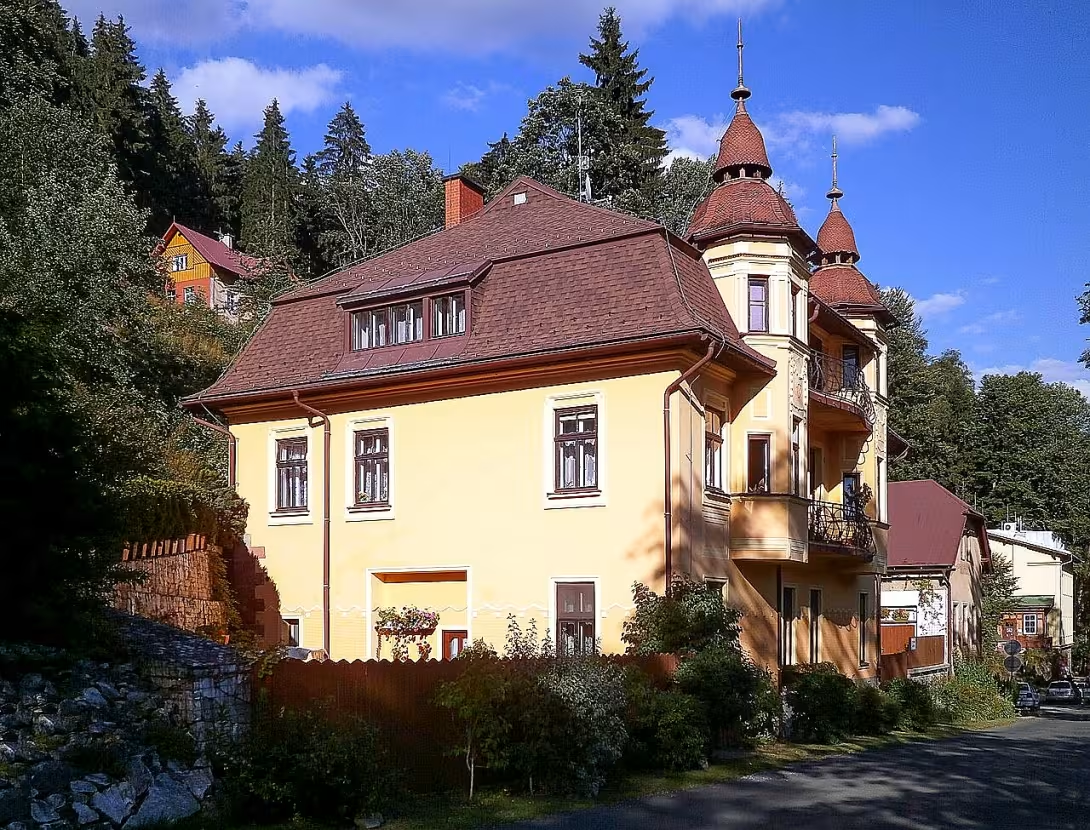
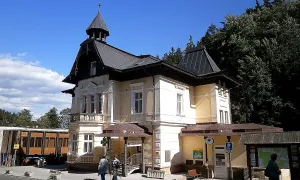
Vila čp. 93, formerly known as the Hercynia Villa, is a Art Nouveau building built in 1908 in Janské Lázně. This object is remarkable with its architectural value and historical significance, to which both its location on the edge of the city and its rich ornamental elements contribute. It was originally a spa house, but later became a private family house. Since 2003 it has been protected as a cultural monument and in 2007 it underwent renovation with the restoration of the Art Nouveau facade.
The establishment of Villa No. 93 was related to the development of an Art Nouveau which took place in Central Europe in the early 20th century. This architectural style was characteristic of its innovation and aesthetic details, which is also evident in this building. The villa was built by Wenzel Tippelt, owner of the boatyard, who decided to invest in the spa house at a time when Janské Lázně experienced development and popularity as a health centre.
Architecturally, the villa is an example of an Art Nouveau with the use of a wall structure and a Mansard roof. The facade is richly decorated with ornaments such as friezes, shambrans and garlands, which give the building a characteristic appearance of this era. Special attention should be paid to hand-made waves on the façade, made by a special formation into a moist rough plaster according to the pattern preserved on the adjacent economic building. The two-storey wooden shed, adjacent to the main house, gives the complex an architectural interest.
Key events include the position of the villa in 1908, its classification as a cultural monument in 2003 and the renovation in 2007. The monogram WT on the left bay of the front facade resembles the builder Wenzel Tippelt, which is another interesting part of the building.
Today the villa is available for visit and is worth visiting thanks to its historical value and architectural details. Its preservation and renovation ensure that it can continue to be appreciated as an important example of Art Nouveau in Central Europe.
Vila čp. 93 is not only a monument to architecture, but also a witness to historical changes and cultural development of Janské Lázně. Its visit offers a view of the past and recalls the importance of Art Nouveau as an architectural style that shaped many buildings in Central Europe in the early 20th century.
Historical milestones
- 1908
- The status of the villas.
- 2003
- Classification as a cultural monument.
- 2007
- Renovation with the restoration of the Art Nouveau facade.
Architectural development
The villa was built in Art Nouveau style using a wall construction and a mansard roof. The facade is richly decorated with ornaments that give the building a characteristic look of this architectural era.
Historical events
- 1908
- The villa was built.
- 2003
- Classification as a cultural monument.
- 2007
- She went through a renovation of the Art Nouveau facade.
Owners
Originally it served as a spa house, later it became a private family house. In 2003 the building was classified as cultural monuments.
Points of interest
- Vila čp. 93 is a Art Nouveau building built in 1908. - It has been protected as a cultural monument since 2003 and underwent renovation in 2007. The builder was Wenzel Tippelt, owner of the boatyard. - The facade is richly decorated with ornaments, such as friezes, shaman and garlands. - The WT monogram on the facade resembles the builder Wenzel Tippelt.
Guide
Show guide text
This text was created by artificial intelligence and has not been editorially reviewed. It may contain inaccuracies.
Welcome to Jansky Spa. You're standing in front of one of those places that gives this city its unmistakable face and a deep historical touch. In front of your eyes is a building that is not just an ordinary house, but a real witness to the ancient era that shaped the present form of this place. It's villa number ninety-three. You may not be able to link it to her old, poetic name at first glance, but in the past, this place was called the Hercynia villa. Can you feel the strange atmosphere? The feeling that it is this view that will bring you back more than a century to the time when architecture sought perfect harmony between human work and the beauty of the outside world?
Now let's move further into time together. This building, which you are now observing so closely, was built in the year one thousand nine hundred eight. This was a fascinating year when the Art Nouveau style started to promote completely new ways of expressing beauty and elegance. The Art Nouveau, this style that you see here, does not seek to be a tree or a cold geometry, but seeks inspiration in smooth lines and rich decoration. The villa was built not only as simple living, but as an expression of a certain lifestyle, success and aesthetic feeling. Although we no longer know who was the exact author of these architectural plans, the building itself speaks a very clear and rich language. This villa has gone a long and interesting way. From its inception in the early twentieth century to the present day, it is now protected as a significant cultural monument. It is this protection that she gained in the year two thousand and three that guarantees that her unique beauty will be preserved for future generations who will admire her after you.
Now, I'd like to ask you to pay close attention to the details you have in front of you. Look at the construction of the house itself. Do you see the solid walls that form the unshakeable foundation of the building? Above them is the very characteristic Mansard roof. This type of roof is absolutely typical of the given epa and gives the building its specific, noble and somewhat mysterious look. But the greatest mystery and true beauty, however, is hidden in the decorative elements that decorate the facade. Pay attention to these details that flow through the walls. Try to focus your eyesight on those fine, embossed shapes that are professionally called friezes. These outputs are not just random shapes, but they are works of art on a small scale that give the walls depth and the game of light and shadow. Then look at the ornamental frames around the windows and openings called the champagne. These elements frame each window beautifully and give the house structure. And then there are the garlands, the beautiful, smooth chains of decorative elements that are caused by the facade and give the whole house a sense of ease and constant movement. This whole visual experience is even more complemented by what is right next to the main building. There is a wooden shed directly attached to it with two floors. This wooden structure gives the complex a very interesting architectural contrast. While the main house looks noble and monumental, the shed brings a certain human, almost rural side to the overall operation of the house, which beautifully complements the rich architecture of the main villa.
So who was behind this beauty? Who decided that right here, in the heart of Janské Spa, a villa so richly decorated should be created? Even though we don't know the names of the architect, we know the man who was its owner and probably its main visionary. It was Wenzel Tippelt. If you look at it now through the optics of history, you will see a man who has successfully done his business in this area in boatshed. Imagine that time when the roads were full of horses, carriages and rhythmic clotting of hooves. Tippelt was a man who prospered at this time and wanted to mirror his success and social position in the architecture of his home. His name is inextricably linked to this place and his legacy still stands before your eyes.
And now, before you go any further on your journey, I have a little challenge that may interest you. Try looking up one small but very important detail on the facade. If you look really carefully at some parts of the decoration, you can see a monogram. These are two letters that form the abbreviation of his name: W and T. This little character is like a silent signature that the owner left to the world to remind that this place was his home and his personal vision. It's like a hidden code that connects the ancient past to today's present.
But in order to look so closely and admirably at these details today, we must realise that the building has undergone a very important renewal. In the year two thousand and seven there was extensive and careful renovation, during which the Art Nouveau facade was completely restored and returned to the original glare. Thanks to this effort, today we can look forward to the rich ornaments and clean lines that you are now observing. Without this professional work, many of these fine details could be lost or completely lost over time.
I won't keep you now. I hope this brief view of Villa Ninety Three has helped you better understand its meaning, its history and its unique beauty. Please continue your walk and let the atmosphere of the Janské Spa fully drift away. Every corner of this city can have its own hidden story, waiting to be discovered. Thank you for your attention and I wish you a beautiful and inspiring continuation on your journey.
Tips for visitors
The best time to visit Villa No. 93 is autumn or spring when vegetation is green and sunlight is ideal for photography. This period also brings lighter weather compared to winter.
You can verify the best connections using an online search engine or mobile application for traffic information.
When visiting the villa it is advisable to take the camera with you, especially if you like architectural details. Mansard roof and wall construction are the best resources for beautiful photos.
The surrounding park is suitable for families with children, where children can play and enjoy the natural environment. The park is close to the villa and offers a quiet space for relaxation.
In the vicinity of the villa no.
Frequently asked questions
Can the monument be visited?
This is a residential or farm building, not a museum with opening hours. Please view it from public space and respect the owners' privacy. We have no information about access to the interior.
Where is the monument?
Location: Janské Lázně. The map on this page shows the exact spot.
Why is the monument protected?
It is listed in the Central List of Cultural Monuments of the Czech Republic as a cultural monument (register no. 1000122722).
Businesses nearby
Do you run a restaurant, accommodation, shop, museum, rental, wellness or other visitor service near this monument? Show yourself directly to the people heading to it — this is how they will see you in the app and on the web:
Nearby
🏰 Historic sites (96)
- kaple sv. Antonína 3.1 km
- Aichelburg 4.2 km
- 1914 -18 4.3 km
- Evangelický kostel Rudník (Heřmanovy Sejfy) 4.5 km
- Vodní tvrz 5.2 km web
- sv. Jan Nepomucký 5.3 km
- Muzeum Podzemí Krkonoš 5.4 km
- Socha sv. Michaela Archanděla 5.5 km
- Horní Vlčice 5.5 km
- Břecštejn 5.9 km
- 1914 - 1918 6.3 km
- T-S 82 7.2 km
- Kašparka 7.6 km
- T-S 81b 8.0 km
- T-S 81a 8.0 km
- zámek Vlčice 8.2 km
- Muzeum Vápenka 8.4 km
- Žacléř 8.5 km
- Eliška Rejčka 8.7 km
- Dělostřelecká tvrz Stachelberg (srub T-S 73) 8.8 km web
🍽️ Restaurants and dining (241)
- Restaurace Karmela Sanssouci 0.3 km web
- Kavárna Kolonáda 0.4 km web
- Biograf 0.5 km
- Lesní dům 0.5 km
- Black Hill 0.5 km
- Rustic Coffee & Brunch 0.6 km
- Hospůdka Na Formánkách 0.6 km Sportovní 342
- Arnika 0.6 km
- Magma Bar 0.8 km
- Krakonoš 0.8 km
- U Pytlákovy Evicky 1.0 km
- Sejkora 1.1 km web
- FordBar 1.1 km
- Hladík & Žíža Janská Bouda 1.5 km
- R-Burger 1.8 km
- Měšťanský dům 2.1 km
- Lestánek 2.2 km
- V Korunách 2.2 km web
- Hoffmanovy Boudy 2.2 km
- FordBar Černá hora 3.2 km
🏨 Accommodation (304)
- Hotel Astoria 0.1 km web
- Penzion Betlém 0.1 km web
- Hotel Kotva 0.2 km web
- Pension Mariánská Výšina 0.3 km web
- Penzion Marianum 0.4 km web
- Penzion Villa 0.4 km web
- Lázeňský dům 0.5 km
- Hotel Lesní dům 0.5 km web
- Penzion Kamínek 0.5 km web
- Hotel Terra 0.6 km
- Pension Adrie 0.6 km
- Pension Valja 0.6 km
- Pension Janský potok II. 0.6 km web
- Merlin 0.6 km +420603342382 web
- Hotel Arnika 0.6 km +420 725 556 564 web
- Pension Protěž 0.7 km web
- Pension Janský potok I. 0.7 km web
- Penzion Martin 0.7 km web
- Svatý Jakub 0.8 km web
- Pension Chata Lovrana 0.8 km web
🚲 Rentals and sport (44)
- K+K Ski School 0.6 km Sportovní 324 web
- Hotelový bazén Omnia 1.1 km
- K+K HOFMANKY 2.3 km
- Lyžování - "Ski půjčovna Kos" / Ski-Verleih 4.0 km Třída Josefa II. 92
- Ski-centrum Šmejdíř 5.4 km
- Karhan sport 5.5 km
- tělocvična 6.0 km
- Ski rent SUN Ski 7.8 km
- Skate minirampa KlonDike 8.1 km Pec pod Sněžkou 139 +420 728502738 web
- Nextbike Czech Republic 8.4 km
- Monkey Park Pec pod Sněžkou 8.5 km
- Nextbike Czech Republic 9.1 km
- Sportisimo 9.1 km
- Hervis 9.8 km
- Nextbike Czech Republic 10.4 km
- Nextbike Czech Republic 10.6 km
- Nextbike Czech Republic 10.8 km
- sportovní hala 11.2 km
- Nextbike Czech Republic 11.2 km
- Nextbike Czech Republic 11.3 km
🥾 Hiking and nature (235)
- Janská hora 0.7 km
- Starostův pramen 0.9 km
- Pánský Pramen 1.4 km
- Silbersteinův plodný pramen 1.4 km
- Ludvíkův pramen 1.6 km
- Petronela 1.8 km
- Modré kameny 1.8 km
- Zlatá vyhlídka 2.0 km
- Stezka korunami stromů Krkonoše 2.1 km web
- Medvědí jeskyně 2.2 km
- Šibeniční vrch 2.4 km
- Bukový pramen 2.4 km
- Kraví vrch 2.7 km
- Skřivaní vrch 3.0 km
- Rozhledna Panorama 3.3 km
- Světlá 3.4 km
- hledisko 4.0 km
- Černá hora 4.1 km
- hledisko 4.1 km
- Bártův les 4.2 km
Accommodation nearby
Themed route
Thematic cruise route from the village Janské Lázně
1.Vila čp. 93 (villa) The main objective of our route is Vila čp. 93, a historical building built in the early 20th century. Its architectural style and rich interiors attract many visitors interested in history and design. The villa is an ideal beginning to explore cultural monuments in Janské Lazne.
2. Old spa buildings (spa) After visiting the villa we move to the Old Spa Buildings, which are an important part of the history of Janské Lazne. These buildings testify to the rich past of local health services and baths where doctors have been involved in treating various diseases using mineral springs.
3. Mineral springs (spring) The next item is a visit to Mineral Springs, which are the most important natural source of Janské Lazne. These springs were and are still a key factor for the development of the spa industry in the village, offering a unique opportunity to get acquainted with the region's mineral wealth.
4. Tree alley (park) After exploring the spa springs, we can relax in the Stromková alley, a beautiful parking area near Villa No. 93. The alley is an ideal place for relaxing and walking, offering a pleasant environment for starting or ending your trip.
5. Municipal House (historical buildings) The final part of our route will be the Municipal House, a historical building serving as an administrative centre of the city. Its architecture and location in the centre of the village represent an interesting contrast to the spa character of Janské Lazne, which concludes our journey by recognizing the diversity of local cultural heritage.
This route offers a comprehensive view of the history and culture of Janské Lazne, from the spa past to architectural monuments to natural resources.
Seasonal recommendations
Spring: In the spring season Villa No. 93 is surrounded by flowers and leaves that begin to green. The sunlight joins the building and its architectural details appear in sweet brightness. The atmosphere is full of recovery and hope, which creates a pleasant environment for visiting. It is recommended to visit in the morning or late in the afternoon to avoid weaker sunlight and possible rains. Good clothes are light shirt with jacket for possible cool winds.
Summer: In summer the surroundings of Villa No. 93 are full of mature trees and flowering gardens, which gives space to life and color. The sun's rays illuminate the architecture more strongly, allowing for a more detailed view. Summer is the most popular time for tourists, so you can meet bigger news. The best time to visit is in the early morning or late afternoon when the temperature is lighter. It is recommended to wear light clothes and a sun protective tie.
Autumn: In autumn, the trees around the villa No. 93 have colorful leaves that form a colorful landscape theme. The sunlight is less intense and long shadows add an atmosphere of peace and relief from the summer hot sun. Autumn visit offers mild temperatures, so it is advisable to carry clothes for colder weather. Best to visit during the afternoon until evening when the temperature is most comfortable.
Winter: In winter the surroundings of Villa No. 93 can be covered with snow, which adds a romantic atmosphere and a unique view of architecture. The sunlight is weaker and long shadows create a quiet environment. Winter can be cold, so it is recommended to wear warm clothes such as shirts with jacket and protective gloves. The best time to visit is at noon when sunlight is strongest and temperature slightly higher.
Visualizations and artistic views

The visualisations are generated by artificial intelligence and serve as inspiration.
Photos from the area
Real photos taken near the monument


Zdroj a licence jsou uvedeny u každého snímku.
Tips from visitors
No tips yet. Be the first!
Log in and add your tip.
Sources and literature
Photos: JiriMatejicek / CC BY-SA 3.0 — Wikimedia Commons. The author and licence also appear when you hover over the image.
Faktickým podkladem tohoto textu byl článek na Wikipedii, jehož autory jsou přispěvatelé Wikipedie. Článek je dostupný pod licencí CC BY-SA 4.0.
Location on the map


Příběhy a pověsti
Legendy, pověsti a příběhy spjaté s touto památkou
Fotografie návštěvníků
Zatím žádné fotografie. Buďte první, kdo přidá fotografii z návštěvy!
Log in a přidejte svou fotografii nebo hodnoťte.
Za ověřenou návštěvu v aplikaci získáte víc bodů — poznáme podle GPS, že jste na místě.
Reviews and comments