






Vila Gustava Geipela Villa
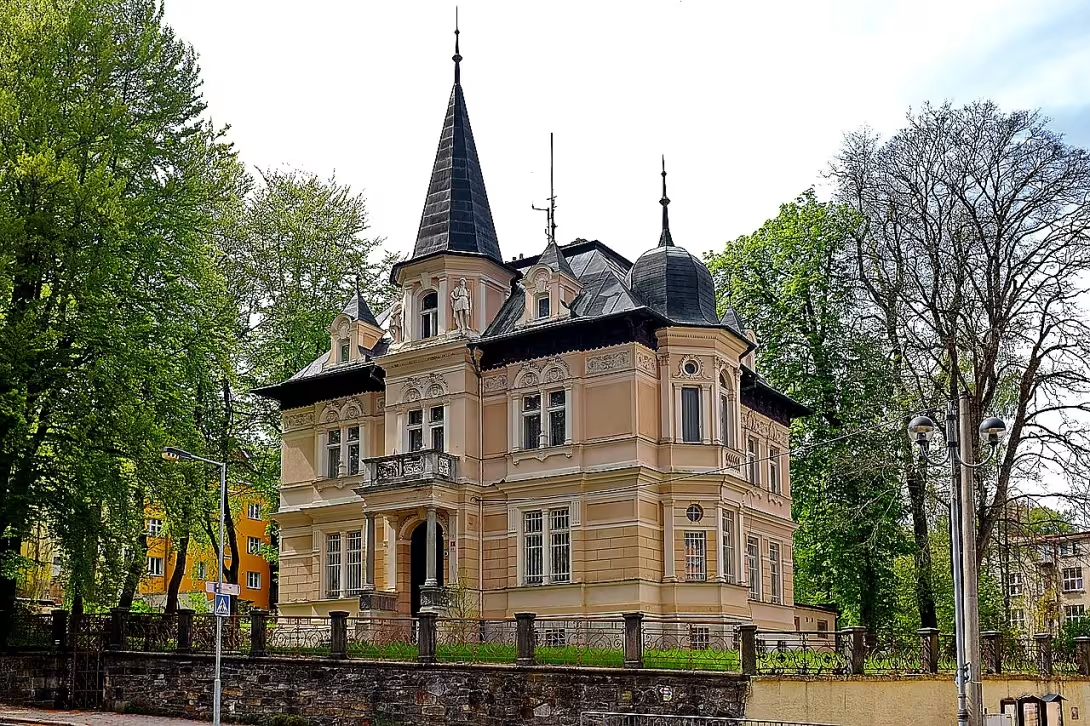
Vila Gustava Geipela is a monument from 1888. Located in the heart of Aše in Cheb district in Karlovy Vary region. It is a representative residence in the style of romantic historism, which has been registered since 2015 as a cultural monument of the Czech Republic. The object is extremely valuable in its authenticity as it was not affected by any subsequent modifications or reconstructions.
The villa was established in 1888 for Gustav Geipel, the leading Aše businessman and benefactor. Geipel was born in 1853 into a family of textile workers. His father Christian was co-owner of Geipel & Jäger, later Christian Geipel & Sohn. Gustav in the family business began to act as a procurer in 1877. The building was built on the site of a large agricultural estate of the Ploss family. This was bought by Christian Geipel in 1885 and then left it to his son. The project was developed by a major Aše architectural office Köhler & Pschera. For example, it designed the building of the city cinema or the Geipel and Fischer families.
The construction is carried out in the spirit of romanticizing historicism with neo-Renaissance and non-Baroque motives. The floor building with almost square ground plan is located in the centre of Aše, near the roundabout on the corner of Gustav Geipel and Main. The terrain is elevated and separated from the street by a supporting wall. The garden area is surrounded by original forged fence with stone columns; in the green part there is a small raked gazebo.
The facade is equipped with stucco decoration. It is dominated by a three-axis street front with a central risalite, which ends with a polygonal tower with a high needle roof. On the ground floor of this risalita is the main entrance above which there is a balcony with a column and a preset staircase. The upper part of the polygonal output is decorated with statues, while a richly carved wooden balcony comes out of another risality.
The interior on the ground floor consists of a representative part of the house. There is a hall with a cluster ceiling and walls with taping. The first floor is optically separated from the ground floor by a cordon post-date ledge. It is dealt with with less honorably, yet some rooms have stucco ceilings.
After the founder's death, several owners were replaced by the owner of the villa. Since 1926, the Fischer family owned the building. In the 1960s, the building went under the administration of the Ministry of Interior, where the local Department of Public Security was based. Later, the villa was owned by the city of Aše, which rented it to the Police of the Czech Republic. The police worked here until 2018 when the city sold the construction for CZK 6 million to the Ministry of Interior of the Czech Republic. In January 2021, the building was offered for sale by the Office for the Representation of the State in Property.
Gustav Geipel was an important figure in the city. In addition to his business, he served as deputy mayor in the City Council and since 1907. He paid for the charity and care of the employees for whom he founded the sickness insurance plant and paid for the accident insurance. His merits include the construction of Luther Square in 1906, paving pavements in 1908 and financing the construction of sewerage and paving roads in 1910. After his death in 1914, he left the city extensive land and 6 million crowns to pay off the city's debt and complete the paving of the streets. In 1924, a massive monument was built in the park off Circular Street.
Vila Gustava Geipela represents one of the most preserved examples of historical architecture in the region. Its value consists in maintaining the original internal layout, historical structures and architectural details which have not been disturbed by insensitive modifications.
This monument is proof of the expansion of the industrial revolution and the social status of the then business families. Its visit offers insight into the architecture and history of the city of Aše at the turn of the 19th and 20th centuries.
Historical milestones
- 1888
- building of villa
- 2015
- declaration for cultural monument
- 2018
- sale to the Ministry of Interior of the Czech Republic
Architectural development
The building was built in 1888 according to plans of the architectural office Köhler & Pschera. The style represents a romanticizing historism with unorthodox and non-Baroque motives. A single object with almost square ground plan and a distinctive turret with a needle roof remained in its original form.
Historical events
1888: construction of a villa on the site of the former estate of the Ploss family; 2015: entry in the list of cultural monuments; 2021: offer for sale through the auction by the State Representation Office in Property matters.
Owners
Gustav Geipel (1888), Fischer family (since 1926), Ministry of Interior (since the 1960s), City of Aš, Ministry of Interior (from 2018)
Points of interest
- The object is extremely valuable with its authenticity as it was not affected by any subsequent modifications or reconstructions. - The building was built in 1888 on the site of a large agricultural estate of the Plosse family. - The construction is carried out in the spirit of romanticizing historicism with neo-Renaissance and non-Baroque motives. - The facade is dominated by a polygonal turret with a high needle roof and a richly carved wooden balcony. - In the 1960s, there was a local Department of Public Security.
Guide
Show guide text
This text was created by artificial intelligence and has not been editorially reviewed. It may contain inaccuracies.
Welcome. You are standing right in front of a building that carries the incredible power of time and represents one of the most important symbols of the rise of this city. The Vila Gustava Geipela stands before your eyes. The very sight of its massive and representative form must immediately transfer you to an era where Aš was transformed into an industrial centre and when ambitious people sought ways to materialise their success and social status. Feel the atmosphere of peace and nobility radiating from this building. It is a place that does not act as a mere house, but as a witness to one specific epoch, when tradition faced a new, dynamic era of industrial production.
Let us now return together to the past and understand why this building was created. Imagine the end of the nineteenth century, namely 1888. This is the moment when a new chapter in the history of this place began to be written here. This villa was not created on an empty surface, but in a place that had its own, much older history. Before its rise, there was a large agricultural estate of the Plossa family. Imagine the contrast - from the quiet, agricultural environment that was the rule of local families, suddenly became the seat of the man who represented the modern world, the world of factory workers and the capital. The main player in this story was Gustav Geipel. He wasn't just a resident, he was a major textile factory, a man whose success was directly linked to the flourishing of the local industry. He needed a seat to fit his position, a place to host business partners and emit stability and wealth. And that's why this villa was built here.
Now pay attention to the architecture itself that surrounds you. If you look at the overall composition of the building, you can see in it an effort to induce a certain sense of dignity and history. The architects Köhler and Pscher, who were behind this work, worked in the spirit of romantic historism. What does it mean to you, standing right in front of this building? It means the architects didn't want to create something completely new and unknown, but they wanted to draw on the best patterns of the past to create something timeless. Notice how different styles intertwine here. You can see here the non-orenessant motifs that give the construction order, structure and sense of intellectual depth, while at the same time you can find the unarable elements that bring some dynamism, richness and elegance into the overall impression. This combination is not random. It's a deliberate creation of an aesthetic experience to make the building unforgettable. Look at the facade and see how these historical styles complement each other and create a harmonious whole that has been impressive for over a century.
When you look at these details, it is important to realize that you are dealing not only with stones and plaster, but with the work of specific creators who knew how to use architectural language to express power and success. Gustav Geipel in this villa not only sought shelter from the world, but created its own center of influence. Every element you are now observing was voted with great care at that time to reflect the prestige of his name and his field.
And here comes what makes this memory absolutely special and what you should really be interested in looking at it. Most historical buildings have undergone many modifications over the centuries. Owners rebuilt them, modernized them, changed their appearance to match current fashion or technical requirements. Vila Gustava Geipela is, however, a unique feature in this respect. Her greatest value is her incredible authenticity. This construction was not affected in later years by any major reconstructions or significant modifications that would have disrupted its original face. When you look at her today, you see essentially what Gustav Geipel saw in 1888. It's like the architecture is how you can touch the moment the villa was completed. It's a genuine, intact time capsule that allows us to see the world exactly as people saw it over a hundred and forty years ago. This integrity of its original character was one of the main reasons why it was officially declared a cultural monument of the Czech Republic in 2015.
This severity and value of the object has been confirmed in the modern times. Although the Czech State became owner of the villa in 2018 through the Ministry of Interior, its status as a valuable cultural heritage remains preserved. It's proof that this is an object that belongs to all of us as part of our common history.
Stop for a second and just watch. Let your eyes flow across the facade and try to reconstruct the world that existed around this villa in 1888. Imagine the sound of machines from nearby factories, the movement of horse wagons and the excitement of a time when everything around it was changing quickly. This villa remained a fixed anchor in all this, a symbol of stability and beauty that resisted all the storms of time.
I hope that this view of the building was not just an observation of architecture for you, but that you also found a deeper sense and connection to the history that shaped this city. Vila Gustava Geipela is living proof that a great work can survive its creator and its native people and still fascinate us with its truthfulness. Please continue your walk and pay attention to other details of your surroundings. Thank you for spending this moment right here with us. Goodbye.
Tips for visitors
For the best experience we recommend a visit on bright days, when the light beautifully highlights the non-orenessant and uncoloured details of the facade. It is ideal to visit a place during the day when architecture is fully visible and its historical character stands out.
The villa is located in the heart of Aše, which ensures good availability by foot and public transport. Check with local transport services or online search engines for current traffic connections and parking possibilities in the surroundings.
When visiting, prepare for a walk in the historical environment, so it is advisable to have comfortable shoes. If you want to focus on the architecture documentation, remember to take the camera to capture the details of the construction.
The most suitable angles for photography are those which capture the representative nature of the textile factory's seat. The best light for highlighting historical elements is during the morning hours.
As part of a short walk around you can visit Luther Square or visit nearby offices of Köhler & Pschera and Alfred Geipel's villa. For families with children, a tour of historical buildings in the city centre is an interesting activity.
Businesses nearby
Do you run a restaurant, accommodation, shop, museum, rental, wellness or other visitor service near this monument? Show yourself directly to the people heading to it — this is how they will see you in the app and on the web:
Nearby
In the centre of Aše is located near Luther Square and other buildings of the architectural office Köhler & Pschera, such as Alfred Geipel's villa.
Accommodation nearby
Themed route
Thematic cruise route Aš
1. Vila Gustava Geipela (villa) This villa is an architectural pearl of the city and represents an important contribution to the history of Czech construction. This is a great opportunity for those interested in the architecture and history of the region.
2. Luther square (square) Located in the center of Aš, it offers beautiful views of surrounding buildings, including the Geipel villas. The square is an ideal place to relax and explore the historical centre.
3. Office Köhler & Pschera (architectural office) This office is known for its participation in several major construction projects, including the Geipel villas. It's an interesting place for those who want to know more about the architectural heritage of the city.
4.Vila Alfred Geipela (villa) Near Luther Square is this villa, which represents another jewel of architecture Aše. It is an ideal place to compare with Gustav Geipel's villa and understand the family and professional activities of the Geipels.
This route offers a compact survey of architectural monuments in the center of Aše, allowing a deeper understanding of the history and culture of the city.
Seasonal recommendations
Spring in Aši brings a growing nature around Gustav Geipel's villa, where gardens and surrounding parks are covered with fresh greenery and flowers. The lighting is soft and diffuse during this period, which underlines the fine line of Art Nouveau architecture and creates a calm, almost intimate atmosphere. For visitors, spring time is ideal to enjoy the memory without disturbing elements of mass tourism. It is practically appropriate to wear comfortable shoes with anti-slip soles because spring rainfall can leave slippery marks on the tile. The temperatures are variable, therefore we recommend layering clothing, especially a light jacket for a cooler morning. The most convenient is to visit the villa in the morning, when the air is the cleanest and daylight still does not penetrate so intensively into the interior, which allows you to better perceive the details of the decoration.
Summer offers the longest days and brightest sunlight, which fully reveals the richness of colors and ornaments on the facade and in the interior of the villa. Nature is in full bloom, which gives the whole area a living and solemn energy. At this time, the atmosphere is the most lively, but also the busiest, as a large number of tourists and locals are gathering here. From the point of view of practical advice, it is crucial to come as soon as morning, ideally right after opening, to avoid crowds and get the opportunity to photograph without strangers in the background. Dress up light, breathable clothes and protection from the sun is necessary, i.e. hat or hat and sunglasses. Due to the high traffic, it is advisable to check the current opening times in advance and, if possible, book an entry if possible to avoid waiting in line.
Autumn brings to Aši unique atmosphere, where leaves turn into golden and red shades, creating dramatic contrast with elegant white and pastel palette of the villa. The lighting is shorter and warmer in this period, which underlines the historical character of the building and gives it a nostalgic touch. Nature around the villa is less lush than in the summer, but it offers another, quieter beauty, which attracts a slower examination of details. It is practically necessary to put on warmer layers, as the evening's cold is rapidly occurring. We recommend carrying an umbrella because autumn weather is often volatile and rainy. The best time to visit is in the afternoon when the sun falls low and creates long shadows on the facade, which underline architectural elements even more. Avoid weekends as far as possible, because there are also groups of tourists looking for autumn atmosphere.
Winter at Aši is specific with its quiet and often snow blanket, which covers the surroundings of the villa and thus creates a clean, white foundation for its architectural lines. The lighting is the shortest and coldest, which may seem somewhat crude but at the same time dramatic. The atmosphere is calm and thoughtful in this period, ideal for those who seek to escape from noise and rush. Practical advice includes the need to dress in strong frost, i.e. warm shoes, gloves and hats. Due to the winter period, the opening hours may be reduced or the monument closed for technical maintenance, so it is necessary to check the current information in advance. It is best to visit in the morning when the temperature is highest and the daylight is most intense. If snow falls, care should be taken to keep the area moving so that there is no injury on slippery surfaces.
Visualizations and artistic views

The visualisations are generated by artificial intelligence and serve as inspiration.
Photos from the area
Real photos taken near the monument


Zdroj a licence jsou uvedeny u každého snímku.
Tips from visitors
No tips yet. Be the first!
Log in and add your tip.
Sources and literature
Fotografie: Lubor Ferenc / CC BY-SA 4.0 — Wikimedia Commons. The author and licence also appear when you hover over the image.
Faktickým podkladem tohoto textu byl článek na Wikipedii, jehož autory jsou přispěvatelé Wikipedie. Článek je dostupný pod licencí CC BY-SA 4.0.
Location on the map

Příběhy a pověsti
Legendy, pověsti a příběhy spjaté s touto památkou
Fotografie návštěvníků
Zatím žádné fotografie. Buďte první, kdo přidá fotografii z návštěvy!
Přihlaste se a přidejte svou fotografii nebo hodnoťte.
Za ověřenou návštěvu v aplikaci získáte víc bodů — poznáme podle GPS, že jste na místě.
Reviews and comments