



Vísecká rychta Museum building
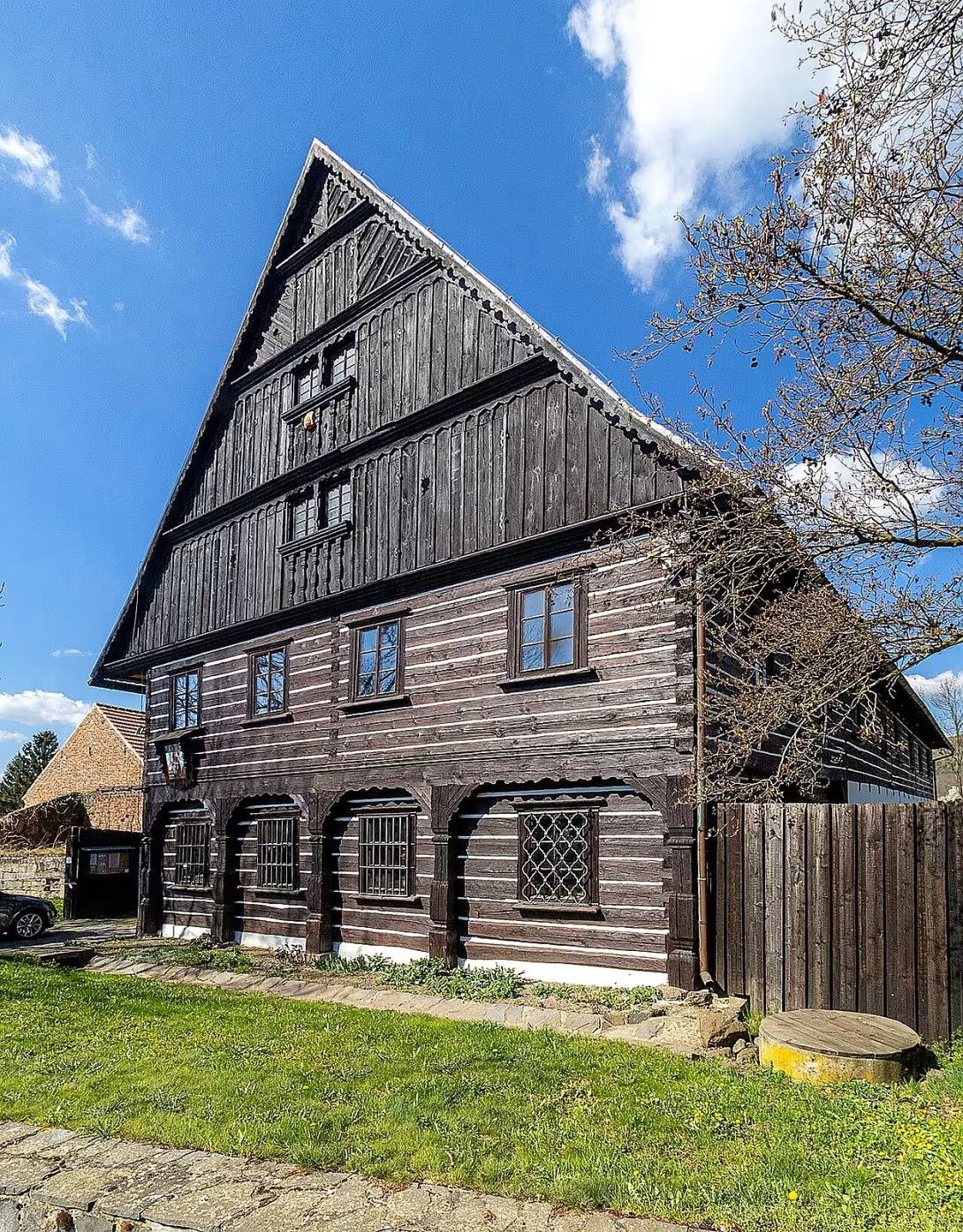
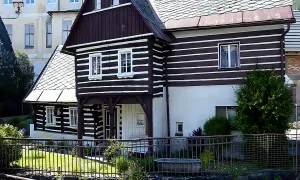
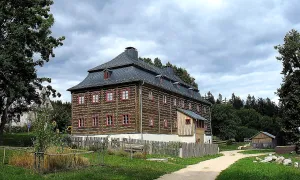
Vísecká rychta is the largest preserved grafted residential building in Bohemia. It is located in the village of Víska Kravaře in the district of Česká Lípa in the Liberec Region. The building from 1797 serves today as a branch of the National Museum and Gallery in České Lípa. It hosts the exhibition of folk art and is protected as a cultural monument of the Czech Republic.
The object was built in 1797 by a speedster Václav Kern. He replaced the original 1509 express known as the Waldstein pub. At the time of the creation of the Vienna was a separate municipality. It remained until 1849 when it was connected to the town Kravaře.
Architecturally, it is a monumental grafted state of 33 × 17 × 28 meters, located on the left bank of the Bobří creek. On the ground floor, there was a black kitchen, a large and small skylight. The floor consisted of five chambers and three floors. Thanks to a series of vents it was specifically modified for drying hops.
The property of the Speedway took turns between kinsmen Kern and Fuchs. The first one had almost six hectares of fields in the 19th century, keeping cattle, horses and sheep. Apart from the grain, they grew hops for which the said land served. Shortly after World War II, the building was still inhabited, then taken over by JZD.
In 1960, the damaged object was acquired by the District National Committee. The then director of the Museum Břítislav Vojtíšek found him in critical condition when he was taken over. The construction was up to a height of one metre full of manure and was used for sheep breeding. It was subsequently restored and dedicated to the Regional Natural Museum in České Lípa. The first exhibition called the People's Art Museum was made available to the public on 5 April 1986.
The current exhibition focuses on the development of folk architecture and housing in northern Bohemia. A collection of painted furniture from the end of the 18th to mid-19th century is concentrated in the premises; The oldest closet dates back to 1761. The bunk chambers are divided into thematic units with examples of equipment, carving and tools. The adjacent stable is used for screening video films, possible exhibitions and presentation of documentation to the history of the construction. In the adjacent wall barn from 1933, the depository of the museum is located with economic machines from the first half of the 20th century.
Vísecká rychta is a member of the Association of Museums and galleries of the Czech Republic. It is open to the public from May to September daily except Monday, April and October on weekends and March and November for ordered mass visits. Together with the village of Kravaře he organizes events such as Masopust, Easter, Midsummer Night, Conquest of the Kravač or the Kravařská malchiad. Since 2014, the coffee meeting cycle has been running fast.
The monument presents a unique testimony about rural life and architecture of northern Bohemia. Thanks to its size and preservation, it is an important goal for everyone interested in folk art. Visiting the museum offers a direct insight into the history of the region.
Then and now
Drag the slider to compare how the landmark may have looked when it was built with the view today.
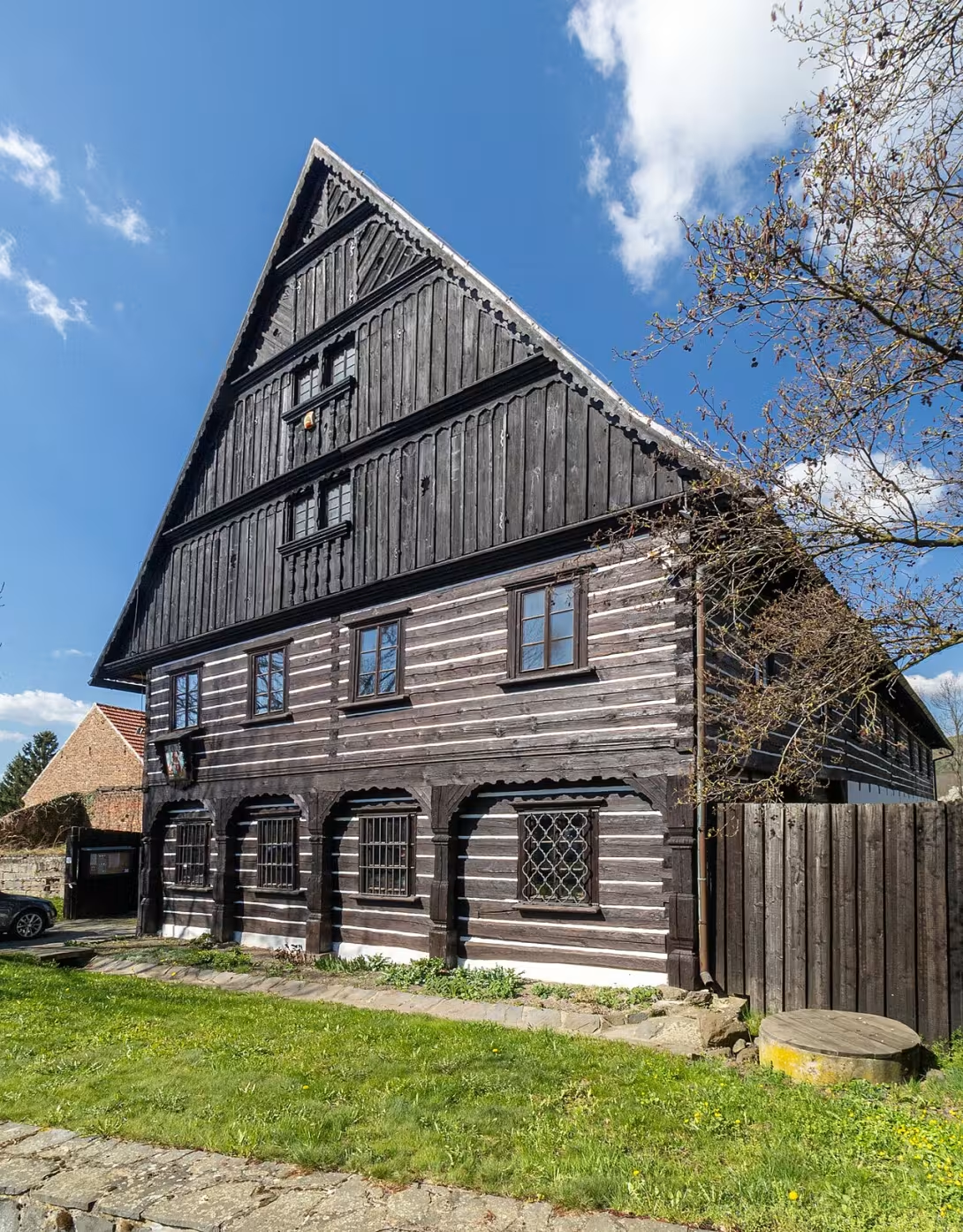
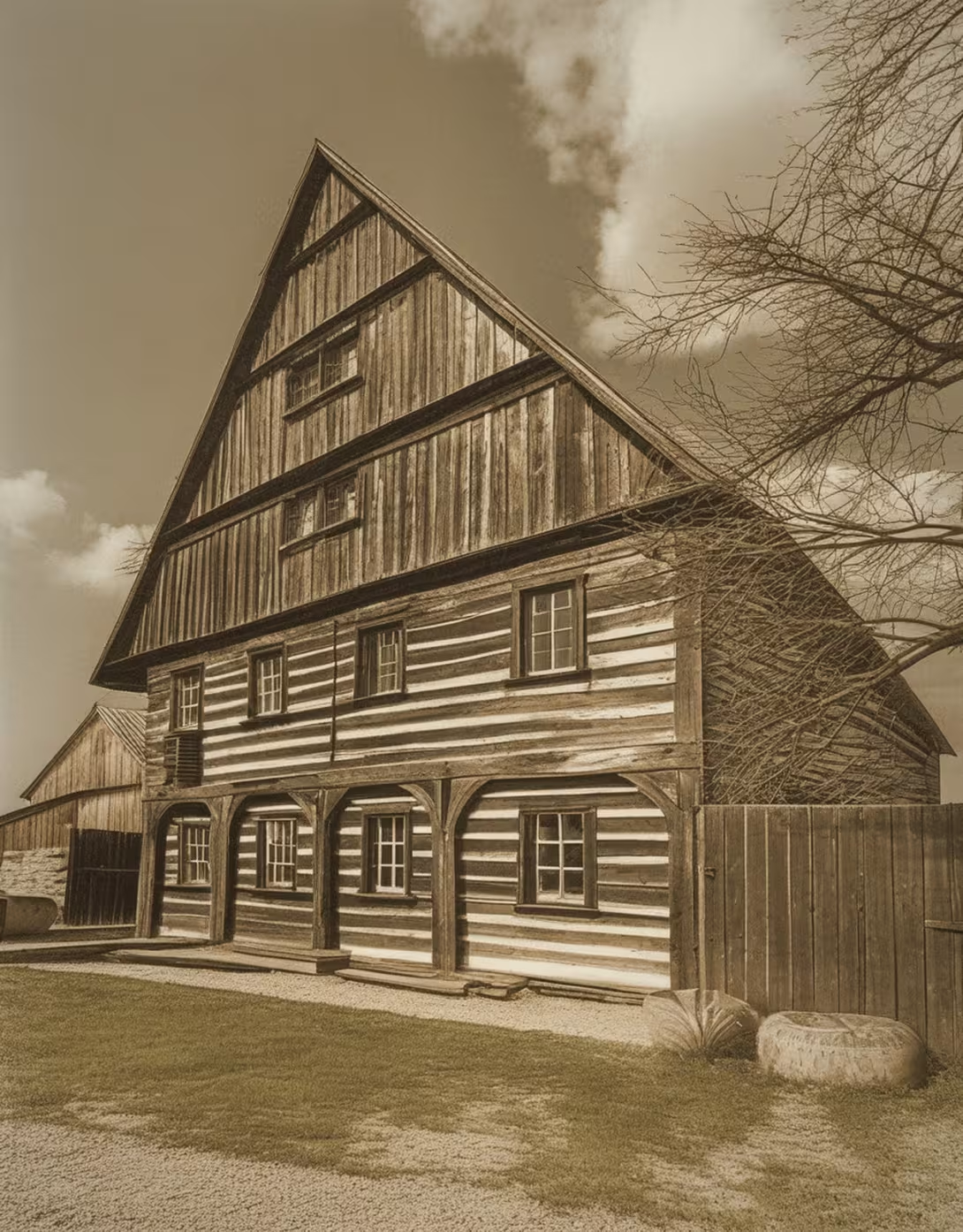
The historical appearance on the left is an AI-generated visualisation and serves as inspiration only.
Historical milestones
- 1509
- The existence of the original express known as the Waldstein pub
- 1797
- The status of the current building with the express by Václav Kern
- 1849
- Connection of village Víska with town Kravaře
- 1960
- Take over the damaged object by the District National Committee
- 1986
- Accessing the first exhibition of the Museum of People's Art to the public
- 2014
- Start of the coffee meeting cycle
Architectural development
The speed was built as a grafted building with three-storey ground for drying hops. Over the years it was restored and converted into a museum, which included cleaning and reconstruction of the interior.
Historical events
- 1797
- The position of the Vienna Speedway to the place of the older Waldstein pub.
- 1960
- Restoration and conversion into a museum branch.
- 1986
- Opening the first exhibition of the Museum of People's Art.
Owners
Originally belonged to the village of Víska, later associated with Kravařemi in 1849. The Kern and Fuchs families were fast. After World War II, it was won by the District National Committee.
Points of interest
- Vísecká rychta is the largest preserved grafted residential building in Bohemia.
- The object was built by an Václav Kern speedster in 1797, replacing the original 1509 express known as the Valdstein pub.
- Architecturally it is a monumental grafted state with dimensions of 33 × 17 × 28 meters, located on the left bank of the Bobří creek.
- The property of the Speedway took turns between kinship families Kern and Fuchs. The first one had almost six hectares of fields in the 19th century, keeping cattle, horses and sheep.
- The current exhibition focuses on the development of folk architecture and housing in northern Bohemia. A collection of painted furniture from the end of the 18th to mid-19th century is concentrated in the premises; The oldest closet dates back to 1761.
Guide
Show guide text
This text was created by artificial intelligence and has not been editorially reviewed. It may contain inaccuracies.
Welcome. You have just stopped in front of a place that carries an enormous number of stories and dominates the whole area with its presence in the village of Viska. You're standing right in front of the Vienna Speedway. Before you take the first step towards her door, I suggest you stop for a moment and just take a look. Feel the atmosphere of peace and history radiating from this place. In front of your eyes is a monumental wooden structure, which at first sight acts with incredible strength and stability. It is an object that cannot remain undetected, and its massive dimensions will immediately indicate that it is not an ordinary house, but a building with a very significant destiny.
Now let's go back deep into the past together to understand why this place is so special. The history of this particular property goes much further than it might seem. There was already another building here in the year fifteen hundred nine, known as the Waldstein pub. Imagine that period, at the time this area was completely different, but this place already served as an important point in the landscape. Over time, however, the needs of the settlement have changed. In seventy-nine of the 18th century, there was a major break. That's when the current speed building was created, which we admire today. This new building was intended to replace an older pub and serve as the seat of a speedster, a local official who performed his important function here.
Now pay attention to the architecture itself, which you are now observing. Although we don't know the name of a particular builder, his championship is visible on every metre of this building. Vísecká rychta is a unique phenomenon. It is the largest preserved grafted residential building in all Bohemia. If you look at its dimensions, you may not realize it easily, but this building measures an incredible 33 meters in length, 17 meters in width and up to 28 meters in height. It's really a monumental grafted object. Feel this incredible woodwork. The massive grafted structure you see is proof of the incredible technical skill of the artisans back then. Every beam, every connection in this huge structure, had to be designed to withstand the time trials, which, as you can see, happened after over 200 years.
Looking at this structure, we can't avoid the figure of the man behind its creation. He was an Václav Kern speedster. He was the visionary who decided to build this new, much more important building in the 1970s. Václav Kern wasn't just a builder, it was a man who shaped life in this part of Kravar. His decision to build such a magnificent speed has determined the face of the village of Viska for centuries ahead. Thanks to him, we can stand here today and admire the work that survived wars, changes in political regimes, and the progressive modernization of the world.
You might find one interesting thing that makes this building a real gem. We often encounter historical monuments that are old, but their dimensions are modest. However, Vísecká rychta is exceptional in this respect. It is an absolute recorder within the Czech Republic. It is the largest grafted residential house that has ever been built in this country and which we have managed to maintain so far in such good condition. It's a monument that, with its size and its structure, raises eyebrows for anyone who sees it.
But the history of this place does not end in the eighteenth century. The object has undergone many changes. In the year one thousand eight hundred forty-nine there was an important administrative step, when the village of Víska joined the town of Kravaře. Over the centuries, speed changed its functions. In the year one thousand nine hundred sixty, the damaged object was taken over by the District National Committee, which was the beginning of a new era of its use. But a real return to the public and to the people occurred in the year one thousand nine hundred eighty-six, when the first exhibition of the Museum of People's Art was opened here. Since then, the hotness has been used as a branch of the Natural History Museum and Gallery from České Lípa. Today, this building is protected as a cultural monument to the Czech Republic, which underlines its immense value to all of us.
Even today, in the modern world, speed maintains its living tradition. Since the year two thousand fourteen, an interesting meeting cycle has been held here under the name Coffee on the Fast. It is a beautiful example of how history can connect with the present and how the historical monument can serve as a place for meeting people, talking and sharing ideas.
But now I will not take you too long. The world of history, folk art and architecture opens before you. I suggest you now enter and be carried away by the atmosphere of the museum. Take a look at the exposition that will present you with the wealth of folk life and art, and try to imagine in your mind how these vast spaces were lived and worked hundreds of years ago. Every corner of this building has its own story waiting to be discovered. I wish you a pleasant tour, and I hope that a visit to the Vienna Speedway, as well as to me, will please you with its size and beauty. Goodbye.
Tips for visitors
We recommend you take comfortable shoes, which is suitable for walking around Bobří creek.
For the best photos, focus your lens on the details of the grafted structure and surrounding nature at the creek.
Families with children will appreciate a tour of the old economy and a visit to the neighboring building where they will see old economic machines in the depository. In the area there is a Bobří stream, which offers a pleasant environment for a short walk.
Frequently asked questions
Can the monument be visited?
Some buildings of this kind are open for guided tours, others serve another purpose or are privately owned. We have not verified whether and when this monument is open – please ask the operator.
What are the opening hours and admission?
We have not verified the opening hours or admission. Current information is published by the operator. Official website: https://www.muzeumcl.cz/obsah/visecka_rychta_kravare
Where is the monument?
Location: Kravaře, Liberecký kraj. The map on this page shows the exact spot.
Why is the monument protected?
It is listed in the Central List of Cultural Monuments of the Czech Republic as a cultural monument (register no. 1000128263).
Businesses nearby
Do you run a restaurant, accommodation, shop, museum, rental, wellness or other visitor service near this monument? Show yourself directly to the people heading to it — this is how they will see you in the app and on the web:
Events nearby
Zdroj akcí: otevřená data měst a obcí ČR (Národní katalog otevřených dat) a kalendář akcí Národního památkového ústavu.
Nearby
The speed is located on the left bank of the Bobří creek.
In the neighbouring building there is a depository of the museum with economic machinery.
Accommodation nearby
Trips and activities nearby
Guided tours, tickets and activities nearby from GetYourGuide
Affiliate link: if you buy from the partner, we may receive a commission. The price for you does not change.
Search tours and activities →Themed route
Thematic cruise route to Kravař
1. Vísecká rychta (museum) - Type: Historical monument, museum - Why it is worth a visit: Vísecká rychta is a key historical monument located on the left bank of Bobří creek. It offers a valuable insight into the past of the village Kravaře and its economic development. It's a place where you can explore the history of governance and rural life.
2. Museum Depository with economic engineering - Type: Museum exposition - Why is it worth a visit: There is a depository in the neighbouring building, which is part of the museum. Here you can see various historical economic machines and discover how agricultural work has been done in the past. This exhibition is ideal for those interested in technology and industrial history.
3. Beaver stream - Type: Natural water flow - Why is it worth a visit: The Beaver stream, which flows through the area of the Visecan express, is an ideal place for relaxation and a short walk. Its peaceful watercourses and natural environment offer a comfortable place to relax after visiting the museum.
4. Tanks Vísek express - Type: Historical area - Why is it worth a visit: The Vísek express tank is suitable for walking and provides the opportunity to enjoy a quiet space with historical background. It's a place where you can stop and enjoy the past.
This route offers a comprehensive view of the history and natural beauty of the Kravaře area, focused around the Vísek Spec.
Seasonal recommendations
Spring brings to the surroundings Vísek spec awakening nature, which creates a quiet and fresh environment for the tour. The lighting is already strong enough to be beautifully admired by the architecture and details of outdoor exhibitions without having to rely on artificial resources. The atmosphere is quiet and suitable for slow walks, because there are no large groups of tourists. It is virtually ideal to visit the memory in the afternoon when the heat is already pleasant, but the sun is not as intense as in the summer months. We recommend layered clothes, with a light jacket, because spring weather is variable and it can be cold in the morning and evening. The surrounding trails can be used along the way, which are usually in good condition after winter and offer views of the emerging landscape.
Summer is the season when the monument is most visited and therefore it is crucial to plan a visit with respect to crowds. It is best to come as early as possible in the morning, right after opening, to avoid high-end traffic and enjoy a quieter atmosphere. The lighting is the longest at this time, which allows a tour until late afternoon hours, but the sun can be unpleasantly strong at noon, so it is necessary to carry a hat, sunglasses and plenty of drinking mode. Clothes should be light, breathable and from natural materials that remove moisture.
Autumn offers a unique atmosphere where the surrounding trees are wrapped in golden and red shades, creating a picturesque contrast to historical buildings. The lighting is shortening, so it is best to visit the memory in the first afternoon when the light is soft and warm, ideal for photo photography and admiration of details. The atmosphere is calmer than in summer, with slightly colder air, which gives a walk a specific, relaxed character. Practical advice includes clothing in layers, with emphasis on a warm jacket and comfortable shoes because autumn rains can leave wet paths. It is advisable to carry a waterproof umbrella because autumn weather is often variable. The visit during this period allows you to enjoy the memory without great crowds and in accordance with the natural rhythm of nature.
Winter brings a quiet and often snowy atmosphere to the Visec hasty, which gives the historical area a special charm. The lighting is the shortest, therefore the visit is recommended in the afternoon, when there is still enough daylight, or it is necessary to expect artificial lighting of the interior. The atmosphere is quiet and quiet, ideal for intimate meetings with history without disturbing influences. It is virtually necessary to carry very warm clothes, including winter jackets, gloves, scarf and warm shoes with a good anti-slip pattern, because frozen paths can be slippery. At advent time the atmosphere can be even more experienced thanks to Christmas lighting, if the monument is open at this time, which adds to the magic of visitors.
Visualizations and artistic views


The visualisations are generated by artificial intelligence and serve as inspiration.
Tips from visitors
No tips yet. Be the first!
Log in and add your tip.
Sources and literature
Photos: VitVit / CC BY-SA 4.0 — Wikimedia Commons. The author and licence also appear when you hover over the image.
Faktickým podkladem tohoto textu byl článek na Wikipedii, jehož autory jsou přispěvatelé Wikipedie. Článek je dostupný pod licencí CC BY-SA 4.0.
Location on the map
Příběhy a pověsti
Legendy, pověsti a příběhy spjaté s touto památkou
Fotografie návštěvníků
Zatím žádné fotografie. Buďte první, kdo přidá fotografii z návštěvy!
Log in a přidejte svou fotografii nebo hodnoťte.
Za ověřenou návštěvu v aplikaci získáte víc bodů — poznáme podle GPS, že jste na místě.
Reviews and comments