



Vlčí jáma Mine
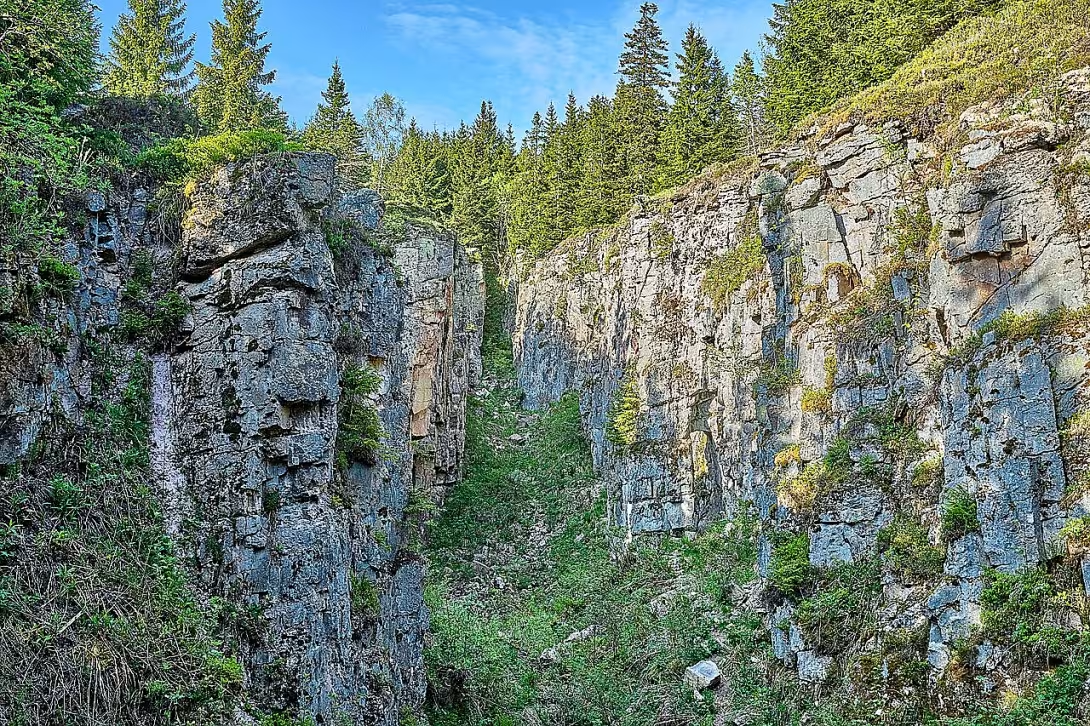
Wolf pits represent a natural monument in the Erzgebirge Mountains in the Karlovy Vary Region. They are located on the southwest side of Blatensky Hill northeast of Horní Blatná in the cadastral territory of the Rivers in Karlovy Vary district. The object of protection is medieval conquests of tin ore, the existence of cave ice and the presence of critically endangered species of moss and animals. They consist of the Wolf and Ice Pits, which were created by the medieval conquest of tin ores and the subsequent collapse of underground space. The remains of both old mines are historically protected.
This building was created by mining activities within the medieval mining of tin in the Erzgebirge Mountains, which took place at the time of the development of mining and colonisation of border raids. These activities fundamentally transformed the wild landscape and laid the foundations for economic development in the region. The height in the slope of the ice pit was created by extraction of the tin band Jiří. It's up to 20 meters deep and very narrow. Vlčí jáma was created by extraction of the Wolfgang tin band and later partial collapse of the ceilings of underground chambers and rock walls. This trap is over 120 metres long, about 14 metres wide and about 20 metres deep. The geological substrate consists of a medium grain, partially porphyric, automamorphosed biotic granite. The object of the extraction was the greisen veins with the presence of mineral tin, tungsten, lithium, molybdenum and bismuth, with the main mineral extracted being casiterite.
At the beginning of the twentieth century, the Ice Pit was opened by the Hornoblaten Krusnomountain Association, which built a stone staircase in it. The protected area shall cover an area of 1,412 hectares at an altitude of 984 to 1010 metres. According to the care plan, altitude is up to 1018 meters. The territory was declared by the Regional National Committee in Karlovy Vary on 5 September 1975 in the category protected by a natural monument.
From 1813 there was a mention of the use of ice from the pit in the treatment of soldiers wounded in the Battle of Leipzig. The ice-making process was disrupted in the Ice Pit in 2005, when nearly two tons of snow and ice were illegally removed to build a snowman. Another negative phenomenon, resulting in the complete disappearance of cave ice, was the drought between 2017 and 2019. Vlčí jáma is also the only place in the Czech Republic where the critically endangered species of Mielichhofer's moss is growing, tied to the exposed veins of copper ore. There is also a population of critically endangered horticultural or common viper.
The natural monument is accessible on a red marked tourist route from Upper Blatná to Blatenské vrůch. In parallel with it is also marked part of the educational path Path A. Günther. Hikers are no longer allowed to enter the Ice Pit due to the release and roll of rock blocks. The surrounding area is Blatenské vrch, the city Horní Blatná and artificial channel Blatenské water moat.
This monument combines the testimony of historical medieval tin mining and unique natural phenomena including specific microclimate and rare species of organisms. Visiting this area offers a view of the formation of the Krušnomountain landscape by human activities.
Historical milestones
- 1813
- Mention of the use of ice from the pit in the treatment of soldiers wounded in the Battle of Leipzig
- 1975
- Announcement of the natural monument by the Regional National Committee in Karlovy Vary on 5 September
- 2005
- Distortion of the ice formation process by illegal transport of nearly two tonnes of snow and ice
Architectural development
The location was created by mining activity, namely by extracting the tin bands Jiří and Wolfgang. The subsequent partial collapse of the ceilings of underground chambers and rock walls created deep sinks and rock formations. At the beginning of the twentieth century he opened the Ice Pit of the Krusno Mountain Association by building a stone staircase.
Historical events
1813: Mention of the use of ice from the pit in the healing of soldiers wounded in the Battle of Leipzig. 1975: Announcement of a protected natural monument by the Regional National Committee in Karlovy Vary. 2005: Illegal transport of snow and ice to the construction of a snowman, which disrupted the ice formation process.
Points of interest
- Wolf pits consist of Wolf and Ice pits, which were created by medieval mining tin ores and the collapse of underground spaces. - In 1813, ice was used from the pit to heal the wounded in the Battle of Leipzig. - Vlčí jáma is the only place in the country where a critically endangered species of Mielichhofer's moss grows. - Ice formation in the Ice Pit was disrupted in 2005 by illegal transport of snow and ice to build a snowman and later by drought between 2017 and 2019. - Tourists are no longer allowed to enter the Ice Pit because of the release and the roll of rock blocks.
Guide
Show guide text
This text was created by artificial intelligence and has not been editorially reviewed. It may contain inaccuracies.
Welcome to one of the most remarkable natural and historical monuments in the whole Erzgebirge Mountains, near the picturesque village of Horní Blatná. You are standing right in front of a deep abyss and a settlement in a country whose raw and freezing atmosphere will consume you instantly. Look in front of you at the dark rock walls and the rubbers opening up to you like a huge blow to the earth's surface. Feel the cold air that blows out of here, and let this unique scenery, where human labor and the powerful force of nature mingle. The wolf pits you are now facing are made up of two parts, namely the Ice Pit and the Wolf Pit. These remarkable formations were not merely created by natural activities, but are the result of strenuous human labor from the Middle Ages, where people with great effort conquered valuable ore, namely tin ore. At the time, miners dug underground spaces, stalls and chambers, but time and hard mining took their toll. By the subsequent collapse of the ceilings of these underground spaces, the entire underground has fallen, and on the surface there have been these huge gaps and pits that you can admire today. Try to imagine the hundreds of hours of human labor in the darkness of the Underground, where the wealth of the region was more easily created. Today, the remains of these old mines are strictly monument protected to preserve them for future generations. Now pay attention to the details of the rocks and surrounding terrain, which are within your sight. Look at the rough worked stone, the walls of the abyss and a lot of rock rubble at the bottom. Do not look here for any decorated columns, windows or facades because the architect of this place was not a man with a drawing board, but centuries of mining and subsequent landslide. It's a raw industrial and natural monument in one. A special microclimate in these places creates conditions that you will not find anywhere else in the area. He kept snow and ice in the Ice Pit for a long time, even during the hottest summer months. The deep abyss holds the cold air inside and prevents its flow, so summer here loses its power. This place is also bound by very interesting historical events and stories that shaped its reputation. The memory takes us to the year eighteen hundred and thirteen, when the ice extracted from this pit was used for a very noble and worthy purpose. For he served in healing and alleviating the suffering of soldiers who suffered serious injuries in the bloody battle of Leipzig. Imagine the horses and chariots carrying the cool ice from the Erzgebirge Mountains far to the field hospitals to help save people's lives. Decades have passed, and people have continued to appreciate this natural rarity, which confirmed the date of September 5 in nineteen-seventy-five, when the Wolves were officially declared a protected natural monument by the District National Committee in Karlovy Vary. But protecting this place is also necessary because it is facing human numbness. An example is the year two thousand five, when the rare and fragile process of ice formation was seriously disrupted by the illegal delivery of nearly two tons of snow and ice by uninvited visitors, which shows how fragile this balance is. Let us now move on to the other interesting things that make this place absolutely rarity on a European scale. Did you know that Vlčí jáma is the only place in the whole country where a critically endangered species of moss is growing in the wild, bearing the name copper? This tiny but incredibly valuable plant species has found its home on the walls where it finds ideal conditions due to the presence of metals in the rock and a specific cold environment. Copper is such a silent witness to the uniqueness of this place, where geology, history and biology join together. Before we say good-bye to you, we advise you to carefully circumvent the edge of the abyss along the marked path and enjoy the views of the depths from different angles. Thank you for putting on your headphones and listening to our stories in this historic place. We hope that for you there was a walk around the Wolves' pits of enrichment and that you will continue to discover other beautiful corners of the Krusty Mountains. Have a nice and happy journey on your next wanderings.
Tips for visitors
Best time to visit The wolf pits are during hot summer days, where snow and ice still lie in the deep ice pit. At that time, you will experience the greatest temperature difference in nature. For the trip to the monument, bring with you firm hiking shoes with anti-slip soles, because the terrain between rocks and sinks is usually moist, slippery and uneven. A warmer outfit and a flashlight are also useful. For photography are the best hours of the morning when the sun's rays penetrate through the trees' crowns into deep rock sinks. You can get the best footage from the top views, where you can see the vast bottom of the old mine. In the vicinity of the monument you can visit the nearby Blatenský hill with a lookout, explore the historic town of Horní Blatná or walk around the artificial canal called Blatenský Water Trench. Families with children will appreciate the adventurous atmosphere of mysterious rock gorges and caves where they can discover the remains of medieval ore mining. Children enjoy exploring rock crevices, but they must always be held by their hands for deep chasms.
Frequently asked questions
Can the monument be visited?
This is a technical monument. Some are open as exhibitions, others are out of use or on private land. We have not verified whether this one is accessible.
What are the opening hours and admission?
We have not verified the opening hours or admission. Current information is published by the operator.
Why is the monument protected?
It is listed in the Central List of Cultural Monuments of the Czech Republic as a cultural monument (register no. 1000135479).
Businesses nearby
Do you run a restaurant, accommodation, shop, museum, rental, wellness or other visitor service near this monument? Show yourself directly to the people heading to it — this is how they will see you in the app and on the web:
Nearby
Blatenský vrch, město Horní Blatná, umělý kanál Blatenský vodní příkop.
Accommodation nearby
Trips and activities nearby
Guided tours, tickets and activities nearby from GetYourGuide
Affiliate link: if you buy from the partner, we may receive a commission. The price for you does not change.
Search tours and activities →Themed route
1. city of Horní Blatná, city, ideal place to start the journey. 2. artificial channel Blatenské water moat, water path, walk along this artificial waterstrip. 3. Vlčí jáma, landmark, main destination of the trip representing this interesting object. 4. Blaten hill, hills, the final part of the route in the elevated place.
Seasonal recommendations
Spring: Vlčí jáma in the spring season offers visitors a unique experience thanks to sunny lighting that penetrates the depths of the cave and adorns its walls with natural art. Nature awakens from winter when leaves begin to flourish and the forest is revived by the diversity of birds and the sound of their singing. The atmosphere is full of recovery and hope. We recommend visiting a monument at noon, when the sun lights up the cave spaces most beautifully. Good clothes should be warm for winter until spring, because the temperature inside the cave is always cold.
Summer: The Vlčí jáma has become attractive for visitors looking to escape the summer hot sun. The cave provides a cool shelter with constant temperature, which is ideal for those who want to relieve the heat. However, a wet atmosphere may cause a feeling of excess moisture. We recommend visiting the cave early in the morning or in the evening when the temperature outside is milder and the cave areas are less flooded for days. Remember light clothes suitable for cold space inside.
Autumn: In the autumn period Vlčí jáma offers visitors an atmosphere full of peace and quiet. Leaves on trees start to change color, which creates a beautiful background around the cave area. The sunlight has penetrated the cave for longer than in the winter, but it is already getting smaller due to shorter days. It is advisable to visit the memory at noon and prepare for the cold air inside the cave. We recommend wearing warm clothes because the temperature inside can be particularly low.
Winter: Winter visit Wolf pits offer a unique atmosphere thanks to cold air and the possibility of seeing cave light in a special way. Snow sheets around the cave can create a romantic and quiet picture that is ideal for peaceful walks. The sunlight only penetrates the cave briefly, causing specific lighting of its walls. It is advisable to visit the memory at noon and prepare for the cold air inside. We recommend wearing warm clothes such as fur coats or blankets, and suitable shoes for snow conditions.
Visualizations and artistic views

The visualisations are generated by artificial intelligence and serve as inspiration.
Photos from the area
Real photos taken near the monument


Zdroj a licence jsou uvedeny u každého snímku.
Tips from visitors
No tips yet. Be the first!
Log in and add your tip.
Sources and literature
Photos: Lubor Ferenc / CC BY-SA 4.0 — Wikimedia Commons. The author and licence also appear when you hover over the image.
Faktickým podkladem tohoto textu byl článek na Wikipedii, jehož autory jsou přispěvatelé Wikipedie. Článek je dostupný pod licencí CC BY-SA 4.0.
Location on the map
More monuments – Karlovarský kraj
Show all in the region
Příběhy a pověsti
Legendy, pověsti a příběhy spjaté s touto památkou

Fotografie návštěvníků
Zatím žádné fotografie. Buďte první, kdo přidá fotografii z návštěvy!
Log in a přidejte svou fotografii nebo hodnoťte.
Za ověřenou návštěvu v aplikaci získáte víc bodů — poznáme podle GPS, že jste na místě.
Reviews and comments