






Vodní mlýn čp. 75 Water mill
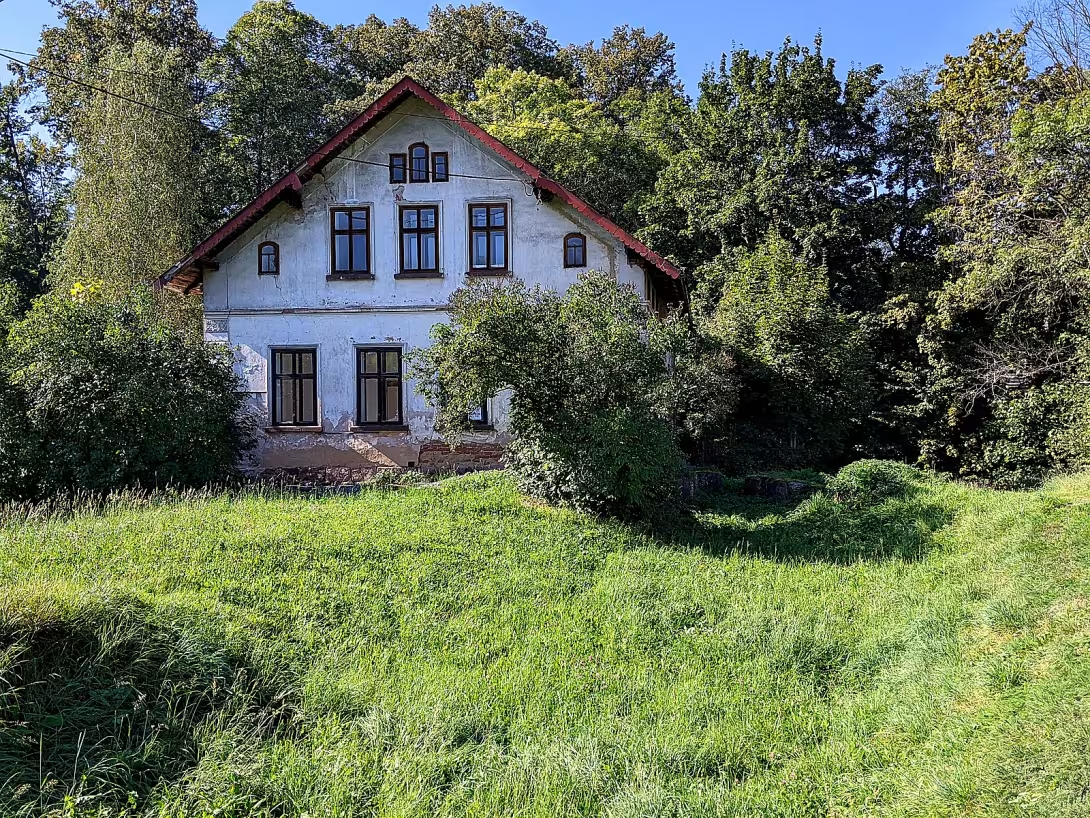
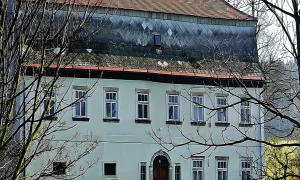
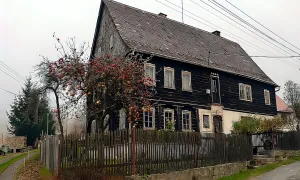
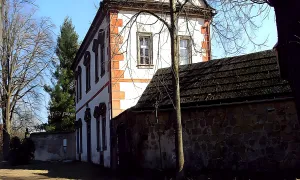
The Lukšov Mill, located in the village of Peřimov in Semily district, is a cultural monument and a former water mill built in the style of late classicism. This object, registered as a cultural monument, stands on the stream Olšina. It is a typical example of a walled water mill from the end of the 19th century, which was originally used for grinding grain. Its architectural structure and history make the mill interesting for a visit.
The original wooden mill, known as the Studnik Mill, is already recorded on a stable cadastral of the first half of the 19th century. At the end of the 19th century, this original building was referred to as a ruin and subsequently built a new brick mill in the style of late classicism. The three-storey rectangular house has a middle-pass hall.
In 1902 he became owner of Bohumil Lukeš, who later transferred ownership to his son Josef Lukeš. During World War II, Lukšov's mill served as a shelter for parachutists from the CHAN group, which adds additional historical value to the building.
Architecturally, the building is built in the style of late classicism and equipped with mill equipment from Julius Hübner and Karl Opitz of Pardubice. This material-walled object preserved its original functional and architectural character, which is evidenced by its inscription as a cultural monument.
Today, Luke's Mill is situated in the property of the descendants of the original owners and is worth visiting not only for its historical value, but also for maintaining the classical architectural style. Its presence in the village Peřimov is an important element of local culture and history.
The uplifting of this building as a cultural monument highlights its importance not only for the local population but also for the wider public. The Lukšov Mill is an example of a well preserved Classicist Mill with its original function and historical value, which makes it an interesting destination for tourists and historians.
Historical milestones
- first half of the 19th century
- The original wood mill (Studničková) was recorded on a stable cadastral, later mentioned as a ruin at the end of the 19th century.
- end of the 19th century
- Built a new brick mill building in the style of late classicism.
- 1902
- The owner of the mill was Bohumil Lukeš.
- world war ii
- Paratroopers from CHAN were hiding in the mill.
Architectural development
The original wooden mill was replaced by a walled building in the style of late classicism. The mill facility comes from Julius Hübner and Karl Opitz from Pardubice. The building has a three-way with a middle-pass hall. Material is the brick construction, typical of the classicist mills of the end of the 19th century.
Historical events
During World War II, parachutists from CHAN were hiding in the mill. The mill was originally wooden (Studniček's Mill) and is documented on a stable cadastral of the first half of the 19th century. At the end of the 19th century it was already mentioned as a ruin and subsequently a new brick mill was built.
Owners
1902
after 1902
Points of interest
- Luke's Mill is a cultural monument and a former water mill built in the style of late classicism. - Originally it was wooden, known as the Wellniček Mill, recorded on a stable cadastral of the first half of the 19th century and a new brick building was built at the end of the 19th century. - During World War II, he served as a shelter for parachutists from the CHAN group, which adds historical value. The mill plant was made by Julius Hübner and Karl Opitz of Pardubice. - He preserved his original functional and architectural character, which is evidenced by his enrolment as a cultural monument.
Guide
Show guide text
This text was created by artificial intelligence and has not been editorially reviewed. It may contain inaccuracies.
Welcome to Luke's Mill in Peřimov!
You are facing one of the most interesting examples of a water mill in our territory - a building that has been transformed for centuries from a simple wooden building into a walled house with the soul of late classicism. In front of you stands a rectangular house with a simple but impressive construction that reflects not only the technical skill of past generations, but also their daily need to use the power of water to grind grain. Feel this small building being inserted into the quiet environment of the Olšina stream as a living witness to the work that came here every day.
Let's look at the history of this place. The first mention of the mill dates back to the first half of the nineteenth century, when there was a wooden mill, known as the Studničkov. It was a simple but functional building that served the locals. Unfortunately, with time, it became a ruin. Only at the end of the nineteenth century did they decide to build a new, walled mill - the same one you see before you. It was a building with a tripartite layout, which became a typical example of the water mill of its time. In 1902 Bohumil Lukeš became the owner, whose name is still connected to this place.
Now pay attention to the architecture. The mill is a typical example of late classicism - style which is characterized by clean lines and harmonious arrangement. Look at the facade of the building - you can see how simple the building is, but at the same time carefully processed. The building is rectangular, with a floor, which means there is another level above the first floor. This was typical of water mills because it made it possible to make effective use of the space for storing grain or other activities related to milling. The internal equipment of the mill was technically advanced - the mill equipment comes from important companies Julius Hübner and Karl Opitz from Pardubice, which shows the quality and modernity of the then operation.
One of the most interesting stories associated with the Lukšov Mill is its role during World War II. In fact, there were parachutists from CHAN - brave men who tried to help our nation in difficult times. This gives the place a special atmosphere and reminds us that even such simple buildings could have been places of determination and courage.
Let's now look at something that makes this mill really special. It is a cultural monument - a building that has been recognised as of historical and technical importance. This means that it has been carefully preserved and to this day we can see what it looked like at the time of its greatest expansion. The mill is also an example of how people tried to adapt their needs to nature - the use of water to drive millstones was one of the most important inventions that enabled agriculture to develop.
Look around you before leaving. Feel how the mill is inserted into the landscape - how the Olšina stream flows around and reflected in its walls. This little house is like a living story that tells about our ancestors, their work and their determination. If you like this building, it is certainly worth looking into other parts of the village Peřimov. The landscape here is full of similar hidden treasures, waiting to be discovered by you.
Thank you for taking a moment to visit Luke's Mill. I hope you like this little but significant monument and that you can carry some of her spirit with you. May you succeed in rediscovering our historic places!
Tips for visitors
The best time to visit Lukšov's mill is in the spring or autumn period, when nature is around in full beauty and the temperature is not too hot. This time of year also offers ideal light for photography.
Parking can be found near the village Peřimov. For those who prefer public transport, a place is available by bus; You can verify a specific connection using an online search engine.
When visiting, wear a suitable suit and shoes because the road to the mill can be wet in the winter months or after the rain. Don't forget the protective sunglasses and enough drinking.
The best place for photography is at the mill itself, where you can enjoy an excellent light especially in the early morning or late afternoon. Nature around the Olšina stream also offers beautiful opportunities for landscape photography.
You can visit the fortress in the village Peřimov, which is a historical object with a rich past. It is also convenient to explore the nature reserves in the Semil Region, where you can enjoy beautiful forest and mountain landscapes.
Businesses nearby
Do you run a restaurant, accommodation, shop, museum, rental, wellness or other visitor service near this monument? Show yourself directly to the people heading to it — this is how they will see you in the app and on the web:
Nearby
V okolí se nachází přírodní krajina s potokem Olšina a lesy. V blízkosti (do 5 km) jsou další historické objekty jako například tvrz v obci Peřimov nebo přírodní rezervace v okolí Semilského kraje.
Accommodation nearby
Themed route
Thematic cruise route: Historical and natural treasures Peřimova and surroundings
1.Vodní mlýn čp. 75 Type: Technical monument, example of traditional mill operation. Why visit? A unique example of a well-preserved water mill with an original facility that shows the life of rural communities in the past. The surrounding stream Olšina supplied energy and still forms a picturesque surroundings.
2. Fortress in Peřimov Type: Medieval defensive structure, ruins. Why visit? One of the few preserved harbours in the region that shows the importance of the village in the past. Just a few minutes walk from the mill and offers a view of the history of the local estate.
3. Natural Reserve at Semilina Region Type: Protected forests and wetlands. Why visit? Untouched nature with rich fauna and flora, ideal for walking and bird watching. The reservation is about 3 kilometers from Peřimova and connects with the Olšina stream, which forms the natural boundary of the landscape.
4. Olšina stream (circular route along the flow) Type: Natural trail, water flow. Why visit? The picturesque section of the stream, which connects the mill, the fort and the reservation, offers a quiet environment for walking and observing nature. The route is simple and suitable for families.
5. Forests between Peřimov and Semil Region Type: Natural landscape, forest roads. Why visit? Thick forests with original trees and quiet roads that complement the atmosphere of historical monuments. Suitable for cyclists or walking trips between the different points of the route.
Seasonal recommendations
Spring: During the spring season, the mill in Peřimov appears in its most beautiful flash when flowering shrubs and trees open their leaves. The sun's rays illuminate the water flow and add life to the place. It is advisable to visit the mill in the early afternoon, when we are still avoiding crowds. The earlier visit also ensures better photographic conditions with bright light and warm but overheated temperature allows a comfortable walk. Recommended clothing should be versatile - short gloves and light jacket on any cool winds.
Summer: For years, the mill is most visited when the water in the missiles slows under the effect of sunlight. The atmosphere is full of life and loving energy, which attracts families with children and lovers of nature. The best time to visit is an early afternoon or evening when the crowd is relieved and we can enjoy the quieter moments in green meadows around the mill. We recommend wearing clothes suitable for the solar climate, such as short legs and hat, and carrying water.
Autumn: In autumn, shrubs and trees are acquired around the mill of colour shades - yellow, orange and red. This painting is particularly impressive in the morning or evening light, when the colours seem to melt in the atmosphere. Visit the memory in the early afternoon to enjoy a quiet walk before the arrival of today's crowd. Clothes should be decent - warm jackets and gloves should not be missing to protect against mild storms.
Winter: Winter Mill offers a different but equally attractive atmosphere. When the ice rind is in the missiles and the surrounding countryside is covered by snow, a stunning picture is created that attracts even the most determined lovers of the frost. The best time to visit is early afternoon, when the light is sufficient for the photo and the opening time of the sights is longer than in most other periods. The important thing is to carry warm clothes such as fur and thick jackets to protect against cold.
Visualizations and artistic views


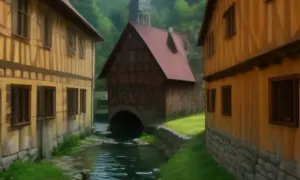
The visualisations are generated by artificial intelligence and serve as inspiration.
Photos from the area
Real photos taken near the monument


Zdroj a licence jsou uvedeny u každého snímku.
Tips from visitors
No tips yet. Be the first!
Log in and add your tip.
Sources and literature
Photos: Sovicka169 / CC BY-SA 4.0 — Wikimedia Commons. The author and licence also appear when you hover over the image.
Faktickým podkladem tohoto textu byl článek na Wikipedii, jehož autory jsou přispěvatelé Wikipedie. Článek je dostupný pod licencí CC BY-SA 4.0.
Location on the map
Příběhy a pověsti
Legendy, pověsti a příběhy spjaté s touto památkou
Fotografie návštěvníků
Zatím žádné fotografie. Buďte první, kdo přidá fotografii z návštěvy!
Log in a přidejte svou fotografii nebo hodnoťte.
Za ověřenou návštěvu v aplikaci získáte víc bodů — poznáme podle GPS, že jste na místě.
Reviews and comments