



Vodní mlýn (Lázně Kundratice) Umgebinde house
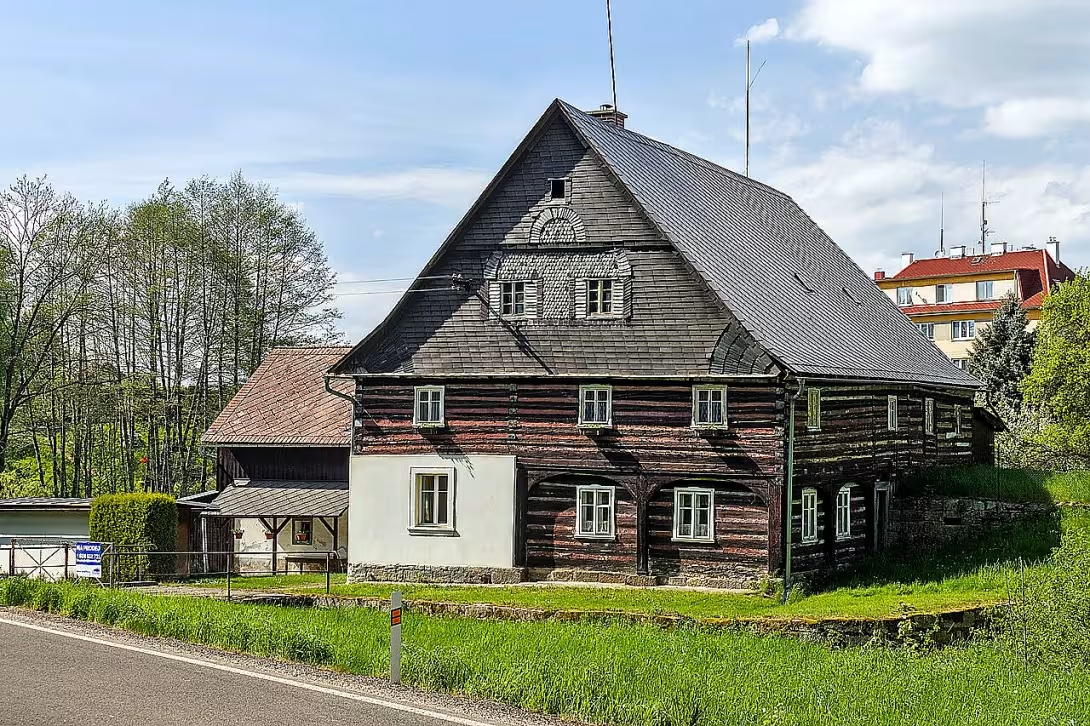
The Kočvar Mill in the Spa Kundratika near Ossečná on Liberec is a classical water mill on the river Ploučnice. An object whose history dates back to the end of the 18th century has been protected as a real-estate cultural monument since 1995. It represents a valuable document of the technical history of the region.
The construction of the mill dates back to 1799, when this year was carved into a stone portal of the southern facade. In a broader context, the object was created during the period of enlightened reforms under the rule of the Habsburgs, in times influenced by the reverberations of the French Revolution and the advent of the Napoleonic wars. Another significant milestone, a classic entry portal, bears a dating date from 1823.
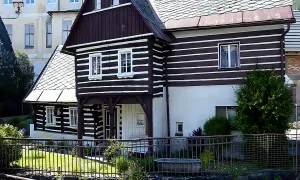
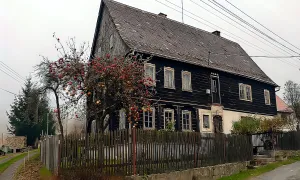
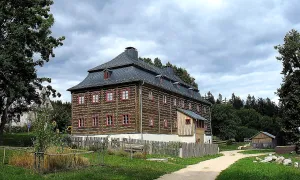
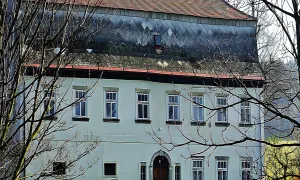
Architecturally, it's a two-storey building on the ground plan of the letter L. Under one roof, it integrates the mill and the residential part, even though they are dismounted. The entrance part of the ground floor is walled, while the rest of the ground floor and the whole floor are grafted. The technical background consisted of a water wheel on top water with a diameter of 6,25 metres and a width of 1,85 metres, located in a wooden extension. The water was flowing towards it from the pond attack and the vantroks that led along the northern facade.
The operation of the mill is still documented in the 1930s. At that time, the facility had one wheel on top water with a drop of 3.8 meters and a power of 3.16 meters. The original equipment has until today been preserved sandstone grinding stones, cylindrical stools with one pair of smooth cylinders in a wooden cabinet and a flat two-box sower. An interesting element is the secondary use of grinding stones, which are now part of the paving of the yard.
The Kočvar Mill is an important technical monument documenting traditional ways of milling production and period building procedures. Visiting this building near the spa area offers an opportunity to see the history of rural technology and architecture, which has been preserved in this form until now.
Historical milestones
- 1799
- The dating mill on the stone portal of the southern facade.
- 1823
- The dating of the classical entrance portal.
- 1930
- Operation of the mill with one wheel on top water.
- 1995
- Declaration of the building for a cultural monument.
Architectural development
The building combines the wall ground floor in the entrance part with the grafted construction of the rest of the ground floor and the whole floor. The mills and the house are easily separated even though they are located under the same roof. The original technical equipment included a water wheel with a diameter of 6,25 metres located in a wooden extension.
Historical events
In 1930 the mill was operated with one wheel on top water of 3.16 m. Since 1995 the building has been listed in the list of real cultural monuments of the Czech Republic.
Points of interest
- The building has been protected as a cultural monument since 1995. - The 1799 is carved into the stone portal of the southern facade and another portal is dated in 1823. - The building has a ground plan of the letter L and it integrates both the mill and the residential part under one roof. - The original water wheel on the top water had a diameter of 6.25 meters and a width of 1.85 meters. - The grinding stones are being used as part of the paving of the yard.
Guide
Show guide text
This text was created by artificial intelligence and has not been editorially reviewed. It may contain inaccuracies.
Welcome to the place where the echoes of the past mingle with the constant noise of running water. You are standing in front of one of the most precious technical jewels of this region - the Kočvar Mill in the Kundratice Spa. Before you go any further, stop for a moment and feel the atmosphere of this place. Listen to how the Ploučnice River flows around the building and how the sound of water is reflected from its walls. It is this constant movement of water that has been the heart and main engine of everything that has happened here for centuries. In front of your eyes, there is an impressive, storey half-garted building that dominates the whole area with its presence. Its appearance is not random, every plank and every stone tells the story of the diligence and technical skill of the people who lived and worked here.
Now let's look together at how this object was created and what period it had to go through to become what it is today. The Cat Mill is not just an ordinary building; He's a living witness to the late 18th century. When you look at its structure, you realize that this is not a simple house, but a complex whole that was designed to serve two purposes at once. Welcome to the era where work and private life intertwined in one space. This building was built to integrate both the mill and the residential part, thus creating a harmonious place for living and for heavy craftsmanship. History tells us that the roots of this place go deep into the past, and even though time was changing, the mill here lasted as a fixed point in the landscape.
Now pay attention to the architecture itself that is surrounding you. If you look at the floor plan of the building, you'll notice it's shaped like an L. This specific shape was chosen not only for aesthetic reasons, but above all for practical use of space and proximity to water. The building is half-grafted, which means that the combination of wooden structure and stone ground floor gives the whole unmistakable, rustic character. Now look carefully at the facade. This is where the most significant traces of time are hidden. If you turn to the south facade, you can see a stone portal in which the date of 1799 is carved. It's a fascinating view - a touch with history carved into stone.
Subsequently, however, your attention may shift to another location. Note the entrance portal, which is processed in classical style. This element carries a different dating, in 1823. This difference in dating and architectural expression suggests that the mill was undergoing gradual changes. There may have been a reconstruction, perhaps a modernization, so that the building corresponds to the ideas of grandeur and style at the time. This contrast between the older stone portal and the more elegant classical entrance is one of the most interesting details you can see here. It's like the building speaks two different languages that complement each other.
Now let's move on to what gave this place life - the technical part. Although you may not be able to look directly at the internal mechanisms, imagine the force that used to work here. The mill was powered by a water wheel to the top water. That's an important technical detail. Unlike other types of wheels, here the water flowed from above, which required precise water ducts and drives. Notice how the building is located just near the flow. The water was brought into the mill using a drive from the adjacent pond. Imagine the constant movement of the water in the drive, the sound and the energy that was poured into the wooden wheel and then into the entire machine inside the building. It was this power that allowed people to work here, to grind the grain and to provide a livelihood not only for their family, but also for the whole area. In 1930, the mill operation was still functional, and even then one wheel was used for the top water, indicating the incredible resistance and durability of this system.
Perhaps you are now told why this place is so important to today's generations. Since 1995, this building has been officially protected as a cultural monument. This means that its value is not only in its use, but in its ability to remind us how people in the past have been able to use natural resources in accordance with technology. It is a monument to human efforts and technical progress, which was at the time absolutely top.
There's one interesting thing to think about. Think about the two dates, 1799 and 1823. Why did it need to be adjusted so significantly? Why was the building's style changing in less than a quarter-century? This question remains carved in stone and waits for your own interpretation. It is the secret that the Kočvar Mill carries - the story of how the world changes, how people's needs change, and how certain shapes and traditions try to survive. This duality between the old stone foundation and the newer classical detail is a symbol of the transition between the old world and the emerging modern times.
Now that you have an idea of what you see and what has happened here, I suggest you continue your search of the area. Walk along the flow, feel the smell of water and forest and try to find the view from which the building is visible throughout its L-shape beauty. Let yourself drift through the atmosphere of this place where time seems a little slower. Thank you for spending this moment with us and for being interested in the history of this valuable place. We wish you a nice walk and other pleasant moments when exploring the beauty of our country.
Tips for visitors
The best time to visit is late spring or summer, when the surroundings of the river Ploučnice are blooming and offers a pleasant climate for walking around the mill. In these months you will enjoy the atmosphere of the technical monument in green.
To visit, pack with you fixed shoes suitable for field movement around the water stream and camera. To capture the best images of the half-grafted building, we recommend using morning or evening light to highlight the details of historical architecture and reflections on the river surface.
In the immediate vicinity of the mill is located the spa area of Kundratice and the river Ploučnice, which are ideal for easy walks. The whole area offers a quiet environment suitable for relaxation in nature.
The location is suitable for families with children due to flat terrain and proximity to the spa zone. We recommend that you combine a tour of the mill with a walk along the river flow, where children can observe nature, while keeping them safe by the water.
Frequently asked questions
Can the monument be visited?
This is a residential or farm building, not a museum with opening hours. Please view it from public space and respect the owners' privacy. We have no information about access to the interior.
Where is the monument?
Location: Osečná, Liberecký kraj. The map on this page shows the exact spot.
Why is the monument protected?
It is listed in the Central List of Cultural Monuments of the Czech Republic as a cultural monument (register no. 1000120609).
Businesses nearby
Do you run a restaurant, accommodation, shop, museum, rental, wellness or other visitor service near this monument? Show yourself directly to the people heading to it — this is how they will see you in the app and on the web:
Events nearby
Zdroj akcí: otevřená data měst a obcí ČR (Národní katalog otevřených dat) a kalendář akcí Národního památkového ústavu.
Nearby
The mill is located in the village Osečná in the district of Liberec, near the spa area of Kundratika and the river Ploučnice.
Accommodation nearby
Trips and activities nearby
Guided tours, tickets and activities nearby from GetYourGuide
Affiliate link: if you buy from the partner, we may receive a commission. The price for you does not change.
Search tours and activities →Themed route
Thematic cruise route around the Water Mill (Spa Kundratice)
1. Water Mill * Type: * Historical landmark * Why is it worth a visit: * This ancient water mill is located in the picturesque environment of the village Osečná and attracts its history and architecture. It is an ideal place for those interested in technical monuments and their role in the development of local industry.
2. Spa complex Kundratice * Type: * Spa * Why is it worth a visit: * After exploring the mill you can go to the spa area of Kundratice, which is known for its mineral springs and relaxation possibilities. It's a great way to relax after exploring historical sites.
3. River Ploučnice * Type: * Natural landmark * Why is it worth a visit: * Near the spa area there is a river Ploučnice, which gives the area a lively rhythm. It is an ideal place for a short walk or relaxation on the shore where you can enjoy the natural environment and peaceful ambience.
4. Village Osečná * Type: * Local municipality * Why is it worth a visit: * After exploring the spa area and river you can immerse yourself in the quiet atmosphere of the village Osečná itself. It is a place where you can enjoy outdoor peace and perhaps explore some local traditional businesses or restaurants.
This route offers a combination of historical and natural experiences that will guide you from the technical monument to the relaxation spa area.
Seasonal recommendations
Spring brings the awakening of nature and increased flow of water, which gives the mill dynamic. The flowering trees and fresh greenery create an optimistic atmosphere, while the morning sun gently illuminates the facade. We recommend moisture-resistant shoes and a visit in the morning when the air is the cleanest.
In the summer months, the memory is dominated by dense greenery and hot air, which pleasantly cools the noise of flowing water. It is an ideal time for walking around even if there are more visitors. To avoid the biggest crowds in the season, come first thing in the morning wearing light clothes and don't forget the sun protection.
The autumn mill covers the golden and red colors, which together with the morning mist create a mysterious mood. The lighting is softer during this period and very suitable for capturing the details of the construction. It is suitable for layered clothing and planning the journey for late afternoon, when nature is the most colorful.
Zimą reigns in the surroundings peace and freezing purity, while snow can turn the mill into a fairy tale scenery. The atmosphere is cramped and quiet, which underlines the historical character of the place. Do not forget to wear very warm clothes and check the shortened opening times that are common during this period.
Visualizations and artistic views


The visualisations are generated by artificial intelligence and serve as inspiration.
Photos from the area
Real photos taken near the monument


Zdroj a licence jsou uvedeny u každého snímku.
Tips from visitors
No tips yet. Be the first!
Log in and add your tip.
Sources and literature
Photos: Miloslav Rejha / CC BY 4.0 — Wikimedia Commons. The author and licence also appear when you hover over the image.
Faktickým podkladem tohoto textu byl článek na Wikipedii, jehož autory jsou přispěvatelé Wikipedie. Článek je dostupný pod licencí CC BY-SA 4.0.
Location on the map
Příběhy a pověsti
Legendy, pověsti a příběhy spjaté s touto památkou
Fotografie návštěvníků
Zatím žádné fotografie. Buďte první, kdo přidá fotografii z návštěvy!
Log in a přidejte svou fotografii nebo hodnoťte.
Za ověřenou návštěvu v aplikaci získáte víc bodů — poznáme podle GPS, že jste na místě.
Reviews and comments