



Vodní mlýn (Rochov) Water mill
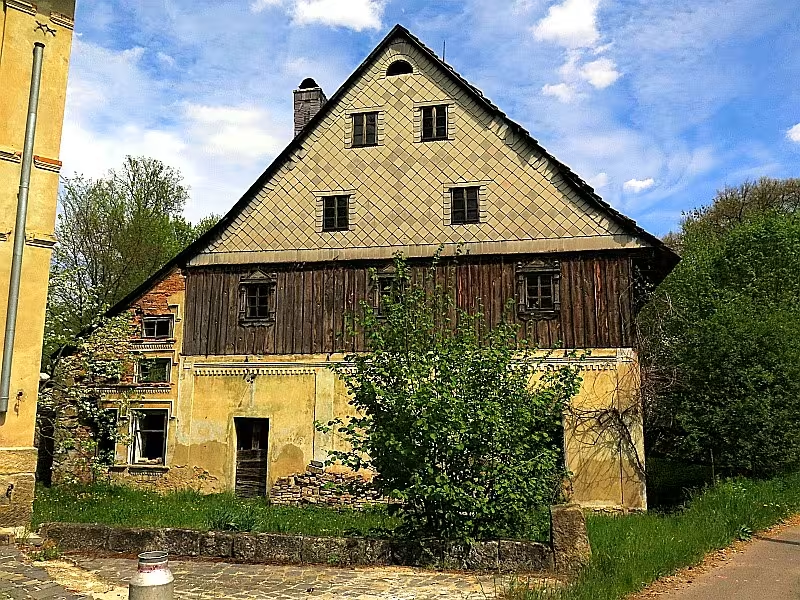
Rohovský mlýn, located in Rochov u Úštěk in the district of Litoměřice, is a water mill built on Uštěcké potok and protected as a cultural monument of the Czech Republic. This building is remarkable by its architecture from probably the first half of the 19th century, which was a period of intensive industrial and infrastructure development in Bohemia. The mill boasts a two-storey half-garted construction with a walled ground floor and a floor decorated with a late empirical stucco facade, which is supplemented with pilasters and tooth bands. The grafted parts are equipped with elements in late classical style.
The history of Rohovský mill probably dates back to the 1st half of the 19th century, which was a period of intensive development of milling industry in Bohemia. Water on the water wheel led the drive from the pond, which was later released. This type of infrastructure was a common element of the mill facilities at the time and served as an important source of energy for the operation of the mill.
The Rohovský Mill is an architect of late Empire style, which is reflected in its stucco facade with pilasters and tooth bands. The grafted parts are decorated with elements in a late-classical style that give the object a unique character. In 1930, a Francis turbine was installed in the mill with a flow rate of 0.156 m ³ / s, a drop of 3.8 m and a power of 13.2 HP, indicating the modernization of the equipment during its history.
The information about the specific owners or managers of the mill is insufficient, but it is known that the object has undergone several phases of modernization and maintenance. The key event was the installation of the Francis turbine in 1930, which meant technological progress compared to the original mill operation.
Today the Rohovský Mill is a protected cultural monument and is worth visiting thanks to its history, architecture and location at the Pittoreský Úštěcský stream. Although specific information about owners or dramatic changes is missing, its preservation as a cultural monument highlights its historical and aesthetic value. The visit to this mill offers an opportunity to explore part of the milling heritage of the Czech Republic and appreciate its architectural details.
The Rochov Mill is not only a monument but also a witness to the history of industrial development in the region. Its preservation allows the following generations to appreciate and understand the importance of milling for the past society. By exploring this object, visitors will not only save themselves the memory, but also get a deeper insight into the history and culture of the Úštěk region.
Architectural development
The mill is probably from the first half of the 19th century. Water on the water wheel led the drive from the pond, which was later released.
Historical events
- 1930
- The mill had one Francis turbine with a flow rate of 0,156 m ³ / s, a drop of 3,8 m and a power of 13,2 HP.
Points of interest
- Rohovský mlýn is built in Úštěcké potok and protected as a cultural monument of the Czech Republic.
- The mill boasts architecture from probably the first half of the 19th century, which was a period of intensive industrial and infrastructure development in Bohemia.
- Architecturally, it is a representative of late Empire style with stucco facade decorated with pilasters and tooth bands, the grafted parts have elements in late classical style.
- In 1930 a Francis turbine was installed in the mill with a flow rate of 0.156 m ³ / s, a drop of 3.8 m and a power of 13.2 HP, which shows the modernization of the equipment during its history.
- Today Rohovský Mill is a protected cultural monument and is worth visiting thanks to its history, architecture and location at the Pittoreský Úštěcský stream.
Guide
Show guide text
This text was created by artificial intelligence and has not been editorially reviewed. It may contain inaccuracies.
Welcome to Rohovsky Mill. You've just stopped by one of the most prominent construction sites in this part of the country. Before we go into deeper exploration, let yourself stand for a moment and soak up the atmosphere of this place. Do you hear that constant, soothing noise? This is the Ostrich stream that has been flowing through these shores for centuries and gives power to this very building. In front of you is an object that is not just a simple house by the water, but a living witness of a long time ago when the rhythm of human life was closely linked to the movement of flowing water and working in the agricultural industry. Look at his face and try to imagine what this landscape looked like two hundred and forty years ago.
Let us now return in time to understand why this mill is so special. Although the exact date of its foundation remains hidden in history, architecture and the way of construction tells us a great deal. The mill probably originated in the first half of the nineteenth century. This was a period that could be described as a time of huge expansion. At the time, infrastructure and industrial production developed intensively in the then Czech countries. The mills were at that time the absolute foundation of the economy, the indispensable nodes, where grain was processed and where people from surrounding villages met. The Robov Mill did not therefore rise only as a private enterprise, but as part of the wider technological progress that changed the face of the country at the time. It is precisely because of its historical value and unique character that this mill is today protected as a cultural monument of the Czech Republic, which gives it a completely different dimension to ordinary buildings in the surroundings.
Now pay full attention to the construction itself, which stands right before your eyes. Look at the structure. It is fascinating how two completely different worlds are mixed here - a world of durable stone and masonry and a world of traditional wooden construction. The mill has two floors and its foundation consists of a wall floor and a floor, which ensured the necessary stability for the hard work that took place inside. But above this foundation is a semi-grafted structure that gives the building its specific, rural character.
Try to take a closer look at the facade of the upper floor. Notice how the simplicity of the rural mill meets the elegance of urban architecture. The facade is decorated with late Empire stucco decoration. If you look at the vertical elements, you will see pilasters, which are impact columns, which make the facade optically radiate and give it nobility. Note also horizontal details - these are tooth bands that create a fine shadow and rhythm on the walls. This style, late empirical, was a symbol of stability and order at that time. But not everything here is made of plaster and stone. When your eyes slide to the grafted parts, you see something completely different. These wood elements are not just beams. They are decorated with carved details in late classical style. This combination, when the wooden craft meets the architectural decorating style, is extremely rare, and that is precisely the aesthetic strength of this place.
Although we do not know the names of the particular architects who designed this project, we can feel the hands of the masters of our craft in every cutting of wood and every decorative element. Imagine a miller who lived and worked here every day. His life was dictated by the level of the stream and the seasons. He must have understood water, mechanics and material. The mill wasn't just a building, it was a machine that had to work all the time to ensure the livelihood of the people around it. Even though the mill is no longer used so intensively, its presence still exudes the special, silent dignity of a place that had its clear purpose and importance for the whole community.
You might find one interesting thing that connects what seems contradictory in this building. Most of the historical mills were either purely practical or purely residential. But the Rohov Mill is a fascinating example of synthesis. It is also a robust working machine built on water and at the same time an elegant building that is not afraid of the decorative stucco and architectural details that you would rather find in the urban houses of that time. This unusual combination of rural semi-garbled style and urban empirical decoration makes it a real architectural unique one that deserves your attention.
Now that you've seen the main features of this monument, I suggest you continue your walk around the building. Try to look at the mill from other angles, watch how light changes to its decorated facade and how the shadow pilaster changes depending on the position of the sun. Feel the connection of this building to the nature surrounding it. Thank you for spending this moment with us and paying attention to this piece of history. We wish you a beautiful and inspiring next trip around.
Tips for visitors
The best time to visit is when there is plenty of water in Úštěcky stream, which gives the mill an authentic atmosphere. For photography we recommend to use the morning or late afternoon light, which will highlight beautifully the semi-gagged construction and texture of wood. The best angles for the images are from the bank of the stream, where you capture the mill in the whole continuous context with water.
You can reach the mill by car and public transport. The current connection of means of transport is best verified in the Internet search engine.
For a comfortable experience, bring with you comfortable shoes suitable for the terrain of the water stream and possibly your own refreshments. It is advisable to be prepared for walks in the natural environment right by the water.
Families with children can appreciate the observation of the water stream and the proximity of nature, however it is necessary to keep children under constant supervision for water safety. It may be interesting for children to watch the water flow around the mill.
Within this location you can focus on observing the historical architecture of the mill itself. Since there are no other targets in the immediate vicinity, we recommend that you concentrate fully on a detailed tour of this protected cultural monument.
Frequently asked questions
Can the monument be visited?
This is a technical monument. Some are open as exhibitions, others are out of use or on private land. We have not verified whether this one is accessible.
What are the opening hours and admission?
We have not verified the opening hours or admission. Current information is published by the operator.
Where is the monument?
Location: Úštěk, Ústecký kraj. The map on this page shows the exact spot.
Why is the monument protected?
It is listed in the Central List of Cultural Monuments of the Czech Republic as a cultural monument (register no. 1000155539).
Businesses nearby
Do you run a restaurant, accommodation, shop, museum, rental, wellness or other visitor service near this monument? Show yourself directly to the people heading to it — this is how they will see you in the app and on the web:
Nearby
🏰 Historic sites (105)
- Muzeum čertů 4.0 km
- Muzeum pohlednic Úštěk 4.0 km Podskalská 17 +420 416 795 418 web
- Galerie U brány 4.0 km 1. máje 52 +420 416 731 643 web
- Pomník vojákům Rudé armády 4.2 km
- 1914-1918 4.3 km
- zámek Liběšice 4.3 km
- Helfenburk 4.7 km
- osvobození 1945 4.8 km
- sv. Jan Nepomucký 4.9 km
- 1945 5.0 km
- Hřídelík 7.5 km
- Julius Komárek 7.8 km
- Nejsvětější Trojice 7.8 km
- Zřícenina hradu Levín 8.2 km
- svatá Máří Magdaléna 8.2 km
- Litýš 8.3 km
- 1945-1948 9.0 km
- 1914 9.3 km
- zřícenina hradu u Hvězdy 9.5 km
- Fort Křemín 9.5 km
🍽️ Restaurants and dining (142)
- Racek 3.9 km Levínská 134 +420 728 705 208 web
- Pizzerie Čertovna 4.0 km
- Hradní kavárna 4.0 km
- Motorest Kulturák 4.1 km
- Pod podloubím 4.1 km Mírové náměstí 58
- U Zámku 4.2 km
- Zmrzlina, zákusky 4.3 km
- Sporthotel Patriot 4.4 km Sídliště pionýrů 263 +420 416 535 467 web
- Sáčko 4.5 km Sídliště pionýrů 154
- U Skrblíka 4.7 km
- Statek pod Kalvarií 4.9 km +420 602 344 829 web
- Pod Kalvárií 4.9 km
- Hotel U Lišky 6.6 km
- U Gregorů 6.7 km
- Hospoda U Libora 6.8 km
- Lesní hospůdka Na Skalce 7.1 km
- Pod Ronovem 8.0 km +420 725 099 307
- U Levínského Kocoura 8.2 km
- Pivovar Spitt 8.9 km
- Motorest Nučnice 9.1 km +420 416 786 159 web
🏨 Accommodation (87)
- Kemp Úštěk u jezera Chmelař 4.0 km
- U rybníka 4.4 km Rybniční 240 +420 737 920 494 web
- Statek pod Kalvarií 4.8 km +420 602 344 829 web
- 2 7.6 km
- Junák 7.6 km
- Devítka 7.6 km
- Tarzan 7.7 km
- Sosna 7.8 km
- Myšárna - Wakan 7.8 km
- Kancelář 7.9 km
- Staré sedlo 7.9 km
- Strážce lesa 8.0 km
- ARTG 8.0 km
- Kačabača 8.0 km
- Krkavec 8.1 km
- U ptáčka 8.1 km
- Srdce starý party 8.1 km
- Přespávací převis 8.1 km
- Náhoda 8.1 km
- Lasička 8.3 km
🚲 Rentals and sport (10)
- Sportcentrum 6.7 km
- Labe aréna Račice 10.5 km
- Roudnický bazén 14.2 km
- Yachtklub Roudnice nad Labem 14.2 km
- Plavecký bazén 14.3 km Daliborova 2078/7
- Yacht-klub Lovosice 14.4 km web
- Sokol 14.7 km
- bajk:a 14.7 km
- Střelecký klub Dubá 14.8 km
- norskamoda 14.9 km
🥾 Hiking and nature (222)
- Na Černčí 2.4 km
- Pod Budinou 3.7 km
- Budina 3.9 km
- Písková výšina 3.9 km
- výhled na Helfenburk 4.6 km
- Helfenburk 4.7 km
- výhled na Helfenburk 4.8 km
- Johanův kámen 4.9 km
- Hrádecký důl 5.0 km
- Opomenutá 5.0 km
- Poutní kaple Ostré 5.0 km
- Matznerova věž 5.1 km
- Hořidla 5.2 km
- Zaječí stěna 5.2 km
- Zaječí hlava 5.2 km
- Zaječí hřbet 5.2 km
- Svišť 5.2 km
- výhled na Opičí skálu 5.3 km
- Žabka 5.7 km
- Krásná studánka 5.7 km
Accommodation nearby
Trips and activities nearby
Guided tours, tickets and activities nearby from GetYourGuide
Affiliate link: if you buy from the partner, we may receive a commission. The price for you does not change.
Search tours and activities →Themed route
Thematic cruise route "View history and nature"
1. Vodní mlýn (Rochov) - Mill Start your journey at the Water Mill, which is not only a technical monument, but also a place full of history. This ancient mill welcomes you with its architecture and offers a view of traditional ways of restoring energy. It's an ideal place to understand the past when water was used as the main source of energy.
2. Forest walkways at Úštěku - Walkway After visiting the mill, proceed to nearby forest pavements that will guide you through the natural beauty of the surroundings. These sidewalks are ideal for relaxing walks and listening to the silence of nature. It is also an opportunity to enjoy the fresh air and see the local fauna.
3. Historical Living Zone Úštěka - Living Complex After walking in the forest you will return to Úštěk itself, where you can explore the historical parts of the city. These areas welcome you with ancient houses and architecture, which tells about the rich past of this place. It's a great way to learn more about local life in earlier times.
4. School and School and Real - Educational facilities Continue to the school area where you can explore an educational institution that is an important centre for the community. This place offers the opportunity to learn more about the current life and education system in the area.
5. Traditional Czech cafe - Restaurant To relax after a day's walk, we recommend visiting one of the traditional Czech cafes in Úštěk. Enjoy authentic Czech cuisine and drinks here, which is a great way to end your adventure.
This route will offer you a combination of history, nature and cultural experiences that will make you unforgettable.
Seasonal recommendations
Spring: In the spring nature awakens around the mill and water flows are very lively thanks to melting snow and spring rains. The light is soft in this period and ideal for capturing details of the historical building in the background of fresh green leaves. For a visit I recommend choosing layered clothes because the morning cold can quickly turn into warmer air during the day. It's the perfect time for a quieter tour before the season starts.
Summer: The summer months bring a rich green screen and a pleasant shade to the surroundings of the mill, offering shelter from the heat. The voice of flowing water is very refreshing in the summer days. Due to the main summer season get ready for a larger number of visitors, therefore it is best to arrive early morning or late afternoon. Dress lightly and don't forget enough fluids.
Autumn: Autumn season turns the surroundings of the mill into a colorful world full of gold and red shades, creating a nostalgic and calm atmosphere. The morning mist above the water gives the place mystery, but they can limit the view. High-quality waterproof footwear and laminated clothing are essential for this time of year, as humidity and cooler air are a common phenomenon. It's the best time for those who seek solitude and peace without crowds.
Winter: In winter there is silence around the historic mill and the landscape turns into a freezing, often snowy scene. The ice cover on the water surface and the crispy snow create a completely different, more crude character of the place. Due to short days and lower temperatures it is necessary to wear very warm clothes and schedule a visit so that it can still be done in the light of day. There are the least people in this period, which allows a deeper perception of history in silence.
Visualizations and artistic views


The visualisations are generated by artificial intelligence and serve as inspiration.
Photos from the area
Real photos taken near the monument


Zdroj a licence jsou uvedeny u každého snímku.
Tips from visitors
No tips yet. Be the first!
Log in and add your tip.
Sources and literature
Photos: Sovicka169 / CC BY-SA 4.0 — Wikimedia Commons. The author and licence also appear when you hover over the image.
Faktickým podkladem tohoto textu byl článek na Wikipedii, jehož autory jsou přispěvatelé Wikipedie. Článek je dostupný pod licencí CC BY-SA 4.0.
Location on the map
Příběhy a pověsti
Legendy, pověsti a příběhy spjaté s touto památkou
Fotografie návštěvníků
Zatím žádné fotografie. Buďte první, kdo přidá fotografii z návštěvy!
Log in a přidejte svou fotografii nebo hodnoťte.
Za ověřenou návštěvu v aplikaci získáte víc bodů — poznáme podle GPS, že jste na místě.
Reviews and comments