



Vodní nádrž Harcov Water structure
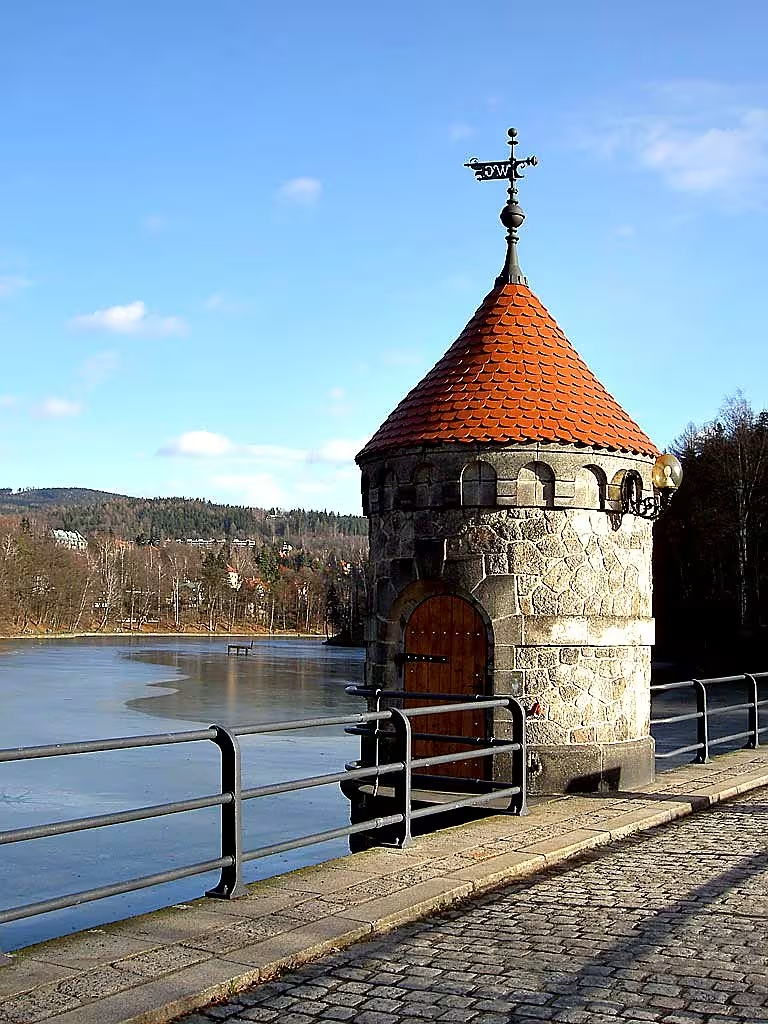
Vodní nádrž Harcov is a dam tank in the valley of Harcov creek in the local part of Liberec V-Kristiánov. She was shot on April 29th, 1904. It is the first valley in Bohemia and the first heavy wall dam in Central Europe.
The need for construction arose in response to catastrophic floods of 30 and 31 July 1897. These caused considerable damage in and around Liberec, including the destruction of Liebieg's factory. In order to protect the city from flooding and to secure water supplies for industry, the Water Cooperative was founded on 25 September 1899 to regulate river flows and to build a dam in the water catchment area of Zřelecká Nisa. The head of the cooperative was the factory Karl Zimmermann, among the members were also Count František Clam-Gallas and glassmaker Leopold Riedel. The project was commissioned by the Dam Otto Intze, who presented his plans on 13 January 1901.
From the point of view of the construction, it is a heavy wall dam with a height of 20,5 metres and a length of 157 metres. Its crown is located 13 meters above the surrounding terrain. The width of the dam is 4.5 metres in crown and 16 metres in heel. Three quarry stones in the flood area were used for construction. The best quality and suitable stones for masonry were selected for the mantle. The dam stands on solid granite ground. At a depth of 8 meters, the apparent leaks were solved by drainage and cement milk. The work includes five holes of a 5-metre-wide security overflow with a follow-up waste gutter with an eight-stage cascade. The lower outlet with a piping diameter of 800 mm was covered with a brick stopper.
The construction was realized by W. Streitzig and spol. from Liberec and H. Rell and nephew from Vienna. The total cost of the work was 789 111 CZK. The cooperative received support from the Land Assembly in the form of non-refundable contributions and interest-free loans. Currently, the water works are operated by the State firm Podozi Elbe.
The dam was already useful in November 1904 when it stopped the flood of 230 000 m ³. The tank was part of the German-Czech exhibition in 1906. There were sea battles on its surface and exhibition pavilions on the shore. In later years, a promenade, a city swimming pool and a left-hand road were established. In 1954, a 750-metre-long supporting wall was built against the erosion of the right bank, and in 1990 Banki's turbine was installed with a maximum output of 11 kW.
The technical parameters of the tank include a total volume of 687 000 m ³. It is able to hold 630 000 m ³ water from the water catchment area of 14,78 km ². In 1986, sediments were extracted from the bottom and sewers were built. Since the autumn of 2022, there has been a major reconstruction of the dam and overflow. The aim is to increase safety and increase retention space. The tank start-up after these works is planned for the beginning of 2026.
Today, the building serves primarily as a holiday place for the inhabitants of Liberec. In its surroundings there are protected animals, especially the common toad, the common lentils, the large scaffold, the grey forest and the western hedgehog.
Vodní nádrž Harcov presents a unique example of the beginnings of modern dam in Bohemia. Her visit offers an opportunity to see a historic water work that has fundamentally affected the safety and development of Liberec.
Then and now
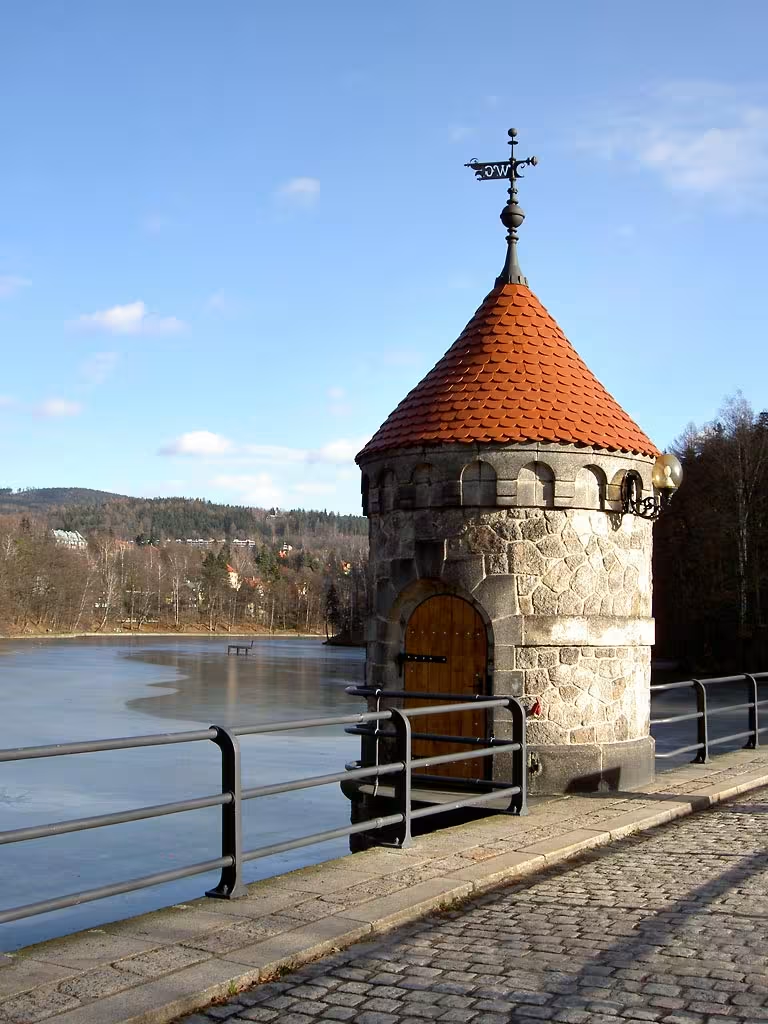
Drag the slider to compare how the landmark may have looked when it was built with the view today.
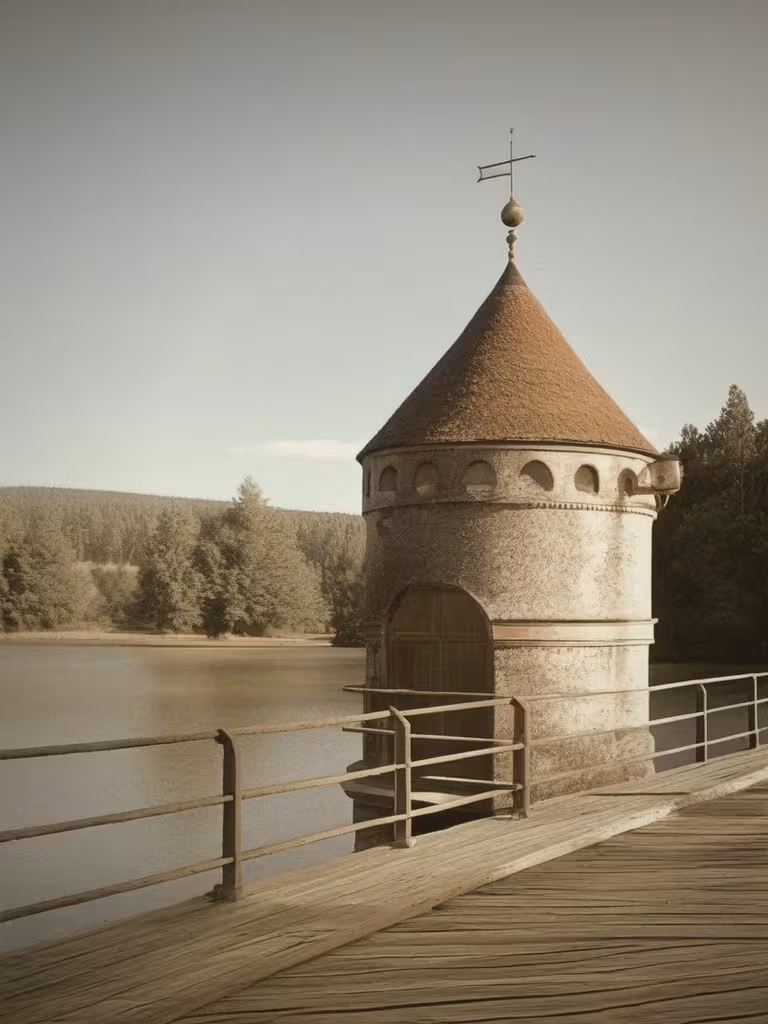
The historical appearance on the left is an AI-generated visualisation and serves as inspiration only.
Historical milestones
- 1901
- presentation of project plans by Otto Intze
- 1902
- opening of land works in november
- 1903
- laying of base stone dam 27 june
- 1904
- completion of construction and collapse on april 29
Architectural development
This is the first heavy wall dam in Central Europe. The best quarry stones in the flood area were used for the mantle, while the air brow was decorated with ordinary stones. The construction includes five holes of a security overflow with an eight-stage cascade.
Historical events
1897: catastrophic floods in Liberec; 1899: establishing a Water Cooperative to regulate river flows and build a dam; 1904: construction collapse.
Owners
operated by the state enterprise Povodi Elbe
Points of interest
- It is the first valley in Bohemia and the first heavy wall dam in Central Europe. - The need for construction arose in response to the disastrous floods of July 1897. - Three quarry stones were used in the flood area for construction. - In 1906 the tank was part of the German-Czech exhibition where sea battles took place on the surface. - There are protected animals in the vicinity of the water work, such as the toad or the hedgehog.
Guide
Show guide text
This text was created by artificial intelligence and has not been editorially reviewed. It may contain inaccuracies.
Welcome to Harcov water tank. You're standing right in front of a place where the power of nature combines with human wit and courage. The water level in the valley of the Harcovsky creek is decomposing before you, which today is peaceful and the trees of the surrounding countryside are hovering over it. It's a place that's likely to impress you with its atmosphere of peace and tranquility, but behind that look is a fascinating story from the beginning of the last century.
When you look at this structure, you don't just have to see a recreational place, but above all a monumental protective shield. To understand why this tank was even built, we need to go back more than a hundred years in time. In July, a thousand eight hundred ninety-seven struck this area with catastrophic floods. The water has destroyed many homes and caused huge damage that has left a profound impression and fear of future floods in people. It is this tragedy that has become the main impetus for the creation of a project which was to protect the city of Liberec definitively from similar disasters. At the same time, a solution was sought to ensure a reliable water supply for a very strong industry in the region.
Now let's look at how this idea turned into reality. The whole project was designed by a renowned expert Otto Intze. His plans were presented in a thousand nine hundred and one. The work was not easy, because construction in the valley required precise planning. In November of the year a thousand and nine hundred and two began the first earth work, which meant huge transfers of clay and stones. The crucial moment was then the 27th June of the year a thousand nine hundred and three, when the foundation stone of the dam itself was ceremonially laid. The whole building progressed very quickly and as early as twenty-ninth April in the year one thousand nine hundred and four the work was completed and officially handed over for use.
Now pay attention to the very structure that stands before you. Notice her mass. It is not just the ordinary wall, but the first valley in Bohemia. That means she was the first in her size and the way she closed the valley of the creek. But even more important is the fact that it is the first heavy wall dam in Central Europe. The word "heavy" means that its stability and its ability to hold a huge amount of water lies in its own weight and wall thickness. When you look at the surface of the dam, realize that this structure has to face the constant pressure of water from one side while remaining completely stationary.
If you're wondering what this building is made of, the answer lies directly below the surface you see. Three quarry stones were used for construction, which were located in the flood area. That was a very clever procedure. The quarry was in a place that was then to be flooded with water, so the material did not have to be transported from a distance. The stones were extracted right here, processed and then inserted into the dam body. It is fascinating to think that the material that forms the foundations of this work comes from places that now lie far below the surface of the tank.
The names of the men who have given their vision and support to it are linked to this construction. In addition to Otto Intze's said designer, they played their role as an important figure of their time. These included František Clam-Gallas, Leopold Riedel or Karl Zimmermann. These people were the top in the area of administration, financing and technical leadership at that time. Thanks to their cooperation and determination, they managed to build a work in such a short time, which at that time represented the peak of water construction.
Now I'm going to lead you to one interesting thing, which will help you imagine the role Harcov played in a broader context. In a thousand and nine hundred and six, this tank became part of a large German-Czech exhibition. Imagine this place not as today's silent park, but as a center of attention, where thousands of visitors from different counties flowed. At that time, the tank was a symbol of modernity, technical progress and man's victory over the destructive power of water. It was the pride of the region that showed that people were able to turn tragedy into something useful and beautiful.
Nowadays, Harcov is no longer primarily a flood defense or a factory storage facility, although it maintains its technical functions in the core. It has become a popular resting place for the inhabitants of Liberec and visitors from the surroundings. It's a space where you can exhale, walk around the water and forget the rush of the city. But it is important to remember that this peace is redeemed by the precise work of engineers from the early twentieth century.
Now, when you look around, feel the contrast between the massive wall structure and the fineness of the surrounding nature. This building is a bridge between the past, when water was a danger, and the present, when water is a source of relaxation and beauty. It is a monument to the human ability to respond to a crisis of balance and create things that will last generations.
Imagine how workers moved here over a century ago with spade in their hand, how it sounded the sound of hammers hitting a rock, and how, in the year one thousand nine hundred and four, the water of the valley first flooded and created this python that you see today. It's a place with its own soul that tells the story of courage, technical progress and care for the safety of the people.
Now I invite you to walk along the shore at a slow pace and to observe the power of the dam from different angles. Try to imagine the three quarries that disappeared below the surface, and think about how much work it took to build the first valley tank in our countries. Explore the surrounding paths, perceive the splendour of water and let the atmosphere of this unique water work engulf you.
Thank you for spending some time with us at Harcov Water Tank. We hope that you are interested in this short trip to history and that you are now seeing more than just a pond in the landscape. We wish you a pleasant rest of the day and a pleasant exploration of this beautiful place. Goodbye.
Tips for visitors
The best time to visit is spring or autumn, when the colours in the valley of the creek are the most pronounced and nature around the dam is the most distinctive. Transport to the Kristiánov area is possible by car and public connections, check the specific path in the maps.
In the valley take suitable shoes for nature walks and repellent as you move in an area with rich fauna. For photo lovers I recommend morning or late afternoon light, which will illuminate the water level and surrounding trees beautifully; the best shots can be obtained from elevated areas with a view to the whole tank.
During the walk, focus on the observations of animals that live here, such as various species of mutton, toad or hedgehog. For families with children, it is ideal to focus on finding traces of local birds, such as a grey leech or a large maggot.
In addition to the water work itself, I recommend exploring the surrounding nature within a short walk where you can observe protected animals in their natural environment.
Frequently asked questions
Can the monument be visited?
This is a structure in a public space that can usually be seen from outside free of charge. We have not verified that this particular one is freely accessible.
Where is the monument?
Location: Kristiánov. The map on this page shows the exact spot.
Why is the monument protected?
It is listed in the Central List of Cultural Monuments of the Czech Republic as a cultural monument (register no. 1000156304).
Businesses nearby
Do you run a restaurant, accommodation, shop, museum, rental, wellness or other visitor service near this monument? Show yourself directly to the people heading to it — this is how they will see you in the app and on the web:
Nearby
V okolí přehrady žijí chránění živočichové, například ropucha obecná, čolek obecný, strakapoud velký, lejsek šedý a ježek západní.
Accommodation nearby
Trips and activities nearby
Guided tours, tickets and activities nearby from GetYourGuide
Affiliate link: if you buy from the partner, we may receive a commission. The price for you does not change.
Search tours and activities →Themed route
Here is a design of a thematic route focused on nature around the village Kristiánov:
1. Vodní nádrž Harcov (water work) - The main destination of the trip, where you can enjoy a view of the water level and calm landscape. 2. Place of occurrence of bluefin tuna and common wheat (natural observations) - You can find these amphibians in wet areas near the dam. 3. Feed the maggot and the catfish (ornithological walk) - Watch these rare birds around the tank in their natural behavior. 4. Hiding hedgehog western (natural observation) - Walk around the edge of the area where, if you are lucky, you will see this protected animal.
Seasonal recommendations
In spring, the surroundings of the water works awaken to life and the landscape around Kristiánova green. The air is fresh and the water in the tank reflects the bright blue sky. We recommend shoes suitable for wet terrain and light coating of clothing, because the wounds can still be cold. The best time for a walk is in the morning when nature is most vital.
Summer brings hot days and intense sun that creates sharp shadows on the surface of the water. The atmosphere is relaxed and the surrounding forests provide a pleasant shade. It is advisable to choose light, breathable clothes and not forget the sun protection. Due to high temperatures, it is best to visit the place in the early morning hours or shortly before sunset.
In autumn, the surrounding trees turn into golden and red shades, creating a melancholy mood. Light is softer and golden, which is ideal for landscape observation. It's practical to wear a waterproof jacket and tight shoes because the road can be slippery from the fallen leaves. An ideal visit in the afternoon is when the colors are most saturated.
In winter the landscape can be covered with snow and the silence around the tank is almost absolute. The atmosphere is strict but calm, and the freezing air gives the place a different character. Hot and waterproof clothing, including gloves and caps, is essential. It is best to go out in the light of day so that it is safe to go around the water.
Visualizations and artistic views


The visualisations are generated by artificial intelligence and serve as inspiration.
Photos from the area
Real photos taken near the monument


Zdroj a licence jsou uvedeny u každého snímku.
Tips from visitors
No tips yet. Be the first!
Log in and add your tip.
Sources and literature
Photos: Original uploader was Pavel.satrapa at cs.wikipedia / CC BY-SA 3.0 — Wikimedia Commons. The author and licence also appear when you hover over the image.
Faktickým podkladem tohoto textu byl článek na Wikipedii, jehož autory jsou přispěvatelé Wikipedie. Článek je dostupný pod licencí CC BY-SA 4.0.
Location on the map


Příběhy a pověsti
Legendy, pověsti a příběhy spjaté s touto památkou
Fotografie návštěvníků
Zatím žádné fotografie. Buďte první, kdo přidá fotografii z návštěvy!
Log in a přidejte svou fotografii nebo hodnoťte.
Za ověřenou návštěvu v aplikaci získáte víc bodů — poznáme podle GPS, že jste na místě.
Reviews and comments