



Vratislavský dům (Praha) Palace
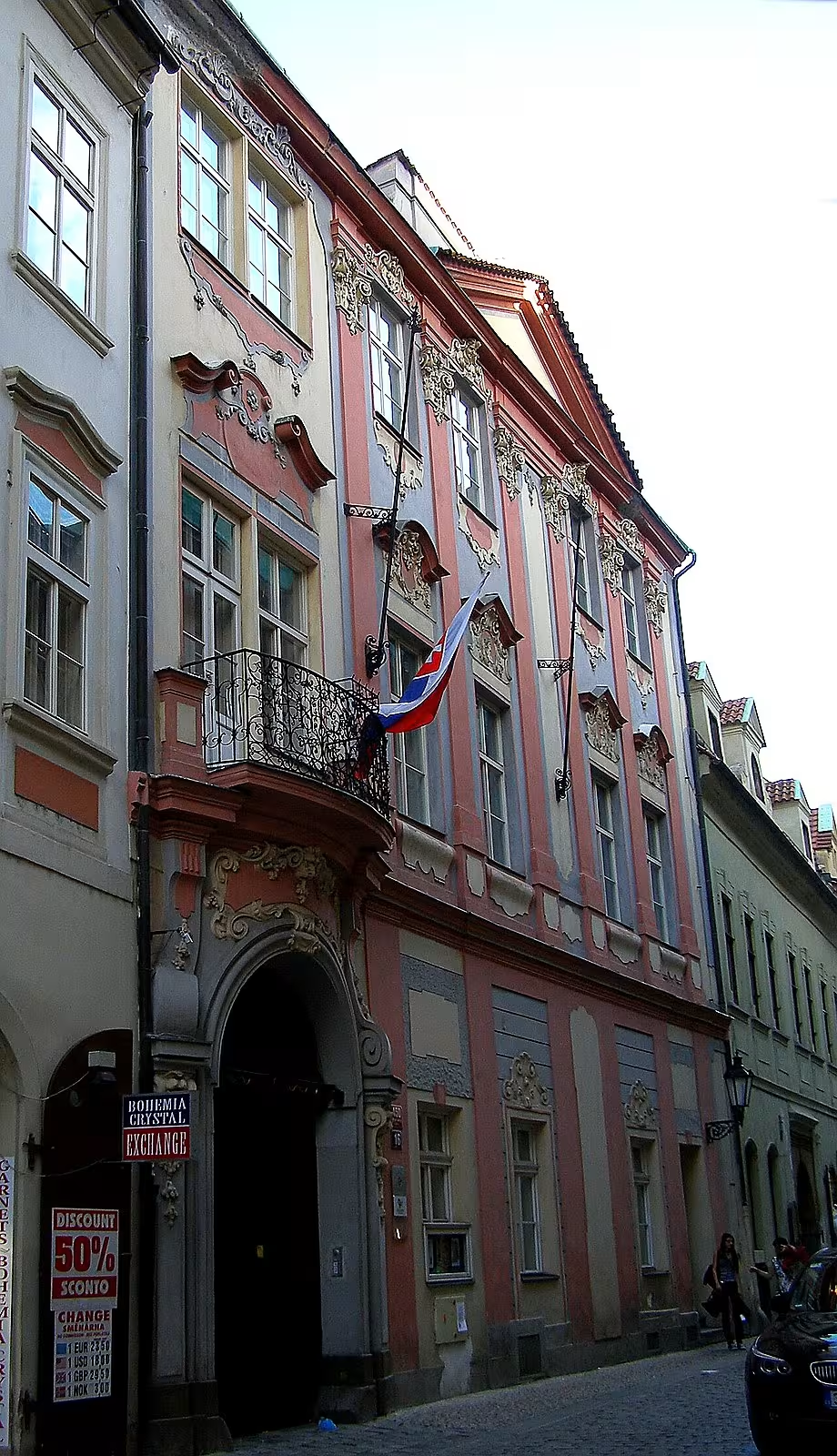
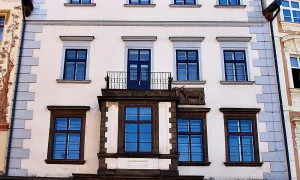
The Wrocław House in Jilska Street 450 / 16 on Prague's Old Town is an important palace building with richly decorated top Baroque facade. Since 1964, the building has been registered as a cultural monument. It is an example of a noble residence that has undergone many building modifications and changes in use over the centuries.
The exact building development of the building is not known in detail. Originally there were two Gothic townspeople 'houses, which were later joined and converted into a palace. A fundamental change of appearance occurred during the period of the high Baroque between 1752 and 1765 when the current street facade was created.
The architectural house stands out for asymmetrical solution of two storey facade, which is divided in ratio one, two and two window axes. There is a triangular shield above the crown ledge in the right side of the building. An important element of the ground floor is a richly decorated portal, supplemented by tilted pilasters with volute headers. Above the entrance there are brackets carrying a balcony with metal railing. Classicist modifications from the 19th century did not significantly affect the appearance of the building. Further modernization took place only at the turn of 1938 and 1939, when the passage was modified and the laboratory set up in the premises above it.
House ownership has often changed over the centuries. The owners were noble families such as Mladotové, Kolovrat-Libštejnští or Morzinové. The house was also owned by an inspector of the Black Manor Jan Kryštof Seifrid. In the middle of the 18th century the object belonged to the Philippines Josefa Vratislav, the wife of Vincent Ignác Vratislav from Mitrovic. Since 1850, the owner was a trader Josef Neumann.
The history of the house is associated with a number of cultural and scientific activities. At the time the house was owned by Filipína Josefa Vratislavová, there was allegedly an amateur theatre. The music composer Carl Maria von Weber, who lived in the house from 1813 to 1816, was an important person associated with this place, when he worked as conductor and artistic director of the Stavov Theatre. After World War II, the premises were used by the research institute for the pharmacology of the Czechoslovak Academy of Sciences and the Slovak Institute was based here until 2016.
The Wrocław House is a valuable sign of the changes of Prague building from Gothic foundations to the highest Baroque representative architecture. The visit to Jilska Street in the historical centre of Prague offers the opportunity to see this monument protected object and to see its rich past in the context of the surrounding construction of Old Town.
Historical milestones
- 1752
- Commencing modifications to the baroque facade.
- 1813
- Moving in the music composer Carl Maria von Weber.
- 1938
- Start modernization of the building for laboratory needs.
- 1964
- House registration as a cultural monument.
Architectural development
The building was created by connecting two Gothic townhouses. The prominent baroque facade was realized in the middle of the 18th century. Classicist modifications were carried out in the 19th century and in the 20th century the internal space was upgraded for scientific purposes.
Historical events
In 1752-1765, a top Baroque reconstruction of the facade took place. In 1813-1816 the music composer Carl Maria von Weber lived in the house. In the years 1938-1939 there was modernization of the transit and establishment of laboratories.
Owners
Mladotové, Kolovrat-Libštejnští, Jan Kryštof Seifrid, Filipína Josefa Vratislavová, Morzine family, Josef Neumann (since 1850).
Points of interest
- The building was created by connecting two originally Gothic townhouses. - Highly Baroque form of street facade was created between 1752 and 1765. - From 1813 to 1816 there was a music composer in the house who led the Stavovská theatre. - At the turn of 1938 and 1939, the passage was modified and there were laboratories above it. Since 1964, the building has been registered as a cultural monument.
Guide
Show guide text
This text was created by artificial intelligence and has not been editorially reviewed. It may contain inaccuracies.
Welcome to the heart of the Old Town of Prague, where you are just in front of one of the most famous historical objects in this city area. You are standing in front of the Wrocław House in Jilska Street, whose rich baroque facade bewitched you from the first sight. This palace building is a real proof of the history and culture that intertwined in Prague for thousands of years.
Let's dive into his rich past. The Wrocław House has roots dating back to the Gothic times, when there were two townhouses. These buildings were gradually rebuilt and merged into one majestic building. The key moment in his history was in 1752, when the modifications to the baroque facade, which you see so pleasantly today, began. This architectural style brought to the street immense elegance and distinctive.
Look up on the top Baroque facade, which is full of details and ornaments. This architectural style is characterized by its complexity and dynamic forms, allowing you to appreciate the builder's championship of that time. Even though we don't know the names of particular architects, their work reminds us of how rich history and art intertwined in this city.
Now let's talk about the key personalities that were connected to this place. From 1813 to 1816, the music composer Carl Maria von Weber, known for his conductor of the Stavov Theatre, lived here. His presence in the house has added another layer of cultural fame to his history.
Another interesting moment was 1938, when the house began to modernize for laboratory needs. This transition from the nobility to the scientific center reflects the changes in the history of the city.
The interesting thing is that the Wrocław House was connected to several important families such as Mladotové and Kolovrat-Libštejnští. These noble families not only inhabited this object, but also actively participated in its history and development.
And now that they've explored all these important places, we're going to invite you for another tour. There are still many attractions waiting in the Old Town and every corner of this historic centre has a story. I hope the House of Wrocław has become not only a beautiful monument for you, but an inspiring place full of life and history.
Thank you for your visit and we wish you many other discoveries. When we meet at another interesting place in Prague!
Tips for visitors
A tour of the Wrocław House is recommended to plan for the morning hours when the sun illuminates the richly decorated Baroque facade from the eastern side, which is ideal for detailed pictures of architecture. You can best reach the historical centre of Prague by walking or by public transport, whose current connection can be found in travel applications. Take with you comfortable shoes suitable for walking on historic tiles and a camera with wide-angle lens to help you capture the majesty of the palace facade in a narrow Jil street. In the immediate vicinity, you can visit the Old Town Square, the Church of St. Jilje or take a walk through Charles Street, while the whole area offers many incentives for families with children who appreciate the atmosphere of old Prague streets and observing details on historical houses.
Frequently asked questions
Can the monument be visited?
Some buildings of this kind are open for guided tours, others serve another purpose or are privately owned. We have not verified whether and when this monument is open – please ask the operator.
What are the opening hours and admission?
We have not verified the opening hours or admission. Current information is published by the operator.
Where is the monument?
Location: Praha 1. The map on this page shows the exact spot.
Why is the monument protected?
It is listed in the Central List of Cultural Monuments of the Czech Republic as a cultural monument (register no. 1000150512).
Businesses nearby
Do you run a restaurant, accommodation, shop, museum, rental, wellness or other visitor service near this monument? Show yourself directly to the people heading to it — this is how they will see you in the app and on the web:
Events nearby

Zdroj akcí: otevřená data měst a obcí ČR (Národní katalog otevřených dat) a kalendář akcí Národního památkového ústavu.
Nearby
Staroměstské náměstí, kostel svatého Jiljí, Karlova ulice, historické centrum Prahy.
Accommodation nearby
Trips and activities nearby
Guided tours, tickets and activities nearby from GetYourGuide
Affiliate link: if you buy from the partner, we may receive a commission. The price for you does not change.
Search tours and activities →Themed route
Thematic cruise route: Historical center of Prague
1. Old Town Square (square, historical site) The Old Town Square is the heart of the Old Prague city and its most famous space. It is an ideal place to start a trip because it offers a view of historical architecture and is the center of many cultural events.
2. Church of St. Gilji (Church) - The church of St. Gilji, famous for its high organ tower and beautiful Gothic architecture, is worth a visit. It is not only a spiritual center of the city, but also a monument with a rich history.
3. Charles Street (street) - Charles Street is one of the oldest and most attractive streets in Prague, known for its bookshops, cafés and historical significance. A walk along this street offers a view of diverse architecture and many interesting details.
4. Wroclaw House (Palace) - Wrocław House, a historic building with a rich past, is the main destination of this route. It is an example of Baroque architecture and has served various purposes over the years.
5. Old Town Square (repetition) (square, historical site) - After exploring the Wroclaw House, return to Old Town Square. This way you can close your trip and maybe enjoy a look at the changes that occurred during the day or look at the actual events.
This route offers a compact survey of historical monuments in the centre of Prague and is ideal for those who want to spend time in recognized cultural places.
Seasonal recommendations
When spring comes, the surroundings get a fresh touch and the colors are very bright. Light is soft and pleasant for the eyes in this period. It is advisable to prepare layered clothes because the morning cold quickly turns into a warmer afternoon. The best time to visit is in the morning when everything is beautiful and people are less.
In the summer, the sun is very strong and the building is bright and bright. There's a lot of excitement and heat in the streets. I recommend choosing very light clothes and not forgetting drinking mode. The best thing is to come early in the morning before the sun burns the most and the streets fill up with people.
Autumn moons bring golden colors and a calmer, even sad feeling to the surroundings. The sun shines lower, creating long and interesting shadows on the walls. It is necessary to carry a warm jacket and scarf because the air is usually wet and cold. It's best to visit the place in the afternoon.
Zimą days are short and the light is muted and gray. The mood is quiet and freezing. It is necessary to wear a strong jacket and warm shoes to protect you from the cold. Given the short day, the best time to observe around noon is when the light is the most.
Visualizations and artistic views

The visualisations are generated by artificial intelligence and serve as inspiration.
Photos from the area
Real photos taken near the monument


Zdroj a licence jsou uvedeny u každého snímku.
Tips from visitors
No tips yet. Be the first!
Log in and add your tip.
Sources and literature
Photos: Michal Kmínek / CC BY-SA 3.0 — Wikimedia Commons. The author and licence also appear when you hover over the image.
Faktickým podkladem tohoto textu byl článek na Wikipedii, jehož autory jsou přispěvatelé Wikipedie. Článek je dostupný pod licencí CC BY-SA 4.0.
Location on the map
Příběhy a pověsti
Legendy, pověsti a příběhy spjaté s touto památkou
Fotografie návštěvníků
Zatím žádné fotografie. Buďte první, kdo přidá fotografii z návštěvy!
Log in a přidejte svou fotografii nebo hodnoťte.
Za ověřenou návštěvu v aplikaci získáte víc bodů — poznáme podle GPS, že jste na místě.
Reviews and comments