



Výklenková kaplička svatého Václava Niche chapel
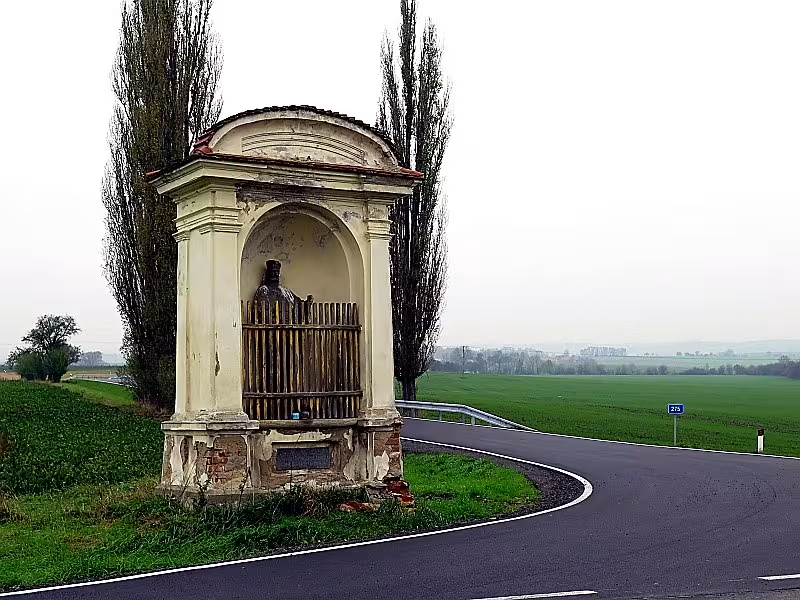
Výklenková kaplička svatého Václava in Křinec is a small Baroque sacral building. It is located on the crossroads towards Žitovice and Bošín, west of the local part of Kuncberk. The building dates back to the period after 1720, it is protected by monuments and forms an important landscape counterpart nearby cemetery chapel of St. John Nepomucký.
The chapel is built in the first half of the 18th century, the era of the highest baroque in Czech countries. This period was characterised by an effort to make a strong visual presentation of the Catholic faith in the landscape through small structures and a cult of saints. The chapel was designed from the beginning as a pendant to the nearby cemetery chapel of St. John Nepomuk.
The construction is walled from bricks on a rectangular plan, which is cut right out in front of the right. The facade breaks the sawdust and the frieze breaks the niche with a glazed condom. Sokl is developed from three sides, Pilaster underpants are reinforced and separated by a ledge. The front rounded side has an arch ledge at the bottom of the niche. Below it is a rectangular impactor with a polished plate made of black grey granite. There is an inscription on the board quoting the sacrament of the church: "Holy Wenceslas, Duke of the Czech Land, do not let us perish nor the future." The upper part consists of a profiled ledge, which is recessed above the niche and extends beyond the back. Above it is a semi-circular shield in the form of a compressed arch. The roof, the shield and the ledge cover the burnt bags of the beaver type. The rear side of the building is smooth, inclined in the lower two fifths.
In the niche is a life-sized sandstone statue of St. Wenceslas on a low-profile volcano. The saint is shown in contrast with his right foot, dressed in armour and pelerine. With his right hand, he holds the cloak, he has a stung Old Painful Paladium and a crown on his head. Left hand grips the flag. In front of the statue, there is a wooden railing hung on the cliffs, which has been painted green in the past.
The chapel falls under the parish Křinec. The building is today protected as a cultural monument.
This small sacral structure is a proof of baroque piety and thoughtful landscape formation around Křenka. Visiting the site offers the opportunity to look at detailed stonework and to remember the historical importance of the sacramental tradition in the Czech environment.
Historical milestones
- around 1720
- Exhibit of baroque chapel in Křenice initiated
- 1750
- Reconcentration of exhibition at the peak of the Baroque
- 20th century
- Entry of the object into the list of cultural memories
Architectural development
It is a brick structure with a rectangular plan, which is cut in front of the right-hand side. The facade is broken down by pilasters and the frieze is cut off by a niche of a glazed condom. The roof, the shield and the ledge are covered with burnt bags of the bobcat type.
Historical events
Construction of the chapel after 1720 as a pendant to the cemetery chapel of St. John Nepomucký.
Points of interest
- The chapel is a small Baroque building dating back to 1720. They form an important landscape counterpart of the nearby cemetery chapel of St. John Nepomuk. - On the front side of the building there is a polished plate made of black and grey granite with engraved text of St. Veclav's Choral. - There is a life-size sandstone statue of St. Wenceslas in the niche, which has an Old Bolyslav paladium on its breast. - There is a wooden railing in front of the statue, suspended on the graves, which has been painted green in the past. - The roof, the shield and the ledge of the building cover the burnt bags of the bobcat type.
Guide
Show guide text
This text was created by artificial intelligence and has not been editorially reviewed. It may contain inaccuracies.
Welcome to Krinka. You are standing at a crossroads where the roads are moving towards Zitovice and Bošín, and a small but distinctive structure is rising before you, which has been guarding the peace for nearly 300 years. It's the niche chapel of St. Wenceslas. At first glance, her balance sheet may surprise you - it is not a giant church or a dominant village, rather a modest, serenity point in a landscape that knows exactly why it stands here. Notice how the brick body color fits into the environment, how it looks firm and calm, as if it's always been part of this place.
Let's take a closer look at how this chapel awakened to life. The documents tell us that the exhibition began sometime after a thousand seven hundred twenty. This was the time when the top Baroque was fully developed in Czech countries - a style that did not just want to serve, but also address, decorate, raise. The completion was then about a thousand seven hundred fifty, at a time when the Baroque was already ripe, sure of itself, full of dynamism and deep religious feeling. We don't know who built it. Architects remained unknown, which in such smaller monuments is not an exception, but rather a rule. They were local people, masons, blacksmiths, woodcutters whose names were not recorded by history, but their hands left a trail that survived generations. They built it not for their own glory, but as a prayer of stone and bricks, as a landmark for pilgrims and locals, who stopped here to cross and take their peace of mind to the road.
Now pay attention to the architecture that you are now offering to view. You have a brick structure in front of you on a rectangular plan. It's a simple, respectable shape that doesn't require complicated explanation. Check the facade. Notice the pilasters-- the flat forest that grows out of the wall and gives it order and rhythm. They are not columns that bear the burden of roofs, rather they are a tether of the eye, a fine decoration that says: even this small structure has its dignity, its face. The brick from which the wall is composed bears signs of time, its colour was changing in the sun, rain, freeze, and it is in the patina that is now its beauty.
But your view is irrevocably attracted to the center of the facade, to the place that gives this object name and meaning. It's a niche. A deep, semi-porous cut in the wall that creates shadow and depth. And he's in it. A life-sized sandstone statue of St. Wenceslas. It's not a statue monumental, but it's the size of life that makes it close. He's standing there, calmly, in a garment, with a nightgown in his hand, a sign of royal power, but also of service. Sandstone is a soft, vivid material that, over time, diversifies, gains patina, becomes part of nature around it. Look at the face of the saint. Even though it's fossilized, it seems to be following a path that leads from the chapel that protects those who go through it. It is a painting of a ruler who is not far away, but present, who rules not from the top of the mountain, but from the cross of roads.
Now, let's move on to one interesting thing, which makes this chapel quite exceptionally different from hundreds like this in our country. Look at the front of the building, where the wall passes into the niche. You'll see a record. It's not a common board with a year of exhibition or the name of the founder. It's a polished plate made of black and grey granite - hard, tough rock, which looks like a piece of night sky inserted into a brick. And on this board, there's a text engraved. Not in a general text, but in the words of the Saint-Clave Choral. "Holy Wenceslas, Duke of the Czech land, our prince, let us not perish nor the future." The words that every Czech person knows, which have sounded in the most joyful and tightest moments of the nation, are written here forever. It's not just a sign. It's a manifesto. When you stand here and read them, you feel the mass of history. The choir was not just a song, it was a prayer, a lawsuit, a hope. And someone decided that here, at the crossroads, where people meet and separate, he belongs. The granite board is like an anchor holding this place in connection with our entire tradition.
This chapel isn't alone. It is mentioned in the documents that in the landscape they form an important counterpart to the nearby cemetery chapel of St. John Nepomuk. That's the key to understanding this place. We have two saints, two patrons, two worlds touching. Saint Jan Nepomucký near the cemetery - guardian of the Taju, patron of the drowned, symbol of the end of the journey, silence and reconciliation. And here, at the crossroads of life, by the roads that lead to the distance - svatý Václav, prince, warrior, founder, one who protects beginnings, paths, decisions. One at the cemetery, one at the crossroads. One for those who have left, one for those who are yet to go. It's a beautiful, deeply symbolic dialogue between two chapels, two lights at night. If you look around, you'll see the other one in the distance, hidden in the trees by the cemetery. They're like the two pillars we go through.
Let us think for a moment about St. Wenceslas himself, to whom this chapel is devoted. Why him? Because he is the Duke of the Czech Republic. Because he's a symbol of statehood, justice, a Christian prince who got himself killed by a brother-in-law, but his spirit died. The life-size statue in the niche reminds us that saints are not just paintings on the walls. They were flesh and blood people, walking on the ground, breathing the air we breathe. And right here in Křinec, at the crossroads, it becomes Saint Wenceslas, to whom you can place your hand on your shoulder, even if it's sandstone. You can whisper to him a speech you don't have time for in a dark temple, but you have it here, in the light of day, under the open sky.
The interesting thing that can carry your thoughts on is the unknown hand of the creator. Who was that? A local bricklayer who learned from books printed in Prague? A traveling master who stayed for the night and paid for accommodation? Or maybe a community of villagers collecting money for brick, sandstone, granite? Unknown architects - so it is listed in the register. And yet it costs work. It has been standing since 1750, surviving the reforms of Josef II, when hundreds of chapel and churches died. It survived the wars, totalitarianism, the breakdown of agricultural cooperatives, road reconstruction. In the twentieth century, it was listed as a cultural monument, which gave it legal protection, but you gave it the right protection - visitors who stop by, look in the niche, read the choral on granite and take peace from here.
Notice one more detail. The chapel is a niche. It means that her heart - the statue - is not inside, behind the locked door, but outside, visible to everyone. It's an open architecture. It does not require a key, it does not require clothing, it does not require time to open. It's available daily, nighttime, rain, snow, summer. When you stand here at night, and the lights from the cars pass down the road, the shadow of St. Wenceslas in the niche dances on the wall. It's a theatre of light and darkness, which he plays without spectators, but which is available to anyone who stops.
And now that we're finishing our walk together, let me invite you to a little ritual. Stand just outside the niche. Look into the eyes of St. Wenceslas. Read the words on the granite board, even if you know them by heart. Let them sound in your head. "St. Wenceslas, Duke of the Czech Land..." And then turn around. Look down the road to the Riding House, the Boshín road. Can you feel the wind? It's the breath of the countryside. This chapel is part of it. It's a small stone in the mosaic of our memory.
Thank you for stopping by. Thank you for spending your time in this humble but strong place. Let the road guide you safely, let svatý Václav protect your steps wherever you go. See you in Krinka.
Tips for visitors
The best time to visit is during the morning or at sunset, when soft light beautifully depicts the Baroque details of the niche and facade of the chapel.
Use local communication leading towards Žitovlice and Bošín to arrive at the monument. The locality is located in a quiet part outside the main centre of the village, allowing comfortable access by foot and by bike directly to the crossroads where the chapel stands.
For photographers, the chapel is a grateful object due to its location in the landscape. I recommend using wide-angle lens to capture the building in the context of surrounding fields and paths. The best pictures can be taken when the sun lights up the front of the niche, which will highlight the plastic elements of Baroque architecture.
In the immediate vicinity of St. Wenceslas Chapel you can visit the extensive cemetery and see the chapel of St. John Nepomuk. These places form a comprehensive historical whole, which is worth stopping while walking west of the Kuncberk area.
The location offers a quiet environment for a short educational break, where you can bring the children closer to baroque art in the landscape and the history of small sacral structures that previously served as landmarks for passengers.
Frequently asked questions
Can the monument be visited?
This is a structure in a public space that can usually be seen from outside free of charge. We have not verified that this particular one is freely accessible.
Where is the monument?
Location: Křinec. The map on this page shows the exact spot.
Why is the monument protected?
It is listed in the Central List of Cultural Monuments of the Czech Republic as a cultural monument (register no. 1000129969).
Businesses nearby
Do you run a restaurant, accommodation, shop, museum, rental, wellness or other visitor service near this monument? Show yourself directly to the people heading to it — this is how they will see you in the app and on the web:
Nearby
V bezprostřední blízkosti se nachází rozsáhlý hřbitov a kaple svatého Jana Nepomuckého. Lokalita se nachází západně od místní části Kuncberk.
Accommodation nearby
Themed route
1. Výklenková kaplička svatého Václava - chapel Main destination of the route. A small building with a niche that captures its simple beauty and close relationship to the wedding tradition.
2. Large cemetery - cemetery It's right next to the chapel. A walk between the tombstones offers silence and an opportunity to think about the history of the village.
3. St. John Nepomuk Chapel - Chapel It lies close to the cemetery. Its interior and decoration attract a moment of prayer and admiration for rural sacral architecture.
Seasonal recommendations
Spring brings living plant life and warmer temperatures that cause the chapel in Křinec to rotate between winter and summer. Roses and onion apples appear in full colour, and the average temperature allows long walks. For an ideal visit I recommend starting in the morning when the light is bright and nature is most nourished; then you can use the beautiful garden landscape around the chapel. At this time put a light shirt or pants in the library and feel free to come with water because heat can change quickly.
The flights offer intense lighting and hot days that remind you of the summer sun. In the vicinity of the chapel of the quiver many nearby plants and green gardens, which gives visitors space for relaxation. I practically recommend wearing a sun-proof leather cloth and a light birose that doesn't fall in love. The best time to visit is the prehistoric time when heat is still acceptable and light is still golden.
Autumn will bring a change of color and colder temperature, when the chapel acts as a protective port before winter. Feeding trees and warning leaves creates an atmosphere of reflection and calm. At this time put in your clothes layered style - light strawberry and strawberry will provide you with the necessary heat. I recommend a visit at noon when the temperature is still consistent and the light is soft.
Winter brings bold days and the possibility of snow, which adds a melancholy atmosphere to the chapel. The temperature is decreasing, so it is necessary to wear an apple tree and a strawberry, while preparing for the possibility of snow outdoors. The lighting is rather threaded and soft at this time, so it is advisable to plan the visit at times when the temperature is stable.
Visualizations and artistic views

The visualisations are generated by artificial intelligence and serve as inspiration.
Photos from the area
Real photos taken near the monument


Zdroj a licence jsou uvedeny u každého snímku.
Tips from visitors
No tips yet. Be the first!
Log in and add your tip.
Sources and literature
Photos: Sovicka169 / CC BY-SA 4.0 — Wikimedia Commons. The author and licence also appear when you hover over the image.
Faktickým podkladem tohoto textu byl článek na Wikipedii, jehož autory jsou přispěvatelé Wikipedie. Článek je dostupný pod licencí CC BY-SA 4.0.
Location on the map




Příběhy a pověsti
Legendy, pověsti a příběhy spjaté s touto památkou
Fotografie návštěvníků
Zatím žádné fotografie. Buďte první, kdo přidá fotografii z návštěvy!
Log in a přidejte svou fotografii nebo hodnoťte.
Za ověřenou návštěvu v aplikaci získáte víc bodů — poznáme podle GPS, že jste na místě.
Reviews and comments