

zámecký pivovar v Litomyšli Brewery building
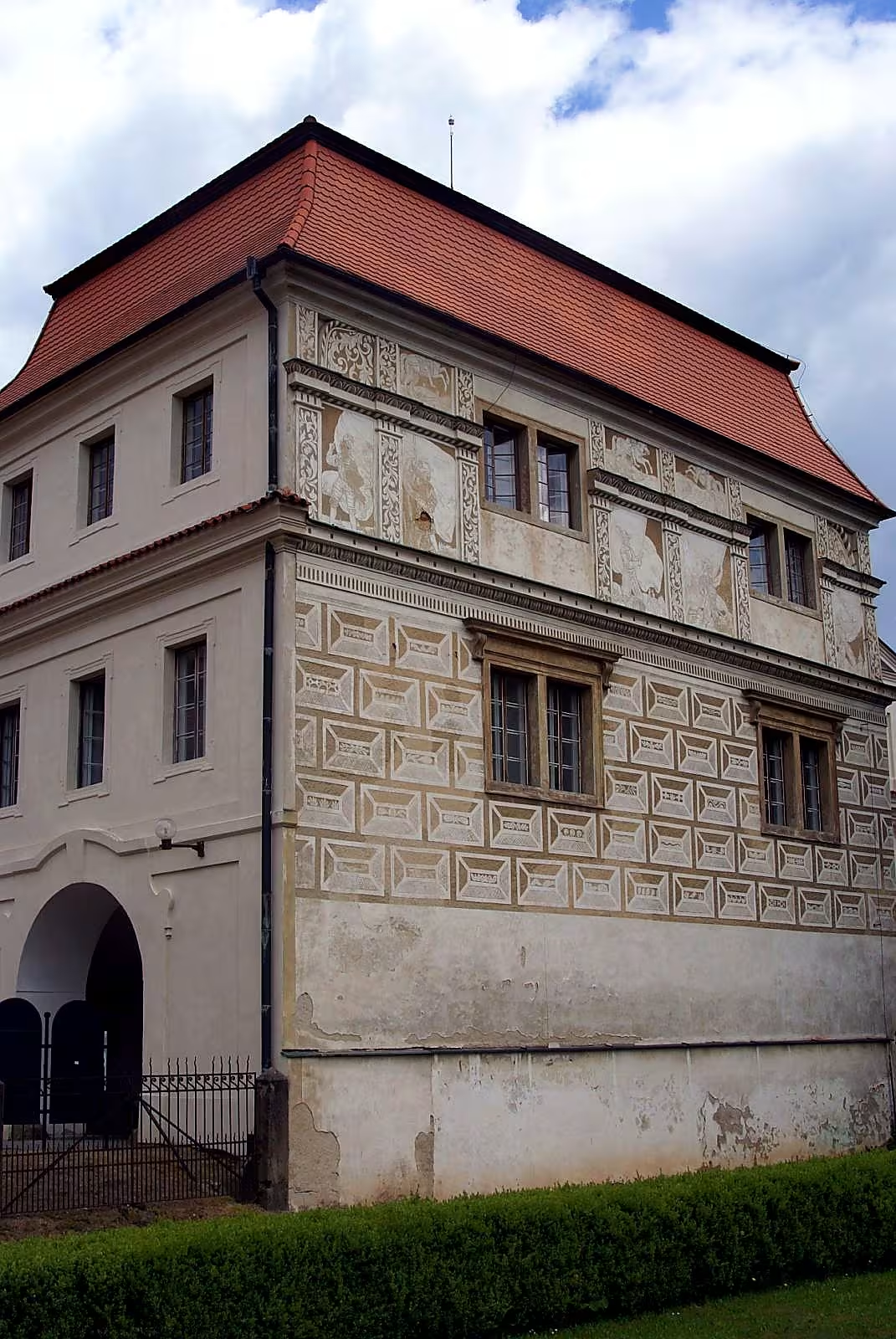
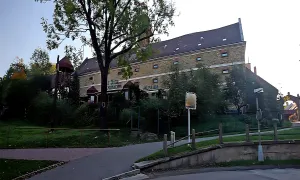
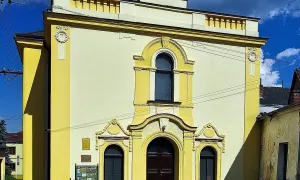
The castle brewery in Litomyšl is a Renaissance-Baroque monument in the village Záhradí in the district Svitavy. The building belongs to the premises of the Litomyšl castle, which is a national cultural monument and since 1999 a registered object of the UNESCO World Heritage List. The building is especially important as the birthplace of Czech composer Bedřich Smetana.
The Renaissance building was completed in 1630, which confirms the sgraffiti decoration on the wall. The masonry of the older Gothic capitula was partly used in the construction, as evidenced by the walled fragment of the Gothic rib, for example. In the 18th century, the building underwent a major Baroque reconstruction according to the design of architect František Maximilian Kaňka. The building was supplied with Mansard roofs, a monumental facade towards the castle and a new passage in the axis of the main castle gate. The south facade was subsequently modified in 1868 in the spirit of historism. In the 19th century there were additions which disrupted the original Renaissance-Baroque concept.
The two-storey building on a rectangular plan is oriented in the direction of JZ-SV. It's covered with mansard, saddle and counter roofs with burnt roofs. The south-western shield facade at the entrance to the complex is decorated with sgraffiti decoration. There is an open passage in the middle of the longer side, which ends in the direction of the lock with an decorative portal with a shield. The front of the yard has 16 window axes, while the opposite side has 13. On the ground floor there are rooms with valened vaults, sections and nails; in some rooms the vaults are supplemented with columns. The ceilings on the floors are flat.
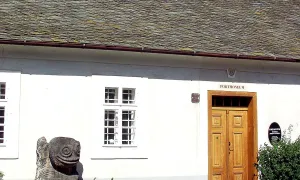
The key event connected to the building is the birth of Bedřich Smetana in 1824 in an apartment on the ground floor which was occupied by his family at the time. By the end of the 20th century, the object gradually faded. The plans of a private investor from the 1990's for conversion to a luxury hotel were rejected. Instead, the YMCA European Alliance project was dominated, which proposed the creation of a training centre with accommodation.
Reconstruction was carried out in 2004- 2014 under the leadership of architect Josef Pleskot. He preserved elements from all historical stages during modifications. The first phase in 2004-2006 focused on the premises west of the pass and the second in 2011-2014 on the eastern part of the building. In these changes, the statue of Čestmír from the workshop of sculptor Olbram Zoubek was placed in the yard.
Currently, the building serves as a hotel, hostel and European Training Centre. On the southwest side there is a tourist information centre and Bedřich Smetana's native apartment works as an exhibition of the Regional Museum in Litomyšl. The building of the former castle riding hall is attached to the brewery, which now hosts a multifunctional cultural hall for 600 visitors.
The castle brewery represents a unique layer of architectural styles from Gothic to Renaissance and Baroque to modern reconstruction. It is a place where industrial history connects with the personality of one of the most important Czech composers. A visit to this building within the Litomyšl area offers a deep insight into the development of local architecture and culture.
Then and now
Drag the slider to compare how the landmark may have looked when it was built with the view today.
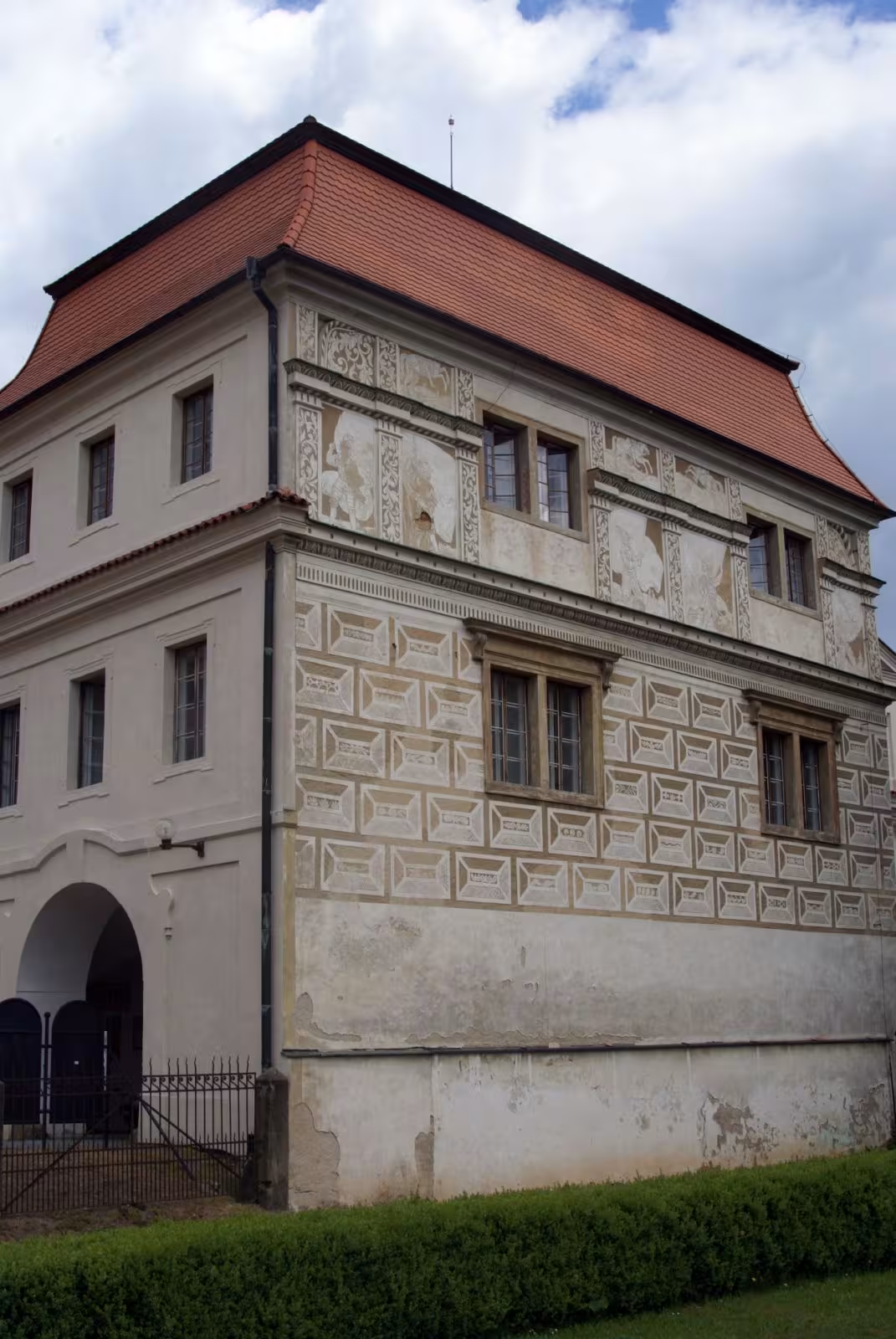

The historical appearance on the left is an AI-generated visualisation and serves as inspiration only.
Historical milestones
- 1630
- Completion of Renaissance construction
- 1824
- Birth of music composer Bedřich Smetana
- 2004
- Start of reconstruction in the first stage
Architectural development
The original Renaissance building from 1630 used partly Gothic elements. In the eighteenth century, the Baroque reconstruction was carried out according to the design of František Maximilian Kaňka. In recent times, the building was renovated by architect Josef Pleskot.
Historical events
1630: completion of the Renaissance building; 1824: birth of Bedřich Smetana; 2004-2014: extensive reconstruction of the building.
Owners
Hradec Kralove
Litomysl
Points of interest
- The construction was completed in 1630 and the masonry of the older Gothic capital was partly used in its construction. - In the 18th century, the architect František Maximilián Kaňka rebuilt the building, which supplied her with the Mansard roofs and monumental facade. - Czech composer Bedřich Smetana was born in the apartment on the ground floor in 1824. - Reconstruction from 2004- 2014 under the leadership of Josef Pleskot preserved elements from all historical stages. - The statue of Čestmír from the workshop of sculptor Olbram Zoubek was placed in the yard.
Guide
This guide is narrated by a synthetic voice generated by artificial intelligence.
Show guide text
This text was created by artificial intelligence and has not been editorially reviewed. It may contain inaccuracies.
Welcome to Litomyšl, the place where history blends with beauty every inch of the way. Right now, you're standing in front of a building that, with its looks and atmosphere, attracts the attention of anyone who sees it. It is a castle brewery, a building which is an essential part of the important castle and the entire monument reservation. If you look at it now, you'll see an impressive object in front of you, bearing traces of centuries and different architectural periods. Feel its size and the way it fits in the vicinity of this historic site. It is a place that, over time, changed its function, but never lost its dignity.
Let us now look deeper into the past together to understand how this building was created. The foundations on which you stand today go deep into the seventeenth century. The Renaissance building itself was completed in the year one thousand six hundred thirty. But it is fascinating to realize that the builders did not start from scratch at the time. In the construction, they used the masonry of older Gothic capitals in part, which means that many older layers of history are hidden in these walls, which are no longer visible at first sight, but form a solid foundation of the whole building. At that time it served as a brewery, which was absolutely crucial for the castle economy. At the time, beer was not only a drink, but an important product that ensured the prosperity of the estate.
Now pay attention to the architecture itself and to what you see right in front of you. The building you're watching today is not just purely Renaissance. If you look carefully, you will notice the distinctive elements of the Baroque style. This is due to the fact that in the eighteenth century the famous architect František Maximilián Kaňka rebuilt the building. He's the one who gave her her current, presentable look. Look up on the roof. Note the so-called Mansard roofs, which are typical of Baroque elegance and give the building some lightness despite its massive dimensions. Also look at the monumental facade, i.e. the overall facade of the building. The trench made it a real architectural jewel that was meant to emit power and wealth. Notice the harmony of the lines and the way the building is broken down. It is a beautiful example of how the older core of the building has managed to adapt to the new trends of its time.
If you admire the appearance of the building like this, let's move on to the people who were connected to this place. This building is not only important for its architecture, but above all for its spiritual and cultural value. This is where one of the most important moments of Czech music history took place. In the apartment on the ground floor, located in the building where you are standing, in the year one thousand eight hundred twenty-four Bedřich Smetana was born. Imagine that for a moment. In these premises, which today serve other purposes, a man who became the most important Czech composer began his life. It's incredible that one and the same building could serve as a place of beer production and as a cradle of a brilliant musical artist. Bedřich Smetana has brought a national character into Czech music and his works still sound in halls around the world, and yet all his journey began here, in Litomyšl, in this particular house.
Now I want to impress you with one interesting thing that shows how the buildings evolve along with time. It's fascinating to see how the functions of this object have changed. From the brewery to the place of birth of the famous composer to the present day. If you look at the building today, you'll find that beer doesn't cook anymore. Currently, the building serves as a hotel, training centre and museum. This means that production space has become a place for relaxation, education and preservation. In order for the building to fulfil these new roles while maintaining its historical character, it had to undergo extensive repairs. In the year two thousand four began the first stage of reconstruction, in which the modern architect Josef Pleskot helped. The goal was to preserve all the beautiful things from the time of the Canyon and the Renaissance, but at the same time to breathe new life into the building to serve people in the new century. It's a bridge between the past and the present.
Now try to connect all these layers in spirit. Gothic masonry capitula, Renaissance completion from the year one thousand six hundred thirty, Baroque touch of František Maximilian Kaňka, crying of the newborn Bedřich Smetana and finally modern care of Josef Pleskot. All this is wrapped in one single building you're standing in front of right now. It's a fascinating testimony about how people's needs change, how taste turns into beauty, and how one place can become a symbol of an entire nation.
Let us now slowly finish this part of our journey. I hope you enjoyed this short dive into the history of the castle brewery. Now invited to further explore the surroundings. Walk slowly around the building, perceive its monumentality, and perhaps in your mind imagine how the thousand eight hundred twenty-four here looked on the ground floor when the future master of music was born here. Litomysl still has many other secrets waiting to be revealed, and this brewery is just one of the many pieces of the puzzle that makes up this amazing urban space.
Thank you for your attention and I wish you a pleasant rest of the day in this wonderful sightseeing reservation. Enjoy every moment spent in Litomyšl and continue to be inspired by its history and beauty. Goodbye.
Tips for visitors
In these times there are also fewer tourists, which allows a more peaceful tour of historical buildings and gardens.
Traffic availability is ensured by car and public transport.
We also recommend having drinking water, especially in the summer months, and a light layer of clothing to protect from cold in the interior of old buildings or from sudden rain. If you plan a longer walk around the castle gardens, sunglasses and hat can be useful.
The morning or late afternoon light is ideal for photography, which creates long shadows and emphasizes architectural details of the Renaissance-Baroque building of the brewery and surrounding structures. Try to avoid sharp midday sun, which can cause strong contrasts and affect the quality of images of historical facades.
These sites offer a rich programme of tours and cultural events.
Frequently asked questions
Can the monument be visited?
Some buildings of this kind are open for guided tours, others serve another purpose or are privately owned. We have not verified whether and when this monument is open – please ask the operator.
What are the opening hours and admission?
We have not verified the opening hours or admission. Current information is published by the operator. Official website: https://www.rml.cz/cs/muzeum/rodny-byt-bedricha-smetany.html
Where is the monument?
Location: Jiráskova 93, Záhradí, Litomyšl, Pardubický kraj. The map on this page shows the exact spot.
Why is the monument protected?
It is listed in the Central List of Cultural Monuments of the Czech Republic as a national cultural monument (register no. 128). It is protected as part of a larger listed ensemble.
For kids
Imagine going back to a time when Litomysl was a small town full of life and action. Imagine moving down the time zones, and suddenly here you are in the mid-16th century.
Litomysl was big and important back then. It was an important center of trade and trade. On her square stood a beautiful Gothic church, surrounded by narrow alleys full of wooden houses. And on one of them, in the heart of the city, there was a castle.
Businesses nearby
Do you run a restaurant, accommodation, shop, museum, rental, wellness or other visitor service near this monument? Show yourself directly to the people heading to it — this is how they will see you in the app and on the web:
Events nearby

Zdroj akcí: otevřená data měst a obcí ČR (Národní katalog otevřených dat) a kalendář akcí Národního památkového ústavu.
Nearby
Litomyšlský zámek a městská památková rezervace.
Accommodation nearby
Themed route
1. City Monument Reservation, type: historical center. Walk through the city reveals the beauty of old architecture and pleasant atmosphere. 2. Litomysl Castle, type: lock. This building is unique in its form and rich history. 3. Castle brewery in Litomyšl, type: brewery. Ideal place to taste traditional beer in the historic environment.
Seasonal recommendations
In spring, the surroundings of the brewery awaken to life and the landscape in Pardubice region green. The light is fine and the air fresh, which creates a pleasant atmosphere for walking around historical walls. We recommend shoes suitable for wet grass and light jacket, because morning and evening cold can still be felt.
In the summer months, the bright sun and hot air are dominated. Buildings in full light excel in their architecture and the surrounding trees provide the desired shade. It is advisable to choose the time early in the morning or late in the afternoon to avoid the greatest heat. Light summer clothes and sun protection are unmarked.
Autumn brings gold and red leaf colours to Záhradí, which perfectly complement the appearance of the monument. The atmosphere is quieter and the light has a warm, soft touch. It is ideal for visitors to wear layered clothes and solid shoes that can handle fallen leaves and possible mud on the road.
Zimą is quiet near the building and the landscape can be covered with snow, which gives the place a cozy and mysterious character. Short days mean that the best time to visit is around noon when the most daylight is. Hot winter shoes, gloves and a fat sweater are essential.
Visualizations and artistic views


The visualisations are generated by artificial intelligence and serve as inspiration.
Photos from the area
Real photos taken near the monument

Zdroj a licence jsou uvedeny u každého snímku.
Atmosphere of the place
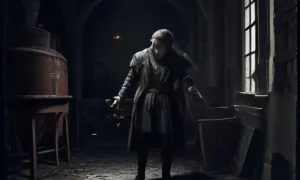
This atmospheric visualisation of the place and period was generated by artificial intelligence. It is not real footage of the location.
Tips from visitors
No tips yet. Be the first!
Log in and add your tip.
Sources and literature
Photos: Txllxt TxllxT / CC BY-SA 4.0 — Wikimedia Commons. The author and licence also appear when you hover over the image.
Faktickým podkladem tohoto textu byl článek na Wikipedii, jehož autory jsou přispěvatelé Wikipedie. Článek je dostupný pod licencí CC BY-SA 4.0.
Location on the map

Příběhy a pověsti
Legendy, pověsti a příběhy spjaté s touto památkou
Fotografie návštěvníků
Přidat fotografiiZatím žádné fotografie. Buďte první, kdo přidá fotografii z návštěvy!
Máte k místu vzpomínku nebo zajímavý příběh?
Log in a přidejte svou fotografii nebo hodnoťte.
Za ověřenou návštěvu v aplikaci získáte víc bodů — poznáme podle GPS, že jste na místě.
Reviews and comments