






Zámek Hošťálková Chateau
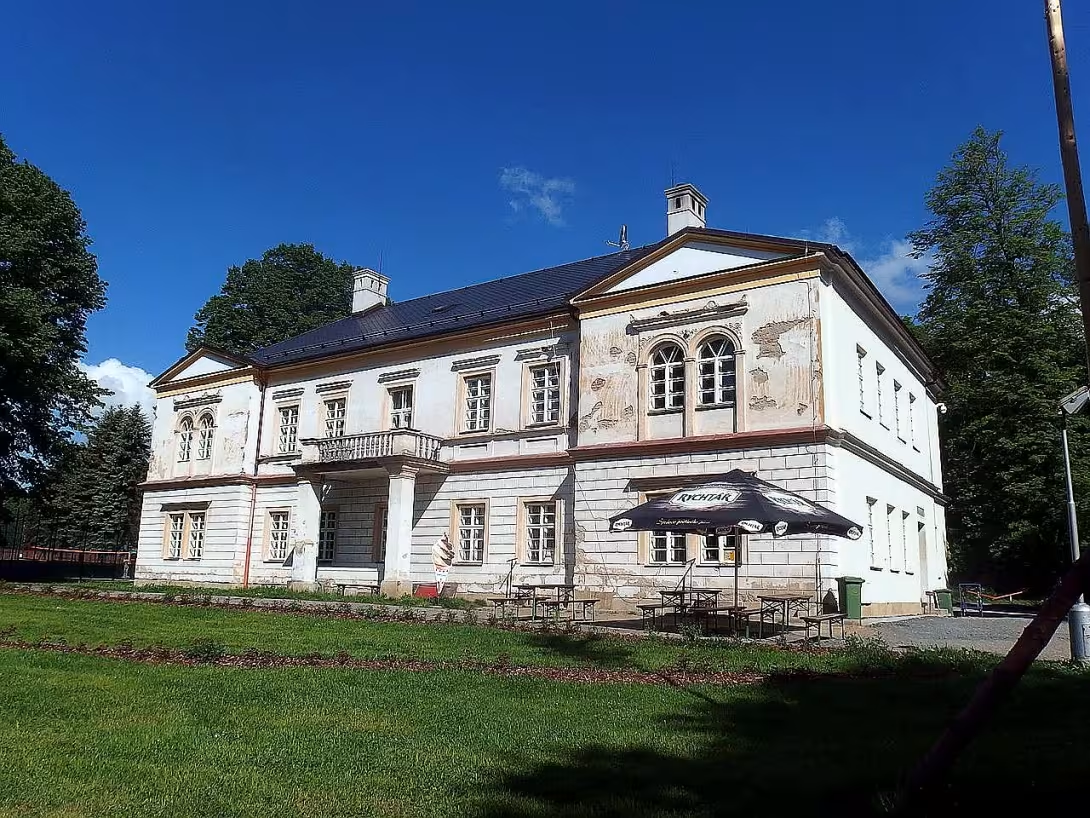
The Hošťálková Chateau is a cultural monument situated in the village of Hošťálková, approximately 9 kilometers northwest of Vsetín in the Zlínský kraj region. This Empire-style chateau was built in the early 19th century as a summer residence for the Chorinský family. Its unique architecture and historical significance offer a glimpse into the lives of Moravia's nobility during the 19th century.
Commissioned by Fridrich Karel hrabě Chorinský z Ledské in the early 1840s, the project was led by master builder Karel Absolon and decorated by the Vienna sculptor Anton Rücker. The total cost was 8,728 gold coins. The chateau was built within an English park, also created at the same time. This significant undertaking reflected the wealth and influence of the Chorinský family, prominent nobles in Moravia during the 19th century.
The chateau is a one-story building with a rectangular floor plan and two corner pavilions. The main entrance is on the eastern side, and the facade features a cornice and a balcony supported by two columns. The chateau is surrounded by a small English park, which includes six ponds, a fountain, and greenhouses. The park was created during the chateau's construction and reflects the family's love for nature and beauty.
Throughout its history, the chateau has had several owners. After Fridrich Karel hrabě Chorinský z Ledské, it was inherited by Viktor hrabě Chorinský z Ledské in 1861. The chateau changed hands several times, with the Moravská agrární a průmyslová banka in Brno owning it from 1918 to 1924. JUDr. Stanislav Bublík purchased the chateau in 1924 and used it as his residence. The chateau was nationalized in 1948 and used as a training center for the Communist Party. After the Velvet Revolution in 1989, the chateau was returned to the local community and is now used as a restaurant and the seat of the local elementary school.
The Hošťálková Chateau has a rich history, with several notable events taking place within its walls. The chateau served as a summer residence for the Chorinský family, but it was not their main residence. The chateau's small English park is a charming feature, with six ponds, a fountain, and greenhouses. The chateau's architecture is a testament to the Empire style, with a cornice and a balcony supported by two columns.
Today, the Hošťálková Chateau is a popular tourist destination, offering a glimpse into the lives of Moravia's nobility during the 19th century. The chateau's unique architecture and beautiful park make it a must-visit for anyone interested in history and culture. Visitors can explore the chateau's interior, learn about its history, and enjoy the peaceful surroundings of the English park. The chateau's restoration and renovation, which took place between 2013 and 2020, have preserved its original charm and made it an even more attractive destination for tourists.
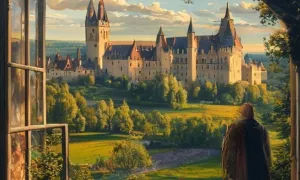
Then and now
Drag the slider to compare how the landmark may have looked when it was built with the view today.
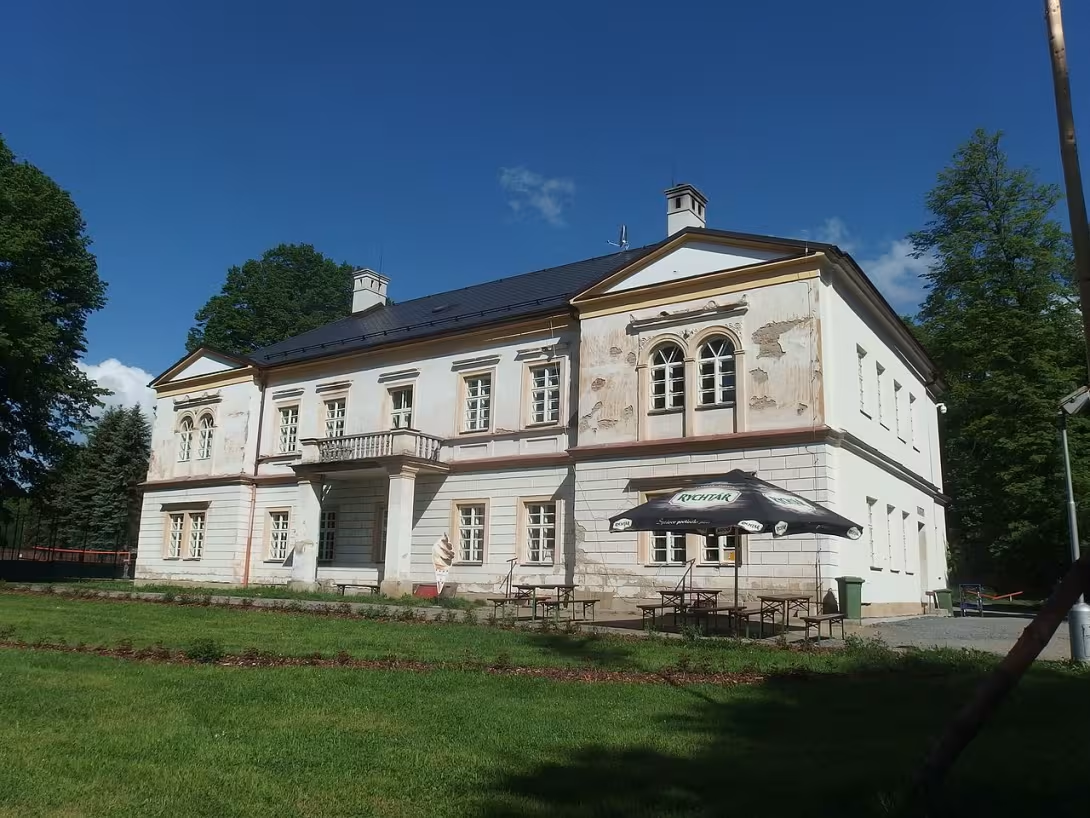

The historical appearance on the left is an AI-generated visualisation and serves as inspiration only.
Historical milestones
- 1802
- Fridrich Karel hrabě Chorinský z Ledské commissioned the construction of the chateau
- 1861
- Viktor hrabě Chorinský z Ledské inherited the chateau
- 1918
- The chateau was sold to the Moravská agrární a průmyslová banka in Brno
- 1924
- JUDr. Stanislav Bublík bought the chateau
- 1948
- The chateau was nationalized and used as a training center for the Communist Party
- 2013
- Restoration and renovation of the chateau began
- 2020
- Restoration and renovation of the chateau was completed
Architectural development
The chateau was built in the early 19th century as a summer residence for the Chorinský family. The construction was led by master builder Karel Absolon, and the decoration was done by the Vienna sculptor Anton Rücker. The total cost of the project was 8,728 gold coins. The chateau was built in the English park, which was also created at the same time.
Historical events
Built in the early 19th century as a summer residence for the Chorinský family
Used as a training center for the Communist Party after 1948
Restored and renovated between 2013 and 2020
Owners
Fridrich Karel hrabě Chorinský z Ledské (1802-1861), Viktor hrabě Chorinský z Ledské (1861-1901), Fridrich hrabě Chorinský z Ledské (1867-1947), Československá dřevařská akciová společnost (1919-1924), JUDr. Stanislav Bublík (1924-1948), státní lesní správa (1948-1960), národní podnik Sandrik Dolné Hámre (1960-1989), obec Hošťálková (1989-present)
Points of interest
– The Hošťálková Chateau was built using a significant amount of gold, with a total cost of 8,728 gold coins.
– The chateau's park features six ponds, a fountain, and greenhouses, which were created during the chateau's construction.
– The chateau was nationalized in 1948 and used as a training center for the Communist Party after the Velvet Revolution in 1989, it was returned to the local community.
– The chateau's interior is not open to the public, but visitors can explore the exterior and learn about its history.
– The chateau's restoration and renovation took place between 2013 and 2020, preserving its original charm and making it an even more attractive destination for tourists.
Guide
This guide is narrated by a synthetic voice generated by artificial intelligence.
Show guide text
This text was created by artificial intelligence and has not been editorially reviewed. It may contain inaccuracies.
The castle in Hošťálková is located in the middle of the village of the same name, approximately nine kilometers northwest of Vsetín, near the Ratibořka stream. It is an Empire style building surrounded by an English park. It has been a cultural monument since May third, nineteen fifty-eight.
Count Friedrich Karl Chorinský of Ledská had the castle built. At the beginning of the eighteen forties, he asked the Viennese architect Franz Schlepse for construction plans. The work was directed by master mason Karel Absolon, and the decoration was created by Viennese sculptor Anton Rücker. The construction cost eight thousand seven hundred twenty-eight guilders. The ground floor contained administrative rooms, while the upper floor had private counts' apartments. At the same time as the castle was built, an English park was created in its surroundings.
In eighteen sixty-one, Viktor, Count Chorinský, inherited the castle and the estate. After his death in nineteen oh-one, it passed to another Friedrich from the same family. The counts' family lived here only occasionally, however, because their main family seat was the castle in Veselí nad Moravou.
In nineteen eighteen, the business family Klein purchased the estate and immediately sold it to the Moravian Agricultural and Industrial Bank in Brno. Between nineteen nineteen and nineteen twenty-four, it belonged to the Czechoslovak Timber Joint Stock Company in Brno. Doctor of Law Stanislav Bublík purchased it from them. At that time, the estate included one thousand one hundred thirty-three hectares of farmable land, and the Bublíks lost part of their forests during the first land reform. In nineteen twenty-six, they also purchased a local knife and cutlery factory. In the castle park, they had six small ponds, a fountain, and greenhouses built.
At the end of the Second World War, a German anti-partisan commando was stationed in the castle. After nationalization in nineteen forty-eight, it housed a training center for the district committee of the Communist Party in Vsetín. At the beginning of the nineteen fifties, there were plans for a social care home, but the castle went to the state forest administration. From the nineteen sixties, it belonged to the state enterprise Sandrik Dolné Hámre, and later to the enterprise Rostex Vyškov. After nineteen eighty-nine, the village acquired it. Today it houses a restaurant and a local art school. Between two thousand thirteen and two thousand twenty, the castle underwent a complete reconstruction. It received new roofing, new windows and doors, and renovated facades.
The castle is a freestanding single-story building with a rectangular ground plan. It has two corner risalits, that is, protruding sections of the facade, crowned with low triangular gables. However, the entrance is not on the main southern facade, but on the eastern side. The main facade is decorated with cornices, the ground floor is emphasized by rustication, that is, plastic articulation of the plaster, and a balcony supported by two columns. The other facades are smooth and without ornamentation.
Tips for visitors
The best time to visit the Hošťálková Chateau is during the spring and summer months when the surrounding English park is in full bloom.
You can also use public transportation, but be sure to check the current schedule in advance.
It's a good idea to bring a camera to capture the beautiful views of the chateau and its surroundings. The best spots for photography are around the chateau's facade and in the English park.
If you're visiting with children, there are plenty of open spaces for them to run around in the park. You can also consider a picnic in the chateau's gardens.
If you're interested in exploring more of the area, there are several other attractions within a 30-minute walk or drive from the chateau, including the nearby village of Hošťálková and the Ratibořka stream.
Frequently asked questions
Can the monument be visited?
Some buildings of this kind are open for guided tours, others serve another purpose or are privately owned. We have not verified whether and when this monument is open – please ask the operator.
What are the opening hours and admission?
We have not verified the opening hours or admission. Current information is published by the operator.
Where is the monument?
Location: č.p. 286, Hošťálková, Zlínský kraj. The map on this page shows the exact spot.
Why is the monument protected?
It is listed in the Central List of Cultural Monuments of the Czech Republic as a cultural monument (register no. 36090/8-245).
Businesses nearby
Do you run a restaurant, accommodation, shop, museum, rental, wellness or other visitor service near this monument? Show yourself directly to the people heading to it — this is how they will see you in the app and on the web:
Nearby
The chateau is located in the village of Hošťálková, near the Ratibořka stream. The surrounding landscape is a small English park with trees and gardens.
Accommodation nearby
Themed route
Trasa: Zámek Hošťálková a okolí
1. Zámek Hošťálková (hlavní cíl) Zámek Hošťálková je historickou památkou, která stojí za návštěvu díky své architektuře a bohaté historii. Nachází se v srdci obce Hošťálková, blízko potoka Ratibořka.
2. Anglický park Nabízí klidné procházky pod stromy a okrasné zahrady, které doplňují atmosféru zámku.
3. Kostel svatého Mikuláše Kostel se nachází v blízkosti zámku a nabízí pohled do historie a kultury regionu.
Seasonal recommendations
Jaro
Spring is the ideal time to visit Hošťálková Chateau, as nature around it is in full bloom. The lighting is natural and sunny, creating a pleasant atmosphere. We recommend visiting the chateau during early spring when there are fewer people, allowing you to explore the site in peace. The best time for a visit is in April or May, when the weather is sunny and warm.
Summer
In the summer season, Hošťálková Chateau is a popular destination for tourists. Therefore, we recommend arriving early to avoid large crowds. The lighting is sunny and warm, but don't forget to bring an umbrella and hat for sun protection. The best time for a visit is in June or July when the weather is sunny and warm.
Autumn
Fall is a beautiful season to visit Hošťálková Chateau, as nature around it displays vibrant autumn foliage. The lighting is sunny and pleasant, but remember to bring an umbrella for rain protection. We recommend visiting the chateau in October or November when the weather is cooler and there are fewer people.
Winter
Winter is the quietest season to visit Hošťálková Chateau, as there are fewer visitors, allowing you to explore the site in peace. The lighting is often artificial but creates a pleasant atmosphere. Don't forget to bring warm clothing and gloves for protection against the cold.
Visualizations and artistic views


The visualisations are generated by artificial intelligence and serve as inspiration.
Photos from the area
Real photos taken near the monument


Zdroj a licence jsou uvedeny u každého snímku.
Atmosphere of the place
This atmospheric visualisation of the place and period was generated by artificial intelligence. It is not real footage of the location.
Tips from visitors
No tips yet. Be the first!
Log in and add your tip.
Sources and literature
Photos: Palickap / CC BY-SA 4.0 — Wikimedia Commons. The author and licence also appear when you hover over the image.
Faktickým podkladem tohoto textu byl článek na Wikipedii, jehož autory jsou přispěvatelé Wikipedie. Článek je dostupný pod licencí CC BY-SA 4.0.
Location on the map
Příběhy a pověsti
Legendy, pověsti a příběhy spjaté s touto památkou
Fotografie návštěvníků
Zatím žádné fotografie. Buďte první, kdo přidá fotografii z návštěvy!
Log in a přidejte svou fotografii nebo hodnoťte.
Za ověřenou návštěvu v aplikaci získáte víc bodů — poznáme podle GPS, že jste na místě.
Reviews and comments