



Zámek Rychvald Chateau
This page was machine-translated from Czech. The translation has not been language-checked and may contain errors.
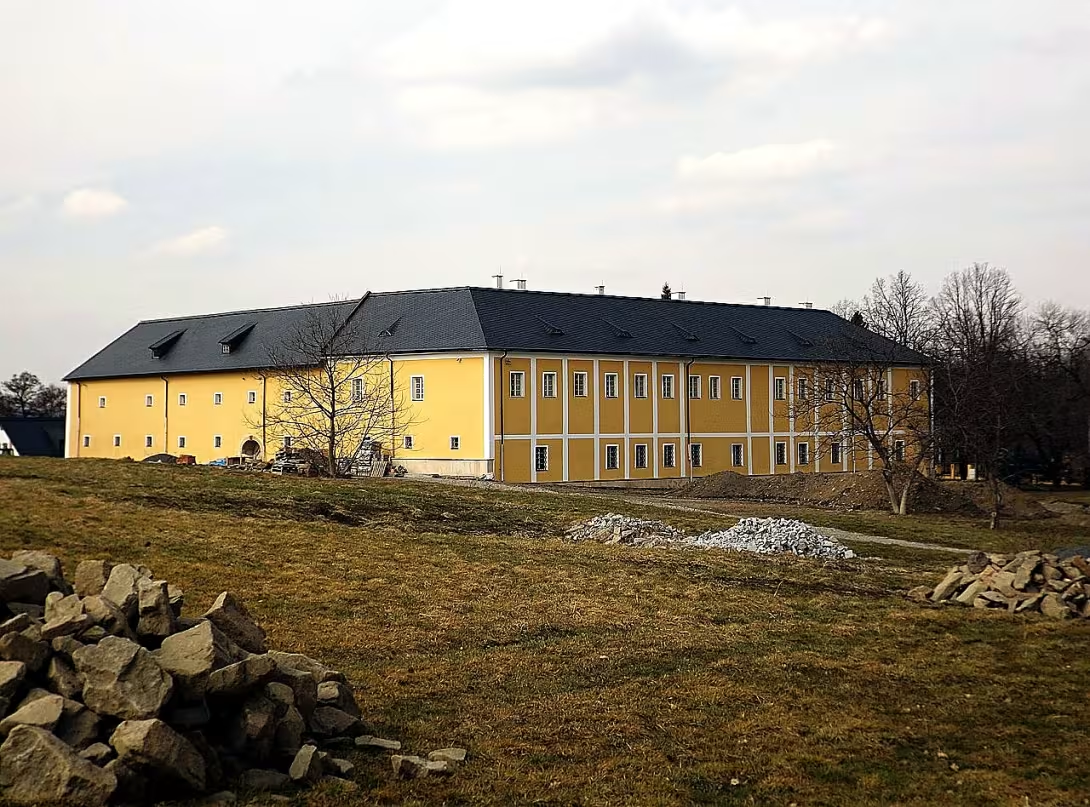
Rychvald Château, also known as Starý dvůr, stands in the western part of the town of Rychvald in the Karviná district, just a few kilometres from Ostrava. Rychvald lies in the historical region of Cieszyn Silesia. The château is a cultural monument and belongs to a private owner; it has never belonged to the town.
Seat of the Barský z Baště family
Rychvald belonged to the Duchy of Cieszyn (Teschen). The duke fell into debt and had to sell part of his estate, including Rychvald. In 1573 it was bought by Burian Barský z Baště. His son Bernard Barský z Baště chose Rychvald as his seat and in 1575–1577 built an extensive two-storey Renaissance château here. According to the town, it is the oldest surviving building in Rychvald. By tradition, stone from the demolished Benedictine monastery in Orlová was used in its construction. As a Protestant, Bernard Barský also had a masonry church built – today's Church of St Anne.
Four wings around a courtyard
The château has four wings around a courtyard. According to the town, it measures 60 × 80 metres on the outside and the courtyard 48 × 48 metres. The north and east wings were residential; the south and west wings housed granaries and stables. The chapel was only added during one of the later rebuildings. The stone portal of the main entrance bears the coats of arms of Bernard Barský z Baště and his third wife, Anna Sobišovská ze Šinovic. A metal combined coat of arms of the Larisch-Mönnich and Starhemberg families with a count's coronet was later placed above the portal.
From the Barský family to the Starhembergs
The Barský family held Rychvald until 1630. After them the estate passed through other families: the Tluks of Tošanovice, the Haugwitz family of Biskupice, the Vrbna family, the Freudenthal family and the Gašín family of Rosenberg. In the mid-18th century the indebted Gašíns sold Rychvald to Baron Jan Václav Mönnich. His only daughter and heiress, Anna Maria, married Count Jan Josef Larisch in 1791, founding the Larisch-Mönnich family. Evžen (Eugen) Larisch-Mönnich and his daughter Franziska carried out practical rebuilding of the château in the second half of the 19th century. In 1869 a stop on the Košice–Bohumín Railway was opened right in front of the château and named after it: Schloss Reichwaldau. In 1898 Franziska married Ernst Rüdiger Starhemberg, later a prince, and brought him the château as her dowry. From 1903 the Starhemberg family held the château and the estate.
Decay and rescue
After 1945 the château was expropriated. It was taken over by the National Property Administration, which in 1950 handed it to the Rychvald collective farm (JZD); the farm turned it into storerooms, flats and a farmyard. It has been a cultural monument since 1958, but even that did not stop the decay. From 1962 to 1989 it belonged to the OKD company's Rekultivace plant, and by 1988 its demolition was already being considered. In the 1990s several owners came and went and the château kept deteriorating. The turning point came only in 2009, when it was bought by Ing. Pavel Šmíra. In 2010–2016 he had the château and the adjoining grounds completely reconstructed.
Then and now
Drag the slider to compare how the landmark may have looked when it was built with the view today.
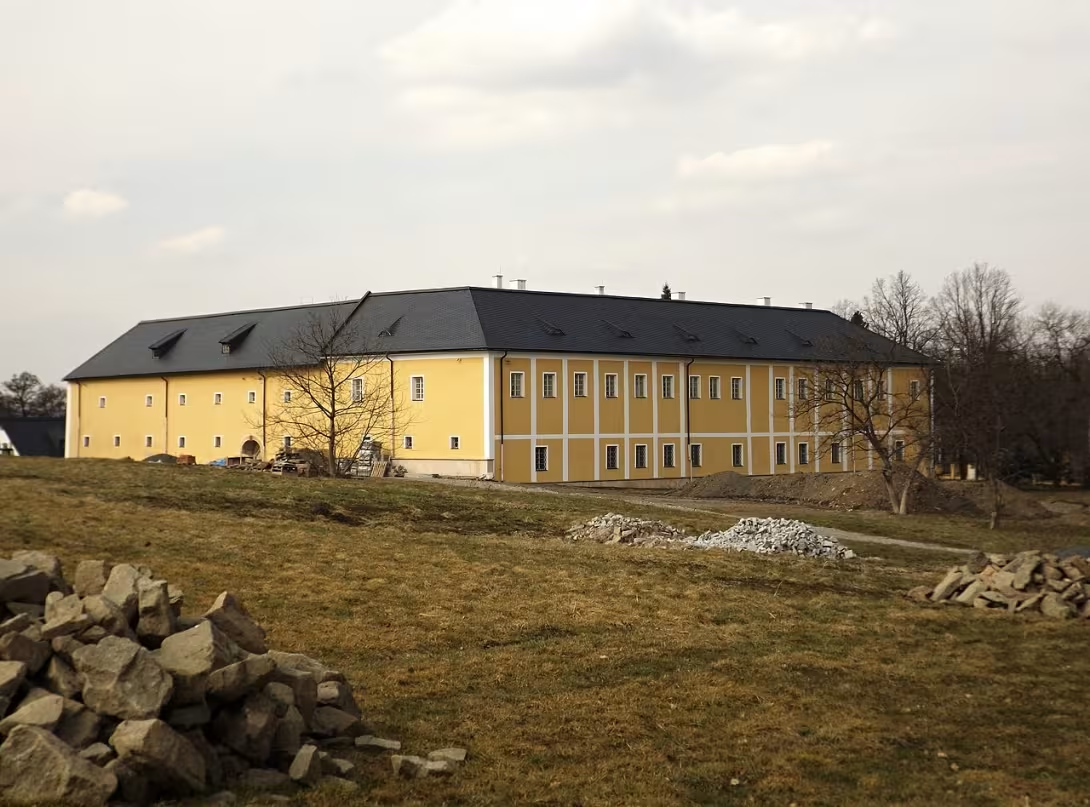

The historical appearance on the left is an AI-generated visualisation and serves as inspiration only.
Historical milestones
- 1573
- Burian Barský z Baště buys part of the ducal estate of Cieszyn including Rychvald.
- 1575–1577
- Bernard Barský z Baště builds an extensive two-storey Renaissance château.
- 1630
- The Barský family's tenure ends; other families follow on the estate.
- 1791
- The marriage of Anna Maria Mönnich and Count Jan Josef Larisch founds the Larisch-Mönnich family.
- 2nd half of the 19th century
- Evžen (Eugen) Larisch-Mönnich and his daughter Franziska rebuild the château.
- 1869
- The Schloss Reichwaldau railway stop opens in front of the château.
- 1903
- The château and estate pass fully to the Starhembergs.
- after 1945
- Expropriation; in 1950 the château goes to the Rychvald collective farm.
- 1958
- The château is protected as a cultural monument.
- 1962–1989
- The château belongs to OKD's Rekultivace plant and falls into serious decay.
- 2009
- Ing. Pavel Šmíra buys the château.
- 2010–2016
- Complete reconstruction of the château and its grounds.
Architectural development
Bernard Barský z Baště built the château in 1575–1577 as an extensive two-storey Renaissance building. It has four wings around a courtyard; according to the town it measures 60 × 80 m on the outside, with a courtyard of 48 × 48 m. The north and east wings were residential, the south and west wings served as granaries and stables. The chapel was only added during one of the later rebuildings. The main rebuilding took place in the second half of the 19th century under Evžen (Eugen) Larisch-Mönnich and his daughter Franziska.
Historical events
In 1869 a stop on the Košice–Bohumín Railway called Schloss Reichwaldau was opened right in front of the château; from 1921 it bore the Czech name Rychvald zámek. In 1936 Friderika, daughter of the last noble owner Georg Adam Starhemberg, was born at the château. After 1945 the château served as storerooms, flats and a farmyard of the collective farm. In 1988 its demolition was considered. After the Velvet Revolution the Starhembergs visited the château, but their plans for its restoration came to nothing. In 2010–2016 the château and its grounds underwent a complete reconstruction.
Owners
Rychvald belonged to the Duchy of Cieszyn. In 1573 Burian Barský z Baště bought part of the indebted ducal estate including Rychvald, and his son Bernard Barský z Baště built the château here in 1575–1577. The Barský family held Rychvald until 1630. They were followed by the Tluks of Tošanovice, the Haugwitz family of Biskupice, the Vrbna family, the Freudenthal family and the Gašín family of Rosenberg. In the mid-18th century Baron Jan Václav Mönnich bought Rychvald from the Gašíns.
Points of interest
- The château is called Starý dvůr (Old Manor Farm). Yet on the maps of the Third Military Survey of 1876–1878, today's château is marked “Teich Hof”, while an “Alt Hof” is drawn about 800 metres to the north-west. According to the town's website, that may have been the seat of the estate's earlier owners.
- By tradition, stone from the demolished Benedictine monastery in Orlová was used to build the château.
- The portal of the main entrance bears the coats of arms of Bernard Barský z Baště and his third wife, Anna Sobišovská ze Šinovic. The same relief appears on the stone lintel above the side entrance of the Church of St Anne, which was built by the same owner.
- According to records cited by the town, in the days of serfdom punishments at the château were carried out on a bench called “na bardoňu”. It supposedly got its name from the first person to try it out.
- In 1869 a railway stop named after the château was opened in front of it: Schloss Reichwaldau, later Rychvald zámek. Passenger services there ended in the 1960s.
- The château is the subject of the book Zámek v Rychvaldě. Stavba, obyvatelé, proměny by L. Augustinková and K. Barcuchová (Rychvald 2017).
Guide
This guide is narrated by a synthetic voice generated by artificial intelligence.
Show guide text
This text was created by artificial intelligence and has not been editorially reviewed. It may contain inaccuracies.
Welcome to the château in Rychvald. Locals also call it Starý dvůr, the Old Manor Farm. The château is privately owned, so we will look at it from the outside.
Its story begins in 1573. The Duke of Cieszyn was in debt and had to sell part of his estate including Rychvald. It was bought by Burian Barský z Baště. His son Bernard chose Rychvald as his seat and in 1575 to 1577 built an extensive two-storey Renaissance château here. By tradition he also used stone from the demolished Benedictine monastery in nearby Orlová.
The château has four wings around a courtyard. According to the town, it measures sixty by eighty metres on the outside. People lived in the north and east wings; the south and west wings held granaries and stables. The stone portal of the main entrance is decorated with the coats of arms of Bernard Barský and his third wife, Anna Sobišovská ze Šinovic. The metal coat of arms above the portal was added much later and combines the arms of the Larisch-Mönnich and Starhemberg families.
After the Barský family, many other families held the estate. In the mid-18th century Rychvald was bought by Baron Jan Václav Mönnich, and the marriage of his daughter Anna Maria to Count Jan Josef Larisch founded the Larisch-Mönnich family. In the second half of the 19th century the château was rebuilt by Evžen Larisch-Mönnich and his daughter Franziska. In 1869 a railway stop named after the château was opened right in front of it. Franziska then brought the château as her dowry to her husband Ernst Rüdiger Starhemberg, and it belonged to the Starhembergs until 1945.
After the war the château was expropriated. It served as storerooms, flats and a farmyard of the collective farm and later belonged to the OKD company. Although it had been a cultural monument since 1958, it fell into decay, and in 1988 its demolition was even considered. It was saved only by the owner who bought it in 2009 and had it completely reconstructed between 2010 and 2016. As you continue, visit the Church of St Anne too. It was built by the same Bernard Barský z Baště.
Tips for visitors
Expect to see it from the outside, from the public street, and please respect the private property. The château occasionally hosts events: in April 2025 the first Easter fair took place here, when many people saw the château for the first time since its reconstruction. The town of Rychvald announces such events on its website.
Frequently asked questions
Can the monument be visited?
Some buildings of this kind are open for guided tours, others serve another purpose or are privately owned. We have not verified whether and when this monument is open – please ask the operator.
What are the opening hours and admission?
We have not verified the opening hours or admission. Current information is published by the operator.
Where is the monument?
Location: Orlovská 1, Rychvald, Moravskoslezský kraj. The map on this page shows the exact spot.
Why is the monument protected?
It is listed in the Central List of Cultural Monuments of the Czech Republic as a cultural monument (register no. 21268/8-2699).
Businesses nearby
Do you run a restaurant, accommodation, shop, museum, rental, wellness or other visitor service near this monument? Show yourself directly to the people heading to it — this is how they will see you in the app and on the web:
Events nearby
Zdroj akcí: otevřená data měst a obcí ČR (Národní katalog otevřených dat) a kalendář akcí Národního památkového ústavu.
Nearby
About 1.7 km from the château as the crow flies stands the Church of St Anne, which was also built by Bernard Barský z Baště at the end of the 16th century. Another landmark of the town is the Hussite church of 1924–1925. Rychvald is rich in ponds. The best known is Skučák, a nature reserve since 1969 and an important nesting site for water birds. The memorial Rychvald Oak grows by a meadow near the reserve.
Accommodation nearby
Themed route
Bernard Barský's Rychvald and its ponds: start at the château (Starý dvůr) and view the extensive four-winged building of 1575–1577 from the street. About 1.7 km away as the crow flies stands the Church of St Anne, built by the same Bernard Barský z Baště. Below the church is a memorial to those who fell in the First World War. Then continue to the Hussite church of 1924–1925, another landmark of the town. Finally, head to the Skučák pond, a nature reserve with nesting sites of water birds, and to the memorial Rychvald Oak, which grows by a meadow near the reserve.
Seasonal recommendations
You can view the château from the outside at any time of year. Events at the château, such as the Easter fair in April 2025, are announced by the town of Rychvald. In spring and autumn it is worth combining your visit with a walk to the Skučák pond, a nesting site and migration stopover for water birds. Unlike other ponds, Skučák is both filled and drained in autumn, because of the nesting birds.
Visualizations and artistic views


The visualisations are generated by artificial intelligence and serve as inspiration.
Photos from the area
Real photos taken near the monument

Zdroj a licence jsou uvedeny u každého snímku.
Tips from visitors
No tips yet. Be the first!
Log in and add your tip.
Sources and literature
Photos: Tadeáš Bednarz / CC BY-SA 4.0 — Wikimedia Commons. The author and licence also appear when you hover over the image.
Faktickým podkladem tohoto textu byl článek na Wikipedii, jehož autory jsou přispěvatelé Wikipedie. Článek je dostupný pod licencí CC BY-SA 4.0.
Location on the map
Příběhy a pověsti
Legendy, pověsti a příběhy spjaté s touto památkou
Fotografie návštěvníků
Zatím žádné fotografie. Buďte první, kdo přidá fotografii z návštěvy!
Log in a přidejte svou fotografii nebo hodnoťte.
Za ověřenou návštěvu v aplikaci získáte víc bodů — poznáme podle GPS, že jste na místě.
Reviews and comments