



železniční viadukt v Červených Pečkách Railway bridge
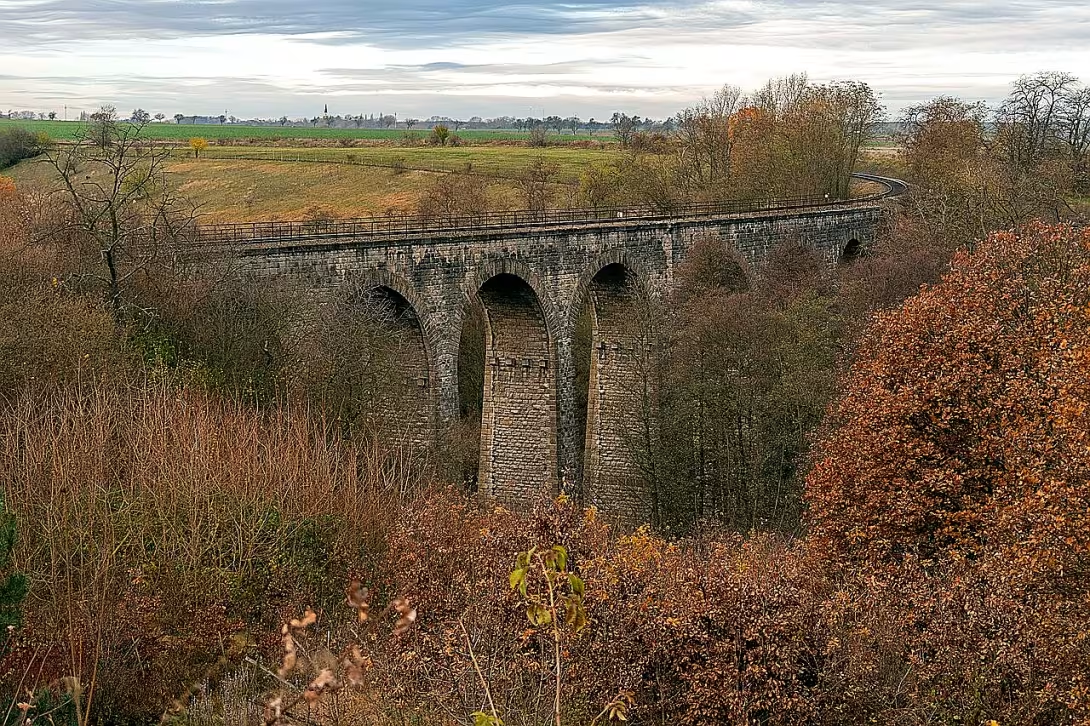
The monument-protected railway viaduct near Red Peček is a unique cultural monument that boasts its history and architectural beauty. Located on the Cologne-Ledečko line northwest of the town Červené Pečky in the district of Cologne in the Central Bohemian Region. This stone bridge has been registered on the Central List of Real Estate Cultural Monuments of the Czech Republic since 2 January 1991 and represents an important part of regional infrastructure and culture.
The Viaduct was built in 1900 within five months, suggesting technical fitness and organization of the time. The concession for the construction of the local railway from Cologne via Bechováry, Kohlířský Janovice and Rataje nad Sazavou do Čerčan was awarded to Count Leopold Šternberk on 10 May 1899. Viaduct over the Polepka Valley, which is part of this line, was built by Ing. Osvalda Živský with support of workers from southern Tyrol.
The architecture of the viaduct is remarkable by its esque curvature and seven semicircular arches. The bridge has a length of 109 meters and the maximum height above the valley of Polepka, or Chotouchov creek, is 31 meters. Construction materials include barefoot quads from Kutnohorsky sandstone and granite blocks from quarry near Lipnice nad Sazavou. The bridge pillers are made of a smaller stone masonry with quad tiles, reinforced with quad wreaths in the middle of their height. The outer supports of the bridge and the end of the embankment are lined with Cyclops masonry.
On the southwest side of the viaduct there is a commemorative plaque with the year "1900," which resembles the year of construction. The original iron railing of the bridge has been preserved until today, adding to its historical authenticity. The Viaduct was designed not only to meet functional requirements but also to be aesthetically harmonised with the surrounding landscape. The construction used progressive technologies of the time, such as cement spawn and insulation with asphalt infused.
The history of the viaduct is linked to the development of railway transport in the region. After the entire line was operational in August 1901, it was not busy for a long time, but with the years progressing, its importance increased. In 2013, motor cars of the 810 series were replaced by Regionals (814 engine units), which reflects the modernisation of railway transport.
The surroundings of the viaduct are as interesting as the construction itself. The Valley of Polepka, through which the bridge is clicked, is known for its romantic landscape beauty, waterfalls and rock formations as "Pashinka," which serves climbers as a training terrain. In the past there were eleven mills in the valley of Polepka and Czech grenades were extracted here, which the Cologne skaters then processed into jewelry. In addition, there are several archaeological sites in the vicinity, such as the extinct Halštat Hradišovice and the remains of the Boretice Castle.
Today, the viaduct is not only a technical monument, but a place full of history and culture. Its preservation and protection is an important aspect of the cultural heritage of the Czech Republic. Viaduct is accessible to visitors, which allows not only to understand its technical and historical value, but also to appreciate the beauty of the surrounding landscape. For those who want to explore the regional heritage and natural beauty, a visit to the viaduct at Red Peček is a truly valuable experience.
Historical milestones
- 1899
- the award of a concession for the construction of the local runway by Count Leopold Šternberk
- 1900
- construction of stone bridge within five months
- 1901
- start-up of the whole line
- 1991
- entry to the Central list of real-estate cultural monuments
Architectural development
The bridge is built of barefoot blocks from Kutnohorsky sandstone and granite blocks from quarries near Lipnice nad Sazavou. Pillars are made of stone masonry with quad tiles. For insulation of vaults was used cement spawn and felt infused with asphalt.
Historical events
1899: the award of a concession for the construction of the track of Count Šternberk; 1900: completion of bridge construction; 1901: the whole line is operational.
Points of interest
- The Viaduct was built in 1900 in five months. - The construction was carried out by Ing. Osvalda Živský with the help of workers from southern Tyrol. - The bridge has an esque curvature, seven semicircular arches and a length of 109 meters. - Quads from Kutnohorsky sandstone and granite blocks from the quarry near Lipnice nad Sazavou were used for construction. - The original iron railing was preserved on the bridge.
Guide
Show guide text
This text was created by artificial intelligence and has not been editorially reviewed. It may contain inaccuracies.
Welcome to the unique stone bridge that rises above the valley of the Polepka River in the village Červené Pečky. In front of you is a massive stone viaduct, whose seven half-circle arches line up like a chain of fortress. The total length of the bridge is 109 metres and the highest point is 31 metres high, giving it an impressive silhouette against the blue sky. When you look around, you hear the noise of water, and you feel a slight chill in the lower humidity, while the stone blocks reflect the sun's rays and create a game of light and shadow.
Let's move on to the beginnings of this building miracle. In 1899 Count Leopold Šternberk was granted permission to build a local railway line to connect the region and promote industrial development. The work on the stone bridge itself began in 1900 and within just five months the construction was built. This success was possible thanks to the careful planning and deployment of experienced craftsmen who worked under engineer Osvald Životský. In 1901 the line was put into operation and since then it has served as an important transport artery. In 1991, the viaduct was entered on the Central List of Real-Estate Cultural Monuments, thereby obtaining protection and recognition of its historical value.
Now pay attention to the architectural details that make this stone bridge so special. The construction is built from Kutnohorsky sandstone and granite blocks, materials which were considered most suitable for such heavy loads at that time. Each of the arches has a semicircular profile, which adds a bridge of characteristic esque curvature which extends along the entire length. If you look closer at the connecting stones, you will notice carefully worked edges and uniform mass distribution, which ensures stability after more than a hundred years. High columns that support individual arches are also made of granite and sandstone, and their massive bodies act as pillars that bear the weight of the entire structure.
As we go through the history of this place, we are meeting with several key figures who were involved in its creation. Count Leopold Šternberk, who obtained a concession for construction, was a major supporter of the development of the railway network in the region. His vision united local authorities, businessmen and craftsmen. Engineer Osvald Živský, who designed and managed the construction, brought to the project his expertise and experience with stone architecture. The workers from South Tyrol who participated in the construction industry brought their skills in stone craft to the team, which reflected in the precision of the processing of individual blocks. Thanks to their joint efforts, the viaduct became not only a transport infrastructure, but also a symbol of cooperation and technical progress of its time.
One of the most interesting anecdotes is that the entire bridge was built in just five months, which was considered a true miracle at the time. Workers had to work in variable weather conditions, often even in rain and cold to keep a strict deadline. Another amazing fact is that part of the stone blocks come from quarries near Kutna Hora, while granite segments were extracted in nearby mountain bands. This combination of materials contributed to the unique appearance and longevity of the construction. Moreover, it is reported that during construction, unexpected underground watercourses appeared on site, which artisans had to circumvent without compromising the stability of the entire bridge.
Now look around and see the atmosphere that exists here. The air is filled with the scent of a damp stone and a light breath of forest undergrowth. In the distance, you can hear the noise of trains passing the track, and remind yourself that this bridge is still fulfilling its original purpose - connecting places and people. If you look up, you'll see how arches rise up to the sky and create an almost poetic image that attracts you to think about how a human hand can create such a permanent and aesthetic work.
Finally, I invite you to look at this stone bridge from different angles and get carried away by its historic charm. Walk along his underpass, listen to the echoes of steps on stone platforms and see how the weight of the past mingles with the present. If you want, you can go further along the railway track and discover other interesting places that this area offers. Thank you for joining this audio guide, and I wish you a pleasant rest of the day in the beautiful setting of the Red Pike. Say goodbye to this majestic bridge and feel that you have become part of its long and rich history.
Tips for visitors
The best time to visit the viaduct in the Red Pečky is early spring or late autumn, where it is quieter and nature offers beautiful colors. This time of year also allows you to take photos without excessive sunlight.
When visiting the viaduct, wear a suitable suit because the weather may make it cold. It is also important to have drinks and refreshments with you as there are no restaurants nearby.
For the photography of the viaduct are the best places at its ends where you can record the overall view and details of the arches. The best light offers morning or evening when the sun is not directly above your head.
In the vicinity of the viaduct there is a romantic valley of Polepka with waterfalls and rock formation Pashinka, which are ideal for short walks. These places are also suitable for families with children, where children can play and have fun in nature.
Frequently asked questions
Can the monument be visited?
This is a structure in a public space that can usually be seen from outside free of charge. We have not verified that this particular one is freely accessible.
Where is the monument?
Location: Červené Pečky, Středočeský kraj. The map on this page shows the exact spot.
Why is the monument protected?
It is listed in the Central List of Cultural Monuments of the Czech Republic as a cultural monument (register no. 1000445036).
Businesses nearby
Do you run a restaurant, accommodation, shop, museum, rental, wellness or other visitor service near this monument? Show yourself directly to the people heading to it — this is how they will see you in the app and on the web:
Nearby
Romantické údolí Polepky s vodopády, skalní útvar Pašinka, zaniklé halštatské hradiště Dobešovice a pozůstatky hradiště Bořetice.
Accommodation nearby
Trips and activities nearby
Guided tours, tickets and activities nearby from GetYourGuide
Affiliate link: if you buy from the partner, we may receive a commission. The price for you does not change.
Search tours and activities →Themed route
Thematic trip route from the Red Peak
1. Railway viaduct in Red Peak (bridge)
Type: Historical monument
Why is it worth a visit: This bridge is an impressive example of 19th century engineering, which combines history and technology. It is an ideal place for those who like the architecture and history of railways.
2. Romantic valley of Polepka with waterfalls
Type: Natural attractions
Why is worth a visit: This place offers beautiful landscapes and a quiet atmosphere, ideal for relaxation. Waterfalls are an impressive natural phenomenon that attracts visitors with its beauty.
3. Rock body Pashinka
Type: Geological interest
Why is it worth a visit: Pashinka is a fascinating rock shape that offers views of the surrounding landscape. It's a great corner for lovers of nature and geology.
4. Zaniklé Halštat Hradišovice
Type: Archaeological site
Why is it worth a visit: This place is an important archaeological site that provides insight into the life of the Hallatians tribes. It's an interesting stop for those who like history and archaeology.
5. Remains of the castle Boretice
Type: Historical department
Why is it worth a visit: This site offers a view of the remains of the ancient castle, which is interesting for historians and lovers of history. It's a place full of secrets from past times.
This route will guide you through the beautiful surroundings of the Red Baths and offer a variety of entertainment for the whole family.
Seasonal recommendations
Spring: In the spring season, železniční viadukt v Červených Pečkách appears in beautiful lighting, when the sun's rays light up through fog and green trees. This atmosphere offers a unique view of the bridge, surrounded by flowering bushes and trees. Although the crowds are still mild at this time, it is recommended to visit early morning or late afternoon to avoid rain weather. Due to warm and sometimes humidifying conditions, it is advisable to bring clothes to prevent moisture.
Summer: Summer offers the best views of železniční viadukt v Červených Pečkách, where nature is at its peak and the bridge is mirrored in the calm waters beneath it. The atmosphere is full of sunlight and heat, making this season ideal for shooting or relaxing in nearby meadows. Due to the popularity of this place in the summer period, it is advisable to come earlier, especially on Fridays and weekends to avoid large crowds. It is also recommended to wear light clothes and plenty of drinking.
Autumn: In autumn, železniční viadukt v Červených Pečkách offers a view of the beautifully coloured nature, when tree leaves gain a colorful gloss. The atmosphere is calm and quiet, allowing full use of the beauty of this place without excessive crowds. Due to colder conditions, it is advisable to bring warmer clothes and perhaps blankets if you plan to spend more time here. The best time to visit is in the early afternoon when the sun is still in the sky.
Winter: In winter, železniční viadukt v Červených Pečkách offers a unique view under the snow umbrella, when the bridge and its surroundings turn into beautiful snowy landscapes. The atmosphere is calm and quiet, which allows you to enjoy peace without many visitors. Due to cold conditions, it is important to wear warm clothes, including hat and gloves, and be prepared for shorter opening times of the sights. The best time to visit is in the morning or afternoon to avoid the cold evening hours.
Visualizations and artistic views


The visualisations are generated by artificial intelligence and serve as inspiration.
Tips from visitors
No tips yet. Be the first!
Log in and add your tip.
Sources and literature
Photos: Michal Gregor / CC BY-SA 4.0 — Wikimedia Commons. The author and licence also appear when you hover over the image.
Faktickým podkladem tohoto textu byl článek na Wikipedii, jehož autory jsou přispěvatelé Wikipedie. Článek je dostupný pod licencí CC BY-SA 4.0.
Location on the map




Příběhy a pověsti
Legendy, pověsti a příběhy spjaté s touto památkou

Fotografie návštěvníků
Zatím žádné fotografie. Buďte první, kdo přidá fotografii z návštěvy!
Log in a přidejte svou fotografii nebo hodnoťte.
Za ověřenou návštěvu v aplikaci získáte víc bodů — poznáme podle GPS, že jste na místě.
Reviews and comments