



Zemědělský dvůr Dřevíč Homestead
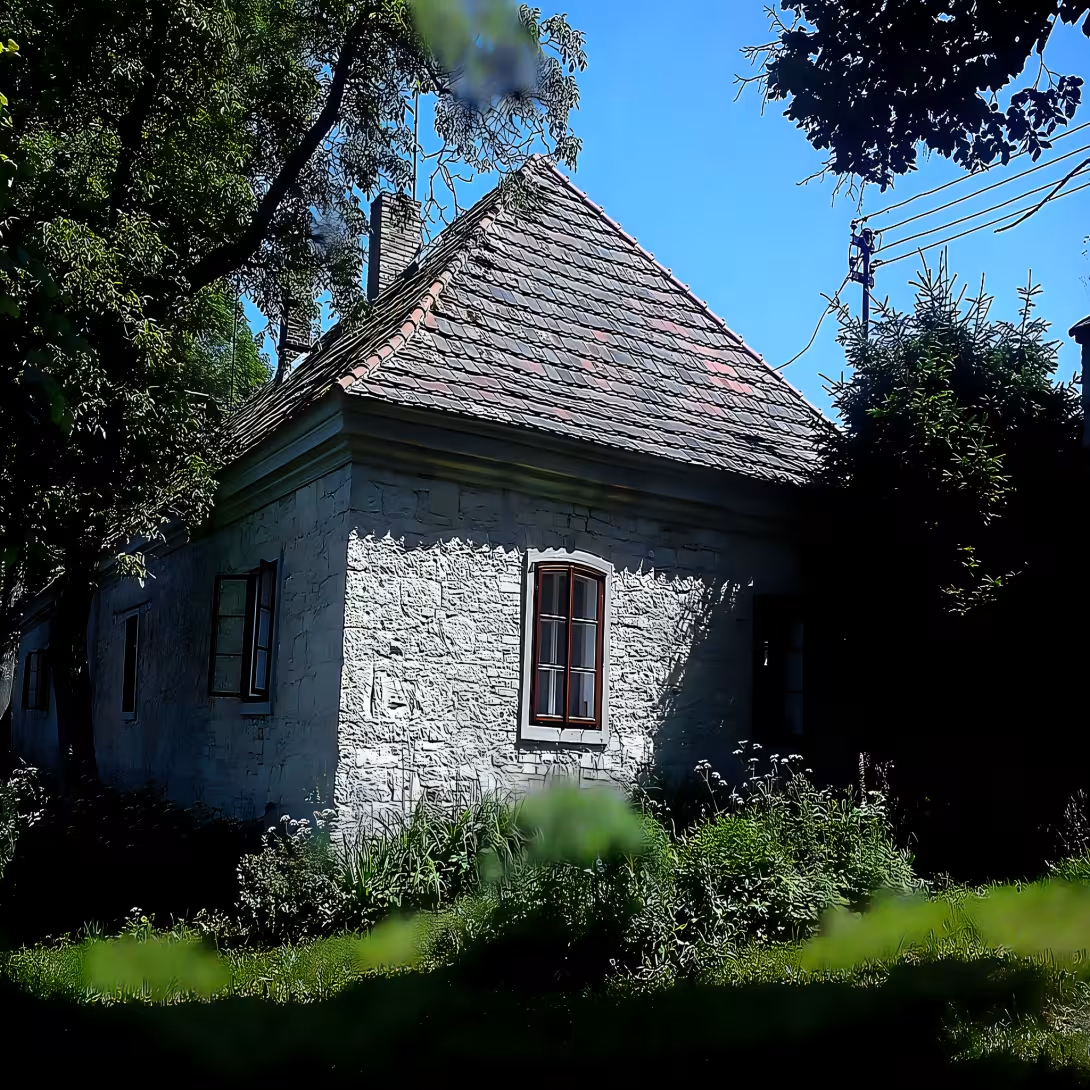
Zemědělský dvůr Dřevíč in the village Kozojedy in the district of Rakovnice is a Baroque economic area from the end of the 17th or early 18th century. Probably served originally as a sailing yard. The monument has been protected since 1992. Its importance lies in maintaining an extensive agricultural complex in close proximity to the early medieval castle.
The origin of the yard is likely to be linked to the nearby castle of Wooden, for which it could perform the function of a floating farm. This hypothesis, however, remains unproven without thorough archaeological research. The current installation was created under Schütz von Leupoldsheim. In this period, noble large states were developed in the Czech countries and agricultural farming was modernised, which was reflected in the available premises.
The area has a regular square plan and lies on a steep slope at the edge of the forest. It is closed by buildings and fenced walls with two gates, making the yard accessible. There's a spring in the middle of the grass. On the north side there is a residential house with a side pillar gate. The western side is made up of a former sheepskin with later-fitted drying hops and small trailers. There are also stables, stables, shed and a large barn within the area. The main buildings are built out of a non-squalor of quarries in the Joban Mountains, with bricks in place. During the 18th and 19th centuries the court was rebuilt and supplemented. The ports from the end of the 19th century are no longer significant from the historical point of view.
The first documented owners of the current building were the Schütz von Leupoldsheim family. Since 1984 the building has been privately owned when its function has been changed to recreational.
The yard is located in the immediate vicinity of the archaeological location of the Lávík castle from the 10th to 12th century. Here were found remnants of valleys, medieval ceramics, iron knife and Slavic clips from the 7th century. Because of the position on the border of the Czech-Hungarian, there is a presumption that it was not a meadow fort. The church of St. Wenceslas, Obora grove, and the streams of Popralovský and Vinarický flow. On the repaired wall of the yard are today placed sculptures, among which stands the wooden ship Ark.
Nowadays, the monument serves as a recreational place. The area is available on a red marked tourist route from the village Kozojedy.
Zemědělský dvůr Dřevíč represents a valuable example of baroque economic construction in harmony with historical landscape. Visiting this place offers the possibility to link the knowledge of architecture to the exploration of the ancient castle.
Historical milestones
- 1700
- The creation of a Baroque economic complex under Schütz von Leupoldsheim
- 1800
- Period of gradual reconstruction and replenishment of buildings within the premises
- 1890
- Construction of later ports
- 1984
- Transfer to private property and change of function to recreational
- 1992
- Commencing protection of the building as monuments
Architectural development
The basic building was built at the turn of the 17th and 18th centuries. During the 18th and 19th centuries the court was gradually rebuilt and supplemented with new functions. In the end of the 19th century, minor additions were added.
Historical events
1984: Transfer of the building to private property and change of use to recreational. 1992: Declaration of Memorial Protection.
Owners
House Schütz von Leupoldsheim (late 17th to early 18th century), private owners (since 1984).
Points of interest
- It is a Baroque economic area from the end of the 17th or early 18th century, which probably served as a sailing yard. - The area has a regular square plan and a spring rises in the middle of its grassy area. - The main buildings are built out of the unflattened spillage of the quarry in the Joban Mountains, with some bricks. - There are sculptures of sculptures on the repaired wall of the yard today, among which stands the wooden ship Ark. - The monument lies in close proximity to the early medieval castle Wooden from the 10th to 12th century.
Guide
Show guide text
This text was created by artificial intelligence and has not been editorially reviewed. It may contain inaccuracies.
Welcome to Capricorn. You are standing in front of a remarkable place, which is the Agricultural Court of Timber. When you look around you now, you will see a closed area in front of you, resembling a solid fortress, even though its purpose was to manage the country and manage it. Notice how buildings together with the wall form a regular square that now surrounds you. This space seems calm and balanced, which is typical of its time. The two gates leading to the compound are the only way to the inner world of this historic complex.
Let us now stop at the question of how people got to this place and why it came to be. This economic area was probably created at the turn of the seventeenth and eighteenth centuries. At that time, there were figures of the royalty Schütz von Leupoldsheim. They were the ones who had this baroque complex built here. It is assumed that the Court served as the so-called "Sailing Court." This means that it was not just an ordinary farm, but a centre for the management of the estate, where the fruits of the land were collected and the management of the surrounding fields and meadows. It was basically an administrative and warehouse hub of the entire estate.
Now pay attention to the architecture itself and the materials from which the buildings are built. Look carefully at the walls of the main buildings. Notice they're not plastered. So you see the natural structure of the stone, specifically the unthrown opposites. This material is not just random, it comes from local quarries in the Joban Mountains, which lie nearby. It's fascinating to see how builders used what the landscape around them itself provided. If you look more carefully, you will see that the opka is sometimes supplemented with bricks which have been used for more detailed development of certain parts of the buildings. The whole complex with its square plan bears witness to careful planning and pursuit of order, which was the basic principle of baroque thinking.
When we think about the people who worked here, we return to the already mentioned Schütz von Leupoldsheim family. Imagine what life was like here hundreds of years ago. This court was the heart of the region's economy. Generations of farms, workers and nobles have passed through it. Even though today we do not know the names of the particular craftsmen who raised these walls, their work has survived for centuries. Over time, however, the area was changing. In the nineteenth century, namely around a thousand eight hundred and ninety, additional extensions were added to the buildings to deal with the new needs of the time. Each of these layers tells the story of how agriculture changed and how the area adapted to new conditions.
Now, I'm going to lead you to one interesting thing that may be hidden from the first glance, but it gives this place a special atmosphere. If you look at the center of the area, where the grass is spread out, you'll find that this is where the spring rises. Water is the basis of life, even in the case of the economic court. The presence of the spring right in the heart of the square complex was probably one of the main reasons why the site was located here. Imagine how this water was previously used for the needs of animals, humans and the farm itself. It's a little natural treasure hidden in a stone encircling.
Also interesting is the fate of the site in the newer times. After a long time serving as an agricultural center came in a thousand nine hundred and eighty-four breaks. The court went into private ownership and his function changed completely. He stopped being a place of hard work in the fields and became a space for recreation and rest. This change helped preserve buildings for future generations. In the year one thousand nine hundred ninety-two, the entire complex was officially recognized as a monument and its legal protection began. That means everything you see today is protected as a valuable piece of our common history.
Now, when you look around you oddly quiet courtyard, feel the contrast between the power of the unobstructed opposites and the fineness of the grassy interior. This site is proof of how people managed to build a functional and aesthetically valuable space in accordance with nature. It is a place where the history of nobility, the craftsmanship of stonemakers and the power of nature in the form of a spring of water meets.
I now invite you to explore the surrounding walls in peace, see the details of the brick accessories in the exit walls and try to feel the atmosphere of this Baroque court. Let yourself be guided by your curiosity and explore how space closes around you and how the gates separate you from the outside world. I hope this short trip to history has helped you better understand the importance of the Court of Timber. I wish you a pleasant rest of the tour and a beautiful day in the Capricorn.
Tips for visitors
For best experiences we recommend a visit in the spring or autumn season, when the surrounding nature is the most colorful. Light is most suitable for viewing architecture during the golden hour, i.e. shortly after sunrise or before sunset, which will highlight the shapes of old buildings.
The road to the place is also possible by car through public transport; Please check the current connection in your search engine. For comfortable movement in the surroundings, good quality footwear is suitable for nature.
When shooting, focus on the regular square shape of the complex and details of the buildings from the end of the seventeenth or early eighteenth century. You get the best views from a certain distance to capture the entire geometry of the buildings from the outside.
In the surroundings you can enjoy nature in the Jbana mountains or follow the course of the Poholovský and Vinarický streams. For history lovers is an interesting archaeological location of the castle Wooden and close church of St. Wenceslas.
Families with children can use the proximity of the natural park to walk. It is good to take water and refreshments with you because it is an area associated with nature.
Frequently asked questions
Can the monument be visited?
This is a residential or farm building, not a museum with opening hours. Please view it from public space and respect the owners' privacy. We have no information about access to the interior.
Where is the monument?
Location: Kozojedy. The map on this page shows the exact spot.
Why is the monument protected?
It is listed in the Central List of Cultural Monuments of the Czech Republic as a cultural monument (register no. 1000118478).
Businesses nearby
Do you run a restaurant, accommodation, shop, museum, rental, wellness or other visitor service near this monument? Show yourself directly to the people heading to it — this is how they will see you in the app and on the web:
Nearby
Archeologická lokalita hradiště Dřevíč, kostelík svatého Václava, hájovna Obora, potoky Pochválovský a Vinařický a Přírodní park v pohoří Džbán.
Accommodation nearby
Themed route
1. Natural park in the Jbana mountains - Type: Natural area. A place with a beautiful landscape that serves as an entrance to the cruise route. 2. Obora grove - Type: Building. Good point for a stop and rest in nature. 3. Archaeological locality of the castle of Wooden - Type: Historical site. Here you can observe the remains of the ancient fortification. 4. Zemědělský dvůr Dřevíč - Type: Economic area. The main destination of the trip, which is the centre of local agriculture. 5. St. Wenceslas church - Type: Religious building. A small temple that offers peace and space to think about.
Seasonal recommendations
In the spring, the surroundings of the yard awaken to life and the young greenery contrasted beautifully with the historical appearance of the buildings. We recommend a visit in the morning when the light is fine and the air is fresh. Due to frequent exaggeration, it is advisable to wear shoes that are not afraid of mud and a light waterproof jacket.
In the summer months the landscape is dominated by rich green colors and bright sun, which highlights the details of the facades. The best time for arrival is shortly before sunset, when shadows are long and temperatures are more pleasant.
Autumn brings golden shades and melancholy atmosphere to the landscape around the Capricorn. The tour from the outside is very cozy during this period, especially accompanied by coloured leaves. We recommend layered clothes and fixed shoes suitable for walking on rural roads.
In winter there is a yard The wood is very quiet and soggy, especially if the construction covers a layer of snow. The lighting is colder in this period and the days are short, therefore it is ideal to plan the journey around noon. Hot winter clothing, gloves and high-quality footwear with anti-slip sole are essential.
Visualizations and artistic views

The visualisations are generated by artificial intelligence and serve as inspiration.
Photos from the area
Real photos taken near the monument

Zdroj a licence jsou uvedeny u každého snímku.
Tips from visitors
No tips yet. Be the first!
Log in and add your tip.
Sources and literature
Photos: Palu / CC BY-SA 3.0, rozlišení zvýšeno umělou inteligencí — Wikimedia Commons. The author and licence also appear when you hover over the image.
Faktickým podkladem tohoto textu byl článek na Wikipedii, jehož autory jsou přispěvatelé Wikipedie. Článek je dostupný pod licencí CC BY-SA 4.0.
Location on the map
Příběhy a pověsti
Legendy, pověsti a příběhy spjaté s touto památkou

Fotografie návštěvníků
Zatím žádné fotografie. Buďte první, kdo přidá fotografii z návštěvy!
Log in a přidejte svou fotografii nebo hodnoťte.
Za ověřenou návštěvu v aplikaci získáte víc bodů — poznáme podle GPS, že jste na místě.
Reviews and comments