



Boží muka (Valtice) Wayside shrine
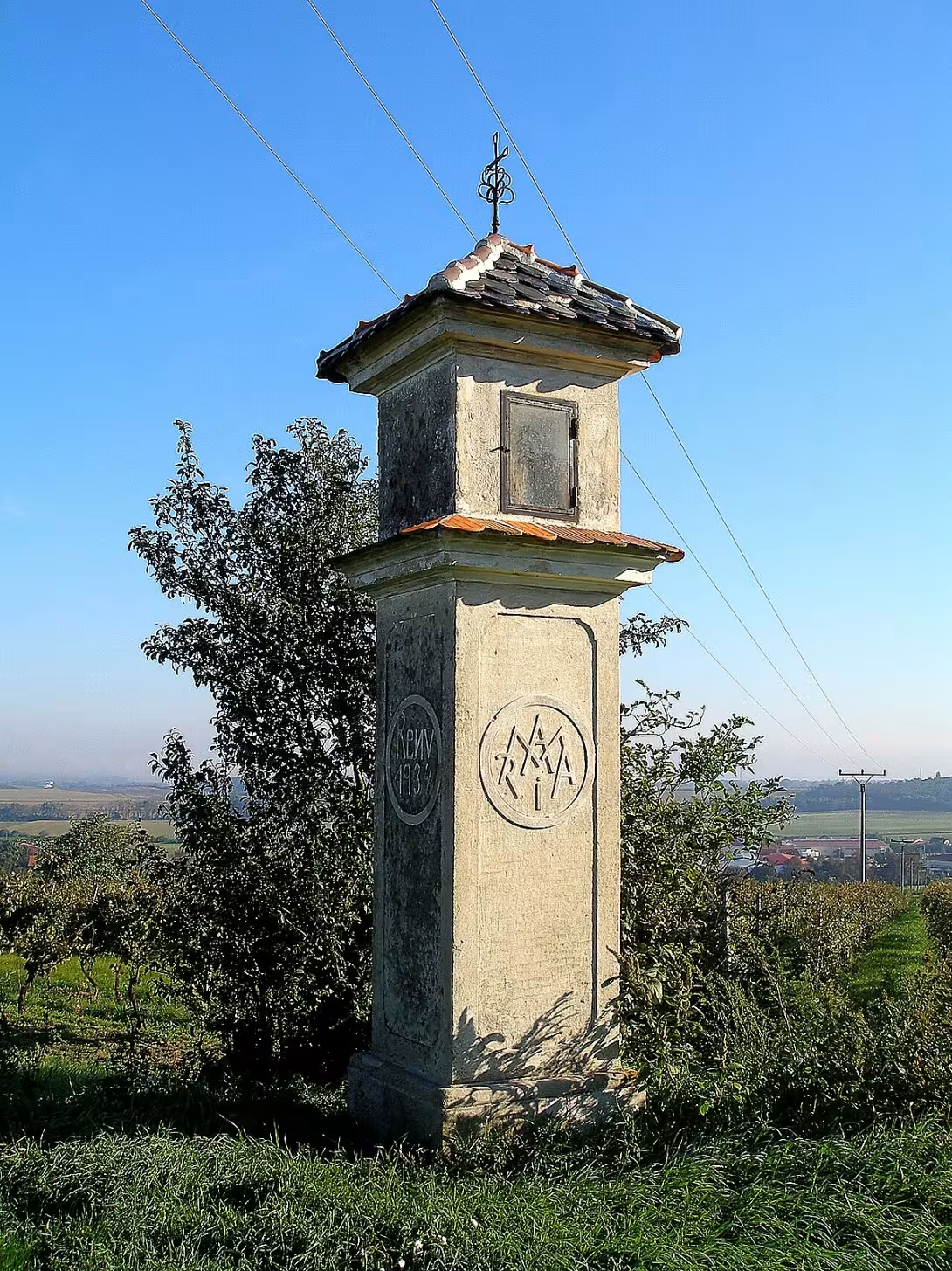
God's torment in Valtice is a sacral building from the late 18th century, which stands by the road towards the Úvaly. The monument is important by its close association with the convention of the order of merciful brothers and the detailed symbolism of these order. The building has been protected historically since 3 May 1958.
An unknown artist built the building at the end of the 18th century. It was created during the period of the development of popular piety in Czech countries, which was reflected in the construction of God's torment in the landscape.
The object is characterized by niche in which various statues and paintings have been placed over the years. In 1934 the monument was decorated with a plastic circle with initials MARIA and a sign of merciful brothers. It makes a pomegranate with a cross and a six-point star. Over the cross is a ribbon with the Latin inscription INSIGNE ORDINIS S. JOANNES DE DEO and on the other side is the inscription REN [O] V [ATUM] 1934.
The history of ownership is related to land exchanges. Originally, the property was owned by Anna and Leopold Andle's husbands. In the second half of 1933, they exchanged it with the Convention of the Order of Merciful Brothers. The exchange took place under the cover of Josua Šalamouna. The monastery gained more than 2 hectares of land towards the Valley. In return, he advanced the building plot at the station stop by the fridge road. The reason was the improper location of the original order lands in urban development and shielding of high trees.
In 1934, the new Prior Petronius Válek had the construction being restored, which had broken windows and a broken cross. The repairs cost approximately 1 000 CZK. For the initiation of the building on 20 September 1934 he invited the conventional priest Josef Whitelohlávka and Prostějov Prior Homobonus Kyovský. He donated three statues: St. Joseph, the Holy Heart of Jesus and the Virgin Mary.
After the abrogation of the church order by the Communist regime, the property was confiscated. The torture of God and the land was assigned to the school farm in Valtice, then the monument fell into oblivion. In 2021, the construction of the city of Valtice was dedicated back to the order of merciful brothers.
In the summer months of 2022, a complete monument renewal took place. It was realized by the restoration company S: LUKAS s. r. o. on the proposal of brother Martin Mack. The only preserved statue of the Virgin Mary was returned to the niche and supplemented with images of saints of Saint John of God and Saint Urban, whose author is Libor Jaros. The repaired monument was blessed by the local vicar Mons on 18 September 2022. Karl Janoušek.
God's torment is a tangible manifestation of the region's spiritual heritage and a testimony of the work of the order of merciful brothers. It's a meeting point for local history with religious symbolism. Visiting this building offers insight into the history of the Valtic landscape and its sacral equipment.
Historical milestones
- 1933
- The exchange of land between the husband and wife and the convention of merciful brothers.
- 1934
- The repair of the object and its initiation by the priest Josef White Head on September 20th.
- 1958
- Entry into the list of protected buildings on 3rd May.
- 2022
- The completion of the memorial restoration and blessing on 18 September by the priest Karel Janoušek.
Architectural development
The original construction from the late 18th century was decorated in 1934 with a plastic circle with initials MARIA and a sign of merciful brothers (pomegranate, cross and star). In 2022 the restaurant was run by the company S: LUKAS, where the paintings of St. John of God and St. Urban were placed in the niche.
Historical events
1934: Repair and new dedication of the monument; 1958: Statement for a protected object; 2022: Complete restaurant and new blessing.
Owners
married Anna and Leopold Andl, convention of the order of merciful brothers (from 1933), school farm in Valtice (after the abolition of the church orders), city Valtice (from 2021), order of merciful brothers (after the donation of the city)
Points of interest
- The construction from the end of the 18th century stands on the road towards Úvaly and has been protected historically since 1958. - In 1934 the monument was decorated with a circle with initials MARIA and a sign of merciful brothers, which forms a pomegranate with a cross and a star. - Land under construction was acquired by a convention of merciful brothers in 1933 in exchange for a plot at the station stop. - In 1934, the neglected building was renovated at a price of approximately 1 000 CZK. - After the property was confiscated by the Communist regime, the monument was allocated to the school farm in Valtice, but in 2021 the city gave it back the order.
Guide
Show guide text
This text was created by artificial intelligence and has not been editorially reviewed. It may contain inaccuracies.
Welcome to this silent and valiant monument, which has just welcomed you with its peace. You stand before God's torments in Valtice, a small sacral structure that, with unchanging humility, guards the path to the Valley. You may be interested in her modesty at first glance, but it is in this simplicity that her strength lies. It is a place where time has stopped and where you can feel the deep spiritual atmosphere of this region. Feel the space around you, the silence of the road and this symbol of faith that has stood here for centuries as a beacon for pilgrims and locals. Now let's look together at how this building came into being and what its story is. God's torment was built at the very end of the eighteenth century. Although today we do not know exactly who was their author, it is clear that it was created with a clear purpose. It was meant to serve as a place of prayer, a stop for passengers and an expression of deep respect for the divine. This monument is not only an ordinary stone by the road, but closely linked to the convention of the order of merciful brothers. It was these men who dedicated their lives to helping others who over the years cared for the construction, renovated it and kept it in good condition. So it is a place that carries a print of mercy and care that the brothers gave not only to the people but also to the space around them. Now pay attention to the details you see right in front of you. Look carefully at the decorating of the building. If you approach, notice the circle that bears the name Maria. It is a delicate but significant detail that gives the monument its unique character. Along with this name, you will find a sign of the order of merciful brothers. Try to recognize it. It's a symbol of a pomegranate that complements the cross and the star. These elements are not random here. Each of them bears deep meaning, which refers to the spiritual values and mission of the order. It is in this detailed symbolism that the greatest distinction lies in this object. It's a visual language that our ancestors tell us about their faith and what they thought was most important in life. When we think about the history of this place, we can't forget the people who were connected to it. The history of God's torment is made up of specific names and actions. For example, we remember figures like Josua Šalamoun, Petronius Válek, Homobonus Kyovský or Martin Macek. Names that may not be widely known today, but which form the cornerstone of the history of this region. A very important moment was the year of the thousand and nine hundred and thirty-three when the land was exchanged between the husband and wife of Andel and the convention of merciful brothers. Thanks to this agreement, the construction came into the hands of those who could appreciate and take care of it. Only a year later, in the year one thousand nine hundred thirty-four, the building was repaired. It was in September, on the twentieth day exactly, when the priest Josef Bělohlávek re-dedicated the memory, thereby returning her full spiritual significance. Let's stop now at one interesting thing that will help you better understand the value of this place. Notice that the building is standing by the road towards the Úvaly. It was this position that was crucial in the past because God's torment should have been seen by anyone who passed through here. Since a thousand and nine hundred and fifty-eight, the monument has been officially included in the list of protected objects. This means that the state has recognised its historical and cultural value. It is fascinating to think of how many generations of people have passed it, how many prayers have been poured out here and how many passengers have found a brief peace before the next journey. In recent years, the monument has undergone another important rebirth. In the year two thousand and twenty-two was completed extensive monument renewal. It was important that the details that you examined a moment ago were preserved for future generations in their original form. The whole process of reconstruction ended on the 18th of September in the year two thousand twenty-two, when the priest Karel Janoušek blessed the memory. This act closed one chapter and opened a new one. So God's torment today serves as a living manifestation of the spiritual heritage of the entire region. Now, if you look at the whole structure again, think of it as a bridge between the past and the present. It's a small piece of history that survived regime changes, war and oblivion. It is a symbol of the endurance and care that the merciful brothers and locals put into it. It is a reminder that even the smallest structures can be of great importance if they are linked to human heart and faith. I suggest you stay in silence for a while and let your thoughts float. Try to imagine what this journey looked like a hundred years ago, what sounds were there and how people treated this building. It is the perfect place for a brief reflection of your own life and a search for inner peace. I say goodbye now. I hope you were interested in the story of God's torment in Valtice and found some peace in it. But this journey ends now. I invite you to continue to explore the surroundings and discover other hidden treasures of this beautiful region. Let yourself be guided by curiosity and enjoy every moment spent in these historic corners. I wish you a pleasant journey and a beautiful day of new discoveries. Goodbye.
Tips for visitors
The best time to visit God's torments is early morning during the spring or autumn period when light is soft and tourism is smaller. At these times you can admire the stone structure and its details without rush.
By public transport, check the current connection in the search engine because we do not know the specific number of lines.
Take a walk with comfortable shoes, water, umbrella or sun cap and map area. Since it is an object only for viewing from the outside, it is not necessary to have special equipment, but we also recommend to have a camera mobile with you.
The most suitable for photography are the late afternoon and the first hour of noon when the sun hits the facade and creates interesting shadows. Try to capture the overall view from the path towards the Fouls and detailed shots of stone ornaments; The best angles are from where the road is slightly curved.
In the vicinity of the monument you can visit the village Valtice itself, where you can find historical houses and quiet streets suitable for relaxation.
Frequently asked questions
Can the monument be visited?
This is a structure in a public space that can usually be seen from outside free of charge. We have not verified that this particular one is freely accessible.
Where is the monument?
Location: Valtice. The map on this page shows the exact spot.
Why is the monument protected?
It is listed in the Central List of Cultural Monuments of the Czech Republic as a cultural monument (register no. 1000147808).
Businesses nearby
Do you run a restaurant, accommodation, shop, museum, rental, wellness or other visitor service near this monument? Show yourself directly to the people heading to it — this is how they will see you in the app and on the web:
Events nearby


Zdroj akcí: otevřená data měst a obcí ČR (Národní katalog otevřených dat) a kalendář akcí Národního památkového ústavu.
Nearby
Obec Valtice, silnice směrem na Úvaly.
Accommodation nearby
Themed route
Here is the design of the thematic route:
1. Municipality of Valtice - municipality. The starting point of the path where the atmosphere of the place can be perceived. 2. Roads towards the Valley - road. Walk through the landscape leading from the village to the destination. 3. Boží muka (Valtice) - landmark. The main destination of the trip, which serves as a spiritual and historical point in the landscape.
Seasonal recommendations
In spring the surroundings of the monument awaken to life and the young green creates a fresh frame for this stone object. Light is soft and pleasant in this period, which is ideal for observing details from outside. We recommend shoes suitable for wet grass and visit in the morning when the air is the cleanest.
In the summer months the landscape is dominated by bright sun and rich colors of surrounding nature. It is advisable to choose a light summer outfit, a sun hat and set off either early in the morning or at dusk to avoid the biggest Closing Clock.
Autumn brings golden shades and melancholy mood to the countryside around Valtice. The lighting is rich and warm, which highlights the texture of the stone. It is advisable to take a lighter jacket or coat and plan your way to days when trees are in full color ritual.
In winter, God's torment is in a quiet and minimalist environment, which can be supplemented by a layer of snow. The atmosphere is calm and steep, while the low winter sun casts long shadows. Hot clothes and waterproof shoes are essential, and the best time for visiting is a clear freezing day when visibility is highest.
Visualizations and artistic views

The visualisations are generated by artificial intelligence and serve as inspiration.
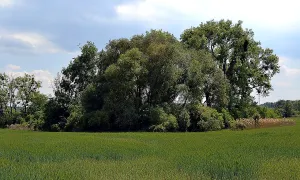
Photos from the area
Real photos taken near the monument


Zdroj a licence jsou uvedeny u každého snímku.
Tips from visitors
No tips yet. Be the first!
Log in and add your tip.
Sources and literature
Photos: Sarkan / CC BY-SA 4.0 — Wikimedia Commons. The author and licence also appear when you hover over the image.
Faktickým podkladem tohoto textu byl článek na Wikipedii, jehož autory jsou přispěvatelé Wikipedie. Článek je dostupný pod licencí CC BY-SA 4.0.
Location on the map




Příběhy a pověsti
Legendy, pověsti a příběhy spjaté s touto památkou
Fotografie návštěvníků
Zatím žádné fotografie. Buďte první, kdo přidá fotografii z návštěvy!
Log in a přidejte svou fotografii nebo hodnoťte.
Za ověřenou návštěvu v aplikaci získáte víc bodů — poznáme podle GPS, že jste na místě.
Reviews and comments