



Brána s brankou usedlosti čp. 10 Gate
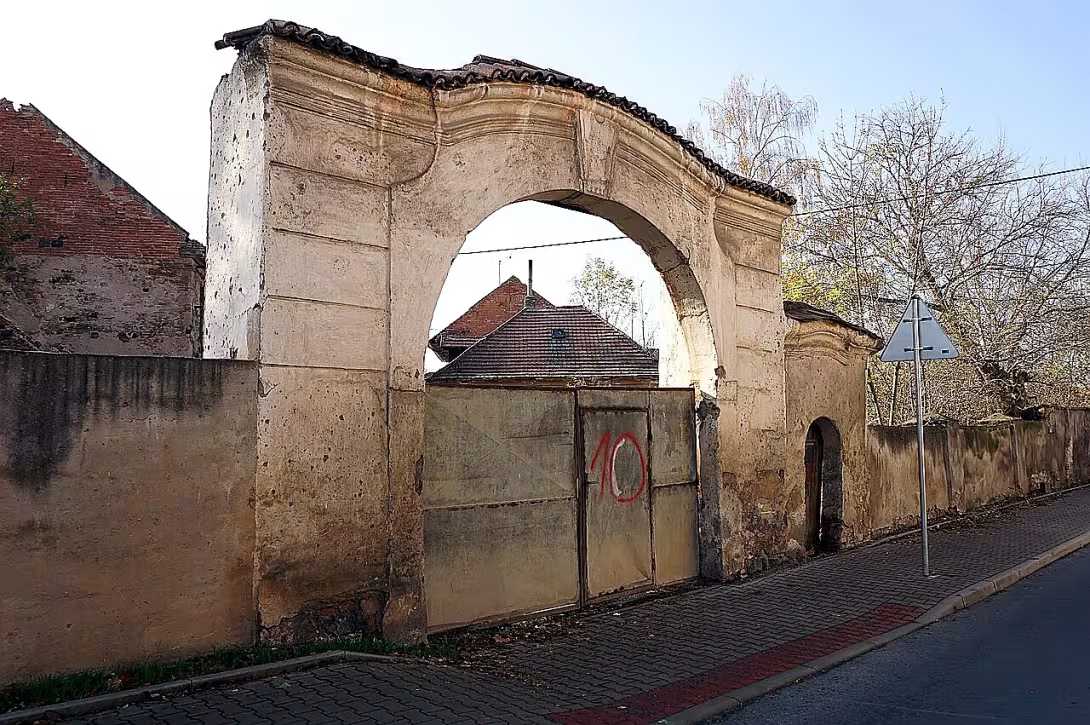
The Baroque gate with the gate near the estate No. 10 in Kojetice is one of the rare preserved entrance buildings in this style around Mělníka. Located in the village Kojetice, district Mělník, Středočeský kraj, and is protected as a cultural monument of the Czech Republic.
This object represents a unique example of late Baroque architecture, which was preserved in its original form. The gate was established at the end of the 18th century and still serves as an entry point of the estate. It is walled, plastered and decorated with a semi-rounded arched goal with fine stucco decoration and a profiled ledge with a prejj roof. The Baroque style manifests itself in fine decorative elements that give the object elegance and harmony with the surroundings.
Architecturally, the gate is typical of its simple but carefully constructed design. The stucco decoration and the profiled ledge highlight the entrance part of the estate. This type of construction was used as a protection against disorder and as an aesthetic element of the farm.
There is little information about the history of the gate. As a cultural monument, it is protected from its creation, which suggests that over the years it has not been preserved to destroy it or major reconstruction. Today it is a part of private property, but its importance for regional history and architecture makes it interesting for visitors.
The gate can be seen in good technical condition, although it is not open for routine inspections. Its greatest jewel is the authenticity and preservation of the baroque entry element, which is a rare example of the residential architecture of the late 18th century. It is an interesting example for lovers of history and architecture, as the Baroque aesthetics also appeared in smaller building elements.
This gateway proves that even small, unobserved objects can be carriers of rich history and aesthetic values. Visiting her means seeing a living document of the past worth paying attention to. If you go to Kojetic, it is worth stopping at this gate and admiring its simple but elegant architecture.
Historical milestones
- end of 18th century
- Establishment of baroque entrance gate with gate according to register data
Points of interest
- It is a rare preserved example of a late Baroque entrance building around Mělníka.
- It has been in its original form since the end of the 18th century and still serves as an entrance part of the estate.
- It is decorated with a half-circle arched gate with fine stucco decoration and a profiled ledge with a roof.
- It is protected as a cultural monument since its inception, which suggests its preservation without major modifications.
- Although it is not accessible for public inspections, it is in good technical condition and is a rare proof of residential architecture.
Guide
Show guide text
This text was created by artificial intelligence and has not been editorially reviewed. It may contain inaccuracies.
Welcome to the village Kojetice in the heart of the Central Bohemian Region. Stop for a moment, take a breath and feel the silence. Right now, you're facing one of the silent witnesses to the history of this place. There's a gate in front of you with a gate of the estate with a description number of ten. At first glance, it may seem like it's just an entrance to the court, but if you look closely, you'll see the embodiment of period elegance and craft precision. It is a place where practical purpose meets aesthetic beauty, and this harmony makes it a protected cultural monument of the Czech Republic.
Let us now look together at where this building came from and at what time it came from. According to available records in the registers, we date this entrance gate to the end of the eighteenth century. So imagine the world over 200 years ago. It was a time of great change when the countryside began to change and the wealthier economy wanted to decorate their homes to discourage their position and level. It was during this period that baroque words ruled, which brought dynamism, playfulness and emphasis on detail to architecture. This gate is a typical representative of this style in its rural, steeper form. Although we do not know who was the project's specific author, it is clear that the builder wanted to create something more than just an ordinary fence. He wanted to create a representative entrance that would welcome guests and at the same time separate the private area of the estate from the public road.
Now pay attention to the architecture itself and the details you have right in front of you. Look at the material and the surface. The gate is walled and covered with plaster, which gives it a uniform and clean look. Notice how dominant the semicircular gate is in its center. This arc is not only a structural element that carries weight over itself, but is also an aesthetic symbol. The semicircle seems calm and balanced. If you raise your eyes above, you will see a fine decorating. These are stucco decorations that are so characteristic of the Baroque period. The stucco, a mixture of lime and other ingredients, enabled craftsmen to create plastic ornaments that play with light and shadow depending on the position of the sun.
Look even higher, to the very top of the gate. Here is a profiled ledge. Rome is the rising edge that optically closes the structure upwards while at the same time serving as a practical protection of plaster from running water. This whole file is finished with a prejj roof. Preface shape means that the roof has two oblique surfaces converging in the ridge, which is a very traditional solution that ensures that the precipitation easily flows away and the construction remains in good condition for centuries. All of these elements together form a whole that acts nobly and yet remains consistent with the atmosphere of the village.
When we think about the people who were connected to this gate, we have to acknowledge that history is silent about the specific names of architects or owners who would be in textbooks today. And that's where the magic of this place lies. This gate does not belong to one famous person, but belongs to the community, craftsmen and generations of people who lived and worked in Kojetice. Imagine all the people walking through here. Do you hear in your mind the sound of the hooves of horses carrying a ferry with crops, or perhaps the silent footsteps of people in period clothing who entered their home after a long day of work in the fields? This gate was a gateway to their world, a symbol of security and family stability. It is a silent monument to everyday life that took place in the rhythm of nature and seasons.
Perhaps you can think of a question as to why such a simple element, such as the gate of the estate, is protected as a cultural monument. The answer lies in her authenticity. Today, when the landscape changes rapidly and old buildings are often replaced by modern materials, this preserved piece of the eighteenth century is invaluable. It's like an open book about what Central Czech architecture looked like, what materials were used and what was considered beautiful. The mystery remains, how many similar gates have disappeared in the vicinity and how many stories have gone into oblivion with them. This gate at manor number ten is one of those that managed to survive and tell us their story further.
Stop for a moment in complete silence. Try to imagine what this gate looked like the day it was first completed. How fresh plaster smelled, and how proud the stucco details were in the setting sun. Feel the texture of the walls and imagine the hands of craftsmen who have carefully shaped each arch and each line. It is fascinating that even though we do not know the names of the creators, their work is still with us and gives us respect for craft and patience.
Now that you've seen all the details of this beautiful Baroque gate, I suggest you continue to explore the area. Kojetice has its own atmosphere and each alley can hide other small discoveries. Let yourself be guided by your curiosity and feel the landscape of the Central Bohemian Region, which is full of similar hidden pearls. I hope this short trip in time at the estate number ten brought you joy and a new view of the beauty that surrounds us in our everyday life.
Thank you for spending a moment with us at this historic monument. We wish you a pleasant continuing journey and many other inspirational experiences in discovering our shared roots. Goodbye.
Tips for visitors
Best time to visit
The most suitable period for visiting the gate at the estate No. 10 is in spring or autumn when the weather is pleasant and light creates pleasant shadows on the walled details. The sunny morning is ideal for photography because it illuminates stucco decoration and half-circle vault. In summer, avoid hot afternoon hours where the sun may be too strong and the gate may seem less impressive.
It is recommended to walk because the estate and the gate are in the centre of the village.
What to take with you
All you need to visit the gate is basic equipment - comfortable shoes and clothes according to the weather. If you are planning a longer tour of the area, take a map or navigation with you so that you can navigate easily. It is also appropriate to take a small towel or cloth with you on any dirt on the walls, but remember that the gate is a protected monument and it is not allowed to touch it. For children you can bring some small toys or a book to read.
Photography - best places and light
The best places for photography are in front of the goal, where you can see the overall architecture with a semicircular vault and stucco decoration. Lighting is most impressive in the morning or afternoon sun, which creates soft shadows and highlights details. If you want to capture the whole gate and the estate, choose a place in front of the gate where there is room for composition. It is also appropriate to take pictures from an angle that highlights the profiled ledge and the prejj roof.
What to visit in the area (within 30 minutes)
There is no other location in the vicinity of Kojetic which is within 30 minutes of the gate near the estate No. 10. If you are looking for other interesting places, you can go to nearby villages or towns nearby, but they are not mentioned in this particular context. It is recommended to explore the surrounding nature or visit other historical settlements in the area if available.
Tips for families with children
For families with children, the visit to the gate is particularly interesting due to its historical value and architectural detail. Children can look at a half-circle vault and stucco decoration like a fairy tale. They are advised to explain how such a gateway worked and what its importance was in the past. You can also use the visit as an opportunity for a small trip to nature where children can run and relax. If possible, bring with you some small toys or worksheets that children can fill during the visit.
Frequently asked questions
Can the monument be visited?
This is a structure in a public space that can usually be seen from outside free of charge. We have not verified that this particular one is freely accessible.
Where is the monument?
Location: Kojetice, Středočeský kraj. The map on this page shows the exact spot.
Why is the monument protected?
It is listed in the Central List of Cultural Monuments of the Czech Republic as a cultural monument (register no. 25149/2-2088).
Businesses nearby
Do you run a restaurant, accommodation, shop, museum, rental, wellness or other visitor service near this monument? Show yourself directly to the people heading to it — this is how they will see you in the app and on the web:
Nearby
➜ Zobrazit interaktivní přehled okolí – restaurace, ubytování, půjčovny a další místa v okruhu 15 km.
Data: OpenStreetMap contributors, okruh 15 km.
🏰 Historické památky
- pocta Janu Palachovi (7.8 km)
- Padlým občanům 1914-1918 (8.4 km)
- menhir Zkamenělý slouha (11.3 km)
- Středočeské muzeum v Roztokách u Prahy (11.7 km – Zámek 1)
- Kobyliská střelnice (12.2 km)
- Jiří Wolker (12.8 km)
- První rozhlasové vysilání (13.0 km)
- Mars (13.1 km)
🍽️ Restaurace a stravování
- Skleník (2.1 km)
- Marten Restaurant (2.1 km – 28. října 919)
- Solidní Jistota (2.4 km)
- FraJa (2.5 km)
- Za Stadionem (2.5 km)
- Špičajda (4.0 km – Mělnická 634)
- Pizza Dolce (10.9 km)
- U Jeníka (10.9 km – Tupolevova 608)
🏨 Ubytování
- Olga (8.7 km)
- Astra (9.6 km)
- Penzion Iva (11.1 km)
- Academic (11.8 km – Tyršovo nám. 2222)
- Hotel Jaro (12.6 km – 17. listopadu 174/2)
- Excellent (12.7 km)
- Pension Lucie (12.8 km)
- Garni - Mazanka (12.9 km)
🚲 Půjčovny a sport
- Cyklotip Pivoňka (2.1 km)
- Cyklo Pavlíček (5.0 km)
- Sokolovna Přívory (7.5 km – U Sokolovny 243)
- Sokol Všetaty (7.6 km – T. G. Masaryka 342)
- Viavelo (13.4 km – Nad Šutkou 503/9)
- Ekor (13.5 km)
- Golfgear.cz (13.6 km – Zenklova 210)
- Fitness Hard Core (14.0 km)
🥾 Turistika a příroda
- Dlouhý vrch (5.7 km)
- Klecánky (přívoz, pravý břeh) (10.7 km)
- Ládví (11.7 km)
- Roztoky (žst) (11.7 km)
- Hořínské zdymadlo (11.8 km)
- Drahanské údolí (12.6 km)
- Maxmiliánka (12.9 km)
- Vyhlídka Emy Destinnové (13.5 km)
Accommodation nearby
Trips and activities nearby
Guided tours, tickets and activities nearby from GetYourGuide
Affiliate link: if you buy from the partner, we may receive a commission. The price for you does not change.
Search tours and activities →Themed route
Thematic cruise route to Kojetice and surroundings
1.Brána s brankou usedlosti čp. 10 People's architecture monument - Unique gate with wooden gate, typical of Central Bohemian rural estates. It shows how they protected themselves in the past and decorated the entrance to the yard.
2. Church of St. Jacob the Elder Baroque sacral building - Small but charming church from the 18th century, which stands in the middle of the village. Its interior and surrounding cemetery offer a quiet place for a short relaxing moment.
3. Statue of St. John Nepomuk Baroque sculpture work - A small but well preserved statue from the 18th century, located near the church. It is a typical example of popular religious sculpture in the region.
4. Zámek Kojetice Renesanční a barokní sídlo – Původně renesanční zámek přestavěný v barokním stylu, který dnes slouží jako kulturní středisko. Jeho park a okolní zahrady jsou vhodné pro procházku.
5. Fara in Kojetice Historical building - Older farm building, located near the church. It is an example of rural sacral architecture and its surroundings offer a quiet environment for a short rest.
Seasonal recommendations
Spring During the spring, when nature awakens to life, the gate of the manor No. 10 in Kojetice offers a unique atmosphere full of light and variable weather. The sun's rays penetrate between the branches of young trees, while the last remnants of snow or melted ice lie on the ground. The air is fresh, often with a hint of moisture, and boxes with first shoots spread around the monument. It is an ideal time to visit when nature changes every day - it is cold in the morning, but in the afternoon the temperature rises rapidly. I recommend visiting the gate early in the morning to avoid possible visitors from nearby cycling routes who often pass through the area during this period. Clothes should be layered - a light shirt under a warmer sweater because the spring sun can be deceptive. Shoes with good grip are suitable for possible muddy roads around the area.
Summer In the summer months, when the sun stands high and the day lasts long, the gate of the estate no. 10 turns into a place where the hot afternoon mingles with the calm of the rural environment. The surrounding area is green, the fields and gardens are in full power, and the air smells of grass and flowers. I recommend you take light, breathable clothes, hat and plenty of water, because the shadow around the gate is usually limited. If you are planning photography, choose a soft light clock - either at sunrise or sunset, when shadows create interesting contrasts.
Autumn Autumn brings golden and red leaves to the Kojetic gate of the estate no. 10, which gradually spread around the surrounding trees and create a magical atmosphere. The air is colder, often with a hint of moisture, and the sun shines through bright crowns, which gives the memory a mysterious light. During this period the surroundings are calmer than in summer, but the weather can change quickly - from bright day to cloudy with rain. I recommend visiting the gate in the morning when the light is most favourable for observing details. Clothes should be warm, but not too heavy, because movement may be required. The waterproof shoes are also suitable because after the rain the roads are muddy. In advent time, the surrounding area may seem even more magical due to the lit windows of the surrounding houses.
Winter Winter visit to the farmhouse gate No. 10 brings to the forefront the calm and moderate beauty of the snowy rural environment. The snow covers roofs, fences and surrounding fields, while the sun, as it shines, reflects off the white surface and creates fine shadows. I recommend to dress in warm but comfortable layers - thermic, sweater and waterproof shoes are the basis. The best time to visit is in the afternoon when the sun stands high enough to illuminate the details of the gate, but the crowds are at a minimum. If you choose to visit during Christmas holidays, the surroundings can be decorated with candles or lights, which will give the memory a Christmas mood.
Visualizations and artistic views


The visualisations are generated by artificial intelligence and serve as inspiration.
Photos from the area
Real photos taken near the monument


Zdroj a licence jsou uvedeny u každého snímku.
Tips from visitors
No tips yet. Be the first!
Log in and add your tip.
Sources and literature
Photos: MartinVeselka / CC BY-SA 4.0 — Wikimedia Commons. The author and licence also appear when you hover over the image.
Location on the map





Příběhy a pověsti
Legendy, pověsti a příběhy spjaté s touto památkou
Fotografie návštěvníků
Zatím žádné fotografie. Buďte první, kdo přidá fotografii z návštěvy!
Log in a přidejte svou fotografii nebo hodnoťte.
Za ověřenou návštěvu v aplikaci získáte víc bodů — poznáme podle GPS, že jste na místě.
Reviews and comments