






Budova Českého rozhlasu Building
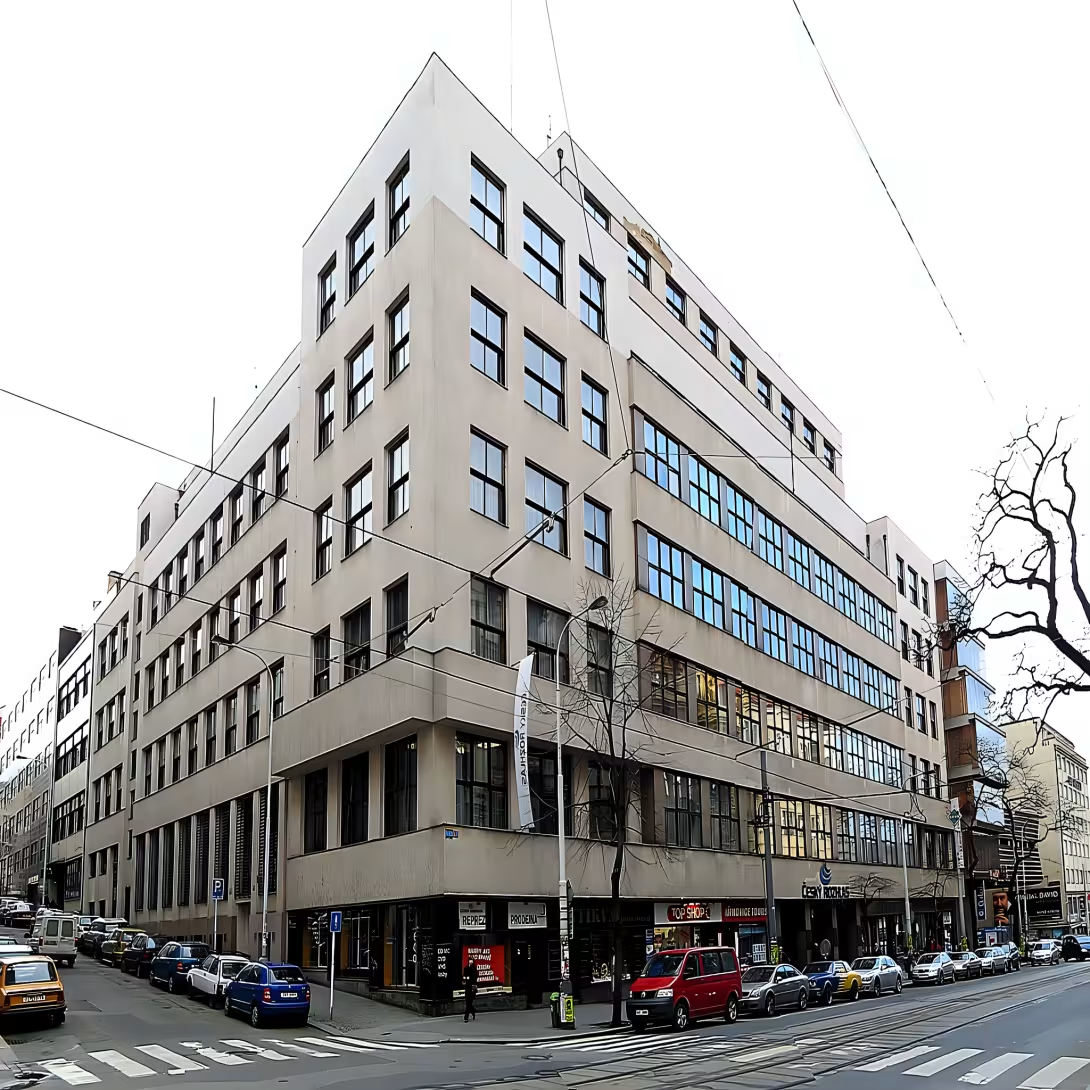
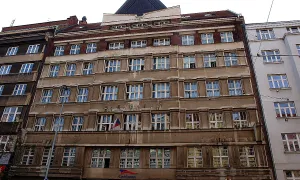
Budova Českého rozhlasu on Vinohradská street number 12 in Prague is one of the most important places in Czech media and political history. It was built between 1929 and 1931 according to the design of architect Bohumil Sláma. It was originally intended for the Post and Telegraph Directorate and also for the Czechoslovak Radio, which started its activities here on 10 December 1933. Around 1935, the building became fully owned by the Czechoslovak Radio.
However, the history of broadcasting in Prague has deeper roots. Czechoslovak radio, known as Radiomournal, started a regular broadcast on May 18, 1923 from a tent near Kbelí Airport. The following ten years the broadcast gradually moved - from Kbel to Khlubětín and back to Kbel, in 1924 to Postage Shopping on Fochov Street (today Vinohradská Street) number 58, in 1925 to Orbís on Fochov Street number 62, and since 1927 from the National House on Peace Square. From there it was broadcast until 1933 when the radio finally moved into a new building in Vinohrady.
The building has forever entered the Czech memory as the place of the beginning of the Prague uprising. On May 5, 1945, at 6 a.m., radio workers began to broadcast exclusively Czech and played banned Czech songs - and the rebellion started with this act. German SS troops responded immediately by attacking the building. There were approximately 90 soldiers from Waffen SS, but Czech police officers and rebels came to defend the radio. During the fighting, German soldiers were lost in the building because the workers removed all German inscriptions. The struggles were intensely conducted by each room and every meter of space. After 18 hours of hard fights, the German unit surrendered. But the day after that, the occupants tried to reoccupy or destroy the building. They deployed tanks and fired from a special armored train at the Central Station. On the evening after 6 May, Messerschmitt Me 262 dropped a quarter-ton bomb on the main building, which completely destroyed the entrance hall, adjacent rooms and broadcasting technology. But the radio did not shut down - the workers immediately continued from the provisional study at the Hus Choir. On 7 May, the Germans re-launched an air raid, but it failed. The fighting ended on 9 May when the Red Army entered Prague. On the same night at 7:05 p.m., the broadcast from the original building in Vinohrady was festively restored.
After the war the building was repaired and completed according to the design of architect Karl Tausenau. Another building was also created in Balbino Street, which formally follows the architecture of Slám.
The building experienced a dramatic moment more than 20 years later. On the night of August 20 to August 21, 1968, when the Warsaw Treaty troops launched an invasion of Czechoslovakia, the Czechoslovak Radio became one of the first targets of the occupants - it was broadcasting an unbiased news of the invasion and calling on the people to calm and quiet resistance. There were clashes outside the building around 7 a.m. About 7:30 a.m., six tanks arrived at the building. A barricade made up of several hundred people, the occupants tried to break through. Dozens of missiles hit the building, Antony's planes flying over the building. Before nine o'clock, the neighborhood was burned - shot-up cars and damaged plaster from buildings. The occupation tank crashed into a barricade made up of a truck; The crash created a fire.
The building has been protected as a memory since 1976. On 23 November 2019, the Government of the Czech Republic declared it a national cultural monument, officially recognising its irreplaceable contribution to the Czech history of the twentieth century.
Then and now
Drag the slider to compare how the landmark may have looked when it was built with the view today.
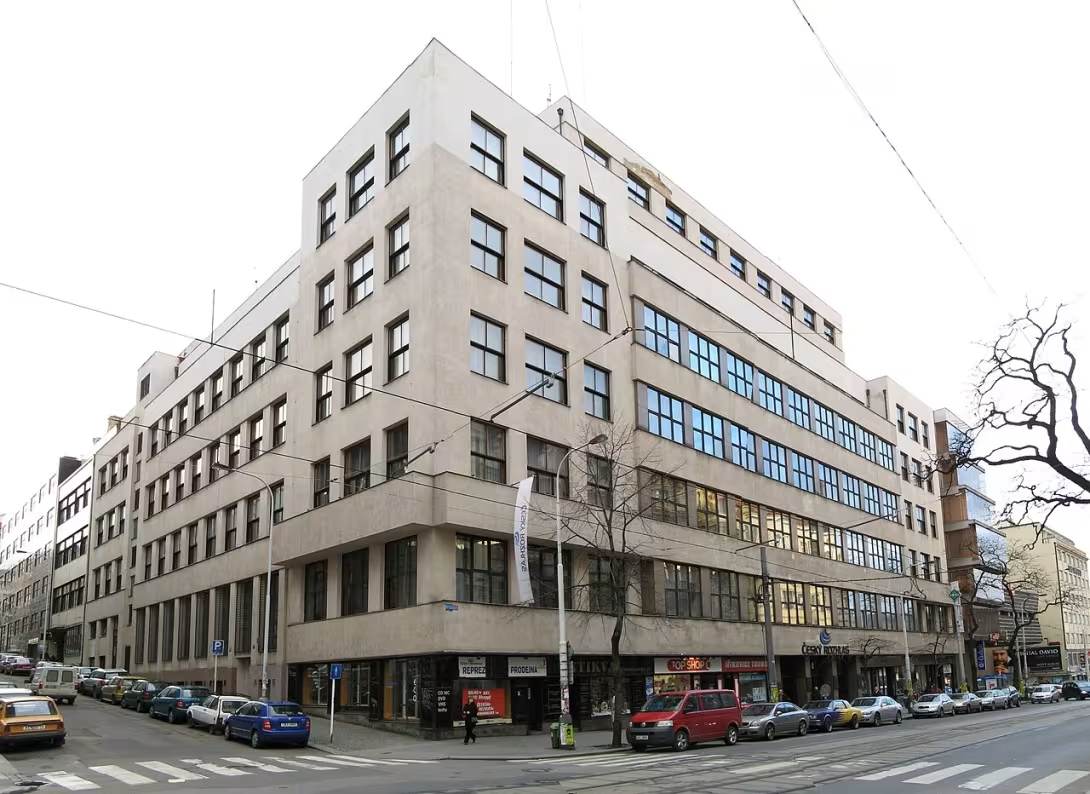
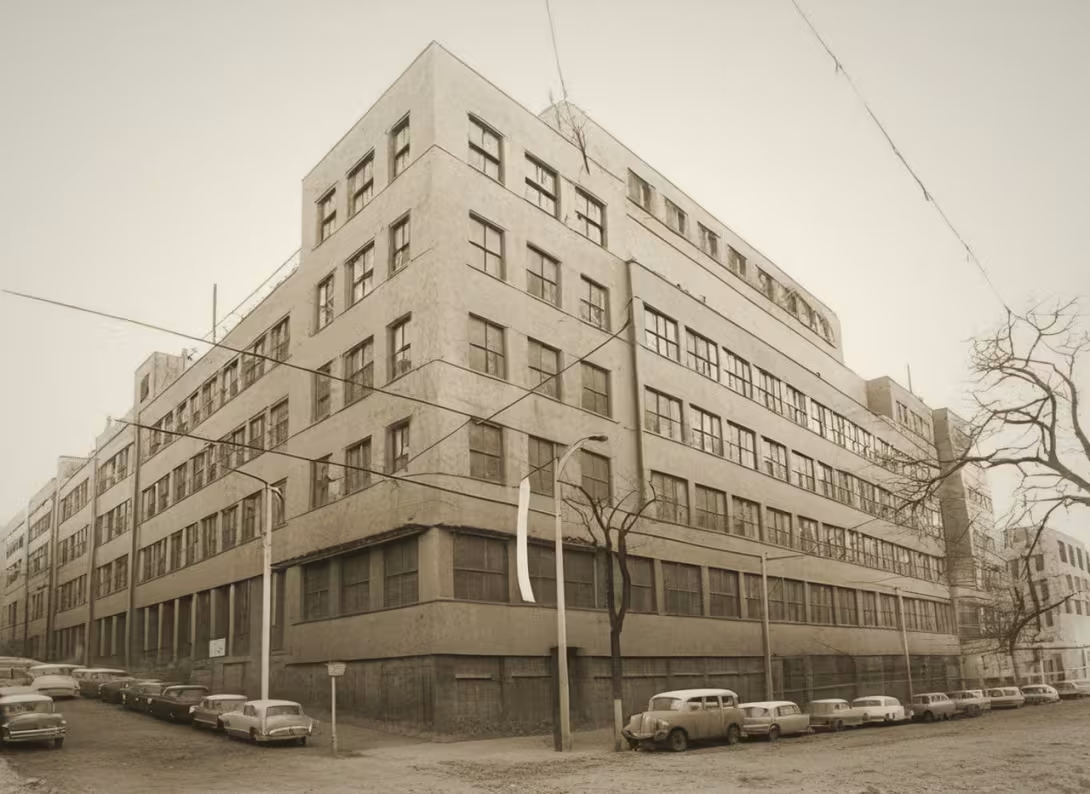
The historical appearance on the left is an AI-generated visualisation and serves as inspiration only.
Historical milestones
- 1945
- The Prague uprising.
- 1968
- Invasion of the Warsaw Treaty troops.
Architectural development
Originally built for the Post and Telegraph Directorate, the building went into the property of Czechoslovak Radio around 1935. After the war destruction, it was repaired and expanded according to the Karl Tausenau project.
Historical events
- 1945
- The building became the center of the Prague uprising.
- 1968
- The building was targeted during the invasion of the Warsaw Treaty troops.
Owners
Since its inception the building belonged to Czechoslovak Radio, which later transformed into Czech Radio. This institution is still the owner of the building. Over the years, the building witnessed many historical events and changes, but its purpose remained the same - to be the headquarters of public service broadcasting.
Points of interest
- Budova Českého rozhlasu was built between 1929 and 1931 according to the design of architect Bohumil Sláma.
- Originally designed for the Post and Telegraph Directorate, the building went completely into the ownership of Czechoslovak Radio around 1935.
- On 5 May 1945, radio workers broadcast exclusively Czech and played banned Czech songs, which triggered the Prague uprising.
- During the fighting, the German SS troops tried to occupy or destroy the building, including the use of tanks and fire from a special armored train.
- On 7 May 1945 the ceremonial broadcast from the original building in Vinohrady was restored at 19:05, after the liberation of Prague by the Red Army.
Guide
This guide is narrated by a synthetic voice generated by artificial intelligence.
Show guide text
This text was created by artificial intelligence and has not been editorially reviewed. It may contain inaccuracies.
Welcome! You are standing in front of the Czech Radio building, a beautiful example of functionalist architecture in the heart of Prague in Vinohrady. Note how this building emerges from the surrounding building. Its simple yet spacious design is perfectly adapted to the surrounding environment.
Let's move on to the historical context. The building was built between 1929 and 1931 according to the design of architect Bohumil Sláma. Originally it was intended for the Post and Telegraph Directorate, but around 1935 it became fully owned by Czechoslovak Radio. At that time it became a centre of Czech broadcasting and a key place during important historical events.
Now pay attention to architectural details. See the facade of the building where you notice simple yet sophisticated shapes and dimensions. Notice how the building emerges from space and creates a dominant silhouette. The architecture of the building excels with functionality and simplicity, which was typical of the functionalist architects of the time.
Budova Českého rozhlasu has also witnessed many historical events. On 5 May 1945, radio workers broadcast exclusively Czech, which was very important for the time being. And in 1968, the building became the place where important news was broadcast about the invasion of the Warsaw Treaty troops.
Let's go back to the personalities who connected to this building. Bohumil Sláma, an architect who designed the building, was an important figure in the Czech architectural scene. His work reflects the characteristics of functionalism, which was very popular at the time.
And one more interesting thing. Budova Českého rozhlasu is not only a beautiful architectural work but also a place where you can look at the history of Czech broadcasting. If you want to learn more about this building and its importance, try to look around and see the details that will interest you.
Thank you for your attention and I hope you fell in love with the Czech Radio building. If you are interested in learning more about other historical monuments of Prague, stay with us and continue our journey.
Tips for visitors
The best time to visit the Czech Radio building is an early afternoon or an early evening hour when there are fewer people and sunlight creates ideal conditions for photography. The functional architecture of the building is illuminated most beautifully in these times.
When visiting take with you clothes suitable for urban terrain and shoes, which is comfortable to walk. You can also bring a camera or mobile phone to capture architectural details of the building.
Photography of the Czech Radio building offers several interesting perspectives. The best light is in the early afternoon when the sun joins the facade from the left. Also looking at the building from Vinohradsky Square offers an impressive view.
The National Museum is approximately 30 minutes' walk from the building. The museum offers a rich collection of art and historical artifacts, which can be interesting for the whole family.
For families with children, the surroundings of Vinohradsky Square are suitable. Apart from visiting the Czech Radio building, you can use adjacent green spaces and parks where children can play in the open air.
Frequently asked questions
Can the monument be visited?
The building is in use (offices, a school, shops and the like). The interior is generally accessible only during operating hours and tours are not usually offered; we have not verified the details. You can see the exterior from the street.
Where is the monument?
Location: Vinohradská 1409/12, Vinohrady, Praha, Hlavní město Praha. The map on this page shows the exact spot.
Why is the monument protected?
It is listed in the Central List of Cultural Monuments of the Czech Republic as a national cultural monument (register no. 469).
Businesses nearby
Do you run a restaurant, accommodation, shop, museum, rental, wellness or other visitor service near this monument? Show yourself directly to the people heading to it — this is how they will see you in the app and on the web:
Events nearby

Zdroj akcí: otevřená data měst a obcí ČR (Národní katalog otevřených dat) a kalendář akcí Národního památkového ústavu.
Nearby
Budova Českého rozhlasu is located in Prague in Vinohrady, an area known for its rich history and architecture. There are many other important monuments in its surroundings, such as St. Ludmila Church, which dominates the Square of Peace. There are also a number of Art Nouveau and functionalist buildings that demonstrate the architectural development of Prague in the 19th and 20th centuries.
Accommodation nearby
Trips and activities nearby
Guided tours, tickets and activities nearby from GetYourGuide
Affiliate link: if you buy from the partner, we may receive a commission. The price for you does not change.
Search tours and activities →Themed route
Route: Vinohrad radio route
1. Budova Českého rozhlasu (main objective) Budova Českého rozhlasu is an important architectural dominant of Vinohrad. Its unique form and location make it a remarkable dominant feature of Vinohrad.
2. Vinohrad class The Vinohrad class is an important transport artery of Vinohrad. Its history dates back to 1884 and was named after the wine-growing terraces that were previously here.
3. Church of St. Luke St. Luke's Church is a Baroque church built in 1716-1718. It is an important sacral building in Prague and is located near the Czech Radio building.
4. Hospital Na František Na Františku Hospital is the largest hospital in Prague. It is located near Vinohrad and is an important health center.
Seasonal recommendations
Spring: In spring, the Czech Radio building comes to life under bright sun, which illuminates the facade of the building and creates pleasant contrasts with fresh green flowers in the surroundings. The atmosphere is relaxed and full of optimism, as if the building itself was waking from winter sleep. If you want to visit the building, we recommend that you come early in the spring season to avoid crowds of tourists and be able to see the building in peace.
Summer: In summer, the Czech Radio building becomes a popular destination for tourists and visitors to Prague. The capital is full of life and energy, so it is recommended to come to the building early in the morning to avoid crowds and to view the building in its original beauty. In summer it is also an ideal time for shooting a building where sunlight creates beautiful shadows and contrasts.
Autumn: In autumn, the Czech Radio building is surrounded by beautiful colors of nature, when tree leaves turn red and orange. The atmosphere is calm and relaxed, as if the building itself was going to winter. If you want to visit the building, we recommend that you come late in the autumn in the afternoon to avoid crowds and be able to see the building in warm and comfortable.
Winter: In winter, the Czech Radio building becomes a romantic destination for lovers of snow and calm. The atmosphere is quiet and calm, as if the building was sleeping alone. If you want to visit the building, we recommend you come in the winter season early in the afternoon to avoid long queues and to be able to see the building in warm and comfortable. We do not recommend visiting the building at night because it is open only within a certain hour and at night it is dark and cold.
Visualizations and artistic views


The visualisations are generated by artificial intelligence and serve as inspiration.
Photos from the area
Real photos taken near the monument

Zdroj a licence jsou uvedeny u každého snímku.
Atmosphere of the place
This atmospheric visualisation of the place and period was generated by artificial intelligence. It is not real footage of the location.
Tips from visitors
No tips yet. Be the first!
Log in and add your tip.
Sources and literature
Photos: Ludek / CC BY-SA 3.0, rozlišení zvýšeno umělou inteligencí — Wikimedia Commons. The author and licence also appear when you hover over the image.
Faktickým podkladem tohoto textu byl článek na Wikipedii, jehož autory jsou přispěvatelé Wikipedie. Článek je dostupný pod licencí CC BY-SA 4.0.
Location on the map
More monuments – Vinohrady
Show all in the municipality
Příběhy a pověsti
Legendy, pověsti a příběhy spjaté s touto památkou
Fotografie návštěvníků
Zatím žádné fotografie. Buďte první, kdo přidá fotografii z návštěvy!
Log in a přidejte svou fotografii nebo hodnoťte.
Za ověřenou návštěvu v aplikaci získáte víc bodů — poznáme podle GPS, že jste na místě.
Reviews and comments