






budova Českého rozhlasu Brno Bank building
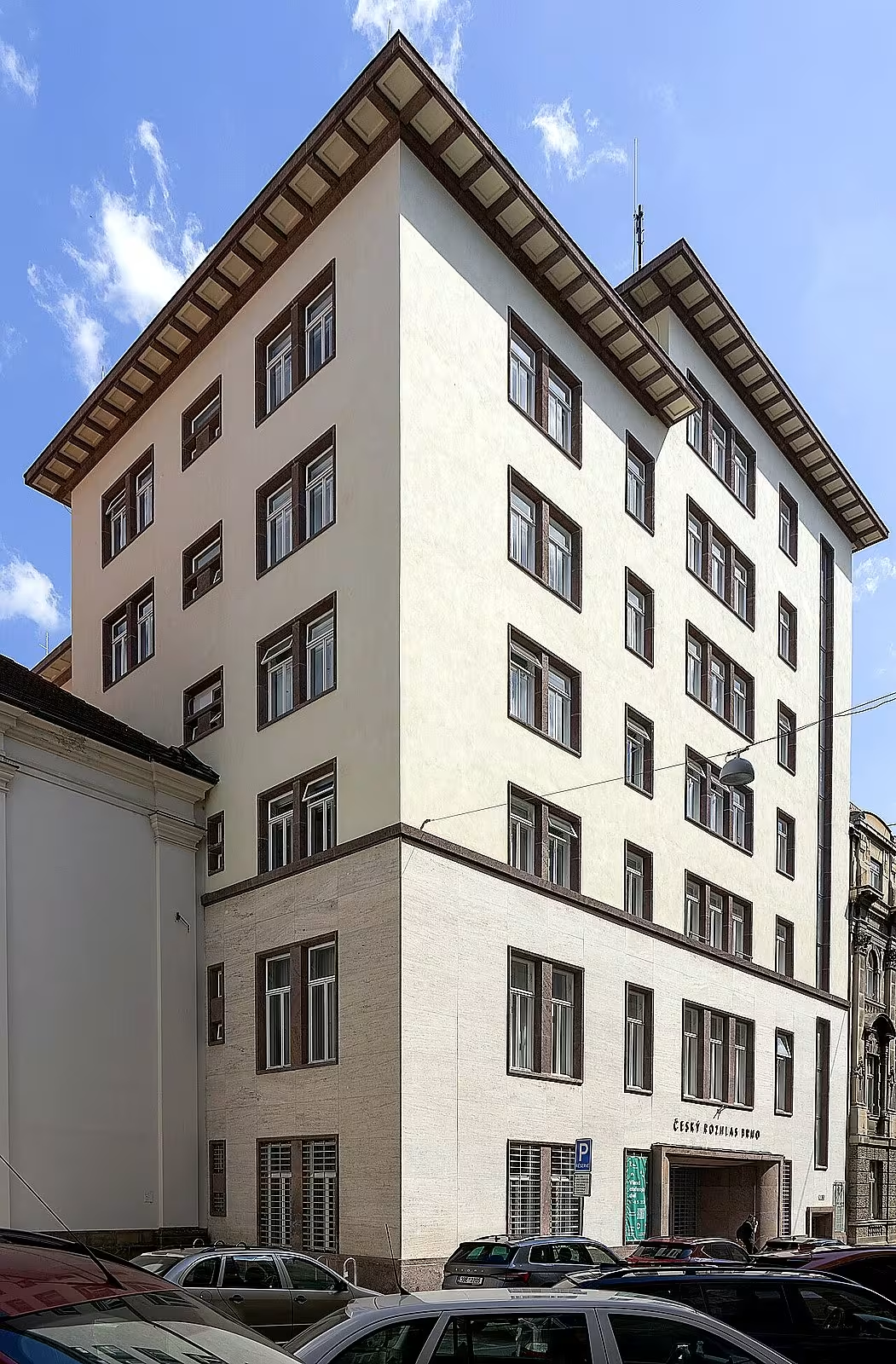
The building of the Czech Radio Brno, located on Beethoven Street in Brno-town, is a historical monument that fascinates visitors with its rationalist design and rich history. Originally built as the headquarters of the Brno branch of the Czech Bank Union in 1923, architect Ernšt Wiesner designed this building as an example of functional and aesthetically interested modernism. After World War II, the building was transferred to the administration of Czech Radio Brno, where it is located today.
The creation of this monument is closely linked to the historical context of the 20th century in Brno. In the period of its creation, intensive urban development projects, such as sanitation and new facilities, led to the demolition of older buildings, between which the Brno Jesuit college was located. This rationalist building was created in its place, designed by Ernšt Wiesner. Its design was focused on functionality and aesthetics, which is reflected in the symmetry and moderate decoration of the building.
The building is an example of rationalism with classical features. The exterior facade highlights the central part and monumental ground floor, while the interior is divided into individual spatial units. This design was also admired by Le Corbusier, indicating its architectural value. The building boasts its first roof garden in Czechoslovakia, which still attracts attention.
The history of the building is also witnessed by dramatic changes in ownership and purpose. After World War II, the original bank was destroyed and the building became the property of Czech Radio Brno, which gradually adapted it for broadcasting needs. This adaptation included extensive reconstruction of interiors and installation of recording studios.
Today budova Českého rozhlasu Brno is not only a protected object, but also an active workplace. It hosts various broadcasting and recording studios, show archives and even hives on the roof. The reconstruction carried out between 2017 and 2022 was awarded as one of the best fixed monuments in the South Moravian Region.
This building is an example of how historical objects can be effectively integrated into modern functions. It's a testament to Brno's rich history and its architectural heritage. For those who are interested in history, architecture or radio production, visiting this building is really a valuable experience.
Then and now
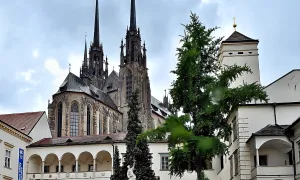
Drag the slider to compare how the landmark may have looked when it was built with the view today.
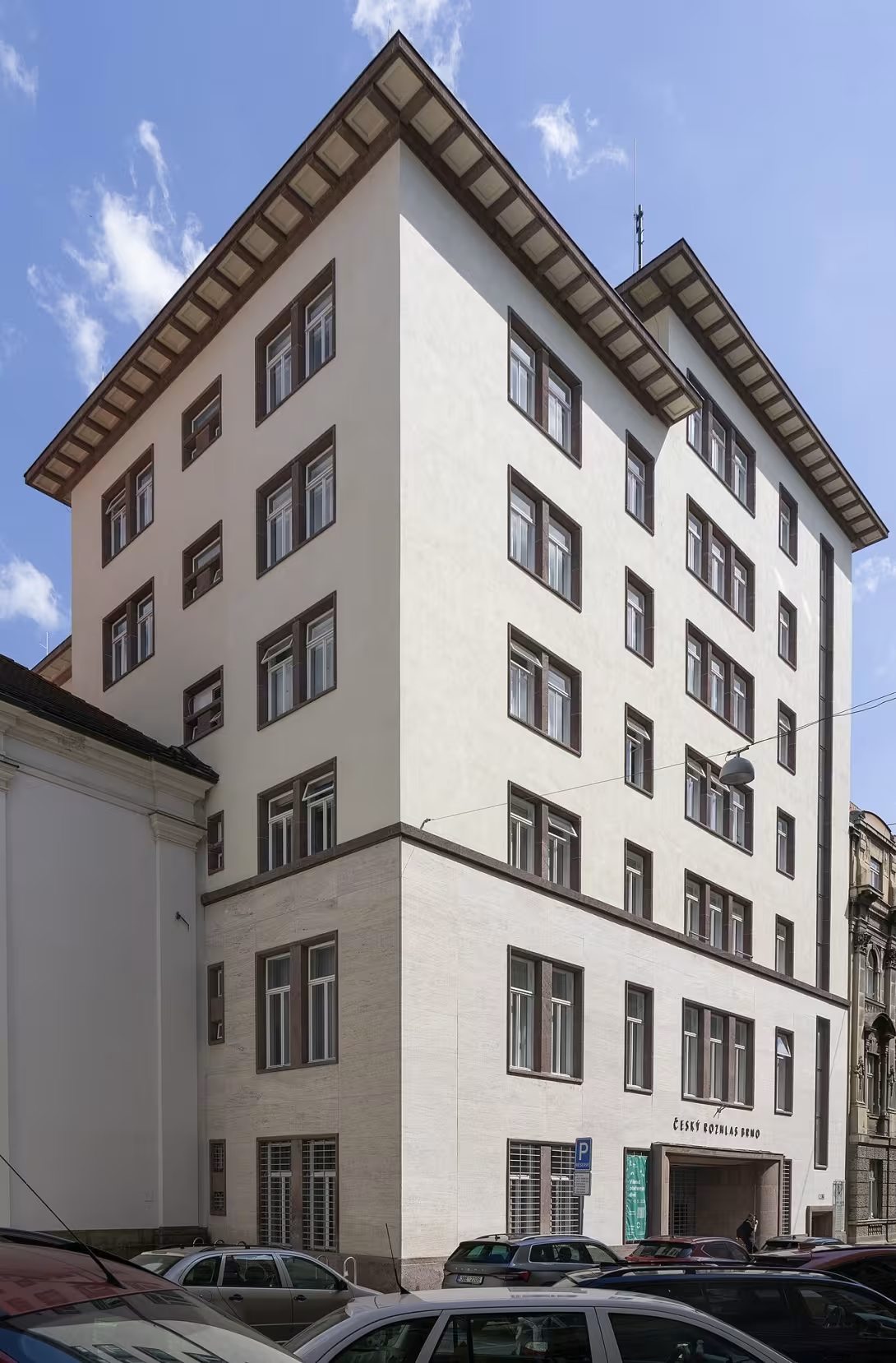
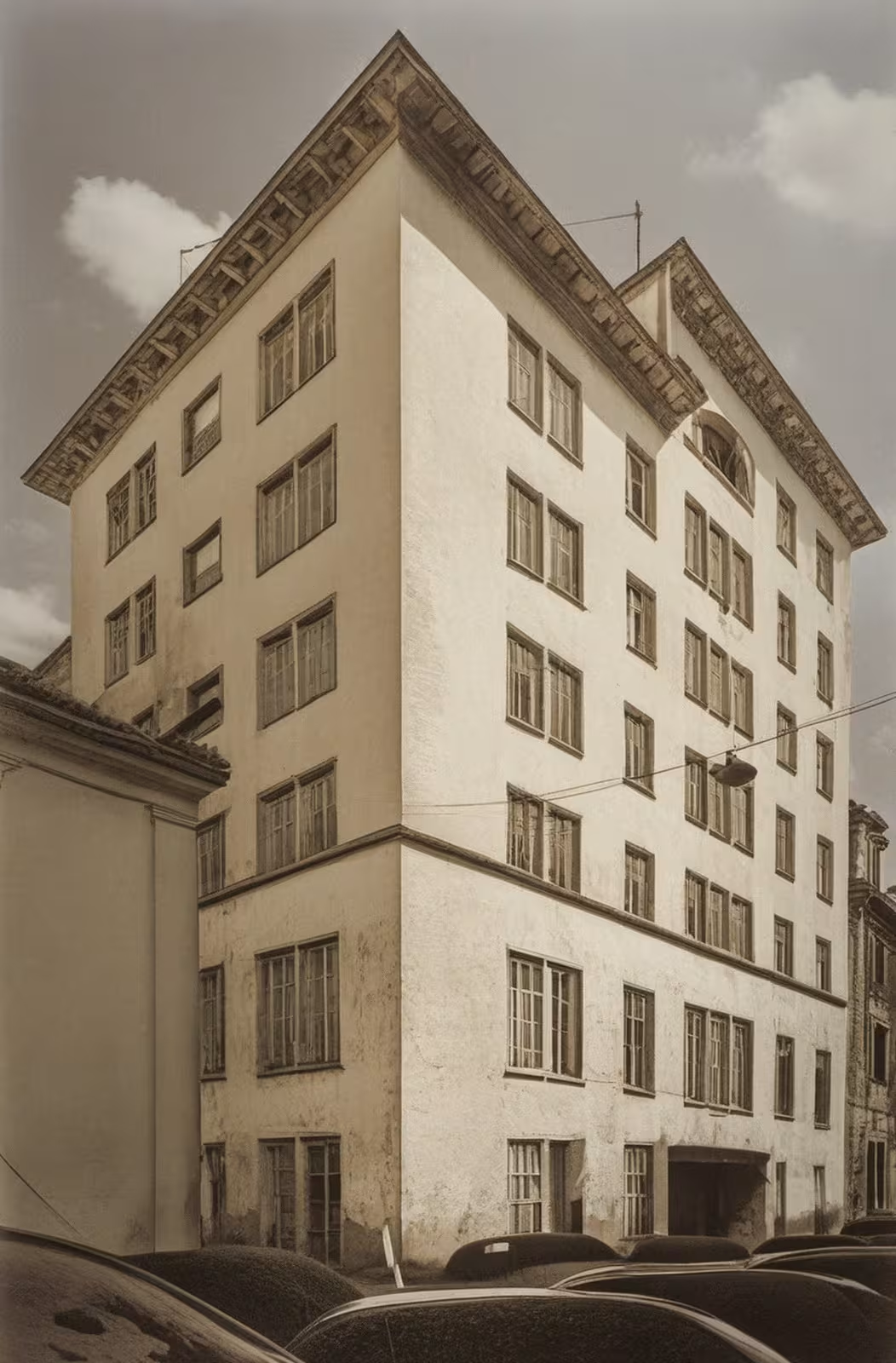
The historical appearance on the left is an AI-generated visualisation and serves as inspiration only.
Historical milestones
- 1923
- The position of the building as the headquarters of the Brno branch of the Czech Bank Union.
- after 1945
- Transfer of the building under the administration of Czech Radio Brno after World War II.
- between 2017 and 2022
- Reconstruction of the building, awarded as one of the best fixed monuments in the South Moravian Region.
Architectural development
The building was designed as a symmetrical and moderately decorated object with classicist features. The exterior facade highlights the central part and monumental ground floor, while the interior is divided into individual spatial units.
Historical events
- 1923
- The creation of the building as the seat of the Czech Bank Union.
- 1950
- Transfer of the building under the administration of Czech Radio Brno.
Owners
- 1923
- 1950
Points of interest
- The building was built in 1923 as the headquarters of the Brno branch of the Czech bank Union. - The construction was designed by Ernšt Wiesner at the site where the Brno Jesuit College used to stand. - The architectural design was also admired by Le Corbusier. The building has its first roof garden in Czechoslovakia. - Reconstruction from 2017 to 2022 was awarded as one of the best fixed monuments in the South Moravian Region.
Guide
Show guide text
This text was created by artificial intelligence and has not been editorially reviewed. It may contain inaccuracies.
Welcome to the centre of Brno, one of its most important streets, bearing the name of the famous composer Beethoven. Please stop for a moment and focus fully on the building that is now standing right in front of you. The first impression that radiates from it is a sense of peace, order and unshakable stability. It's a building that doesn't say much in its form, but it also says everything about the time in which it originated. Feel its balance and the way it fits into the surroundings, yet it dominates it.
Let us now return together in time more than a hundred years back to 1923. Imagine Brno at that time as a city in bloom, full of energy and ambition of the young republic. It is in this spirit that this building has been built. Its original purpose was not to broadcast news or music, but to manage money. It became the seat of the Brno branch of the Czech Bank Union. At the time, banks were not just practical authorities, but should have been symbols of trust, security and modern access to the economy.
This vision of concrete reality was made by a talented architect Ernst Wiesner. Wiesner was a man who understood the new currents of his time and was able to carry them into urban space. If you look at the total size of the construction, you'll see an example of what's called rationalist architecture. What does that even mean? Rationalism in architecture means that the form of the building results from its function. Here you will not find unnecessary ornaments that merely mask the purpose of the construction. Instead, there is logic, purity of lines and geometric accuracy. Look at the facade and see how harmonically the individual elements are laid out. It is a beauty based on order and efficiency, which was an ideal expression for a banking institution in 1923.
What's interesting is what this building is in. If you could look under its foundation, you would find that there used to be a Jesuit college in Brno. It's a fascinating contrast. In a place where spiritual discipline and religious education ruled for centuries, a modern temple of financial stability appeared in the interwar period. This transition from sacral space to modern rationalism in many mirrors of the transformation of Brno as a modern metropolis of the twentieth century.
Now pay attention to how the fate of the building changed after World War II. After 1945, the financial centre became a space for culture and information. The building was transferred to the administration of Czech Radio Brno. Imagine the moment when quiet banking halls began to fill with the sound of a human voice, the noise of microphones and music that began to travel through the air to thousands of households across the country. Since then the radio has been based here today and the building has become an essential part of Brno's cultural life.
Speaking of architecture, one fascinating fact cannot be ignored. Ernst Wiesner's proposal was so successful and modern that he was admired by one of the world's greatest visionaries, Le Corbusier. The fact that such a personality appreciated this particular Brno building shows its high quality and that Brno was at that time a real centre of modern thinking in the area of construction.
And now I want to take you to one of the biggest attractions that the building has hidden, which is not visible from the sidewalk at first sight. Look up to the top of the building. It is here that there is something that was completely pioneering at the time of creation. The building has its first roof garden in the whole of Czechoslovakia. In 1923, it was a total revolution. The idea that the roof of the building may not only be a technical conclusion, but may serve as a green space for relaxation and relaxation in the middle of urban concrete was very brave at the time. This roof garden was an expression of the desire to connect a modern city with nature, which was one of the main pillars of modern architecture.
But time passes relentlessly, and even so, a durable building needs care. In recent years, namely between 2017 and 2022, the building has undergone extensive reconstruction. The goal was to preserve its original genius while adapting it to the demands of today's times. This correction was not just a routine maintenance but a precise work which was subsequently evaluated. The reconstruction was announced as one of the best fixed monuments in the entire South Moravian Region. Today we can admire the building in its full glory, just as Ernst Wiesner himself probably saw it.
Now, if you look at this building again, try to see all these layers of history. Do you see the Jesuit college that used to be here? Do you see an ambitious bank from the time of the first republic? Do you hear the voices of radio moderators who have been here for decades? And do you feel the courage of the first roof park in the country?
This building is much more than walls and concrete. It is a monument to human reason, aesthetics and the ability to adapt to new times. It is a place where finance, culture and architecture meet in one harmonious place.
Thank you for accompanying me in this brief view of one of the pearls of Brno's rationalism. Now I encourage you to look at the building from different angles, feel its rhythm, and perhaps try to imagine how you would feel in that legendary roof garden over the city roofs. I wish you a pleasant continuation in discovering the beauty and secrets of our Brno. Goodbye.
Tips for visitors
Best time to visit the Czech Radio Building Brno is in the spring or autumn season, when the weather is pleasant and the sun lights up the facade of the building especially beautifully. This time of year also offers a softer attendance, which allows a better tour.
Parking can be found in nearby streets or public parking lots. By transport we recommend the use of bus or tram, which are easily accessible from the centre of Brno and can lead directly to the surrounding building. The current connection should be verified by an online traffic search engine.
When visiting, bring sunglasses, protective clothing and luggage for drinking water. The building is located on the street where the sun can be very strong, so protection against UV radiation is suitable.
Photography of the building offers the best possibilities from the side of the street overlooking the facade. The most beautiful light for photos is usually in the early morning or in the evening when the sun illuminates the building from an angle and gives its building elements depth.
In the vicinity is the Jesuit Church of the Assumption of the Virgin Mary, which is suitable for a visit after a tour of the building. The church offers beautiful interiors and historical architecture, which can be an interesting addition to the tour of the radio building.
Businesses nearby
Do you run a restaurant, accommodation, shop, museum, rental, wellness or other visitor service near this monument? Show yourself directly to the people heading to it — this is how they will see you in the app and on the web:
Events nearby


Zdroj akcí: otevřená data měst a obcí ČR (Národní katalog otevřených dat) a kalendář akcí Národního památkového ústavu.
Nearby
Jesuitský kostel Nanebevzetí panny Marie
Justiční palác
Accommodation nearby
Trips and activities nearby
Guided tours, tickets and activities nearby from GetYourGuide
Affiliate link: if you buy from the partner, we may receive a commission. The price for you does not change.
Search tours and activities →Themed route
Building of Czech Radio Brno Type: Architectural monument, cultural institution. Why it is worth a visit: This modern building represents a major dominant feature of the urban landscape and a symbol of media development in the region. Visitors can admire its unique design and atmosphere, which combines functional architecture with cultural events.
Jesuit Church of the Assumption of the Virgin Mary Type: Sacral monument, Baroque architecture. Why is worth a visit: This impressive church is a jewel of Brno history and offers a view of rich Baroque interiors. Its quiet atmosphere provides an ideal contrast to the modern appearance of the radio building and allows visitors to immerse themselves in the spiritual heritage of the city.
Court Palace Type: Historical building, administrative monument. Why is it worth a visit: a service building with a rich history that illustrates the development of the legal system in the region. Its facade and architectural elements are an interesting addition to modern and sacral buildings in the surroundings and offer a view of another era of urban construction.
This route combines three different but complementary architectural and cultural elements close to each other. It starts with the modern symbol of communication, continues with the spiritual centre with a baroque impact and closes with the historical administration building. All three places are located in the immediate vicinity, allowing a comfortable walk without the need to use public transport. During a short walk the visitor gets a comprehensive picture of architectural diversity and historical layering of the Brno environment. Each of these buildings has its own specific character, which enriches the overall experience of the tour.
Seasonal recommendations
Seasonal recommendation for visiting the historical monument. Memorial: budova Českého rozhlasu Brno (building), Brno-město Status:
Spring: In the spring, the surrounding area of the building wakes up and the city turns green. The light is soft and pleasant in this period for observing building details. I recommend a visit around noon when the sun is high enough but not yet burning. Wear layered clothes because spring mornings and evenings can still be cold.
Summer: Summer months bring intense sun and long days to Brno, allowing observation of the building even in the late hours. The atmosphere is very lively, but due to high temperatures and larger crowds it is best to come early in the morning. Do not forget the sun protection and enough fluids to avoid heat fatigue.
Autumn: Autumn offers a nostalgic atmosphere and leaf colours in the nearby area provide an interesting visual contrast to the building. The morning mist may create a mysterious environment, but for the best of visibility, I recommend afternoon hours. Prepare your coat or a stronger sweater because the air is getting wet and cold.
Winter: In winter it is calmer in Brno and the days are much shorter, which affects the time when you can perceive the building in the best light. The atmosphere is very cozy in advent time thanks to the urban lighting. The necessity is a warm winter jacket, scarf and gloves, because staying outside can be unpleasant. Before travelling, check whether there is a limited visit period.
Visualizations and artistic views


The visualisations are generated by artificial intelligence and serve as inspiration.
Photos from the area
Real photos taken near the monument

Zdroj a licence jsou uvedeny u každého snímku.
Tips from visitors
No tips yet. Be the first!
Log in and add your tip.
Sources and literature
Photos: Thomas Ledl / CC BY 4.0 — Wikimedia Commons. The author and licence also appear when you hover over the image.
Faktickým podkladem tohoto textu byl článek na Wikipedii, jehož autory jsou přispěvatelé Wikipedie. Článek je dostupný pod licencí CC BY-SA 4.0.
Location on the map
Příběhy a pověsti
Legendy, pověsti a příběhy spjaté s touto památkou
Fotografie návštěvníků
Zatím žádné fotografie. Buďte první, kdo přidá fotografii z návštěvy!
Log in a přidejte svou fotografii nebo hodnoťte.
Za ověřenou návštěvu v aplikaci získáte víc bodů — poznáme podle GPS, že jste na místě.
Reviews and comments