



Busta J. A. Komenského Sculpture
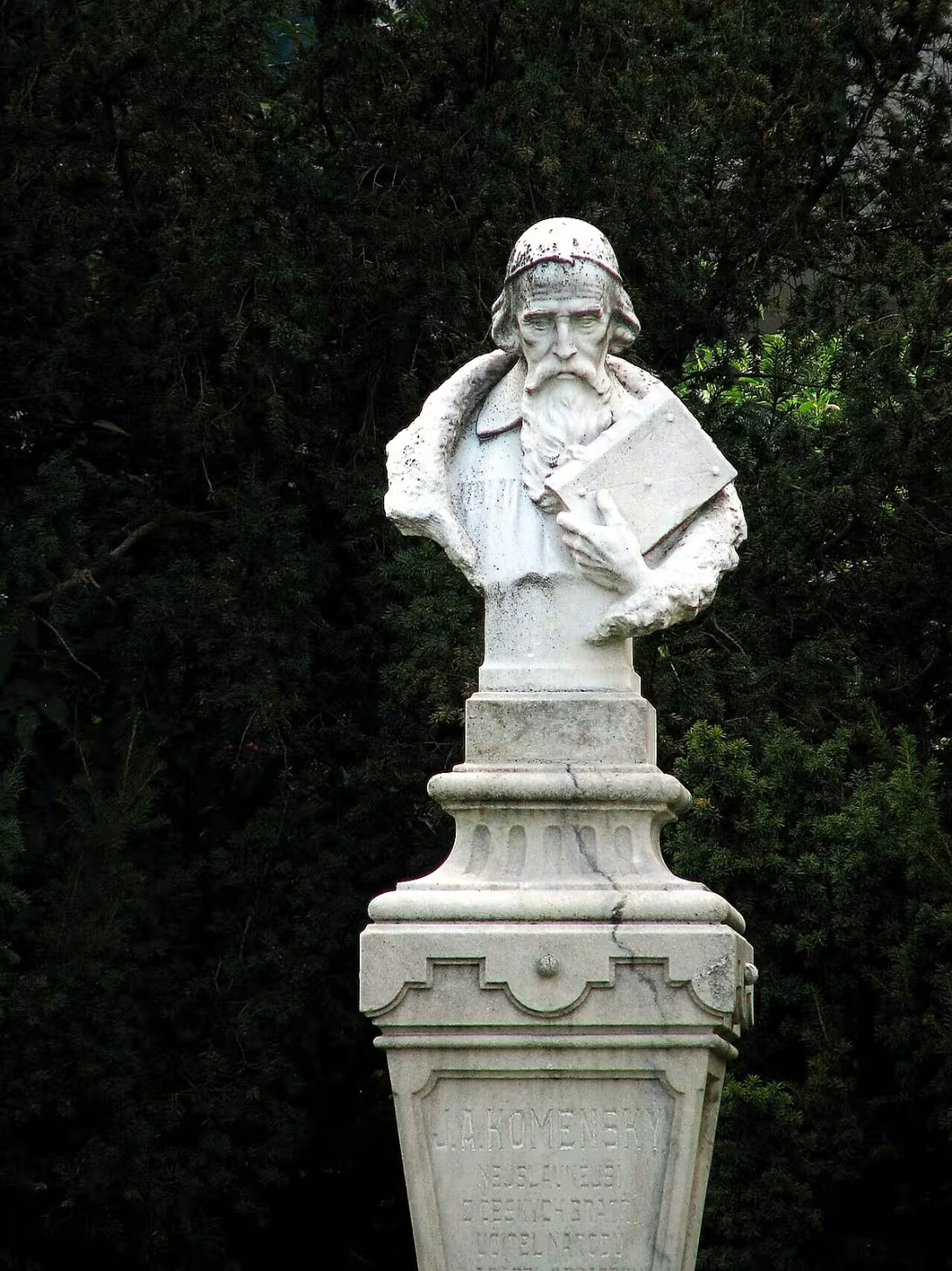
Bust Jan Amos Komenský, located in the village Nové Město na Moravě in the district of Žďár nad Sázavou, is a protected cultural monument of the Czech Republic. This marble statue revealed in 1920 to the 250th anniversary of Komenský's death represents an important historical and cultural monument that deserves the attention of visitors.
Bust was revealed at the site of the former prayer house and lies on a plinth originally intended for bust of emperor Franz Joseph. This Neo-Baroque plinth, with conically narrowing shaping, has been adapted for this new purpose and gives the monument a unique historical dimension. It was created by a native from New Town in Moravia, sculptor Julius Pelikan.
Komenský, also known as the "father of modern education," is a key figure for Czech and world education. His ideas on the reform of education and education remained relevant for centuries, which further underlines the importance of this monument.
Today Jan Amos Komenský's bust is open to the public and is worth visiting not only for its historical value, but also as a symbol of recognition of the importance of educational reforms. Visit it and appreciate its place in Czech culture and history.
This monument reminds us not only of Komenský's legacy, but also of the importance of recognition and preservation of cultural values. It is a reminder that education and culture are key to social progress and harmony. Come and see this monument personally and appreciate its historical significance.
Historical milestones
- 1920
- Discovering the bust for the 250th anniversary of J. A. Komenský's death
Points of interest
- Bust Jan Amos Komenský is a protected cultural monument of the Czech Republic. - It was revealed in 1920 to the 250th anniversary of Komensky's death. - Sokl for bust originally served for bust of emperor Franz Joseph and has a neo-Baroque shape. - It was created by sculptor Julius Pelican, native of New Town in Moravia.
Guide
Show guide text
This text was created by artificial intelligence and has not been editorially reviewed. It may contain inaccuracies.
Hello and welcome to the marble bust of Jan Amos Komenský, located here in New Town in Moravia. You stand before this memorable work, which brings with it a rich history and memory of one of the most important philosophers and educators of Czech countries. Look up at this artwork whose details tell a story full of educational legacy.
This bust was revealed in 1920 at the festive moment of the 250th anniversary of Komenský's death, which meant more than just honoring the monument; It was a statement about the lasting impact of his ideas on world education. Originally, this falcon served as a base for the bust of emperor Franz Joseph, which adds another layer to the history of this place - it combines the Czech educational heritage with the history of the Austrian-Hungarian monarchy.
Let's take a closer look at the details. The marble painting of Komensky is carved to capture his expression and spirit. Notice the care with which this falcon was adapted for a new role - to be home to the memory of Komensky. Although the busts remain unknown, their work tells of deep respect and the worship of a significant person.
Jan Amos Komenský, also known as Comenius, is considered the father of modern pedagogy. His ideas on the way of education and learning influenced not only Czech but also world culture. Although the specific stories associated with this site are little documented, each stone can tell about the important influence of Komenský on education and philosophy.
The interesting thing is that this falcon was originally intended for bust of emperor Franz Joseph. This historical angle reminds us of the complex political and cultural landscape of the time when the Czech educational movement tried to find its space even in the shadow of the great monarchy.
Now that you have explored this monument, I invite you to find time for another walk through New Town in Moravia. Every corner of this city has a story and every work of art carries its own history. I hope this guide inspired you to further discover and appreciate the rich cultural heritage of our countries.
Thank you for your attention and I hope you will remember this memory with a warm feeling. God!
Tips for visitors
The best time to visit J. A. Komenský marble bust is in the spring or autumn season, when the weather is pleasant and vegetation in the surroundings offers a beautiful view. These months also mean lower attendance, which allows a more peaceful tour.
Current connections and times can be found using an online search engine.
When visiting the sights it is advisable to take with you protective clothes such as shoes or hat to help resist the sun. A map guide or mobile application with GPS for better orientation can also be useful.
Photography of the bust by J. A. Komenský is best in the early morning or evening when light is softer and shadow effects add the depth of the picture. Don't forget to check if there are any restrictions on camera usage in the memory.
It is possible to visit the historical part of the village Nové Město na Moravě, where there are many interesting buildings and alleys. For families with children, local parks offer suitable space for games and leisure activities.
Frequently asked questions
Can the monument be visited?
This is a structure in a public space that can usually be seen from outside free of charge. We have not verified that this particular one is freely accessible.
Where is the monument?
Location: Nové Město na Moravě, Kraj Vysočina. The map on this page shows the exact spot.
Why is the monument protected?
It is listed in the Central List of Cultural Monuments of the Czech Republic as a cultural monument (register no. 34386/7-4284).
Businesses nearby
Do you run a restaurant, accommodation, shop, museum, rental, wellness or other visitor service near this monument? Show yourself directly to the people heading to it — this is how they will see you in the app and on the web:
Events nearby
Zdroj akcí: otevřená data měst a obcí ČR (Národní katalog otevřených dat) a kalendář akcí Národního památkového ústavu.
Nearby
➜ Zobrazit interaktivní přehled okolí – restaurace, ubytování, půjčovny a další místa v okruhu 15 km.
Data: OpenStreetMap contributors, okruh 15 km.
🏰 Historické památky
- Horácké muzeum (0.3 km)
- památník partyzánům (7.1 km)
- Vlčí kámen (7.5 km)
- Pomník Broučků (7.7 km)
- Vojákům Rudé armády (9.9 km)
- Stará radnice (9.9 km)
- partyzánský památník (9.9 km)
- Regionální muzeum města Žďáru nad Sázavou (10.0 km)
🍽️ Restaurace a stravování
- Motorest Rovné (6.6 km)
- U Pohanků (9.5 km)
- Poppet (9.8 km)
- Süssův Hostinec (9.9 km)
- U Chalupy (10.0 km)
- U Hajčmanů (10.2 km)
- U Tomáše (10.2 km)
- Táferna (10.3 km)
🏨 Ubytování
- Hotel Panský dům (0.2 km – Vratislavovo náměstí 7)
- Penzion u Martina (5.0 km – 51)
- Horník (5.7 km)
- Hotel Medlov (6.1 km)
- Tábořiště Medlov (6.4 km)
- Hotel Sněžné (9.8 km – 73)
- Balónový hotel a pivovar (10.6 km – Radešín 11)
- Tálský mlýn (10.9 km)
🚲 Půjčovny a sport
- Cyklosport - Šlechta (0.2 km)
- Cyklo Procházka (0.3 km – Jánská 1280)
- Lázně NMNM (0.3 km – Hornická 1495)
- Sporten (1.3 km)
- Cyklo Aréna Vysočina (2.5 km)
- Sportissimo (9.1 km)
- Cyklo Chlubna (9.5 km)
- Relaxační centrum (9.6 km)
🥾 Turistika a příroda
- U koupaliště (1.9 km)
- Tři Smrky (5.0 km)
- Sykovec (rozc.) (6.0 km)
- Barborka (6.1 km)
- Tři Studně (6.4 km)
- Tři Studně - pláň (6.5 km)
- Krátká (8.8 km)
- Samotín (9.3 km)
Accommodation nearby
Themed route
1. Busta J. A. Komenského, statue - The main objective of the tour, which represents an important Czech scholar. 2. The immediate area of the statue, space - A place directly at the monument where artistic details can be monitored. 3. Park near the monument, green area - a quiet part of the immediate surroundings suitable for rest.
Seasonal recommendations
Spring brings awakening nature and soft, soft light, which beautifully highlights the details of the statue. The atmosphere is fresh and full of new energy. It is ideal to visit the morning when the air is the cleanest. Wear layered clothes because the morning temperatures can still be cold.
In the summer, the surroundings are well green and the sun is very bright. A sharp noon light can create deep shadows on the face of the monument. I suggest you come early in the morning to avoid the greatest heat and sudden groups of visitors. Remember light clothes and sun protection.
Autumn offers a colourful spectacle thanks to golden leaves and often foggy, nostalgic atmosphere. The afternoon sun is low in this period and creates very pleasant lighting for the observation of art. Prepare for changing weather and wear a waterproof jacket and tight shoes in case of rain.
Winter moons cover the memory with peace and white scenery. The light is weak and the days are short, so it is best to come around noon. Due to the cold and wind in this area it is necessary to have very warm clothes, including hat and gloves to make the visit pleasant.
Visualizations and artistic views


The visualisations are generated by artificial intelligence and serve as inspiration.
Photos from the area
Real photos taken near the monument


Zdroj a licence jsou uvedeny u každého snímku.
Tips from visitors
No tips yet. Be the first!
Log in and add your tip.
Sources and literature
Photos: Maxx / CC BY-SA 3.0 — Wikimedia Commons. The author and licence also appear when you hover over the image.
Location on the map



Příběhy a pověsti
Legendy, pověsti a příběhy spjaté s touto památkou
Fotografie návštěvníků
Zatím žádné fotografie. Buďte první, kdo přidá fotografii z návštěvy!
Log in a přidejte svou fotografii nebo hodnoťte.
Za ověřenou návštěvu v aplikaci získáte víc bodů — poznáme podle GPS, že jste na místě.
Reviews and comments