



Vodní mlýn (Nové Město na Moravě) Water mill
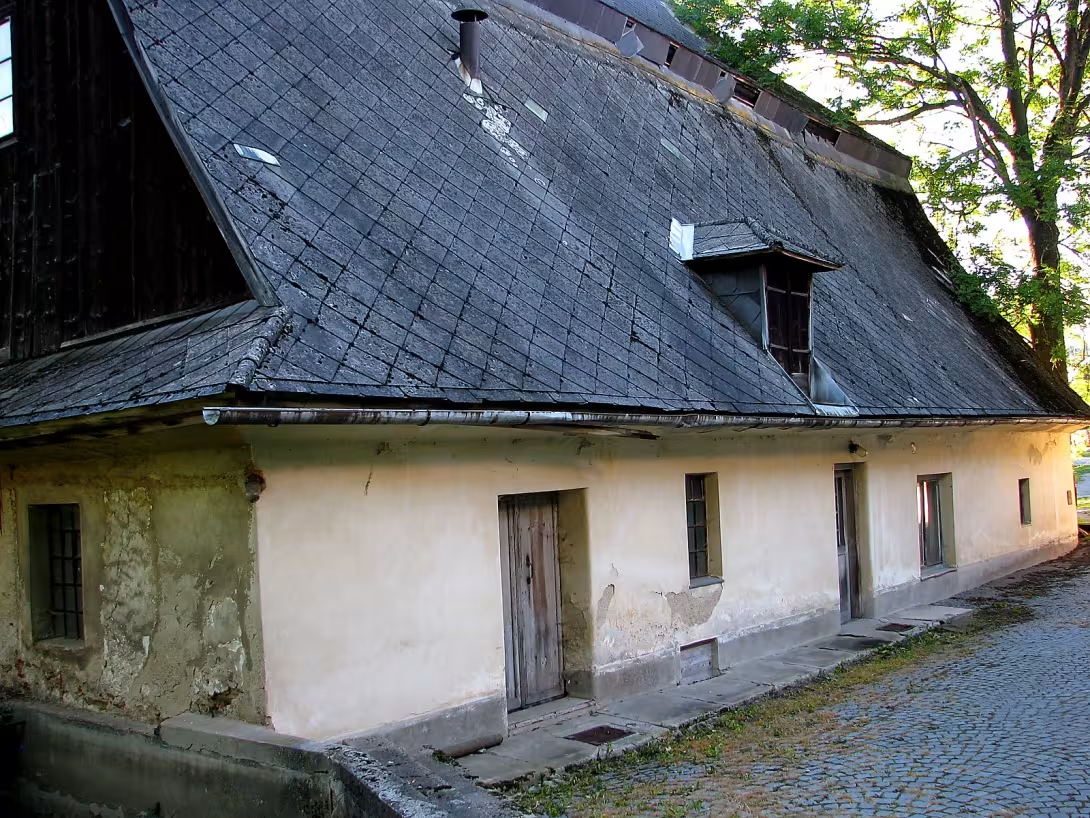
The water mill in Petrovice near New Town in Moravia is a historical monument located on the river Bobrovice. This Baroque object is probably from the first half of the 15th century and has its present form from the turn of the 16th and 17th centuries. The mill was protected as a cultural monument of the Czech Republic in the years 1958-1987, highlighting its historical and cultural value.
The history of the mill dates back to the first half of the 15th century when it was founded. However, its current form dates from the turn of the 16th and 17th centuries, reflecting the architectural development of the time. During its existence, machinery was continuously modernised, showing its adaptability and importance to the local population. In 1980 the mill operation was stopped, but the artistic composition was preserved including Francis's turbine in a very good and operational condition.
Architectural is interesting with a combination of different structures. On the ground floor there are several vaults, while the rooms in the residential area on the second floor have wooden trays with covers. Partly they are rolled arches with lunettes, which gives space a unique character. Construction structures of the mill and crov dates back to the end of the 17th century. Early Baroque treatment of the wall of the north-western shield wall, with individual active architectural elements, was also preserved.
In 1930, the mill had one wheel on top water and saw driven around on top water. The water was driven by a drive into the turbine fountain, which enabled efficient operation. The spiral Francis turbine was installed by the Union a.s., České Budějovice, which survived in very good condition.
The mill has undergone several phases of development and modernization. The machinery was continuously updated, which included the installation of Francis' turbine. Architectural elements such as vaults and walls have undergone baroque treatment, which contributes to its historical significance.
The mill was included in the list of protected cultural monuments in 1958 and the operation stopped in 1980. These events highlight its historical value and importance for the cultural heritage of the region.
Today the mill is available for visiting. Its artistic composition, including Francis's turbine, has been preserved in very good condition and represents an interesting opportunity to explore the history of miller plants. Visiting this mill is valuable not only in terms of its architectural importance, but also as a reminder of technological progress and adaptability of past generations.
The water mill in Petrovice near New Town in Moravia is therefore not only a monument to architectural art, but also a witness to the history of milling and technological development. His visit offers a unique view of the past and a reminder of the importance of preserving cultural heritage for future generations.
Historical milestones
- around 1450
- The start of the mill.
- the turn of the 16th and 17th centuries
- The mill takes its present form.
- end of the 17th century
- Construction construction of the mill and crov.
- 1930
- Installation of Francis turbine by Union a.s., České Budějovice.
- 1958
- The mill is included in the list of protected cultural monuments.
- 1980
- Stopping the mill.
Architectural development
The mill has undergone several phases of development and modernization. The machinery was continuously updated, which included the installation of the Francis turbine by the Union a.s., České Budějovice, in 1930. Architectural elements such as vaults and walls have undergone baroque treatment.
Historical events
- 1958
- The mill was included in the list of protected cultural monuments.
- 1980
- The mill operation has been stopped.
Points of interest
- The water mill in Petrovice near New Town in Moravia is a historical monument located on the river Bobrovice. - This Baroque object is probably from the first half of the 15th century and has its present form from the turn of the 16th and 17th centuries. - The mill was protected as a cultural monument of the Czech Republic in the years 1958-1987, highlighting its historical and cultural value. - Architectural is interesting with a combination of various structures such as vaults on the ground floor and wooden trays with covers on the second floor. - The mill underwent several phases of development and modernization, which included installation of the Francis turbine from Union a.s., České Budějovice.
Guide
Show guide text
This text was created by artificial intelligence and has not been editorially reviewed. It may contain inaccuracies.
Welcome to Petrovice, New Town, Moravia. Stop for a moment, take a breath and feel the surroundings. You're standing right in front of the Water Mill, a place where the rhythm of nature has been blended with human labor for centuries. Look at this area in front of you. The dominant is the mill itself, but your attention should also be paid to the surrounding economic structures and the self-standing object of the saw, which complements the overall picture of this historical whole. All this makes sense to the river Bobrovka, whose current was the main force that powered this machine and which still determines the atmosphere of the whole place. It's a space where water, wood and stone tell the story of how the past lived and worked on the Moravian landscape.
Now let's look deeper into the past together to understand how they got to this place. Imagine we're going back more than 500 years in time. Probably by 1450 the first mill activity was established here. At that time, in the first half of the 15th century, the mill was the key point of every village. It was the center of economic activity, the place where people around here brought their cereals to turn them into flour. It's fascinating to think that even then, in the late Middle Ages, people used the power of the Bobrose River in this very place. However, the mill was not a static construction. It gradually evolved, grew and adapted to new needs. He gained his present appearance at the turn of the 16th and 17th centuries. It was during this period that the mill went through a fundamental transformation that gave it the character that you see today.
Now pay attention to the architecture and details surrounding you. A baroque-style object stands before you. The Baroque has brought some monumentality and playfulness to architecture, which can also be seen in the overall layout of this complex. If you look closely at the construction of the mill and its rover, you will be transferred in your mind to the end of the seventeenth century. It was at this time that a construction was built, which still holds the whole roof and protects the inner spaces. Notice how the organic mill fits into the landscape. The whole area is not just about one building, but about the interaction of several objects. In addition to the main mill, you can see economic buildings that were used to store grains, tools or accommodation. And then there's the solitary saw. Its separate location was not random, but practical, so that wood and sawmill dust were mixed with flour only minimally. Look at the facade and see how these buildings communicate with each other and form a closed workpiece.
Although today we do not know the names of the particular architects who raised these walls or the personalities who lived here over the centuries, we can try to imagine the life of the mill maker. He was a man who had to understand not only the technique of grinding, but above all the behaviour of the water. He must have known when Bobrose was flowing heavily and when to spare her strength. Life in the mill was filled with the constant noise of the bubbling water, the roaring of the mill stones and the smell of fresh grain. It was life in the rhythm of the seasons, from spring thaw to winter frost, which could stop the stream of water and with it all work.
If we move forward in time, we'll find an interesting technical breakthrough. Although the mill seems very ancient, he too had to keep up with the times. There was a major modernization in 1930. The Francis turbine was put into operation, supplied by Union from České Budějovice. Imagine the contrast. Old Baroque walls from the seventeenth century and inside them a modern machine from the twentieth century, which was able to use water energy much more efficiently. This turbine was a symbol of transition from traditional craft to industrial efficiency. It was a time when the mill tried to remain competitive in a rapidly changing world.
However, this mill in Petrovice also has its legal and protective history, which tells us how we saw monuments at different times. In 1958 the mill was officially included in the list of protected cultural monuments of the Czech Republic. This was the moment of recognition of its historical, architectural and technical value. The state said by this step that this place is an important testament to our past and must be preserved for future generations. This protection lasted until 1987. It is interesting how priorities have changed over the years and how the view of what is a real monument has changed.
The end of an era came in 1980. It was this year that the mill definitely ceased operation. The mill wheels stopped, the turbine went silent and the house stopped performing its primary function. Since then the mill no longer has any grain, but began to milk something else, namely memories and history. You are therefore standing here in front of a silent witness to the past, who no longer works, but still tells his story to anyone who stops and listens.
Now try to imagine what this place would look like if it was still busy. Do you hear the noise of Bobrose in the distance? That's the same water that powered the mill in 1450, 1600, and 1930. It's the only element that remains essentially immutable. It is in this contrast between the constantly flowing water and the still stone walls that lies the mystery and magic of this place.
Now, I invite you to walk quietly around the entire campus. Walk around the farm buildings, stop by the saw and look again at the main mill building. Feel the atmosphere of this forgotten corner where time has stopped. Try to imagine all the people who walked through here and all the bags of flour that were leaving here to the surrounding villages.
Thank you for accompanying me on this short trip to the history of the Water Mill in Petrovice. I hope you've found some peace and quiet, and that this baroque jewel on the river Bobrovoc has taken your interest. I wish you a pleasant continuation in your discovery of the beauty of New Town in Moravia and its surroundings. Goodbye.
Tips for visitors
Spring and summer are the most suitable period for visiting this historical monument, as the surrounding nature along the Bobřovka river is fully blooming and flowing water gives the whole place an unrepeatable atmosphere. The morning hours offer a calmer experience with fewer arrivals, while the afternoon brings pleasant lighting of the building.
You can easily reach the building by car or public transport. We recommend that you look up current public transport connections in advance in available search engines and check the official site of the monument for information on the time of entry or opening.
Don't forget to take firm and comfortable shoes suitable for walking around the water stream, plenty of fluids and small refreshments.
The best pictures are taken from the banks of the Bobrovka River, where you can capture the reflection of the historical building on the water surface. Late afternoon light creates very impressive warm shades on the facade that highlight the ancient nature of the mill.
For families with children, a visit is a great opportunity to explore history in the natural environment. You can combine the tour with a light walk along the river, where the children will take off in the fresh air and see what the historical structure was like with the use of water power.
Frequently asked questions
Can the monument be visited?
This is a technical monument. Some are open as exhibitions, others are out of use or on private land. We have not verified whether this one is accessible.
What are the opening hours and admission?
We have not verified the opening hours or admission. Current information is published by the operator.
Where is the monument?
Location: Nové Město na Moravě, Kraj Vysočina. The map on this page shows the exact spot.
Why is the monument protected?
It is listed in the Central List of Cultural Monuments of the Czech Republic as a cultural monument (register no. 1000157774).
Businesses nearby
Do you run a restaurant, accommodation, shop, museum, rental, wellness or other visitor service near this monument? Show yourself directly to the people heading to it — this is how they will see you in the app and on the web:
Events nearby
Zdroj akcí: otevřená data měst a obcí ČR (Národní katalog otevřených dat) a kalendář akcí Národního památkového ústavu.
Nearby
🏰 Historic sites (94)
- František Palacký 1.7 km
- Markéta Brady Metzlová 1.8 km
- Horácké muzeum 1.8 km 566 650 216 web
- Karel Skutecký 1.9 km
- Rudolf Skutecký 1.9 km
- Mořic Skutecký 1.9 km
- Bedřiška Skutecka 1.9 km
- Filip Skutecký 1.9 km
- J.A.Komenský 2.1 km
- Pomník obětem 1. světové války 3.6 km
- Strom života 4.1 km
- Svatý Josef 4.3 km
- Svatý Jan Nepomucký 4.3 km
- Pomník obětem světových válek 4.4 km
- Stopa Járy Cimrmana 6.2 km
- Studánka Vitulka 7.6 km
- památník obětem letecké nehody 7.7 km
- Bohuslav Martinů 7.9 km
- Václav Kaprál 7.9 km
- sv. Jan Nepomucký 7.9 km
🍽️ Restaurants and dining (161)
- Pivnice na Beranici 1.6 km
- hotel Horní Dvůr 1.6 km web
- The Black Cup - espresso bar 1.6 km Nečasova 31
- Kebab house 1.8 km +420 605 121 066
- Hejkal 1.9 km +420 720623902 web
- Hostinec Za vodou 1.9 km
- Bistro ČTYŘKA 1.9 km web
- U Skuteckých 1.9 km
- Bufet nemocnice 2.0 km
- Štěstí 2.0 km
- Kafé 133 2.1 km
- K-Club 2.1 km
- Kozlovna u dvou koček 2.2 km +420 778 732 731 web
- Na zastávce 2.3 km
- Malá Indie 2.4 km Malá 161 +420 723 835 095 web
- Musil 2.5 km
- U Matěje 2.5 km +420 733 427 857
- Penzion Vrchovina 2.9 km
- Kiosek Harusák 3.2 km +420 776 719 176 web
- Romantika 3.6 km web
🏨 Accommodation (76)
- Hotel Horní Dvůr 1.6 km
- Penzion U Pasáčka 1.7 km
- Hotel Panský dům 1.9 km Vratislavovo náměstí 7
- Musil 2.4 km
- Maršovská rychta 3.9 km
- Hotel SKI 4.0 km Vlachovická 100 +420 566 653 011 web
- Jasenka 5.6 km
- Rokytno 6.1 km
- Lesní zátiší 6.8 km Vojtěchov 11 +420 566 551 450 web
- Penzion Studnice 6.9 km web
- Penzion u Martina 7.0 km
- Hotel Pavla 7.1 km +420 566 619 245 web
- Rekreační středisko Na Mýtince 7.2 km web
- Horník 7.2 km
- Autokemp Sykovec 7.3 km web
- skautský tábor 7.5 km
- Penzion Sykovec 7.7 km web
- Horácko 7.8 km
- Chata Duha 7.8 km web
- Hotel Medlov 8.0 km
🚲 Rentals and sport (29)
- Cyklo Procházka 1.8 km Jánská 1280 +420 777 011 415
- Cyklosport - Šlechta 1.9 km +420 566 616 080 web
- Ski Shop & Půjčovna lyží 1.9 km
- Lázně NMNM 2.2 km Hornická 1495
- Sportovní hala 2.4 km web
- Sporten 3.3 km
- Sportovní areál Řečice 3.7 km web
- Cyklo Aréna Vysočina 4.0 km
- Sportissimo 8.6 km
- Relaxační centrum 9.2 km
- Cyklo Chlubna 9.3 km web
- sokolovna 9.3 km
- Cyklo Moravec 9.5 km
- Active Club 9.5 km web
- Sportovní hala Žďár nad Sázavou 9.6 km
- Bowling Sauna 9.6 km Jungmannova 2278/16
- Best Fitness Sport Club 9.6 km
- FC Žďas 9.8 km
- Fitness centrum Orlovna 10.1 km
- Offroad & military 10.6 km
🥾 Hiking and nature (176)
- Beranice 1.3 km
- Lysý kopec 1.7 km
- Kalvárie 2.0 km
- Brožkův kopec 3.0 km
- Chlumek 3.3 km
- Mnichova hora 3.3 km
- Harusův kopec 3.5 km
- Skautská 3.6 km web
- Olešná 3.6 km
- Kopec 4.1 km
- vyhlídka Vejdoch 4.1 km
- Strom života - památník 100 let Republiky 4.1 km
- Vratislávka 4.3 km web
- Pod Jelení skálou 4.4 km web
- Pernovka 4.5 km web
- Chocholáč 4.5 km
- U lyžaře 4.9 km web
- Kříštice 5.3 km
- Pod Černou skálou 5.3 km web
- Vávrova skála 5.4 km
Accommodation nearby
Themed route
Water mill
Type: Technical monument Why is it worth a visit: This historic water mill presents a great example of folk construction and craftsmanship of our ancestors combined with the power of flowing water. Visitors can admire the original facilities here and soak up the atmosphere of the old days.
Since there are no other places listed in the area, our route continues inside the site itself.
Internal area of the water mill
Type: Monument area Why is it worth a visit: The immediate surroundings of the mill and its inner courtyard attract you to a peaceful walk. It is possible to explore the outdoor parts of the water jet in detail and admire the traditional architecture of the building.
Seasonal recommendations
Spring brings awakening nature around Vysočina, when the melting snow is powered by streams and the water wheel starts again after winter calm with the singing of birds. The sun's rays are nice and warm, but the morning freezers can still surprise, so it is an ideal time to visit the morning when the photogenic fog is rolling over the water surface. During this period you will not meet crowds of tourists, so you will enjoy the tour in complete peace. Put your tight shoes on wet and light waterproof jacket, because the forest roads leading to the mill can be muddy after rain.
Summer offers a lush green landscape and a shady refuge under old trees at the mill, where the murmur of water and shadow provide welcome cooling during hot days. The lighting is the most striking in the late afternoon, when the low sun creates golden reflections on the wooden construction of the building. In the main summer season, it gets busier, so it pays to come first thing in the morning after opening to avoid groups of hikers. Take breathtaking clothes, sunglasses and plenty of drinking water, as you are tired of walking along the surrounding hills.
Autumn turns the surrounding spruce and leaf forests into a colourful palette of shades of yellow, red and brown, creating a unique atmosphere for nostalgic photographers. The light is silenced and mysterious throughout the day due to frequent haze and low clouds. The practical council heads off around noon when the fog retreats and the sun passes through the trees for a while. As the dry weather brings a cool wind, don't forget the warm sweater, hat and non-inflatable layer of clothing, because the historic rooms of the mill are not heated.
Winter covers the whole area in deep snow, which gives the old mill a fairy tale, which highlights the freezing water on the mill and silence interrupted only by grinding snow under its feet. The day is very short, which is why it is the best time to visit early in the afternoon before it gets dark quickly. Count on limited opening times and the need for careful walking on slippery terrain. The absolute basis is a winter feather jacket, quality gloves and high winter shoes with anti-slip soles, so that you don't get cold in the cold.
Visualizations and artistic views


The visualisations are generated by artificial intelligence and serve as inspiration.
Photos from the area
Real photos taken near the monument


Zdroj a licence jsou uvedeny u každého snímku.
Tips from visitors
No tips yet. Be the first!
Log in and add your tip.
Sources and literature
Photos: Maxx / CC BY-SA 3.0 — Wikimedia Commons. The author and licence also appear when you hover over the image.
Faktickým podkladem tohoto textu byl článek na Wikipedii, jehož autory jsou přispěvatelé Wikipedie. Článek je dostupný pod licencí CC BY-SA 4.0.
Location on the map



Příběhy a pověsti
Legendy, pověsti a příběhy spjaté s touto památkou
Fotografie návštěvníků
Zatím žádné fotografie. Buďte první, kdo přidá fotografii z návštěvy!
Log in a přidejte svou fotografii nebo hodnoťte.
Za ověřenou návštěvu v aplikaci získáte víc bodů — poznáme podle GPS, že jste na místě.
Reviews and comments