






Bývalá tvrz v Malíkovicích Fortress
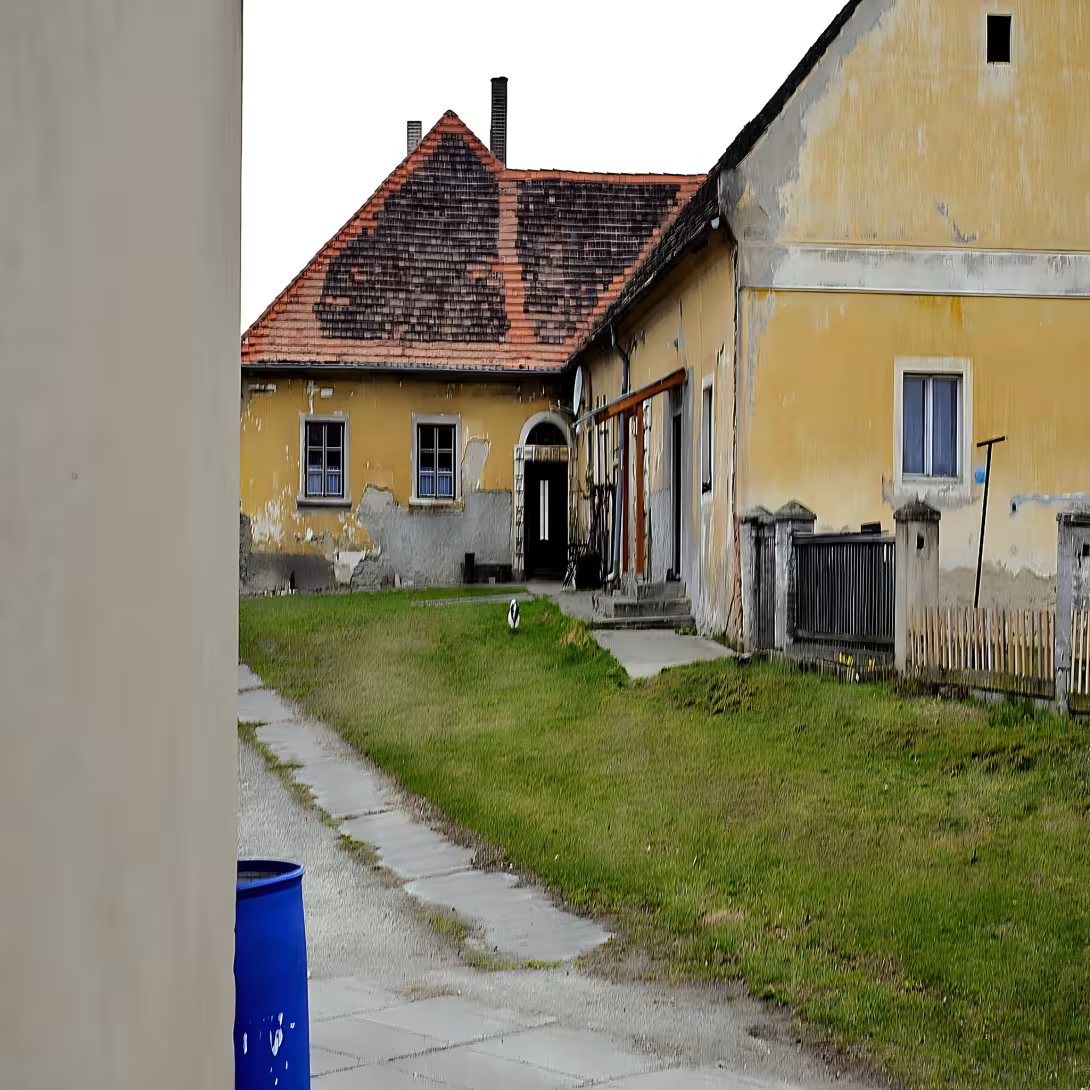
The fortress in Malíkovice was probably established in the 14th century and was the seat of local nobles. The first known owner was Ctibor z Malíkovic, allegedly the owner of the fort in 1349. Some sources say that she was the cradle of the genus Přibyslav from Malíkovic, and they attribute her a more permanent origin. In its first phase, it was one of the usual medieval forts of lower nobility, which served as both defensive and representative mansions.
During the 15th and 16th centuries she passed through a number of members of the Malíkovsky family. In 1418 it became the seat of Bushka of Malíkovic, who became the owner of the whole village after merging several properties. His son Jindřich controlled it after it, later it was acquired by Malíkovský of Byně. The fundamental change was brought by lower nobles with larger assets - in 1508, Malíkovice came under control of Dábel of Lobkovice, and the posteriormente then passed over to Gothard Florian Zdárský, who carried out the Renaissance reconstruction here. It opened a new face of construction and gave it a look characteristic of the turn of the 16th and 17th centuries. In 1599 the purchase of a village of Sister Eliska and Marie Valdštejnice from Martinique, guardian of minor Jaroslav Boríta, and connected her to the estate of Smecko. This ended the fort as a mansion.
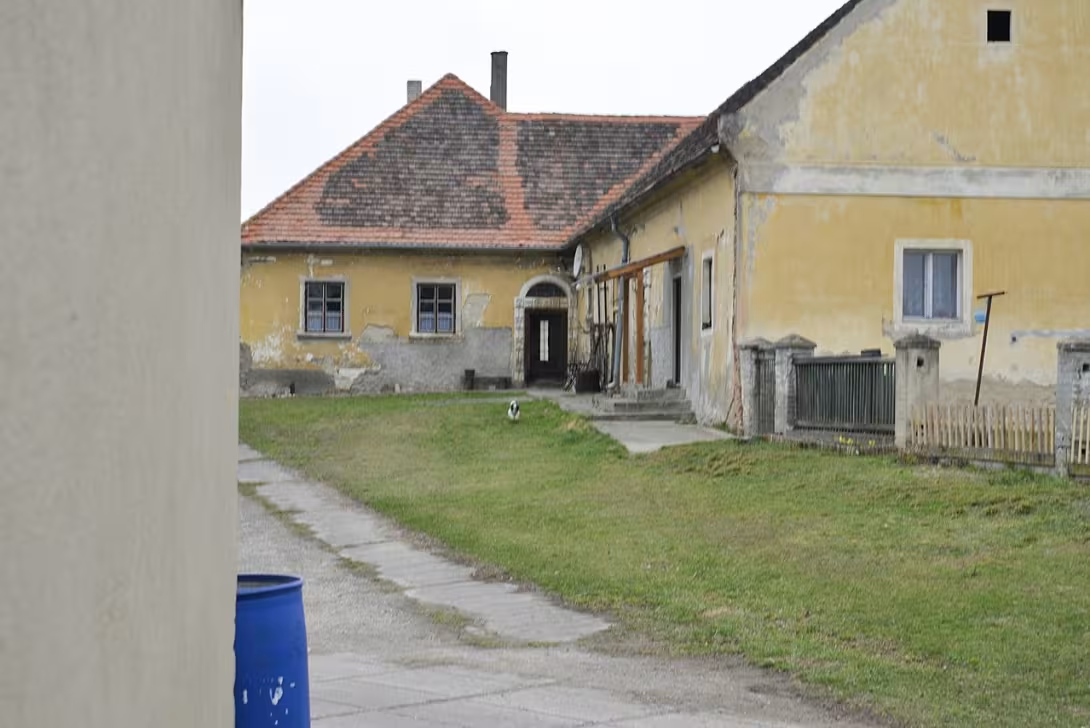
Since joining Smečn, the Monument has turned into an economic court, a common fate of many medieval harbours that have lost their military and representative meaning. The original building has preserved fragments of renaissance treatment - especially Renaissance portals for residential buildings of the economic court in the area, which are the most valuable part in terms of style and craft. The house itself has a look characteristic of the late Renaissance and the early period of the post-white mountain - two-wing building with smooth facades covered by a saddle roof. The building material is brick and stone, the interior is protected, it has been marked and protected primarily by doors and windows as architecturally valuable elements.
In the 20th century, the fate of the fortress was bound to the history of the village. During the socialist period, the building of the Economic Court served in an unusual way - as a scrap mill for JZD Development, which was incorporated in 1945. After the fall of communism, after 1989, it was restituted and returned to private property. The fortress has been protected as a cultural monument since 31 December 1967 and still retains its historical remains as a silent witness to three centuries of development of the figure of Czech nobility and economy. The reconstructed economic buildings today have a small, semi-permanent meaning, but the original house itself with Renaissance details remains a testament to the quality of construction and historical changes that the Czech village was going through.
Then and now
Drag the slider to compare how the landmark may have looked when it was built with the view today.
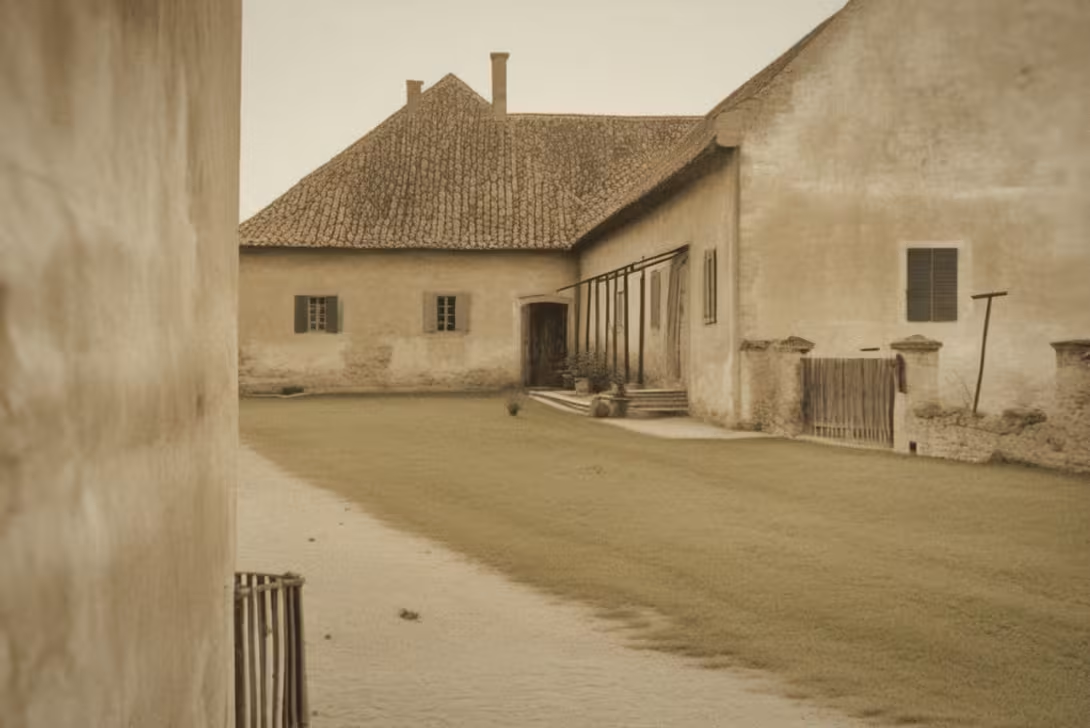
The historical appearance on the left is an AI-generated visualisation and serves as inspiration only.
Historical milestones
- 1349
- The first written mention of the owner of the Czubor of Malíkovice.
- 1418
- The first explicit mention of the fort in the unification of the village.
- 1967
- Entry of the object into the list of cultural monuments.
Architectural development
The original medieval fortress was rebuilt during the Renaissance period under Gothard Florian Zdářský. The construction is made of bricks and stone, originally chamber type. From a historical point of view, the Renaissance doors and chamber windows are especially important.
Historical events
1418: The first explicit mention of the fort when merging the goods in the village. 1599: Connection of the village to the Smečno estate and loss of office of the mansion. 1945: Integration of the Court into the JZD Development.
Owners
Ctibor z Malíkovic, Bušek z Malíkovic, Henry of Malíkovice, House of Malíkovsky of Bysně, Děpold z Lobkovic, Gothard Florián Žďárský, House of Martinique.
Points of interest
- The fortress was built probably in the 14th century and served as a seat of local nobles. - Gothard Florián Žďárský performed a Renaissance reconstruction on the fortress, which gave her a look characteristic of the turn of the 16th and 17th centuries. - After joining the Smečno estate in 1599, the fort ceased to fulfil the role of the mansion and turned into an economic court. - The most valuable preserved part of the building is the Renaissance portals for residential buildings of the farm yard. - During the socialist period, the farm yard building served as a scrap mill for the local a
Guide
This guide is narrated by a synthetic voice generated by artificial intelligence.
Show guide text
This text was created by artificial intelligence and has not been editorially reviewed. It may contain inaccuracies.
Welcome to Malíkovice. You've just stopped in front of a place that carries a silent but extremely strong footprint for many centuries. You are standing right in front of a former fortress that, despite its present form, still radiates some nobility and tranquility that is typical of objects with such deep roots. Look at the building that now stands before your eyes. It may seem like a simple, quiet house to you at first glance, but believe me, under this apparent simplicity, there is a story of power, noble generations and gradual changes that have shaped this landscape for centuries. Feel the atmosphere of this place, where the silence of today meets the echo of the ancient past.
Let's go back deep into time together to understand what you're watching. To really understand the importance of this object, we need to move to the 14th century. The first paper trail that leads us to understand the history of this place dates back to 13,000 forty-nine. In this very year, the name of Czubora from Malíkovic appears for the first time in historical documents. This man was probably the first important owner of this mansion and his presence here marks the beginnings of noble reign in this area. The fortress was not only a building at the time, it was a symbol of stability and influence within the Central Bohemian region. Already in the year 14-18, this fortress was explicitly mentioned in connection with the unification of the village, which confirms to us that it had already played a crucial role in the local order at that time. Imagine those times when this fortress was the center of the universe for its people and gave certainty in troubled times.
Now pay attention to the construction itself, which now stands before your eyes. Even though time is relentlessly moving forward and the building has undergone many changes, her face still tells the story of her past significance. Notice its present form. You see a two-wing house with smooth facades and a distinctive saddle roof. This is the result of a long history where the original defensive fortress gradually adapted to new needs and turned into an economic object. However, if you look more closely, especially at the level of passages or inputs, you will encounter what is really the most valuable here and what gives the building its unique character. Focus your view on the Renaissance portals. These stone elements are silent witnesses of the golden age, when architecture here sought beauty and elegance. It is precisely these details that remind us that this place once served as a representative seat of nobility, not just a simple farm yard. These portals are like fingerprints of ancient masters who put their work and art into stone.
Looking at these stone details, you can imagine people living here, deciding and shaping the fate of this place. History has left us traces of them that we can follow with respect today. In addition to that, there are other names such as Přibyslav z Malíkovic or Bušek z Malíkovic in the history of this fortress. These people were the face of this mansion at the time of its greatest independence. Later, however, the fates of the fortress connected with powerful and influential families that dominated the wider surroundings. For example Děpold z Lobkovic or the famous Jaroslav Bořita z Martinic. Each of these names brought a new dimension of power and social weight to Malíkovice. A very important figure for today's appearance of the building was Gothard Florián Žďárský. It was thanks to his interventions that he passed through the Renaissance redevelopment stronghold, which gave her that specific look that could still be recognized in her, even though her original function changed over time. It's fascinating to think how his vision of architecture has affected what you see before you today.
Perhaps you can think of the question as to why such a significant noble residence has turned into something that today resembles rather an economic object. The key to this mystery and to understanding the transformation of this place lies in the year fifteen-ninety-nine. This year, the fate of the fort changed irreversibly when it was joined to the Smečno estate. With this move, her original role as a separate mansion was lost. The fortress ceased to be the centre of an independent nobility and became part of a wider economic unit. This transformation was a very common process at the time, when the old defence houses adapted to the new economic reality and became part of larger land. Despite the fact that the building became part of the agricultural operation, its nobility did not disappear entirely. This proves that already in the year one thousand nine hundred sixty-seven this building was recognised as a cultural monument, thereby ensuring its protection for future generations. It's fascinating how the place that was supposed to defend the attacks became a place that was supposed to run and support life around here.
You are standing in front of a place that has survived for centuries, and changes in political regimes and economic systems have survived. He is a silent witness to history who has now allowed you to look into your rich past. I hope this brief view of the history of Malíkovice has helped you better understand the beauty and weight of this object. Now, however, there are no other words waiting for you, but the opportunity to look at the surroundings and feel the atmosphere of this place with your own eyes. Continue to walk and be carried away by the silence of this beautiful landscape. Thank you for your attention and I wish you a pleasant continuation in exploring the surroundings.
Tips for visitors
The best time to visit is during sunny days from spring to autumn. In this period, the historical architecture of the fortress and surrounding landscape of the Central Bohemian Region will excel, while daylight allows better observation of the details of the economic use of the building.
You can easily reach the village Malíkovice by car. Parking is possible in the village, but be sure to respect local traffic. Public transport can be used from the nearby area, please find specific connections in the current timetables.
For visiting we recommend fixed shoes suitable for movement in and around the historical area. Don't forget about the camera, the best pictures you can get during side lighting, which will highlight the structure of the masonry and historical elements of the former mansion.
In the vicinity of the fort you can visit the town of Smečno, to which the village was historically connected. Walk around the village Malíkovice and its nearby surroundings in the district Kladno offers a quiet atmosphere suitable for easy trips.
For families with children, the location is suitable as a stop when exploring the history of the region. We recommend to join a visit with a walk around the village where children can become acquainted with the rural environment and history of the mansions in a safe outdoor area.
Frequently asked questions
Is Bývalá tvrz v Malíkovicích open to the public?
Yes, the fort is open to the public. The best time to visit is from April to October, when the weather is mild and you can see the outside of the area without difficulty.
How do I get to the place by car / public transport?
By car, you can get to the parking lot before the fort. Public transport (urban public transport) is available in nearby cities, from which you can reach by bus or taxi.
How much is the entrance fee and is it paid on the spot?
Payment is made at a place where you can also purchase souvenirs.
Is the tour suitable for children and seniors?
Yes, the fort is accessible to all ages. Special inspection materials are prepared for children and special benches and tables are prepared for seniors.
How long does the tour take?
The tour takes about 1 hour, but you can spend more time if you want to see all parts of the complex.
What are the opening times and booking is required?
The fort is open from 9: 00 to 5: 00. Reservation is not necessary, but if you want to see a special excursion or concert, it is good to order it in advance.
What's interesting in the immediate vicinity?
In the immediate surroundings there is a nature reserve with forests and river. You can take a nice walk or a picnic.
For kids
Imagine going back to when our ancestors were building chateaux and chateaux. And that's how it is with the former fort in Malíkovice. This hidden dam was probably built in the 14th century, but its history is full of mysteries and secrets.
Businesses nearby
Do you run a restaurant, accommodation, shop, museum, rental, wellness or other visitor service near this monument? Show yourself directly to the people heading to it — this is how they will see you in the app and on the web:
Nearby
The village Malíkovice is located in the district of Kladno, near the town of Smečno, to which the village was historically connected.
Accommodation nearby
Themed route
Thematic cruise route from Malíkovice
1.Bývalá tvrz v Malíkovicích (fortress) * Type: * Historical landmark * Why is it worth a visit: * This former fortress is a key historical monument of the village, which attracts interest in the past of the region with its architectural character and history. It's an ideal place for those who want to familiarize themselves with the history of the local population.
2. St. Anne's Chapel in Malíkovice * Type: * Religious object * Why is it worth visiting: * The chapel is a place of peace and rest where you can enjoy a quiet moment. It is also an important cultural and spiritual point for residents and visitors.
3. Church of St. Nicholas (Smečno) * Type: * Church * Why is it worth a visit: * Even if it is located in the neighboring town of Smecko, it is a short and comfortable walk from Malíkovice. This church is famous for its history and architecture, which attracts visitors from all over the region.
4. Smechen Chateau * Type: * Historical landmark * Why is it worth a visit: * Even if it is not around Malíkovic, it is only a short way from Smečna and offers a view of the history and architecture of the region. It is an ideal place for those interested in the history of Czech agriculture and Baroque architecture.
5. The village in Malíkovice * Type: * Local town centre * Why is it worth a visit: * Naves is the heart of local life where there are various traditional houses and small businesses. It is an ideal place to explore contemporary life in Malíkovice and enjoy the local atmosphere.
This route offers visitors a comprehensive view of the history and present life of the village Malíkovice, with an emphasis on its cultural and historical monuments.
Seasonal recommendations
Spring brings freshness and the first signs of green to the surroundings of Malíkovice. The light is fine and scattered during this period, which beautifully highlights the texture of the old walls of the fortress. For a visit we recommend layered clothes because the morning cold can quickly rotate with the heat of the sun. It's an ideal time for quiet tours without large groups of people.
In the summer months the fortress is surrounded by dense vegetation, which creates a pleasant shade and lively atmosphere. The sun is the strongest, which is why it is best to arrive early in the morning to avoid the biggest crowds and the highest heat. Do not forget the quality footwear suitable for uneven terrain and the necessary water storage tank.
The autumn surrounding the monument offers melancholy beauty thanks to golden shades of leaves and morning fog, which supply the place with mystery. It is advisable to carry with you a waterproof jacket and fixed shoes because moisture can cause slippery roads. The best time to observe details is early afternoon, when the sun can still shine through the trees.
Winter highlights the rough and historical nature of the construction, especially in the case of snow. The atmosphere is quiet and lonely, which will be appreciated by lovers of peace and history. Due to the shorter day and lower temperatures, we recommend choosing very warm clothes and planning a visit in clear hours of the day, so that you will not be soon dark.
Visualizations and artistic views


The visualisations are generated by artificial intelligence and serve as inspiration.
Photos from the area
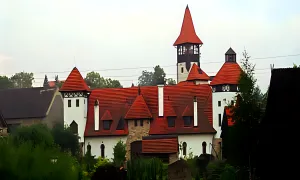
Real photos taken near the monument

Zdroj a licence jsou uvedeny u každého snímku.
Atmosphere of the place
This atmospheric visualisation of the place and period was generated by artificial intelligence. It is not real footage of the location.
Tips from visitors
No tips yet. Be the first!
Log in and add your tip.
Sources and literature
Fotografie: Jirka Dl / CC BY-SA 4.0, rozlišení zvýšeno umělou inteligencí — Wikimedia Commons. The author and licence also appear when you hover over the image.
Faktickým podkladem tohoto textu byl článek na Wikipedii, jehož autory jsou přispěvatelé Wikipedie. Článek je dostupný pod licencí CC BY-SA 4.0.
Location on the map

Příběhy a pověsti
Legendy, pověsti a příběhy spjaté s touto památkou
Fotografie návštěvníků
Zatím žádné fotografie. Buďte první, kdo přidá fotografii z návštěvy!
Přihlaste se a přidejte svou fotografii nebo hodnoťte.
Za ověřenou návštěvu v aplikaci získáte víc bodů — poznáme podle GPS, že jste na místě.
Reviews and comments