



bývalé popraviště v Bečově nad Teplou Ruin
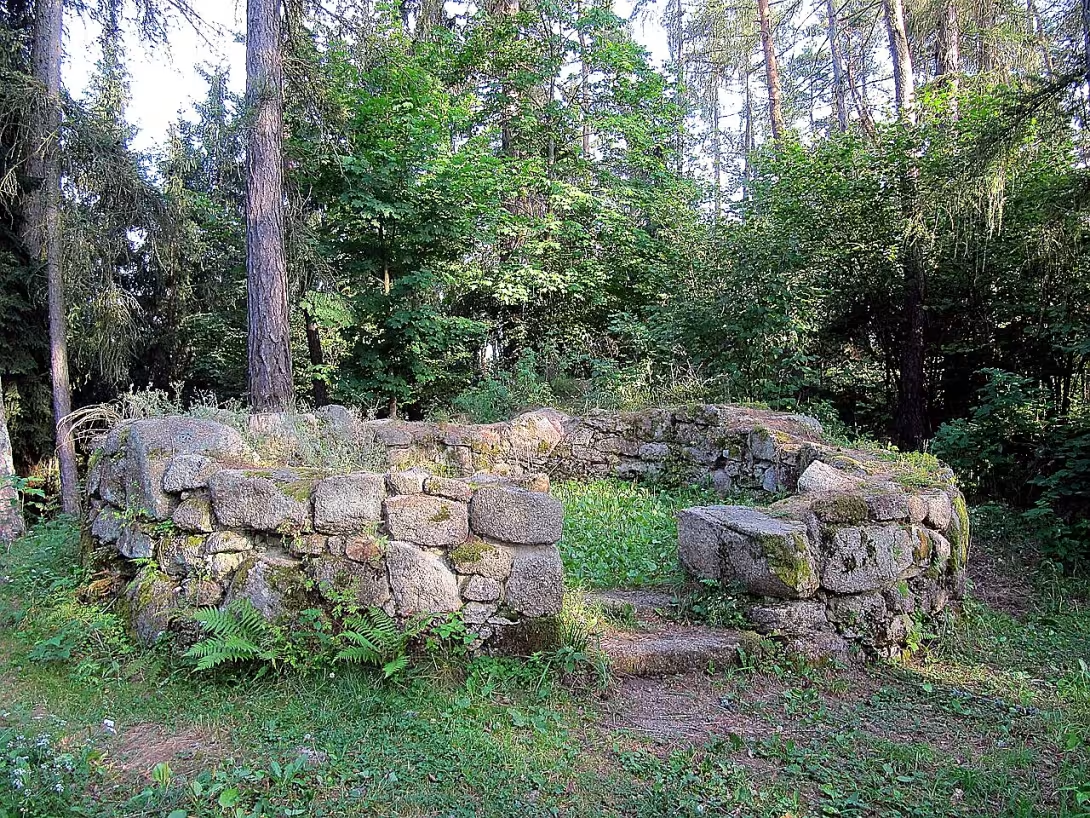
The remnant of the circular gallows in Bečov nad heat is the rest of the former execution site on Sibenice Hill, which was declared a cultural monument in 2004. This historical monument is one of the Teaching trail of Šibenice Hill and is located in the village Bečov nad Teplou, district of Karlovy Vary. It is remarkable by its architectural design as well as the historical context associated with the necklace law and reform of the judiciary.
Sibenice was founded after the award of the town of capital law in 1399. The Borsans of Rýzmburk who granted this power provided that it was governed by Cheb law and, in the cases at issue, it was withdrawn from Lokte. The executions were carried out by called executioners from Jáchymov or Cheb. At the beginning of the 15th century, a simple wooden gallows was built, which was later replaced by a walled structure at the turn of the 15th and 16th centuries. This period is characteristic of the construction of walled gallows in well visible places such as rocky hills or hills near the roads.
The gallows were built from irregular granite blocks connected with lime mortar. It had a diameter of 4.8 meters and was about three meters high. On her ring were plastered columns for wooden beams that served as carriers of the executed. The rest of the gallows retain the masonry from 0.6 to 1.3 metres high and has a width of 0.85 metres. There was an entrance on the northwest side with stone steps leading to a lockable door to prevent the theft of corpses or parts of bodies.
The history of the gallows is linked to several key events. In 1758 the last execution was carried out when Johann Paul Haan was hanged. The reforms of the judiciary for the reign of Marie Theresa have led to the abolition of the capital rights of many Czech cities and the transfer of judicial powers to regional courts, resulting in the abolition of the gallows in Bečov in 1765. According to superstition, the remains of the executed were not buried in the cemeteries, but in the execution site itself or in its vicinity.
The archaeological research carried out in 2002 revealed interesting details about the storage of human remains. The upper part of Sibenice Hill, where the gallows are located, is rocky and probably served as a place to bury dead bodies. The phosphate analysis showed an increased phosphorus content in the soil, which confirms the presence of human remains.
Today the gallows torso in Bečov nad Teplou is available for visitors and is part of the Teaching Path of the Gallows Hill. Its historical importance associated with necklace law and judicial reforms makes this memory interesting for those interested in the history of the region. Visiting this place offers an opportunity to understand the complicated history of the local judiciary and cultural monuments, which show a variable course of Czech countries.
Historical milestones
- 2004
- Torzo stone gallows was declared a cultural monument by the Ministry of Culture of the Czech Republic.
Architectural development
The masonry gallows were built from irregular granite blocks connected with lime mortar. It had a diameter of 4.8 meters and a height of about three meters. On the ring were plastered columns for wooden beams. Torzo has masonry from 0.6 to 1.3 meters tall.
Historical events
- 1399
- The town of Bechuv is granted the capital right of Borsov of Rýzmburk.
- 1758
- Last execution executed; hanged Johann Paul Haan.
- 1765
- The gallows in Bečov have been abolished by the reform of the judiciary for the reign of Marie Theresa.
Points of interest
- The remnant of the circular gallows in Bečov nad Heat is the rest of the former execution site on Sibenice Hill. - This historical monument is one of the Teaching trail of Šibenice Hill and is located in the village Bečov nad Teplou, district of Karlovy Vary. - The gallows were built from irregular granite blocks connected with lime mortar with a diameter of 4.8 meters and a height of about three meters. - Reforms of the judiciary for the reign of Marie Theresa have led to the abolition of the capital law of many Czech cities and the transfer of judicial powers to regional courts, resulting in the abolition of the gallows in Bečov in 1765. - Archaeological research carried out in 2002 revealed an increased phosphorus content in the soil on the Sibenice Hill, which confirms the presence of human remains.
Guide
Show guide text
This text was created by artificial intelligence and has not been editorially reviewed. It may contain inaccuracies.
Welcome to Gallows Hill. You are standing in a place that requires not only a view, but a deep perception and a moment of silence. In front of your eyes is the rest, which at first sight can act as a mere pile of stones, but in fact it is a torso of a former execution site. Do you feel the strange atmosphere that exists here? It's a place where human rights were confronted with human destiny. This historical monument that you are now observing is a silent witness to ancient times that have been distant from us for centuries. You may now be surrounded by peace and the view of the surrounding countryside is reassuring, but know that this particular place has had a very different meaning in the past and has caused fear and awe in people.
Let us return together to a time when there was no such thing as a learning path. Imagine the turns of the 15th and 16th centuries. This was the era when social orders were built on solid, often uncompromising foundations. This circular gallows was not built randomly or simply as a simple wooden device. It was a brick building designed to be visible from far away. At that time, there were no modern means of spreading laws or warning people of the consequences of crimes. Instead, space and visibility were used. That is why this building was located right here, in this elevated place, beyond the borders of the city Bečov nad Teplou. Anyone approaching the city must have seen this place. It was meant to inspire respect and remind you of the power of government. Placing in a well-visible place was a key element of the justice system at the time.
Now pay attention to what you see right in front of you. Notice the details of this structure, even though it is incomplete today. It's not a smooth, perfectly straight wall you might know from modern buildings. This gallows was built from irregular granite blocks. These stones you see here are hard, natural and rough. They were connected by a calcium malto, which was the technological solution at the time to create solid walls. If you look closer at the cracks between the stones, you can see the work of the ancient craftsmen who had to fold these irregular pieces of granite in order to form a solid and stable circular structure. This circle is very important. It's geometry that carries a certain order, even though the stones themselves are so informal and natural. Feel the texture of the granite, its color and how time has touched these surfaces. These stones have resisted rain, snow and wind for hundreds of years, and yet they still stand here as proof of the art of building.
Even though history has not given us the names of the particular personalities that were working here, or the names of those who faced their end here, this place is full of invisible stories. Every stone, every crack in this calcium mortar can be seen as a memory of human destiny. We can only imagine the moments when people came together - witnesses, law enforcement, and those who found themselves at these moments. It's a place where human life met with the relentless will of society. Even if we don't know faces, we feel the weight of the events. There's something sad about it, but it's also fascinating that this nameless history is still so tangible. This gallows was not just an instrument of punishment, it was a symbol of the order that people were trying to keep in the chaos of the world.
You may now wonder why we care so carefully about this rest and why it is so important here for our understanding. The interesting thing is that this torso was officially declared a cultural monument in the year two thousand and four. The State Department of Culture acknowledged that this incomplete remainder is an irreplaceable work of history. It's fascinating how a place that was once linked to the end of life became a protected source of knowledge for all of us. This monument is now part of the learning path of Šibenice Hill, which allows us, today already modern people, to explore these darker aspects of the past in peace, with respect and with knowledge of its historical value. It's a bridge between our world and the world of our ancestors.
Now, please, continue your journey. The educational trail will guide you further through this beautiful landscape and offer you more views of the history of this region. Let yourself be drifted by the atmosphere of Sibenice Hill and pay attention to all the small elements you will encounter along the way. Every next step can welcome you with a new insight. Thank you for stopping by, for taking the time and attention of this historic monument. We wish you a beautiful, peaceful and educational walk.
Tips for visitors
The best time to visit a former execution site in Bečov nad Teplou is the summer months when looking at the ruin becomes more comfortable and pleasant. The sunny days provide ideal light for photography, which emphasizes the historical character of the site.
Transportation to the place is possible both by car and public transport. When planning your journey, check your current routes as the road conditions can be variable from time to time.
When visiting, bring protective clothes and shoes suitable for walking on the most rigid soil, because the ruins can be difficult in certain parts. It is possible to photograph from the north side of the gallows, where the sun shines directly on the ruins and provides the best conditions to capture details.
A number of attractions can be visited in the vicinity of Bečov nad Teplou. A distance of about 30 minutes can be immersed in nature and history, where you will find other cultural monuments or natural beauty. For families with children, an interesting program can be a visit to nearby forest trails or waterfalls, which offer the opportunity to explore nature and relax at the same time.
Frequently asked questions
Can the monument be visited?
This is a ruin. Such sites are often freely accessible, but some can only be visited with a guide or are closed for safety reasons. We have not verified the current situation – take care and respect any restrictions.
Where is the monument?
Location: Bečov nad Teplou. The map on this page shows the exact spot.
Why is the monument protected?
It is listed in the Central List of Cultural Monuments of the Czech Republic as a cultural monument (register no. 1814085147).
Businesses nearby
Do you run a restaurant, accommodation, shop, museum, rental, wellness or other visitor service near this monument? Show yourself directly to the people heading to it — this is how they will see you in the app and on the web:
Events nearby

Zdroj akcí: otevřená data měst a obcí ČR (Národní katalog otevřených dat) a kalendář akcí Národního památkového ústavu.
Nearby
🏰 Historic sites (67)
- Šibenice 0.0 km
- Katovna 0.2 km
- Muzeum historických motorcyklů 0.8 km web
- Kovářské muzeum 0.9 km
- zámek Bečov nad Teplou 0.9 km +420353999394 web
- hrad Bečov nad Teplou 1.0 km
- Novoveský mlý 5.2 km
- Hornické muzeum Krásno 5.5 km web
- Pomník padlým v 1. sv. válce 7.0 km
- Symbolický hrob politických vězňů 7.1 km
- svatý Jan Nepomucký 7.2 km
- svatý Jan Nepomucký 7.4 km
- svatý Florián 7.5 km
- Memento Mori 7.6 km
- Popraviště 8.3 km
- sv. Jan Nepomucký 8.6 km
- Berta Maria Lugert 8.6 km
- Bývalý Dům Richarda Hahna 8.7 km
- Muzeum Prameny 8.9 km
- kaple Panny Marie 9.6 km
🍽️ Restaurants and dining (56)
- Café St. Maur 0.8 km
- Restaurace Riĉ 0.8 km nám. 5. května 24
- Mlsný medvěd 0.8 km
- Pension Hradní bašta 0.9 km nám. 5. května 19
- Penzion Stará Pošta 1.0 km Nádražní 112 +420 732 646 084 web
- St. Maur Caffe 1.0 km
- Stop Cafe 1.7 km
- U Divočáka 5.2 km
- Restaurace u Muzea 7.3 km
- Restaurace Rebel 7.7 km Dlouhá 712 +420 773 208 774 web
- Restaurace Pohoda 7.7 km Dlouhá 711 web
- Stop Cafe 9.7 km
- Alte Post 10.7 km
- Pizzerie Kuželna 10.7 km Školní 592 +420 353 227 158 web
- Restaurace Plzeňka 10.8 km
- Pivnice U Indiána 11.1 km Palackého 300
- Hotel u nádraží restaurace 11.3 km Žižkova 345 +420 353 223 549
- Klášterní restarurace 12.5 km
- Restaurace Svatošské Skály 12.9 km
- Restaurace Jan Svatoš 12.9 km
🏨 Accommodation (66)
- Pension St. Maur 0.8 km nám. 5. května 28
- Penzion Riĉ 0.8 km nám. 5. května 23
- Prameny 8.8 km
- Royal Golf 10.9 km web
- Golf Resort Cihelny 11.2 km Cihelny 7 +420 234 614 822 web
- Hotel u nádraží 11.3 km Žižkova 345 +420 353 223 549 web
- Camping Březová 13.1 km +420 602 20 70 80 web
- Hotel Goethe 13.2 km web
- Betlem 13.3 km
- Penzion u Kapličky 13.3 km Kozlov 110 00420603145076 web
- Hotel Slunce 13.4 km
- Retro Riverside Wellness Resort 13.4 km Březová 157 +420 410 000 095 web
- Pod jezem 13.5 km Zahradní 359/38 +420 777 668 950 web
- Golf Hotel Morris 13.6 km
- Golf Hotel Morris 13.6 km
- Pension Ulrika 13.7 km T. G. Masaryka 19/1 +420 602 127 543 web
- Pension U Frídy 13.7 km Zámecká 20/3 +420 603 261 778 web
- Penzion U Kaktusu 13.7 km Hamerská 79/14
- St. Florián 13.8 km T. G. Masaryka 135/70 +420 352 685 109 web
- Haus Stein Elbogen 13.8 km Rooseveltova 181/4 +420 608 335 559 web
🚲 Rentals and sport (3)
- Sokolovna 10.6 km
- Michal Kandráč 14.8 km
- Liapor 14.9 km
🥾 Hiking and nature (180)
- Šibeniční vrch 0.0 km
- Zlatý vrch 0.4 km
- Homolka 0.7 km
- Homolka 0.7 km
- Petrova hora 0.9 km
- Psí skála 1.1 km
- U hájenky 1.6 km
- Nad tratí 1.8 km
- Zelená hora 2.7 km
- U Vitriolky 2.8 km
- U chaty 3.2 km
- Nad roklí 3.3 km
- Paseka 3.3 km
- Lysý vrch 3.4 km
- Besídka 3.4 km
- U Bečova 3.7 km
- U odolenovických hranic 3.8 km
- Dřevařský vrch 3.9 km
- U Kyselky 3.9 km
- Tančírna 4.2 km
Accommodation nearby
Trips and activities nearby
Guided tours, tickets and activities nearby from GetYourGuide
Affiliate link: if you buy from the partner, we may receive a commission. The price for you does not change.
Search tours and activities →Themed route
1. Place of execution, type: historical monument. The main objective of the tour, where you can see directly the site of historical events. 2. Exposure, type: exhibition. Here you will get detailed information about what happened in this place in the past. 3. The immediate park, type: green area. A quiet area right by the monument that serves to contemplate the past.
Seasonal recommendations
Spring: In the spring season bývalé popraviště v Bečově nad Teplou is dressed in fresh green, where trees and bushes are covered with new leaves. Sun rays penetrate the trees, providing pleasant lighting for visitors. The atmosphere is calm and the relief after winter cold feels at every step. It is recommended to visit this local before the paths begin to be covered with flowers, because this is the time when nature takes on life and trips are especially comfortable. When visiting, you should wear clothes suitable for mild temperatures such as blankets or sweaters, as the weather may be variable.
Summer: During the summer season Bečov nad Teplou becomes useful thanks to long days and warmer sun. The ruins are lit by long light rays that highlight its historical architecture. The atmosphere is full of life and local nature offers beautiful green landscapes. Summer is also a time when more people can get here because it's a popular time for trips and hiking. It is recommended to visit in the morning or evening to avoid the main doses of heat. Wearing light clothes, sunglasses and UV protection cream is more appropriate.
Autumn: In the autumn period, the landscapes around the former execution site in Bečov above the Heat of Coloring, when trees turn into golden and red shades. The sun sets earlier, creating a melancholic light to visit this historic ruin. The atmosphere is calm and nature is growing quiet. During this period, few people can show up, which allows an intimate tour without unnecessary interference. It is recommended to wear clothes suitable for colder temperatures and a visit in mid-day days can be most pleasant when the sun is still strong enough.
Winter: In winter, Bečov nad Teplou is transformed into a place covered with snow and ice, which gives its historic structures a stunning atmosphere. The ruin is dressed in light reflective, when the traces of sunlight are projected on white surfaces. The atmosphere is calm and quiet, which provides a sense of relief from winter urban interference. When visiting you should wear warm clothes, including hat and gloves, because temperatures are usually low. The best time to visit is noon, when the sun provides enough light for the ruin to be seen in the best light.
Visualizations and artistic views

The visualisations are generated by artificial intelligence and serve as inspiration.
Photos from the area
Real photos taken near the monument

Zdroj a licence jsou uvedeny u každého snímku.
Tips from visitors
No tips yet. Be the first!
Log in and add your tip.
Sources and literature
Photos: Palickap / CC BY-SA 3.0 — Wikimedia Commons. The author and licence also appear when you hover over the image.
Faktickým podkladem tohoto textu byl článek na Wikipedii, jehož autory jsou přispěvatelé Wikipedie. Článek je dostupný pod licencí CC BY-SA 4.0.
Location on the map

Příběhy a pověsti
Legendy, pověsti a příběhy spjaté s touto památkou
Fotografie návštěvníků
Zatím žádné fotografie. Buďte první, kdo přidá fotografii z návštěvy!
Log in a přidejte svou fotografii nebo hodnoťte.
Za ověřenou návštěvu v aplikaci získáte víc bodů — poznáme podle GPS, že jste na místě.
Reviews and comments