



Hotel Central (Bečov nad Teplou) House
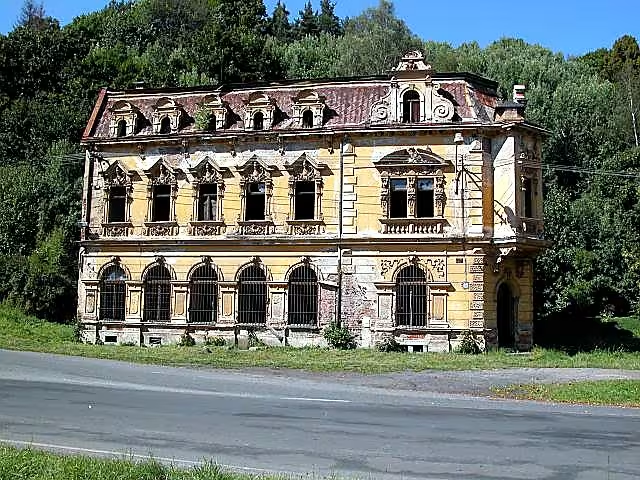
Hotel Central, also known as the Town House, is a historical monument in Bečov nad Teplou. This building, originally built as a luxury hotel with a restaurant, is of key importance for local history and architecture. It was created in the 19th century and during its existence it underwent a number of changes in owners and purposes, reflecting the turbulent history of the region. Today Hotel Central has been registered as a cultural monument since 2014, although it is in a state of decay.
The history of the building begins in 1876 when Georg Röhm bought it. In the following decade, it was sold to Maria Schmidt and underwent an extensive reconstruction in a neo-Baroque style with Art Nouveau elements. In 1901 it was bought by Franz Bachmann, a German of Jewish origin, who started a luxury hotel with a restaurant. Thanks to its convenient position near the Bečov railway station, Hotel Central has become a popular destination for many personalities, including Austrian emperor Franz Joseph I. and Czechoslovak President T. G. Masaryka.
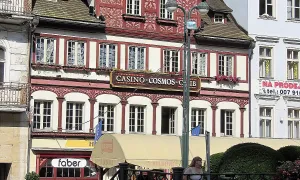
The architecture of the building is characterized by a neo-Baroque style with Art Nouveau elements, which was a typical style for the late 19th and early 20th century. Originally it had a two-storey bay crowned with an onion tower roof, but it died in the second half of the 20th century. The interior of the ground floor was richly decorated and contained a historical fireplace column. The facade is decorated with spalet windows, parapets with conical railing and baroque characters with the displayed letter "S.".
After World War II, the owner Franz Bachmann, as a German, was relegated to post-war displacement and his property, including the hotel, was confiscated. After the war, the building was used to accommodate soldiers of the Red Army and later miners from surrounding coal areas. In 1978, the building was converted into a post office with a café under the Z self-help action. After the Velvet Revolution, the hotel was sold to Agro Karlovy Vary and subsequently passed through a number of other owners, leading to its current emergency situation.
Today Hotel Central is owned by various companies and, despite its decaying, occupies an important place in local memory. Its history reflects not only the architectural but also the social and political transformation of the region. For visitors it is an opportunity to explore Bečov's rich heritage over the heat and appreciate its important past.
Hotel Central is worth visiting not only as a monument but also as a witness to many changes that the region has undergone. His history is a reminder of the important events and personalities who lived here. Visiting this memory is the way to the past, when everyone can touch the page of Czech history.
Historical milestones
- 1876
- First documented owner Georg Röhm
- 1901
- The purchase of Franz Bachmann's house and the launch of a luxury hotel
- 1945
- Confiscation of assets in the post-war displacement of Germans
- 1978
- Transforming the building into a post office with a coffee shop under the Z action
- 2014
- Registration of the building as cultural monuments
Architectural development
The building is built in a neo-Baroque style with Art Nouveau elements. Originally, it had a two-storey bay with an onion tower that died in the second half of the 20th century. The ground floor interiors were richly decorated and included a historical fireplace column.
Historical events
1901 - the launch of a luxury hotel under the direction of Franz Bachmann; 1945 - confiscation of property and displacement of owners; 1978 - self-help conversion to post office with coffee shop under the Z action.
Owners
Georg Röhm (1876), Maria Schmidt (1892), Franz Bachmann (1901), State (nationalized after 1945), Agro Karlovy Vary (1991), various companies (21st century).
Points of interest
- The building was purchased in 1901 by Franz Bachmann, a German of Jewish origin, who started a luxury hotel with a restaurant. - Thanks to the convenient position near the railway station there were important figures, including Austrian emperor Franz Joseph I. and Czechoslovak President T. G. Masaryka. - The original two-story bay with an onion tower roof disappeared in the second half of the twentieth century. - After World War II, the owner was relegated and the building was used to accommodate soldiers of the Red Army and later miners. - In 1978, the building was converted into a post office with a cafe within the framework of the Z self-help event.
Guide
Show guide text
This text was created by artificial intelligence and has not been editorially reviewed. It may contain inaccuracies.
Welcome to Bečov over the heat. Please stop for a moment and take a deep breath. You're standing in front of a building that carries a layer of decades of history, sadness and great hope. In front of you is Hotel Central, which many also know as the Town House. When you look at it today, you may be particularly aware of the signs of time and gradual abandonment, but I want to invite you to close your eyes and try to imagine this place as it was over a century ago. Imagine the noise of horse transport, the smell of expensive cigarettes and the noise of elegant clothes that were heard in this house.
This building was not created by accident. It is a product of the nineteenth century, a time when the world began to move much faster. The first documented owner, known as Georg Röhm, laid the foundations for what later became the heart of local social life in the year one thousand eight hundred seventy-six. At that time Bečov nad Teplou was a place with great potential and this house was supposed to be its representative face. But the real bloom and transformation into a luxury enterprise came to the threshold of the new century. A man named Franz Bachmann bought the building in a thousand and nine hundred years. He was a German of Jewish origin who had a vision to create a place where luxury, hospitality and modern services met. It is here that he started the operation of a luxury hotel with a restaurant that became a sought-after destination for travelers from different corners of Europe.
Now please take a look at the actual facade of the building. Notice its size and the way it dominates the surrounding space. Even though the building is constantly fading and the colors have faded, there is still a desire for representativeness. Look at the lines of the house and perceive its overall atmosphere. At the time, it wasn't just a place to sleep, it was a status symbol. All the details you see today as abandoned were once carefully maintained to impress guests at first sight. Notice the position of the building. It is close to the railway station. In the nineteenth century, the railway was a symbol of progress and the greatest luxury. The fact that Hotel Central was so placed was a brilliant strategic decision. The passengers who got off the train didn't have to look far. It took a few steps to get some rest in the best conditions the city offered.
It is this favourable position that has attracted Beč's people, who are not normally in small towns. Imagine the incredible commotion that must have arisen in the hotel when Austrian emperor Franz Joseph first visited. Emperor with escort, soldiers, servants and locals who followed the parade amazingly. Hotel Central was the real center of power and elegance at the time. But it wasn't just Austrian spikes. Later, at the time of the new state, the Czechoslovak President Tomáš Garrigue Masaryk also stayed here. Imagine these two men, so different in their views of the world, but both connected by finding refuge and rest in these very walls. The hotel was connected in this way to the highest classes of society, witnessed political discussions and possibly secret agreements that were concluded behind closed doors of luxury rooms.
However, history rarely verbs in line. After a thousand and nine hundred forty-five, there was a break that changed the fate of many such places. As part of the postwar displacement of the Germans, the property was confiscated. Luxury hotel, built by Franz Bachmann, lost its original mind and soul. The building began to gradually lose its formal glance. But the biggest change came in a thousand seven hundred seventy-eight. The building was converted into a post office with a coffee shop. It's fascinating and at the same time a little sad contrast. The place where emperors and presidents used to sleep became a place where people would take letters and drink coffee in public service. The luxury hotel has become a useful but modest office space.
Now, if you look around you, you'll see a building that's been decaying ever since the 1990s. It's a melancholy view of how time can erase even the greatest luxury. Notice the cracks, the peeling layers and the silence that rules the building today. Yet there is beauty and truth in this decay. It's a reminder that nothing is eternal. But there is hope in this story. In the year two thousand fourteen, the building was registered as a cultural monument. That means the state has recognized its irreplaceable value for our history. It's not just an old house that's falling apart anymore, but a protected witness to history that deserves to be preserved for future generations.
Interestingly, Hotel Central remains a mystery in many ways. Even though we know the names of the owners and distinguished guests, many details of the daily life in the hotel remain hidden. Who were those people who spent their evenings at the restaurant? What did the passengers who stopped here on their way to other cities talk about? The building is silent, but its walls still tell the story of ambition, wealth, political breakdowns, and the simple human need for rest. It's a place where high aristocracy meets a common citizen, where luxury meets the official routine of the post office, and where nature and time are winning today.
Now I want to invite you to walk around the building slowly. Feel its size and try to imagine what it would look like if it were fully operational again today. Where there would be a hall, where tastes would be served at the restaurant and where important guests would walk. Even if we can't enter her inner space, we can appreciate her presence in the land of Bečov over the heat. It's like an old, forgotten nobleman who no longer has his wealth, but still retains some dignity and pride.
Thank you for accompanying me on this short trip in time. I hope you found more than an old building at Hotel Central and that you felt a connection to the people who lived here and did it a century ago. Now please continue your journey and discover other hidden treasures of this beautiful city. I wish you a pleasant rest of the day and many new, fascinating experiences while exploring your surroundings. Goodbye.
Tips for visitors
The best time to visit Hotel Central is in autumn months when the atmosphere is quieter and sunlight gives the building a unique color shine. Visit it also during local cultural events or markets where special exhibitions and performances appear.
For those travelling by public transport, the hotel is easily accessible from the station Bečov nad Teplou, which is located not least from the monument.
When visiting, take with you suitable shoes and clothes for walking on stone paths. If you are planning to soccer, consider bringing a camera or a mobile phone with a good lens.
For photo lovers are ideal places to capture the building in the morning light when the sun is behind trees and drapes.
It is possible to visit the historical part of the city with its old houses and streets. For families with children it is appropriate to visit a natural park nearby where children can move freely.
Frequently asked questions
Can the monument be visited?
This is a residential or farm building, not a museum with opening hours. Please view it from public space and respect the owners' privacy. We have no information about access to the interior. According to the heritage register the structure is in poor condition – do not enter it and take care nearby.
Where is the monument?
Location: Bečov nad Teplou. The map on this page shows the exact spot.
Why is the monument protected?
It is listed in the Central List of Cultural Monuments of the Czech Republic as a cultural monument (register no. 1816540302).
Businesses nearby
Do you run a restaurant, accommodation, shop, museum, rental, wellness or other visitor service near this monument? Show yourself directly to the people heading to it — this is how they will see you in the app and on the web:
Events nearby
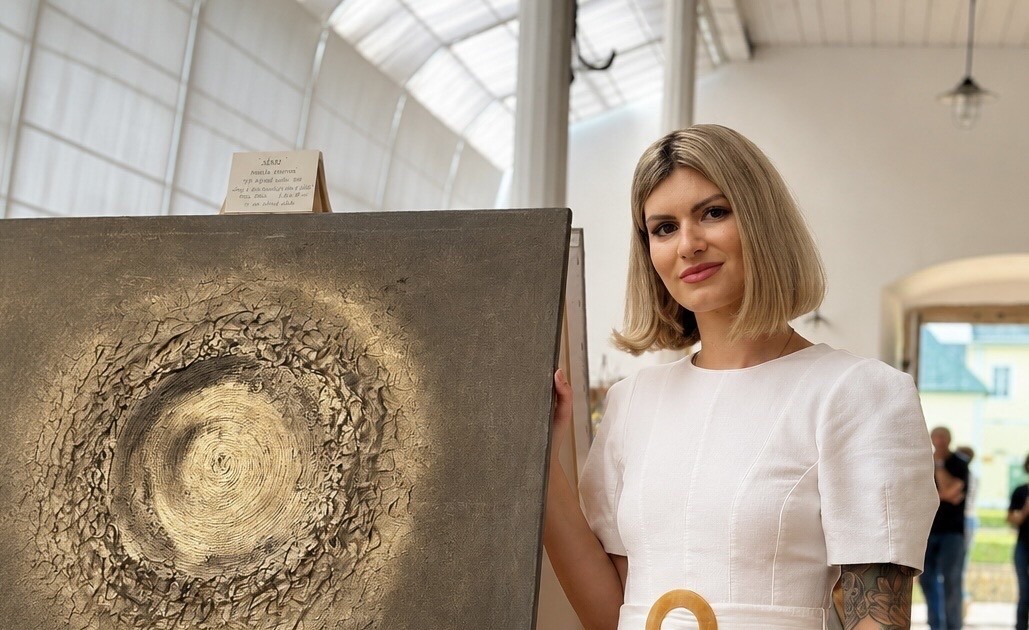

Zdroj akcí: otevřená data měst a obcí ČR (Národní katalog otevřených dat) a kalendář akcí Národního památkového ústavu.
Nearby
Budova se nachází v těsné blízkosti nádraží Bečov nad Teplou.
Accommodation nearby
Trips and activities nearby
Guided tours, tickets and activities nearby from GetYourGuide
Affiliate link: if you buy from the partner, we may receive a commission. The price for you does not change.
Search tours and activities →Themed route
Thematic cruise route from Hotel Central (Bečov nad Teplou)
1. Hotel Central (Bečov nad Teplou) - Main objective Type: Historical hotel residence Why is it worth a visit: This elegant hotel, built in 1890, is an architectural work with a rich history. It offers a view of the local landscape and is an ideal place to relax after exploring the area.
2. Station Bečov nad Teplou Type: Historical railway station Why is worth a visit: The railway station is close to the hotel and is an important transport hub. Its history dates back to the 19th century, when it was built as part of the development of the railway network. It is interesting for its architecture and role in the local transport system.
3. Memorial park near the hotel Type: Local green area Why is worth a visit: The park offers quiet pavement and beautiful nature, ideal for relaxation. It's a place where you can enjoy the quiet moments in nature or dive into reading under the shadow of old trees.
4. Bec pond Type: Local pond Why is it worth a visit: Even if it is not directly mentioned in the "Around," it is one of the closest places to visit. The pond serves as a place for relaxation and the possibility to observe wild fauna. It is ideal for a short bike trip or walking.
5. Local museum exposition at the hotel Type: Small local museum Why is it worth a visit: The museum offers exhibits about the history and culture of the village Bečov nad Teplou. It is a great way to learn more about the local heritage and historical events that shaped the region.
This route offers a combination of cultural and natural experiences near Hotel Central.
Seasonal recommendations
In spring, the surrounding nature awakens and the fresh green creates an interesting contrast to the crumbling masonry. Soft spring light helps to highlight the details of the destroyed facade. We recommend moisture-resistant shoes because the terrain around the monument can be wet after melting snow. It's best to come in the morning before any spring showers start.
The summer season brings a sharp sun that deeply shines empty window frames and highlights the emergency state of the building. The dense leaves of trees partially cover the ruins, which gives the place a mysterious atmosphere. Due to summer rush hour and heat, it is advisable to schedule a visit to early morning hours. Don't forget light clothes and plenty of fluids.
Autumn is the most atmospheric for this ruin thanks to colorful leaves and frequent fog that underscore the melancholy of the place. The golden light of the setting sun hits the old wall beautifully. Due to the variable weather, it is ideal to wear layered clothes. We recommend to be careful when walking on wet and slippery leaves around the building.
In the winter, the buried snow dampens the sounds and creates peace and quiet around the monument. The white surface of the surrounding area contrasts sharply with a grey stone and concrete falling apart hotel. It is necessary to wear warm and waterproof clothes. Count on a shorter access time and we recommend a visit in the morning when the most daylight is.
Visualizations and artistic views

The visualisations are generated by artificial intelligence and serve as inspiration.
Photos from the area
Real photos taken near the monument


Zdroj a licence jsou uvedeny u každého snímku.
Tips from visitors
No tips yet. Be the first!
Log in and add your tip.
Sources and literature
Photos: Manfred E. Fritsche / CC BY-SA 2.0 de — Wikimedia Commons. The author and licence also appear when you hover over the image.
Faktickým podkladem tohoto textu byl článek na Wikipedii, jehož autory jsou přispěvatelé Wikipedie. Článek je dostupný pod licencí CC BY-SA 4.0.
Location on the map

Příběhy a pověsti
Legendy, pověsti a příběhy spjaté s touto památkou
Fotografie návštěvníků
Zatím žádné fotografie. Buďte první, kdo přidá fotografii z návštěvy!
Log in a přidejte svou fotografii nebo hodnoťte.
Za ověřenou návštěvu v aplikaci získáte víc bodů — poznáme podle GPS, že jste na místě.
Reviews and comments