






Relikviář svatého Maura Reliquary
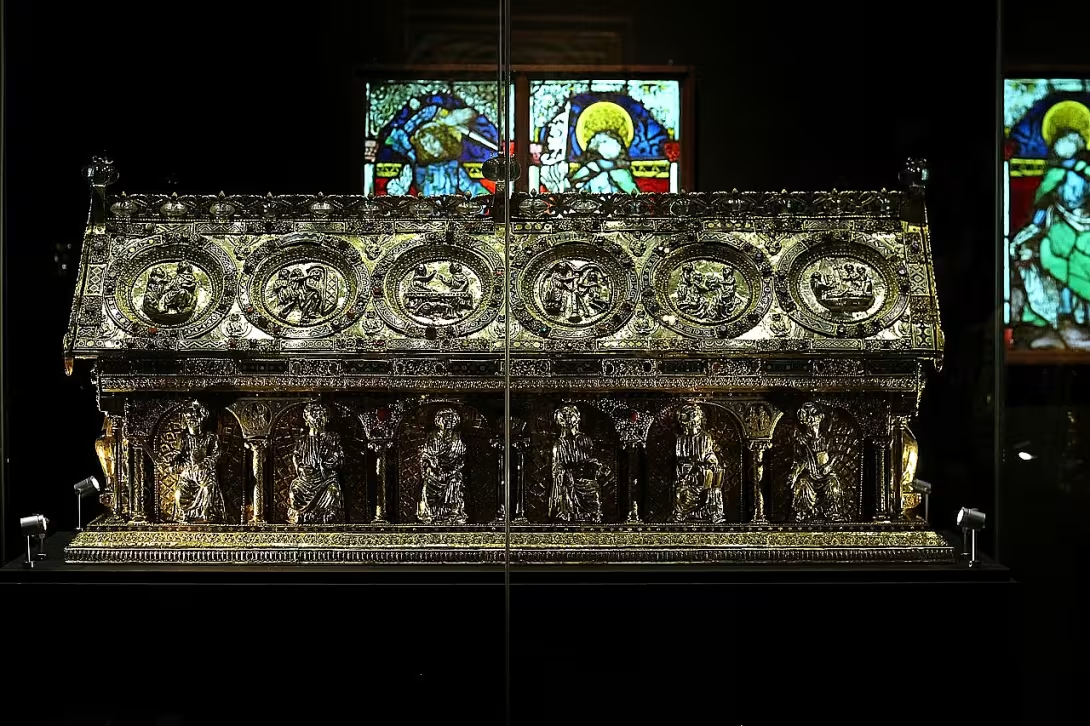
Relikviář svatého Maura is a romantic памятka from the first third of the 13th century as well as the most important jewelry landmark preserved in Czech territory. Its production dates back to 1225-1230 when it was made for the Belgian monastery of St. John the Baptist in Florennes. The contract was awarded by members of the wealthy family of Rumigny - specifically initiated by Gérard de Rumigny, Bishop of Cambrae, who obtained the rare relics of St. John the Baptist and later St. Maura of the Cathedral in Remesh. The remains of Saint Timothy and Saint Apollinar were gradually added to the reliquary. The older textile box could no longer meet the noble requirements for the dignified storage of these sacred remains.
The fate of the reliquary changed after the demise of the monastery in 1798. Although the monastery escaped looting during the French Revolution, its cultural assets were gradually scattered. The reliquary ended up in the sacristy of St. Gangulf's parish church in Florennes, where he stood forgotten for years in the corner between the old furniture. Due to financial difficulties, the church management decided to sell the monument. In 1838 it was purchased by the nobleman Alfred de Beaufort-Spontin for 2500 francs. Between 1847 and 1851, the reliquary was restored with a load of 3,000 francs. However, the sale did not solve all the problems - the litigation lasted for years and ended only in 1900 when the Beauforts paid the Church another 20,000 francs.
After Alfred's death in 1888, the reliquary inherited his son Friedrich, who carried him to his castle in Bečov nad heat. Here it was exhibited in the castle chapel and became part of the regional awareness of local cultural wealth. During World War II, during the collaboration with the Nazi regime, the leadership of the Beaufort-Spontinos hid it. In 1945 Heinrich Beaufort-Spontin and his son Friedrich hid him under the floor of the castle chapel to protect him from the horrors of war.
The reliquary remained hidden until 1985 when the Czechoslovak authorities discovered it. The following decades were devoted to his thorough restaurant, which lasted until 2002. In 1995 the reliquary acquired the status of the national cultural monument of the Czech Republic. Today, its most common place of exposure is a permanent exhibition in the castle in Bečov nad Teplou, where visitors can see it in an authentic environment. Since 2022 it has been permanently exposed to renewed exposure in Pluhov houses, which increases the availability of this unique Romanesque treasure for the wider public.
Then and now
Drag the slider to compare how the landmark may have looked when it was built with the view today.
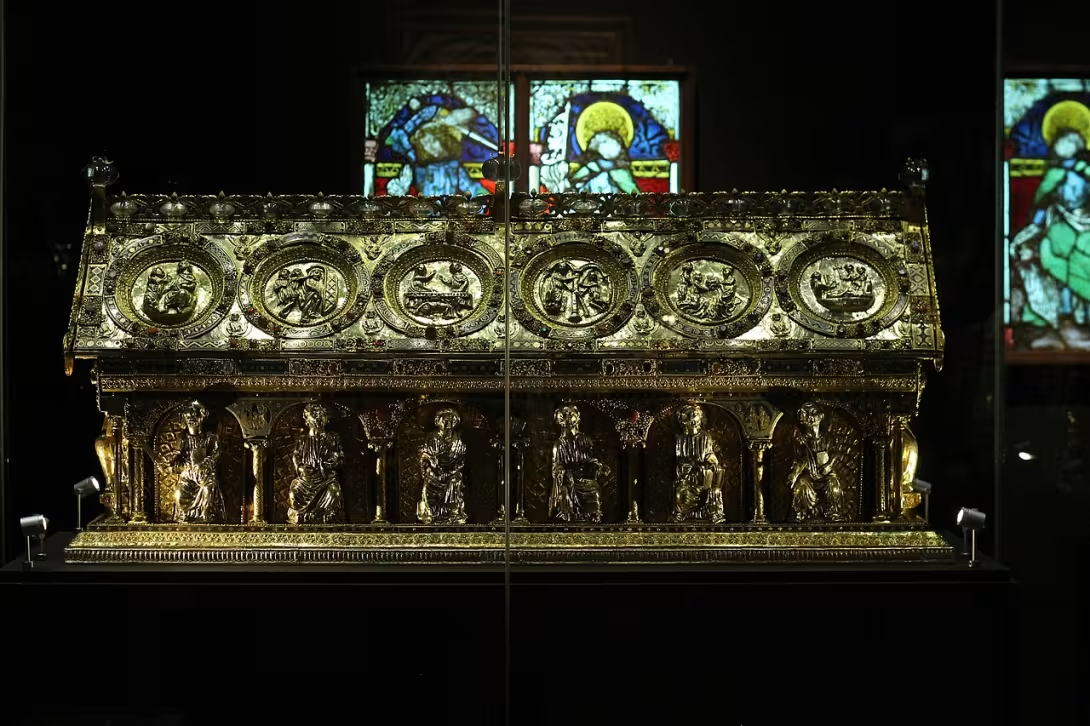
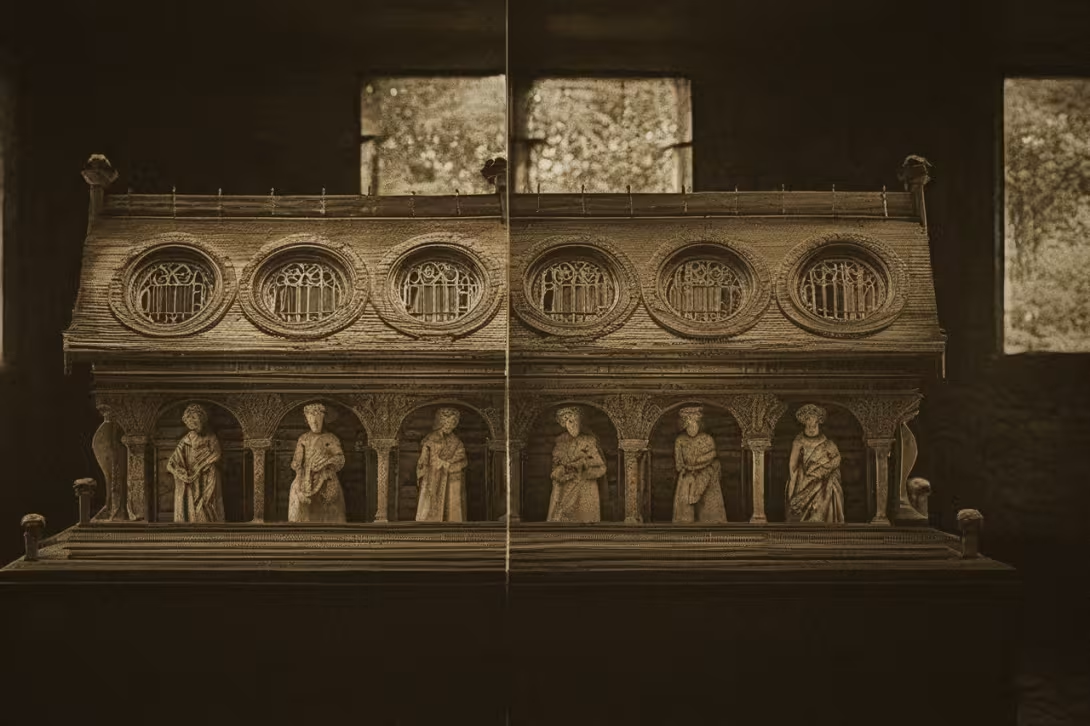
The historical appearance on the left is an AI-generated visualisation and serves as inspiration only.
Historical milestones
- 1225-1230
- Making a reliquary for Gérard de Rumigny.
- 1838
- Purchase of the reliquary by Alfred de Beaufort-Spontin.
- 1945
- Hiding the reliquary under the floor of the chapel at castle Bečov nad Teplou.
- 1985
- Discovering the reliquary by the Czech authorities.
- 1995
- Declaration for the national cultural monument of the Czech Republic.
Historical events
1838: Sales of reliquary to Alfred de Beaufort-Spontin for 2500 francs. 1945: Hiding the monument under the floor of the castle chapel at castle Bečov nad Teplou. 1985: Discovering the reliquary by the Czech authorities. 1995: Declaration for a national cultural monument.
Owners
St. John the Baptist in Florennes, the parish church of St. Gangulf in Florennes, Alfred de Beaufort-Spontin (from 1838), Friedrich de Beaufort-Spontin (from 1888), the Czech state (from 1985).
Points of interest
- It is the most important jewelry landmark preserved in Czech territory, whose production dates back to 1225-1230. - It was made for the Belgian monastery of St. John the Baptist and contained the remains of St. John the Baptist, Maura, Timothy and Apolinar. - In 1838 it was purchased for 2500 francs by the noble Alfred de Beaufort-Spontin. - In 1945 he was hidden under the floor of the castle chapel to be protected from war terrors. - It remained hidden until 1985 and in 1995 it acquired the status of national cultural monument of the Czech Republic.
Guide
This guide is narrated by a synthetic voice generated by artificial intelligence.
Show guide text
This text was created by artificial intelligence and has not been editorially reviewed. It may contain inaccuracies.
Welcome to Bečov over the heat. Right now, you are facing one of the most rare and fascinating objects that you can meet on the territory of our Calculation. In front of you is Relikviář svatého Maura. The first impression of this subject is usually the same among all visitors - it is a sense of amazement from extraordinary gloss and precision. Look at this golden object and perceive its nobility. You see before you a work that carries eight hundred years of history, faith and human destiny. It's a jewelry store in the purest sense of the word that lures you with its golden color and complexity of its execution.
Let us now go back many centuries together to understand how this treasure was born. The reliquary was established between 1225 and 1230. At that time, Europe was in the full bloom of Romanesque art, and it was from this period that this masterpiece came. However, it was not produced here, in our regions, but in the Rhine-Mosian region, which was at that time one of the most important centres of jewelry and metal processing in Europe. The entire object was created to order Bishop Gérard de Rumigny. Imagine the world back then, where such objects were not only ornaments, but served as bridges between the earthly world and the divine sphere. The reliquary was created for the Belgian monastery of St. John the Baptist and its primary purpose was to store the most sacred remains. Inside were stored relics of St. Maura, St. John the Baptist, Timothy and Apolinar. For the then religious and religious hierarchies, this box had an enormous spiritual value that far exceeded the price of gold itself.
Now pay attention to the details you see right in front of you. Although it may appear to be one solid gold object, on closer examination notice rich figural, embossed and decorative decoration. It is in these details that the genius of the unknown masters who made the reliquary is hiding. Watch how finely the figures and ornaments are worked out to decorate the surface. This embossed decoration is not just an aesthetic accessory, but it tells stories and symbolizes the faith of the time. Notice how light plays on golden surfaces and how details change when you move slightly. It is a fascinating example of the Romanesque style, where it combines robustness with incredible fineness of craftsmanship. It is thanks to this combination that the reliquary is considered the most important Romanesque jewel monument in the whole territory of the Czech Republic. If we were looking for something comparable in terms of value and importance, we would have to turn to our coronation jewels, behind which this very object stands in the hierarchy of Czech treasures.
But the history of this reliquary is full of dramatic twists and unexpected paths, which eventually brought it here, to Bečov above the heat. One of the key personalities associated with him was the noble Alfred de Beaufort-Spontin. In 1838 there was an event that changed the fate of this jewel - Alfred bought it for the price of two thousand and five hundred francs. At that time, the reliquary no longer served its original religious purpose in the Belgian monastery, but became part of the private collection of the noble family Beaufort-Spontin. Imagine how this precious object traveled across state lines to find refuge in Bekov. The Beaufort-Spontin family, including Friedrich de Beaufort-Spontina, became essentially guardians of this European heritage.
But the most exciting part of the story begins in the mid-20th century. 1945 was a period of chaos, war and uncertainty. It was in this dramatic year that it was decided that the reliquary must be protected from possible waste, theft or destruction. So he was secretly hidden. And here comes the moment that borders on an adventure novel. The reliquary was not hidden in the vault or in the remote cellar, but was located directly under the floor of the chapel at the castle Bečov nad Teplou. Imagine the silence and darkness in which this golden treasure lay for decades. While time passed over him, the regimes and generations changed, he remained forgotten in the dust and silence beneath the feet of the people who passed through the chapel without knowing that just a few centimetres below them lies one of Europe's greatest jewels.
This mystery lasted until 1985. It was this year that the reliquary was rediscovered by the Czech authorities. It was basically the rebirth of a monument that had been in the underworld for almost 40 years. Imagine the moment of surprise and joy when something so beautiful and precious came back after so long. This discovery caused a huge stir in professional circles and confirmed the incredible value of the object. In 1995, the reliquary was officially declared a national cultural monument of the Czech Republic, which finally recognised its status as an invaluable legacy, which we must protect together.
Now, if you look at the reliquary again, try to perceive not only its material beauty, but also all the layers of time that it carries. From the Rhine workshops of the 13th century, to the Belgian monasteries and aristocratic palaces, to the darkness beneath the floor of the Beèek Chapel. It's an object that survived wars, oblivion, and moving. It is a symbol of the resistance of beauty and art.
Now that you've learned of his extraordinary destinies, I suggest you observe him quietly for a while. Notice how it combines the faith of the Middle Ages with the desire for later generations for beauty and collecting. It's a real miracle that we have the opportunity to see him in that state today.
Thank you for the attention you have given to this extraordinary jewel. I hope you were interested in the story of St. Maura's reliquary and that you felt the depth of the history that is encoded in this golden object. Now invited to further explore the area of the castle and surroundings, where you will find other fascinating pieces of the past. I wish you a pleasant continuation of your journey with Bekov over the heat. Goodbye.
Tips for visitors
For the best experience we recommend a visit in the morning or when it is quieter in the space. At these times, light best highlights the fine details of the Romanesque jewelry store on the reliquary.
The location is available by car and by public transport. Please check the current traffic connections and parking options in the area before travelling in the search engine or on the official website.
We recommend that you have the means to pay the admission fee, which is paid on the spot. If you plan to photograph, you will get the best results when you capture details in soft, natural light, but always follow the current instructions of the staff.
After the tour you can visit Castle Bečov nad Teplou or Pluhov houses, which are in close proximity. For families with children, the tour is interesting due to the uniqueness of historical objects, and we recommend choosing a slow pace of walking.
Frequently asked questions
Is Relikviář svatého Maura open to the public?
Yes, Relikviář svatého Maura is open to the public. The tour is only possible with a guide.
How do I get to the place by car / public transport?
You can get by car to a nearby parking lot or public transport line that stops not far from the place.
How much is the entrance fee and is it paid on the spot?
It is valid only in gas dispensers before entry.
Is the tour suitable for children and seniors?
Yes, the tour is suitable for children and seniors. The tour is possible with a guide who will be able to give you further information.
How long does the tour take?
The tour takes approximately 30 minutes.
What are the opening times and booking is required?
The memorial is open from Monday to Friday from 9: 00 to 15: 00. Reservation is not necessary, but we recommend to make it in advance to avoid long fronts.
What's interesting in the immediate vicinity?
In the immediate vicinity there is a historical centre of the city, which is worth visiting. Near also lies included, which is full of flowers and trees.
For kids
Imagine going back to the past, when the Czech countries were full of life and Christian traditions. The city of Prague was small then, but rich in history and culture. And right here, in the heart of the city, was Relikviář svatého Maura.
How did it look here? Who lived here? What happened here? The city of Prague was a centre of shops and art, where a marketplace full of craftsmen and merchants, where monasteries and churches were full of prayers and songs. And it was in one of these churches that said Relikviář svatého Maura.
Businesses nearby
Do you run a restaurant, accommodation, shop, museum, rental, wellness or other visitor service near this monument? Show yourself directly to the people heading to it — this is how they will see you in the app and on the web:
Nearby
Castle Bečov nad Teplou, Pluhov houses.
Accommodation nearby
Themed route
Relikviář svatého Maura Type: Main destination, historical monument This precious relic box is the heart of the whole trip and represents a unique proof of medieval art and Christian tradition in this area. Visitors can easily see the details of this valuable artifact, which attracts the attention of both historians and clerics.
Castle Bečov nad Teplou Type: Historical building, cultural monument It is located in the immediate vicinity of the main objective and forms a majestic framework for the entire route. Its impressive architecture and rich history provide an ideal context for understanding the importance of the reliquary and the overall cultural heritage of the village.
Pluhov houses Type: Folk architecture, historical development These characteristic buildings offer a view of the traditional way of life and building art in the region. Walk through this part of the village allows you to contradict the festive atmosphere of the castle with an authentic, folk environment that complements the picture of local history.
The route is designed to be as short and clear as possible because all three points lie in a close neighbourhood in the centre of the village. It starts with the reliquary, continues through the lock and closes with a tour of the Pluhov houses. The entire circuit can be managed within a few hours with sufficient time to explore the interior and exterior. Since this is a compact area, it is not necessary to use motorised transport; everything is easily accessible on foot. This combination of spiritual treasure, aristocratic residence and folk architecture forms a harmonious whole that fully describes the character of Bečov over the heat.
Seasonal recommendations
Spring brings freshness and awakening nature to the surroundings of Bečov over the Heat, which complements the historical importance of the place. Light is soft and natural in this period, which allows you to perceive details of the reliquary without sharp shadows. It is advisable for visitors to choose layered clothes to be ready for variable weather. It's the perfect time for a quieter tour before the season starts.
In the summer months, the atmosphere is alive and the sun clearly illuminates the surrounding landscape. The main summer season is the most exciting, so we recommend arriving first thing in the morning to avoid the biggest crowds. Clothes should be light and comfortable, ideal for moving in warmer weather.
Autumn around the monument creates a melancholy and mystical atmosphere that perfectly matches the spiritual character of the reliquary. The golden shades of leaves and morning fog give the whole experience depth. It is reasonable to carry a warmer layer of clothing and high-quality footwear for walking in a humidified terrain. Afternoon visits in this period offer a rare sense of privacy.
Winter brings peace and quiet to Bečov above the heat, which allow full focus on historical treasures. The light is weaker, which in the interior creates a cozy and noble mood. Due to shorter daily time and frost, it is necessary to choose very warm clothes and plan a visit to match shorter opening hours.
Visualizations and artistic views


The visualisations are generated by artificial intelligence and serve as inspiration.
Tips from visitors
No tips yet. Be the first!
Log in and add your tip.
Sources and literature
Fotografie: Draceane / CC BY-SA 4.0 — Wikimedia Commons. The author and licence also appear when you hover over the image.
Faktickým podkladem tohoto textu byl článek na Wikipedii, jehož autory jsou přispěvatelé Wikipedie. Článek je dostupný pod licencí CC BY-SA 4.0.
More monuments – Bečov nad Teplou
Show all in the municipality

Příběhy a pověsti
Legendy, pověsti a příběhy spjaté s touto památkou
Fotografie návštěvníků
Zatím žádné fotografie. Buďte první, kdo přidá fotografii z návštěvy!
Přihlaste se a přidejte svou fotografii nebo hodnoťte.
Za ověřenou návštěvu v aplikaci získáte víc bodů — poznáme podle GPS, že jste na místě.
Reviews and comments