






Dalovice Chateau
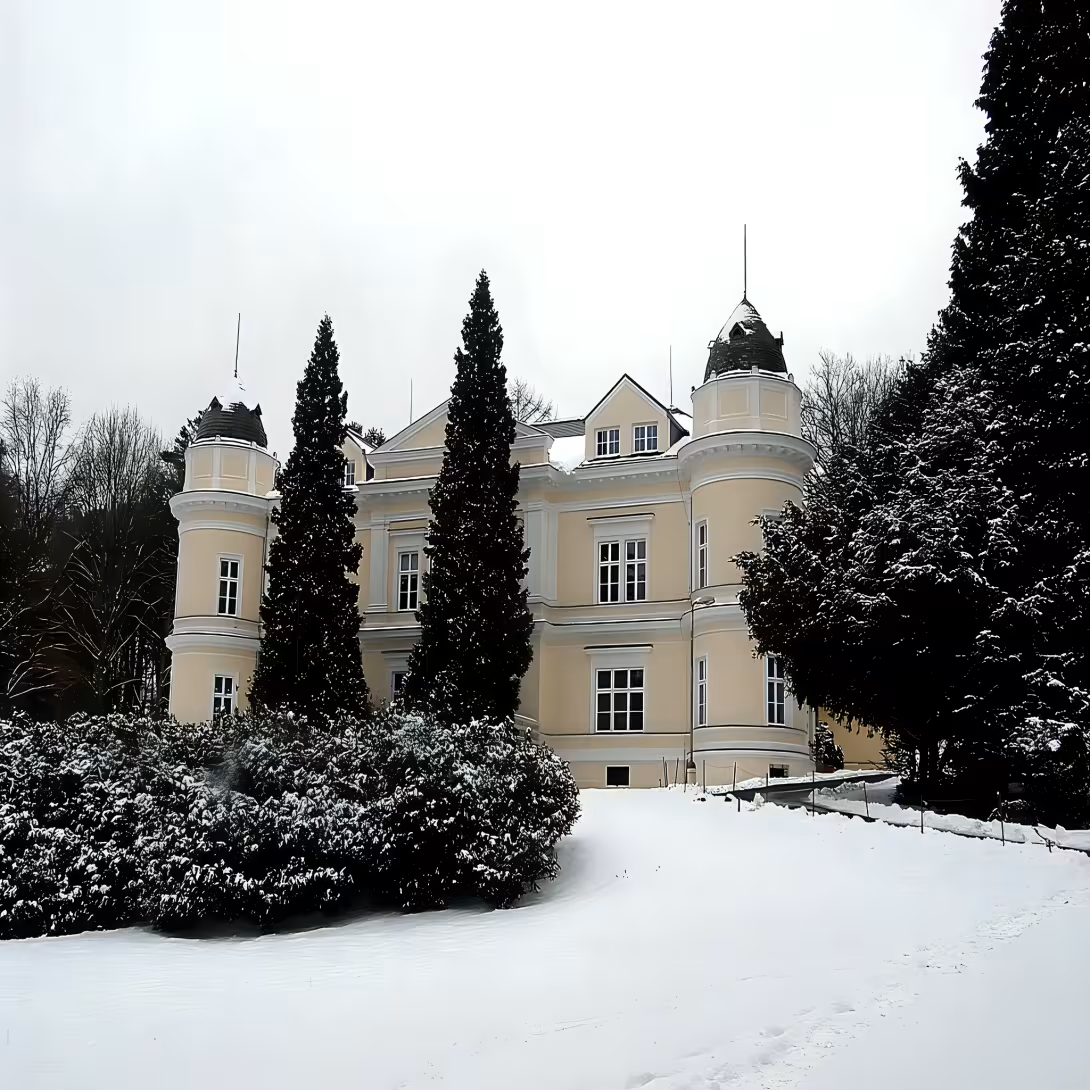
The Dalovice Chateau is unique by connecting two buildings in one place with different building history. The new Renaissance mansion, now called the old chateau, was probably created after the demise of the Dalovice fortress in 1503 after the siege of the Swede. It was built outside the area of the sailing yard on the northern edge of the village Dalovice and during centuries it was undergoing gradual reconstruction according to changing owners of the estate.
The definitive change came in 1899, when the old chateau burned down. Baron Friedrich Riedl von Riedelstein had it rebuilt in a neo-Baroque style, using only the surrounding walls from the original building. Until then, the building served as a hostel for employees of the local porcelain factory. Under Eduardo Riedl von Riedelstein, a rich library with a collection of German, English and French literature was founded here, focusing mainly on geography and travel papers. After World War II, the property was confiscated from the Riedles family and part of the collection was taken by the Red Army. Since 1958, the Czechoslovak State has established an apprenticeship centre here, and later the Central Agricultural Technical School Dalovice was located in the building. After 1990, it was used by the University of Logistics.
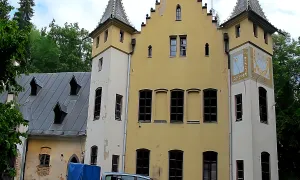
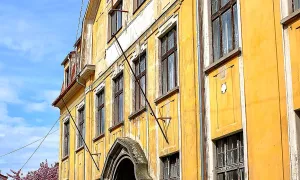
Architecturally, the old chateau is designed as a storey brick building on a square floor plan with a mansard roof and skylights. The facade is decorated with two-axis two-story risties with volute shields, corner sections are divided by pilasters with profiled heads. The north facade contains a balcony with a decorative baroque railing and rectangular windows in profiled shambles with a semi-circular wedge on the floor.
The new chateau was built by the same Baron Friedrich Riedl von Riedelstein between 1847 and 1875 according to the design of architect Josef Benischk. A single-storey brick structure on a low plinth has a valb roof covered with eternity. The main facade open to the park features eight window axes and three-axis central risalite with three-sided Empire shield, supplemented by corner cylindrical towers with cupola roofs. There is a two-arm staircase with a terrace in front of the front door. The rear facade has a more complex architectural solution with stylized towers and a diverse structure of window openings. The facade is divided throughout the perimeter by cordon ledge and Tuscan pilasters. From 2008 to 2012 the New Chateau underwent a comprehensive reconstruction and modernization.
Both locks served public purposes in the 20th century. After World War II, a secondary agricultural technical school and vocational training centre were established. After the privatization of the 1990s, they remain in private hands, where the secondary vocational school currently houses logistics. The complex as a whole with its park and monument represents an excellent example of the continuity of building and cultural development in one place.
Then and now
Drag the slider to compare how the landmark may have looked when it was built with the view today.
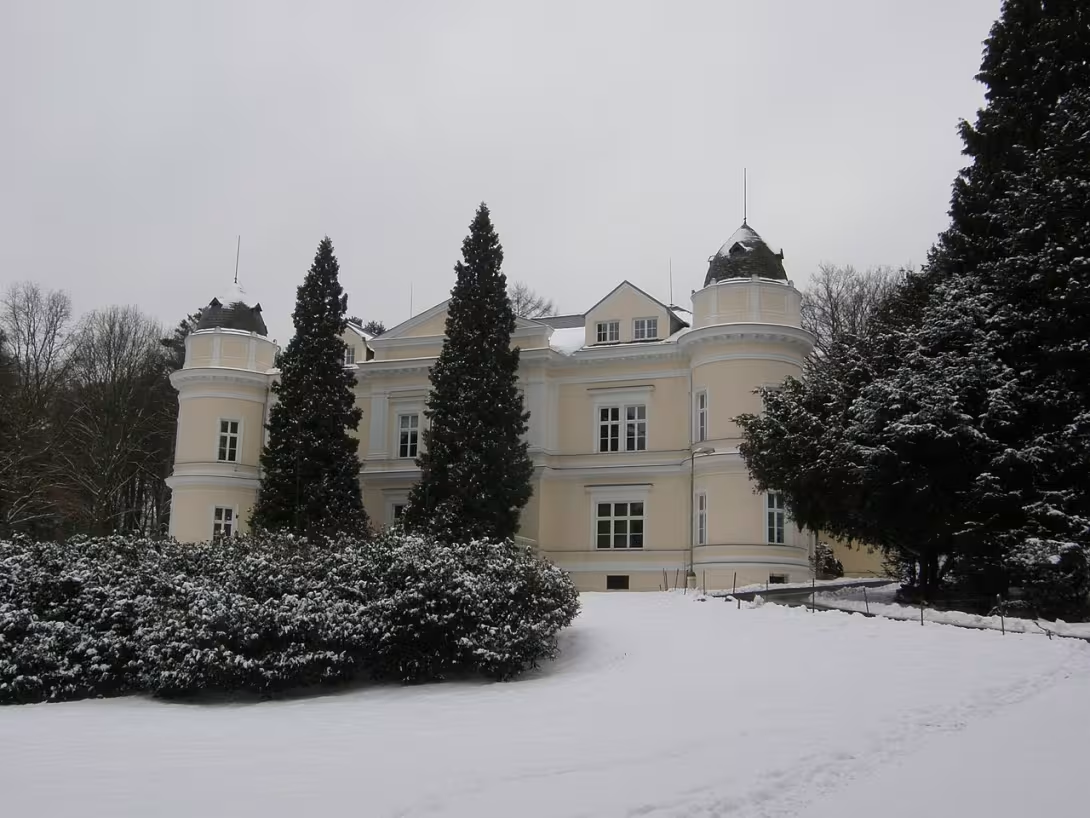

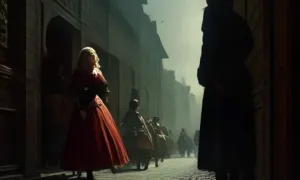
The historical appearance on the left is an AI-generated visualisation and serves as inspiration only.
Historical milestones
- 1503
- The demise of the Dalovice fortress after the siege of the Swede.
- 1847-1875
- Construction of the New Chateau in Neo-Renaissance style.
Architectural development
The old chateau was built after the demise of the fortress in 1503, rebuilt according to the needs of various owners and eventually reconstructed in a neo-Baroque style after burning down in 1899. The new chateau was built in 1847-1875 in a neo-Renaissance style according to the design of Josef Benischk and later modified.
Historical events
- 1503
- The demise of the Dalovice fortress after the siege of the Swede.
- 1847-1875
- Construction of the New Chateau in Neo-Renaissance style.
- 1899
- The burning of the old chateau and its subsequent reconstruction in a neo-Baroque style.
Owners
- 1847-1875
Points of interest
- The Dalovice Chateau connects two buildings with different building history in one place.
- The old chateau was built after the demise of the Dalovice fortress in 1503 and it underwent several reconstructions according to changing owners.
- After the burning of the old chateau in 1899, it was reconstructed by Baron Friedrich Riedle von Riedelstein in a neo-Baroque style, using the original surrounding walls.
- The new chateau was built between 1847 and 1875 according to the design of architect Josef Benischk by Baron Friedrich Riedle von Riedelstein.
- The complex of the chateau, including the park and monument, represents the continuity of building and cultural development in one place.
Guide
This guide is narrated by a synthetic voice generated by artificial intelligence.
Show guide text
This text was created by artificial intelligence and has not been editorially reviewed. It may contain inaccuracies.
Dalovice Castle in the Karlovy Vary district consists of two buildings, the old castle and the new castle. The entire complex, which also includes a castle park and a monument to Karel Theodor Körner, is a protected cultural monument.
The old castle was probably built after the destruction of the Dalovice fortress, which was besieged by the Swedes. The new Renaissance residence was built on the northern edge of the village, outside the manor farm. The building was transformed with each new owner of the estate, until eventually it became a small castle. When the new castle was built, the old one served as accommodation for employees of the local porcelain factory. In 1899 it burned down. Baron Friedrich Riedl von Riedelstein then had it rebuilt in the Baroque Revival style, and only the outer walls remained from the original structure. Under Eduard Riedl von Riedelstein, a library was created there with German, English and French literature, mainly on geography and travel.
The old castle is a multi-story building with a square floor plan and a mansard roof with dormer windows. The facade is decorated with projecting sections topped with volute gables. The one facing the road features a massive bell-shaped roof. On the north side, there is a balcony on the upper floor with ornate Baroque railings.
The new castle was built by Baron Friedrich Riedl von Riedelstein between 1847 and 1875 in the Neo-Renaissance style according to a design by architect Josef Benischka. In the early twentieth century it was renovated. It is a single-story building, also with a square floor plan, with a hipped roof. The main facade facing the park has eight window axes and a central risalit with a triangular gable. Cylindrical turrets with conical roofs stand at the corners. A double-flight staircase with a terrace leads to the entrance. On the rear side, on the upper floor, a large glazed opening with a balustrade replaces three windows. The entrance hall is vaulted with a cross and barrel vault.
After the Second World War, the property was confiscated from the Riedl family and part of the library collection was taken away by the Red Army. From 1958 onwards, both buildings served schools. The old castle first housed a vocational training center and from September first 1960 a secondary agricultural technical school. The new castle housed a postal vocational school. After 1990, both buildings house a secondary vocational school of logistics. The new castle passed into private hands in the nineties and underwent complete reconstruction between 2008 and 2012.
Tips for visitors
The best time to visit the Dalovice Chateau is the summer months, where there is the most beautiful vegetation and sunlight allows you to capture the views in full beauty. Visit the chateau in the morning or evening for milder temperatures and smaller visitors.
We recommend the use of public transport for access to Dalovice; Check current connections and routes in the online search engine or at local information stations.
When visiting the chateau, wear a suitable suit, because some parts of the complex may not be air-conditioned. Also remember the protective sunglasses and water, especially in the summer months.
The best place for photography is the western facade of the New Chateau, where the sun sets behind the building. The best light for the photo is usually morning and evening when the light is softer.
In the vicinity of the chateau Dalovice there are a number of attractions that can be visited within 30 minutes. We recommend exploring the natural park Slavkovský forest or enjoy relaxation at the spa Mariánské Spa.
Frequently asked questions
Can the monument be visited?
Some buildings of this kind are open for guided tours, others serve another purpose or are privately owned. We have not verified whether and when this monument is open – please ask the operator.
What are the opening hours and admission?
We have not verified the opening hours or admission. Current information is published by the operator.
Where is the monument?
Location: Hlavní 114/29, Dalovice, Karlovarský kraj. The map on this page shows the exact spot.
Why is the monument protected?
It is listed in the Central List of Cultural Monuments of the Czech Republic as a cultural monument (register no. 38621/4-779).
For kids
Imagine going back to the past and finding yourself in the beautiful chateau Dalovice, where today stands the chateau with an amazing Neo-Renaissance style. What was going on back then? Who lived here?
It was like a game! The Earl and the nobles here celebrated their weddings and dances while hunting bears and wolves in the neighboring woods. Except for the witch legends that spread among humans... No wonder! But maybe some hidden friend gave the lock special strength.
Businesses nearby
Do you run a restaurant, accommodation, shop, museum, rental, wellness or other visitor service near this monument? Show yourself directly to the people heading to it — this is how they will see you in the app and on the web:
Nearby
Ambient landscape, other sights
Accommodation nearby
Trips and activities nearby
Guided tours, tickets and activities nearby from GetYourGuide
Affiliate link: if you buy from the partner, we may receive a commission. The price for you does not change.
Search tours and activities →Themed route
The route starts in the center of the village Dalovice, where the lock Dalovice stands. It is a romantic Baroque chateau from the 18th century, which stands on the site of an older fortress. The chateau is famous for its beautiful interiors and extensive garden.
We will visit the chateau and look at its courtyard, interiors and garden.
The next stop is the Chapel of Saint Anny, which stands near the chateau. It's a beautiful chapel with rich decorations and it's worth a tour.
From the chapel we go to park and go through its beautiful green area. Park is a quiet place where you can disconnect from the city and relax.
Seasonal recommendations
Spring: Specific is the green forest and flower cover that surrounds the chateau. The atmosphere is calm and calm. Practical advice: the best time to visit is in the morning to avoid crowds. We recommend you bring the camera to take beautiful photos.
Summer: Specific is the heat and the sun that illuminates the entire area. The atmosphere is relaxed and summer. Practical advice: the best time to visit is at the beginning of the season to avoid crowds. We recommend you bring a sun shade and a drink.
Autumn: Specific is the forest colour and smell of fallen leaves. The atmosphere is calm and calm. Practical advice: the best time to visit is in the late morning to avoid crowds. We recommend bringing warm clothes because it is cold here.
Winter: The specific is the dawn and silence that is on the premises. The atmosphere is calm and calm. Practical advice: the best time to visit is in the morning to avoid crowds. We recommend bringing warm clothes and boots with cold insulation.
Visualizations and artistic views


The visualisations are generated by artificial intelligence and serve as inspiration.
Photos from the area
Real photos taken near the monument


Zdroj a licence jsou uvedeny u každého snímku.
Tips from visitors
No tips yet. Be the first!
Log in and add your tip.
Sources and literature
Photos: Mejdlowiki / CC BY-SA 3.0, rozlišení zvýšeno umělou inteligencí — Wikimedia Commons. The author and licence also appear when you hover over the image.
Faktickým podkladem tohoto textu byl článek na Wikipedii, jehož autory jsou přispěvatelé Wikipedie. Článek je dostupný pod licencí CC BY-SA 4.0.
Location on the map
Příběhy a pověsti
Legendy, pověsti a příběhy spjaté s touto památkou
Fotografie návštěvníků
Zatím žádné fotografie. Buďte první, kdo přidá fotografii z návštěvy!
Log in a přidejte svou fotografii nebo hodnoťte.
Za ověřenou návštěvu v aplikaci získáte víc bodů — poznáme podle GPS, že jste na místě.
Reviews and comments