



Dub (tvrz, okres Rakovník) Motte
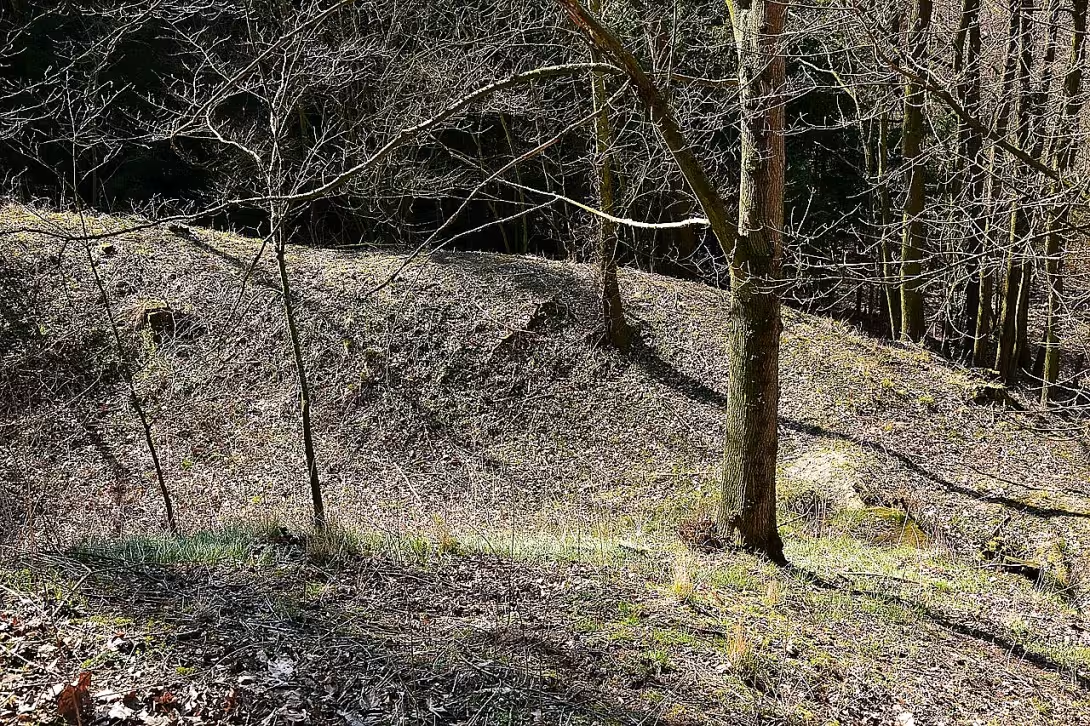
The oak, also known as the Old Castle, is a historic fortress near Svojetína in the district of Rakovice. The fortress located less than two kilometres southwest of Svojetína is protected as a cultural monument. It is remarkable by its history, which dates back to the Middle Ages, and by its extinction during the Hussite wars in 1421.
The fortress was probably built in the late Middle Ages. The first known owner was Jan Čihák z Dubu, commemorated in 1393. The fortress was also associated with Zikmund of Dub, mentioned in the memory of the monastery of Pláska. Later it belonged to the Kolovrat who attached it to the Krakow. In 1539 it is listed as a desolate fortress and village, suggesting its disappearance during the Hussite wars in 1421.
The architecture of the fortress was typical of medieval forts. It had an oval or rectangular floor plan with dimensions of 100 × 80 metres, but the southern part was destroyed by an opening. The core of the fort was 16 meters long and surrounded by a trench of six metres wide and approximately 1.3 metres deep, in front of which is a massive wall. The remains of the building were preserved in the form of two deepened, probably wooden towers on a stone suspect.
The ownership of the oak fort has undergone several changes. After John's Chihuahua of April, she went into the hands of the Kolovrat who linked her to the Manor of Krakow. The fortress probably disappeared during the Hussite wars in 1421 and was declared desolate in 1539.
Dub Castle is associated with historical events, especially Hussite Wars. These conflicts had a major impact on the structure and property situation of the Czech estate, which probably led to the collapse of the fortress.
Today, Dub is protected by cultural heritage. Despite the disappearance and erosion of the southern part of the fortress, it is worth visiting for those interested in the history of medieval castles and their important role in regional history. The fortress offers a unique view of the architecture and living conditions of the time, which is valuable both for historians and tourists.
Visiting the Dub means not only discovering parts of the past, but also thinking about the heritage and impact of historical events on the current landscape. The fortress is witnessing changes that shaped the region, and it is worth looking at in order to better understand its importance in the complex history of the Czech Republic.
Historical milestones
- 1393
- Jan Čihák z Dubu is the first known owner of the fort.
- 1539
- The oak is listed as a desolate fortress and village.
Architectural development
The fortress had oval or rectangular ground plan with moat and walls. The remains of the building include two deepening, probably a wooden tower on a stone suspect.
Historical events
- 1421
- The fortress probably disappeared during the Hussite wars.
- 1539
- The oak is listed as a desolate fortress and village.
Owners
The first known owner of the fort was Jan Čihák z Dubu (1393). Later it belonged to the Kolovrat who attached it to the Krakow. In 1539 it is declared desolate.
Points of interest
- The oak is a historic fortress near Svojetína in the district of Rakovnik also known as the Old Castle. - The fortress located less than two kilometers southwest of Svojetína is protected as a cultural monument. - The history of the fortress dates back to the Middle Ages, it disappeared during the Hussite wars in 1421. - The first known owner was Jan Čihák z Dubu, commemorated in 1393. - The architecture of the fortress had an oval or rectangular plan with dimensions of 100 × 80 meters and was surrounded by a ditch of six meters wide.
Guide
Show guide text
This text was created by artificial intelligence and has not been editorially reviewed. It may contain inaccuracies.
Welcome to Svojetín, quiet corner of Rakovnik County, where the time stopped today. You are standing in the place that in the Middle Ages was the center of local life, power and security. In front of you is a monument known as the oak, or under the popular name on the Old Castle. Perhaps at first glance you might wonder where the lock is, because your eyes see no high walls, no towers, no windows. But that's the secret of this place. You are standing in a fortress, which means that there are traces of a lost fortress in front of you, which has been lured into the ground for a century and became part of the landscape. Feel this atmosphere of peace and let us try together to reconstruct what once stood here.
Let us now return in time more than 600 years ago. To understand why this building was even built here, we have to move to the end of the 14th century. The first written mention of this place dates back to three hundred and ninety-three. The first known owner who was based here at the time was Jan Čihák z Dubu. At that time it was not a luxury palace, but a fortress, which was the basic form of fortified manor of a lower nobility. The fortress served not only as a home, but above all as a safe haven and administrative centre for the surrounding lands. Jan Čihák and his followers, such as Zikmund z Dubu, managed their domain here and, in the form in which the fort was at that time, had to be very dominant and formidable in the surrounding landscape.
Now pay attention to the terrain around you. Even though the walls are gone, the country still tells us its story. If you look carefully at the soil relief, you will notice that space is not exactly equal. Originally, this fortress had an oval or rectangular plan, which was distributed in dimensions of 100 times 80 meters. So imagine the vast enclosed space that separated the inner world of a nobleman from the outside world. Note, however, that today's similarity with the original plan is not complete. The southern part of this area with a gradual time has disappeared, mainly due to the ripening of the fields, which over the centuries has gradually absorbed part of the original fortifications.
Now try to focus on the very core of the fort. This is where the main residential area was located, which was 16 metres long. Even if you can't see any more masonry, feel the space where the main building once stood. This building was not just built on a meadow, it was carefully protected. It was surrounded by a deep moat and tall walls that were supposed to make it impossible for the enemy to access easily. Imagine how you once had to cross a bridge or cross a deep line in the ground to get to the lords of the oak. These moats and moats were a key element of defense at the time, making the fort a real fortress.
Who lived here and what was their destiny? Jan Čihák z Dubu laid the foundations of power in this place, but the history of this house was full of unrest. The Dubu family was building their position here, but the Middle Ages were a period of great change and conflict. The biggest of them came in a thousand four hundred twenty-one. It was this year, during the bloody Hussite wars, that a tragic end to the flowering of this fortress. The oak was destroyed during this period. Imagine the contrast when the silence of this landscape was suddenly overthrown by the thunder of weapons and flames of fire. The fortress that was supposed to protect its people was the victim of war chaos.
After this turning year, Dub never regained his formal fame. It became gradually a ruin that people around here began to see as something distant and forgotten. Historical records lead us to a thousand five hundred thirty-nine, when the oak is referred to as a barren fortress and a barren village. That's a very strong word. Abandoned space means a place where no one lives anymore, where no one works in the fields and where nature began to take control of human architecture. What you see today as a quiet meadow and mild terrain inequality was in the 16th century a silent witness to the decline of one noble family and the entire settlement center.
At this moment, you may be interested in one mystery floating over this place. Why is a fort called the Old Castle when it was basically never a lock in the true sense? The castle evokes luxury, large halls and ornamental gardens, while the fort was basically a functional military and residential building. This contradiction in the name shows us how people's memory works. For the locals, who have looked for centuries at the remnants of valleys and ditches, the word castle was a symbol of something noble and old, whether or not it corresponded to architectural reality. It's a fascinating display of how history turns into legend.
Today, this fortress is protected as a cultural monument. It means that even if we can't see the walls, this invisible architecture in the country is valuable. It is a monument to human effort, ambition and also fragility. You are standing in a place where the ambitions of nobles, the brutality of war conflicts and the patience of nature, all covered with a layer of grass and clay.
Now you are invited to slowly pass through the perimeter of this former compound. Try to follow the lines of the terrain and in your mind add to the missing southern part that once erased the plow of a peasant. Feel the silence that exists here today, and think about how many generations have passed, how many decisions have been made here and how many stories have been buried forever in the country.
Thank you for spending time with us at Dub Castle. We hope this short trip to the past has helped you see more than a meadow in this country. We wish you a pleasant further continuation of your journey and many other discoveries in the beautiful cancer region. Goodbye.
Tips for visitors
To visit the extinct oak fort at Svojetína is best to choose the dry season of the year, preferably in spring or autumn, when lush vegetation less covers off the terrain remains. In summer, there may be a place covered with nettles and bushes. As this is a freely accessible ruin in nature, bring with you solid hiking shoes suitable for unequal terrain and tick repellent. The morning light is best suited for the photography of the historic site, which will nicely draw the contours of the overgrown fortress and moat. Since no other tourist destinations are registered in the immediate vicinity of the monument in a 30-minute radius, this expedition is particularly suitable for lovers of peace and deserted historical places, less for young children who will not find normal children's attractions or facilities.
Frequently asked questions
Can the monument be visited?
This is an archaeological site. Often there is little to see on the ground and the land may be private. We have not verified access.
Where is the monument?
Location: Svojetín, Středočeský kraj. The map on this page shows the exact spot.
Why is the monument protected?
It is listed in the Central List of Cultural Monuments of the Czech Republic as a cultural monument (register no. 1000159051).
Businesses nearby
Do you run a restaurant, accommodation, shop, museum, rental, wellness or other visitor service near this monument? Show yourself directly to the people heading to it — this is how they will see you in the app and on the web:
Nearby
🏰 Historic sites (94)
- T. G.Masaryk 5.0 km
- Hrádek u Vrbice 5.1 km
- Muzeum Kneževes 5.5 km
- sv Jan Nepomucký 5.9 km
- Kounovsky stone series 6.1 km
- Josef II. 6.2 km
- Statue of the Virgin Marie 6.6 km
- sv Prokop 7.0 km
- Search yourself 7.1 km
- Jan Hus 7.3 km
- Pegas 7.6 km
- Druantia 7.7 km
- Kounovsky stone series 7.8 km
- Gibbon 7.9 km
- Marian Columns 8.0 km
- Cert Kamen 8.1 km
- Ruin Jjban 8.4 km
- Gallery Kafka 8.8 km Sirem 7 + 420 774 335510
- victims of the Holy War 8.9 km
- Saint Jan Nepomucký 9.0 km
🍽️ Restaurants and dining (109)
- Guesthouse U Rybnika 2.3 km
- Clear-point 4.4 km Hokov 16 + 420 731 149 010 web
- Café Bistro Kuki 4.9 km
- ♪ ♪ 4.9 km
- JD 5.0 km + 420 605 421 218 web
- lucka cafe 6.8 km
- U Kutíle 7.0 km
- Podjban brewery 7.5 km Large Page 2 web
- Area 8.6 km web
- Cultural House Pošovlky 8.8 km
- U Barona 8.9 km Olešná 185 + 420777139480 web
- U Wild 9.0 km
- Brewery Olešná 9.1 km
- Brewery Olešná 9.1 km web
- Na Gypsies 9.2 km
- Guesthouse at Pasi 9.3 km
- Restaurant Motorest at Šustné 9.7 km + 420 602 597 711 web
- Tank Ono 9.9 km + 420 313 575 259
- U Berana 10.3 km Cancer 240
- Pod Jbanen 10.3 km
🏨 Accommodation (21)
- Chalupa U lesa 2.1 km + 420 737 163 156
- Guesthouse Clear-point 4.3 km + 420 731 149 010 web
- Kemp Old Sad 6.0 km + 420 608 330 371 web
- Lions - Training Centres 6.2 km
- Motorest Na Šustné 9.8 km + 420 602 597 711 web
- Guesthouse Na Statku 10.8 km
- Tábor Eldorádo 10.9 km web
- Sosen 11.9 km + 420 608562781 web
- Accommodation Caffex 12.0 km + 420 313 516 183 web
- Hostel Cancer 12.1 km
- Pansky Mlýn 12.2 km Dukel heroes 65 + 420602 370 541 web
- Na Ryšczy 12.6 km
- Rac Hrad 12.7 km + 420 608 920 929; web
- Hotel Svoboda 12.9 km + 420313 web
- Rozmaryn 13.2 km
- Penzion Šebába 13.2 km + 420 739 012 090 web
- Pension No thanks 13.4 km web
- Accommodation HC Cancer 13.7 km nabank Dr. Beneš 2332 + 420733402633 web
- Guesthouse Na Cháti 14.0 km web
- Mesto Jesenice - Plant Autokemp 14.1 km Pilzenska 368 608029189
🚲 Rentals and sport (18)
- poolnek 2.2 km
- SHOP AVZO Senomaty 9.2 km + 420602302944 web
- U Stone Panny 11.9 km Lishan web
- Tennis Centrum CAFEX, s.r.o. 11.9 km Na Studios 2590 + 420 313 516 183 web
- SK Rakovník 12.1 km
- JK Falco Krušovice 12.3 km
- JK Falco Krušovice 12.3 km
- Sportisimo 12.4 km
- Kola Safranek 12.9 km Railway station 4 + 420606792682
- Wheels Rezek - Rezková 12.9 km Martinovsky 182
- Kola Sanka 12.9 km Vrchlický square 34
- Ramala, s.r.o. 13.1 km Komen Square 2689
- SkiserviceCancer 13.1 km
- Dr. Cyclo 13.2 km Vladislaova 407 + 420 732 470 675
- Winter Stadium of Rakovnika 13.7 km nabank Dr. Beneš 2332 web
- Chevron Nutrition s.r.o. 14.6 km Nerud 603 + 420 775 078 060 web
- Kola Moses 14.7 km Dukel 260 + 420 731 344 610 web
- Cyklo Molds 14.8 km Kadanská 301 + 420 776 044 015 web
🥾 Hiking and nature (63)
- Fort well 2.6 km
- Stone spiral 6.1 km
- Špičás 7.1 km
- Běsenské vr 7.7 km
- Fox top 8.0 km
- Skalky 8.5 km
- 8.5 km
- Hunting 8.7 km
- Export 8.8 km
- Study in Horses Rokli 9.4 km
- Tobias 9.7 km
- Milberk 9.7 km
- Pravda 9.9 km
- Kozinecks 10.1 km
- U Devil's Stone 10.3 km
- Castle top 10.4 km
- _ 10.4 km
- Study Whitenec 10.6 km
- Žban 10.7 km
- Small Uran 10.8 km
Accommodation nearby
Themed route
Since the surrounding area is empty and no other places are available, this thematic cruise route is designed as a detailed tour of the inner area and the history of the monument itself and its immediate surroundings.
1. Hardware Dub - Main destination, historical fortress (district Rakovnice) in the village Svojetín. This place represents the remains of the medieval mansion, which in the past served as a noble sanctuary and an administrative centre. A tour of the landscape shapes and remains of the masonry offers a unique view of the development of rural settlements in this area.
2. Area hards - Outdoor and immediate surroundings of the main destination. Visiting this area allows you to explore the remains of the original fortifications, defensive moats and surrounding historical landscapes. The place is ideal for those who want to immerse themselves in the silence of ancient times and perceive the atmosphere of the extinct mansion in the field.
Seasonal recommendations
Spring: In the spring, nature openly appears on the Dub Castle in Rakovnik when trees and bushes begin to bloom and green vegetation regains life. The sunny bright and mild temperatures create ideal conditions for a relaxed visit where the atmosphere is full of hope and recovery. When designing your visit program, please note that due to less regular weather it is advisable to prepare clothes suitable for variable conditions. Although spring is usually a slightly visited season, in times of beautiful weather there may be an increase in tourist traffic.
Summer: Summer brings to the fort An unforgettable experience thanks to long days and warm sunlight, which illuminates historical architecture in beautiful colours. The atmosphere is full of vitality, making this time ideal for long walks on ruins and natural surrounding landscapes. In the main summer season it is recommended to visit the memory in the early hours to avoid strong crowds of tourists. Don't forget the sun protection and plenty of drinking water.
Autumn: Autumn comes with a magical atmosphere when tree leaves acquire living golden-fiery shades and oak fortress turns into a real scene for photography. Sunshine days are an ideal time to visit when the temperature is still pleasant, while morning and evening cold can be more pronounced. When planning your visit program, please note that it is advisable to prepare for lighter weather and the possibility of precipitation later this season. You visited the memory during these less visited days, when you can fully immerse yourself in a quiet and light atmosphere.
Winter: Winter visit to the fortress Dub offers a unique experience with its shaded, mysterious silhouettes under the cover of snow or in a cool cloud atmosphere. This season is usually less visited, which means a quieter and more intimate walk on ruins. You visited the memory in a quiet time when you can get a look at its history and beauty without disturbing the crowd.
Visualizations and artistic views


The visualisations are generated by artificial intelligence and serve as inspiration.
Photos from the area
Real photos taken near the monument

Zdroj a licence jsou uvedeny u každého snímku.
Tips from visitors
No tips yet. Be the first!
Log in and add your tip.
Sources and literature
Photos: Petr Kinšt / CC BY-SA 3.0 — Wikimedia Commons. The author and licence also appear when you hover over the image.
Faktickým podkladem tohoto textu byl článek na Wikipedii, jehož autory jsou přispěvatelé Wikipedie. Článek je dostupný pod licencí CC BY-SA 4.0.
Location on the map





Příběhy a pověsti
Legendy, pověsti a příběhy spjaté s touto památkou

Fotografie návštěvníků
Zatím žádné fotografie. Buďte první, kdo přidá fotografii z návštěvy!
Log in a přidejte svou fotografii nebo hodnoťte.
Za ověřenou návštěvu v aplikaci získáte víc bodů — poznáme podle GPS, že jste na místě.
Reviews and comments