



důl Pustinka Mine
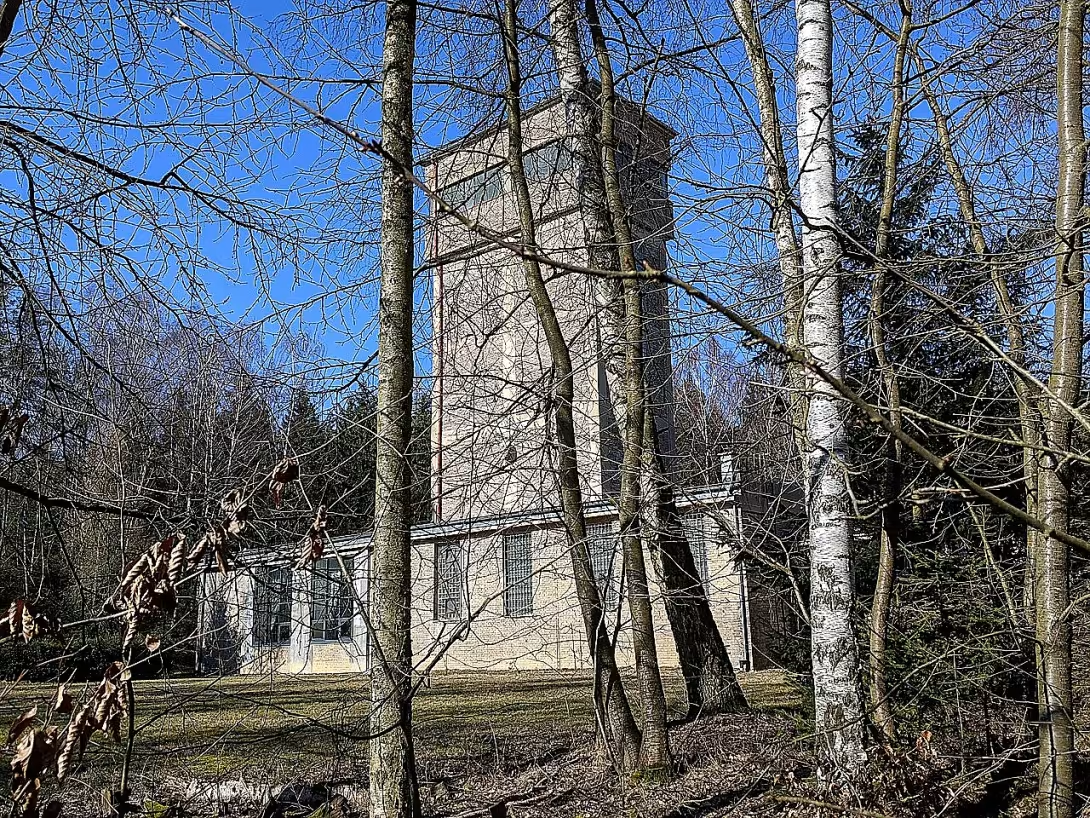
The wind pit Na Pustince u Lán na Kladensk is a functionalist industrial building from 1951 to 1954. It was originally used as an exhilarating wind work for the Nosek Mine in Tuchlovice. The building stands out for its architectural rendition and was declared a cultural monument of the Czech Republic in 2001.
The construction was built in the period of intensive industrialization of Czechoslovakia in the 1950s. The pit was dug up to 240.14 metres and in 1955 it was connected by a winery with the mine Nosek, formerly known as the Jaroslav Mine. The locality is approximately 1500 metres from the Lástá Sloustá Dobrá in the vicinity of the Láska branch.
The architectural design of the building is attributed to Otakar Štěpák, the project documentation was prepared by the office Škoda Plzeň. The construction uses iron concrete skeleton and solid white slag cement bricks. The ground floor building of the rectangular plan is oriented in the east-west direction. Its eastern facade is surrounded by a low annex with concrete lining. A significant element is the column porticus with three smooth reinforced concrete columns before the main entrance. From the centre of the building grows a high prism four-sided tower with slightly extended crown. The interior illuminates large areas of luxers, which are set in the belts on the tower and in the ground areas of the building.
The operation of the wind pit was completed in 2002 together with the closure of the Nose Mine. Subsequently, the pit was destroyed by powder. After the mining activity, the tower was converted into a residential space according to the design of the studio Ivan Vavříček.
This object represents a unique example of industrial architecture, which has managed to connect the original functionalist purpose with new use for housing. Visiting the site offers a view of the technical monument, which illustrates the history of the mining industry in the region while showing the possibilities of modern transformation of industrial buildings.
Historical milestones
- 1951
- The opening of the Windy Pit of the Wasteland.
- 1955
- Breaking through the wind bridge connecting the pit to the Nosek mine.
- 2001
- Declaration of the object as a cultural monument by the Ministry of Culture.
- 2002
- End of mine operation and subsequent filling of the wind pit.
Architectural development
The construction was designed in a spirit of functionalism using a steel concrete skeleton and white slag cement bricks. The architectural design is attributed to Otakar Štěpák, while the documentation was processed by the office Škoda Plzeň. After the mining activity, the tower was converted into a residential space according to the design of the studio Ivan Vavříček.
Historical events
1951-1954: Drowning wind pit. 1955: Breaking a wind dig from the Nosek mine. 2001: Declaration for cultural heritage. 2002: End of operation and fill the pit.
Points of interest
- The wind pit Na Pustince is a functionalist industrial building from 1951 to 1954, which was declared a cultural monument in 2001. - The pit was dug down to a depth of 240.14 meters and in 1955 it was connected by a wind bridge to the Nosek mine. - The architectural design was created by Otakar Štěpánek and the project documentation was prepared by the office Škoda Plzeň. - The building uses a reinforced concrete skeleton, solid white slag cement bricks and large glass blocks are used for lighting the interior. - After the completion of the operation in 2002 and the subsequent filling of the pit, the tower was converted into a living space according to the design of the studio Ivan Vavříček.
Guide
Show guide text
This text was created by artificial intelligence and has not been editorially reviewed. It may contain inaccuracies.
Welcome to Lány, where you are now in front of the fascinating work of functionalism - the wind pit of the wasteland. This industrial building, which once provided smooth operation down Nosek in Tuchlovice, has now turned into a cultural monument and local interest. You are standing in front of a white scaffold building with a central reinforced concrete tower that turns off its elegant shape into the blue sky. Natural lighting and geometry of architecture give this place a unique character.
Let's dive into the history of this monument. In 1951, the windy pit of the Nustinka was started, which was completed three years later. This object served as an extravagant wind work for the Nosek Mine and was designed by architect Otakar Štěpánek, known for his contribution to functionalism. In 1955, he connected a wind pit with a mine, allowing for effective ventilation of the mine's rock system.
Look up at the central reinforced concrete tower. It is one of the key architectural characteristics of this building, which is still fascinated by its design and technical solution. Note the white scaffold bricks and elements from luxers that contribute to the simple but distinctive appearance of the object.
Although specific personalities associated with this monument are not well documented, it is clear that its existence and function supported many of the work of engineers and workers of that time. The Nosek Mine was an integral part of the industrial development of the region in the mid-20th century, reflecting broader economic trends and technological progress.
The interesting thing about this place is its depth - the pit was dug to a depth of more than 240 metres. This indicates an ambitious plan and technological capabilities of the former builders. In 2001, the building was declared a cultural monument, highlighting its historical and architectural value.
Now that you know about this fascinating place, let's look further. Lány offers countless other attractions and beauty. Keep this memory as a starting point for your next discoveries. When you return, we can continue to explore this rich cultural heritage. Thank you for your attention and have a nice day of discovery!
Tips for visitors
The best time to visit is during spring or autumn months when the trees in the surrounding area are not fully foliated, which allows a better view of the functionalist architecture of the building. For the journey to the building, use the forest path leading away from the láska branch, and we recommend choosing fixed shoes suitable for the field. For photographers is ideal early morning or late afternoon when soft light highlights geometric shapes and industrial details of the wind pit. In the surroundings there is a láska branch and Hájšovna Pustá Dobrá, which are suitable for longer walks by nature. We recommend families with children to combine the observation of the technical monument with a trip to adjacent forests, where it is possible to approximate the history of mining in the region by telling about old mines.
Frequently asked questions
Can the monument be visited?
This is a technical monument. Some are open as exhibitions, others are out of use or on private land. We have not verified whether this one is accessible.
What are the opening hours and admission?
We have not verified the opening hours or admission. Current information is published by the operator.
Where is the monument?
Location: Lány. The map on this page shows the exact spot.
Why is the monument protected?
It is listed in the Central List of Cultural Monuments of the Czech Republic as a cultural monument (register no. 1000450359).
Businesses nearby
Do you run a restaurant, accommodation, shop, museum, rental, wellness or other visitor service near this monument? Show yourself directly to the people heading to it — this is how they will see you in the app and on the web:
Events nearby

Zdroj akcí: otevřená data měst a obcí ČR (Národní katalog otevřených dat) a kalendář akcí Národního památkového ústavu.
Nearby
Objekt se nachází v blízkosti lánské obory a přibližně 1500 metrů od hájovny Pustá Dobrá.
Accommodation nearby
Themed route
Thematic cruise route from the Hollow mine
1. The Hollow Mine - Type: Historical site - Why is it worth a visit: Pustinka Mine is a fascinating testament to the history of mining in this area. Visit and enjoy a view of the historic mines that tell about the life of miners from ancient times.
2. Lánek branch - Type: Historical park - Why is worth a visit: This beautifully maintained park is famous for its history and natural beauty. It is an ideal place to relax and walk through gardens where you can enjoy a quiet moment in nature.
3. Hamehouse Hollow Good - Type: Forestry headquarters - Why is it worth a visit: this institution is a centre for the management and protection of local forests. Visit it to learn more about forestry and ecology.
Visiting order: - Start your journey at the Hollow mine where you can see the historic mines. - Then move towards the Norwegian branch, which is approximately 1.5 km from the mine. This beautiful garden offers an ideal environment for relaxation. - Finally, take a look at Pustá Dobrá, which is also approximately 1.5 km from the Lánek field. Here you can learn more about forestry and ecology.
This route offers a combination of history, nature and educational possibilities, making it ideal for the whole family.
Seasonal recommendations
Spring May and March bring a waking surrounding landscape and a fresh green color. The light is soft and rough in this period, which gives the place a peaceful look. It is good to prepare for moisture and mud that often accompanies the melting snow. I recommend choosing waterproof shoes and layered clothes to easily adapt to changing temperatures during the day.
Summer In hot months, the surrounding area is full of thick leaves and the sun shines the strongest. The mood is alive and the daylight is very bright, which creates sharp shadows in the surrounding rocks or walls. For comfortable movement it is necessary to carry a headgear and plenty of water. The best time to visit is early morning or late afternoon when the air is more pleasant and the sun burns less.
Autumn Leaves turn colour into golden and brown shades, creating a calm and beautiful mood. The morning mist often covers the surroundings, which gives the place a mystery. Due to the colder morning clocks and damp soil, it is advisable to wear a windbreaker and firm shoes with good grip. The afternoon light is very golden in this period.
Winter When the frost comes, the landscape becomes silent and can be covered with snow or frost. The light is low and creates long shadows, highlighting the shapes of the outside world. You must cover yourself thoroughly in warm layers and remember gloves and warm shoes. The best place to visit is around noon, when the sun is the highest and is the hottest.
Visualizations and artistic views

The visualisations are generated by artificial intelligence and serve as inspiration.
Photos from the area
Real photos taken near the monument


Zdroj a licence jsou uvedeny u každého snímku.
Tips from visitors
No tips yet. Be the first!
Log in and add your tip.
Sources and literature
Photos: MartinVeselka / CC BY-SA 4.0 — Wikimedia Commons. The author and licence also appear when you hover over the image.
Faktickým podkladem tohoto textu byl článek na Wikipedii, jehož autory jsou přispěvatelé Wikipedie. Článek je dostupný pod licencí CC BY-SA 4.0.
Location on the map





Příběhy a pověsti
Legendy, pověsti a příběhy spjaté s touto památkou

Fotografie návštěvníků
Zatím žádné fotografie. Buďte první, kdo přidá fotografii z návštěvy!
Log in a přidejte svou fotografii nebo hodnoťte.
Za ověřenou návštěvu v aplikaci získáte víc bodů — poznáme podle GPS, že jste na místě.
Reviews and comments