






Dům čp. 133 House
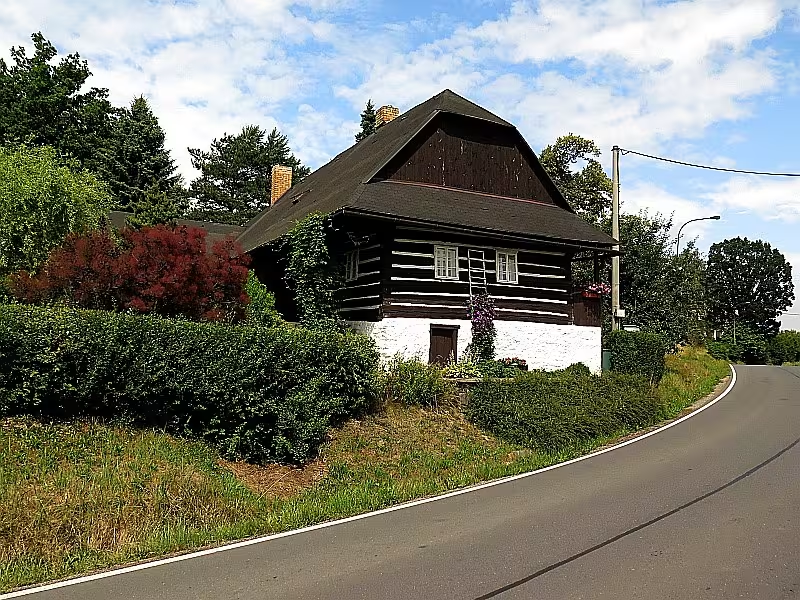
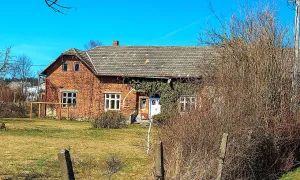
Dům čp. 133 on Top Road in Štramberk in Nové Jicin district is a valuable ground-floor grafted building from the end of the 18th century. This object represents an important example of folk architecture in the original building in the Štramberk suburb and is registered in the Central List of Cultural Monuments of the Czech Republic as part of the city conservation. This monument attracts attention with its preserved construction form and planting in the outlying terrain of the historic city.
The creation of the house dates back to the late 18th century, the period of rule of the Habsburg monarchy in late Enlightenment Absolutism under Josef II and Leopold II, when deep social and political changes were taking place due to the beginning of the industrial revolution and the appearance of the French revolution. In 1558, the Urbář introduced 22 houses with wooden flooring and seven settlements in the suburbs, in 1614 28 farms, rectory, church, school and behind the walls were registered. For the reign of Jesuits, the number of houses rose to 53 in 1656. The first brick house no. 10 grew in 1799, but in the 1930s there were twelve wooden houses near the square. A big fire in 1855 hit Štramberk and burned down 40 houses and two barns.
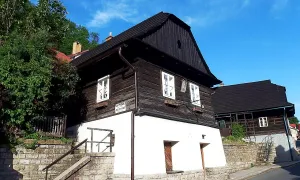
The building design of the house is characterized by a rectangular plan and orientation of the shield side to the street. The building has a traditional tripartite available which includes a scar, a hall and a chamber. The building is based on a high stone suspicion that equalises the slope inequality and hides arched basement spaces with direct entrances from the street. The rear part of the building is walled, while the part of the building that was pushed to the street is grafted from the balls.
The specific names of owners or administrators were not preserved from available sources and the history of the object is not linked to documented dramatic events or battles. The main milestone of the modern history of the monument was its monument reconstruction in the 1980s, which helped preserve the authentic form of the building for the next generation.
Today house no. 133 is a solid part of the city conservation in Štramberk and serves as a proof of folk construction in the suburbs. In the immediate vicinity there is another significant dominant in the form of castle Štramberk with tower Truba.
This house represents a valuable example of historical construction, which reflects the development of the Štramberské suburb in a challenging narrow terrain. Visiting Štramberka and looking at this monument offer a unique opportunity to learn the authentic form of folk architecture of the past centuries.
Historical milestones
- 1988
- The house was entered into the Central List of Cultural Monuments of the Czech Republic before this year.
- 1980
- The building was reconstructed in the 1980s.
Architectural development
It is a ground-floor grafted construction of a rectangular floor plan, which is oriented by the shield side to the street and shows a traditional tripartite available including a scar, hall and chamber. The house is based on a high stone suspect, which equalises a significant slope inequality and hides arched basement spaces with direct entrances from the street. The rear part of the building is walled, while the part of the building that was pushed to the street is grafted from the balls.
Points of interest
- Dům čp. 133 is a valuable underground grafted building from the end of the 18th century.
- This object represents an important example of folk architecture in the original building in the Štramberk suburb and is registered in the Central List of Cultural Monuments of the Czech Republic as part of the city conservation.
- The building design of the house is characterized by a rectangular plan and orientation of the shield side to the street, with a traditional triple layout including a scar, hall and chamber.
- The specific names of owners or administrators have not been preserved from available sources and the history of the object is not linked to documented dramatic events or battles.
- The main milestone of the modern history of the monument was its monument reconstruction in the 1980s, which helped preserve the authentic form of the building for the next generation.
Guide
Show guide text
This text was created by artificial intelligence and has not been editorially reviewed. It may contain inaccuracies.
Welcome to the beautiful Štramberk, where history meets the present in every corner. Right now, you are on one of the most important roads in this city, on the High Road, which follows you through the heart of Strutber suburbs. Please stop for a moment and focus fully on the building that stands right in front of you. It's a house with a number hundred and thirty-three. At first glance, it may seem like a humble dwelling, but if you look at it more carefully, you will see the embodiment of ancient times and the craftsmanship of our ancestors. Feel the atmosphere of this place, the silence that tells stories from the past, and the feeling that you were returning in time for a moment.
Now let's look together at where this house came from and in what context it came from. You're standing in front of a construction that was built at the end of the eighteenth century. So imagine the world more than 200 years ago, the time when life was rhythmically rhythmically, based on sunrise and sunset and seasons. At that time, in the Strtramberg suburb, there began to be characteristic buildings, which today form the unique face of the whole city. House number one thirty-three is not just an ordinary building, but represents a typical example of folk architecture. At that time, the builders were not architects in the modern sense, but they were masters of their practice who knew the properties of materials and knew how to build a house that would be durable and functional. This object was designed to fit into the surroundings and serve its inhabitants in accordance with the needs at the time.
Now pay attention to the architecture itself. Look at the facade and look at the material from which the house is built. It's a grafted construction. The grafting is a traditional technique in which the wooden trunk is folded horizontally and intertwined in the corners. It is this construction that gives the house its specific, warm and robust appearance. Notice this is a ground-floor building. Its low profile and layout in space are typical of folk structures of this type, which did not try to dominate the surroundings, but rather harmonically coexist with them. See how the house is incorporated into the entire building of the High Path. Note how naturally it fills space and becomes part of a larger whole, which is a city monument reservation. It is this connection with the surrounding houses that makes this place such a valuable whole, where one house complements another and together creates an unmistakable face of the historic Štramberk.
When we think about the people who were connected to this house, we have to acknowledge that history is silent about the particular names of architects or significant personalities who would live here. And that's where the special charm of this place lies. House number one thirty-three is not a monument to one famous person, but a monument to ordinary people. It is a testament to the lives of craftsmen, merchants or workers who have lived here, worked and raised their children. The anonymous builders who raised this house at the end of the eighteenth century put their experience and care into it. It's a celebration of the craft passed from father to son. Imagine the hands that worked the wood, and the eyes that kept every layer of grafting sitting in its place. This house is a silent witness to the daily struggle for the existence, joy and suffering of generations that have found refuge in these walls.
You may now be interested in how the house came to be today and why it is so important. Here we come to a very interesting point. House number hundred thirty-three is listed in the Central List of Cultural Monuments of the Czech Republic. This is not only a formal entry in the book, but recognition of its extraordinary value for our nation and our culture. The fact that the house is protected as part of a memorial reservation means that its authenticity must be preserved for future generations. There was one crucial moment in the history of the house worth mentioning. In the 1980s, when the house was almost 200 years old, it was thoroughly renovated. Thanks to this care it was possible to save the grafted construction and ensure that the house could continue to stand as a proud representative of folk construction. It is fascinating to think that the house was officially included in the list of cultural monuments before the year one thousand nine hundred eighty eight, which confirms that its value was recognised long before the last major repair was made.
Now try to close your eyes for a moment and imagine what this street looked like centuries ago. Can you hear the sound of wooden wheels on the road? Can you smell the smoke from the stove and the sounds of morning awakening in the grafted walls? House number one thirty-three carries this invisible layer of time. It's a bridge between us and our ancestors. The fact that we can stand before this building today and admire its simplicity and genius is a gift. People's architecture teaches us humility to the materials and respect for the nature from which these houses came.
Now that you've come to know the story of house number one thirty-three, I suggest you continue to explore the High Path. Watch other buildings, observe similarities and differences in grafting and see how the rhythm of the installation changes. Each house has its own character here, but together it forms a unique organism that is so essential to Štramberk. Let yourself be guided by curiosity and discover details that escape at first sight. You may encounter other hidden treasures that tell you about life in this picturesque city.
Thank you for spending time with us on this precious piece of history. We hope that the view of house number hundred and thirty-three inspired you to take a deeper interest in folk architecture and that you will bear a sense of peace and respect for the traditions that shaped us. We wish you a pleasant further continuation of your trip to Štramberk. Enjoy the beauty of this place and get excited by its unique atmosphere. See you next time.
Tips for visitors
To visit the historical house No. 133 in Štramberk, choose ideally early morning or late afternoon, when the alleys calm down and the sunlight beautifully draws the atmosphere of the old building. Due to the location on the Upper Road in the hilly terrain, it is recommended to arrive by car in the lower part of the city and take the rest of the journey on foot, or to take advantage of local public transport links whose current timetables can be verified in advance. Take with you mainly fixed shoes suitable for walking on uneven historical tiles and slope paths. For photography lovers, the surroundings of the gallows at the end of the eighteenth century offer great compositions with traditional folk architecture, with the best light for capturing details of wooden construction during the golden watch before sunset. Families with children will appreciate a modest walk through picturesque streets that will bring their children closer to life in the past, but care must be taken for the absence of pavement in some of the narrower parts of the historical centre. In the immediate vicinity of the monument is located the City Monument Reservation in Štramberk and the dominant Castle Štramberk with the Truba Tower, where you can get comfortable walking within 30 minutes.
Businesses nearby
Do you run a restaurant, accommodation, shop, museum, rental, wellness or other visitor service near this monument? Show yourself directly to the people heading to it — this is how they will see you in the app and on the web:
Nearby
City Monument Reservation in Štramberk, Castle Štramberk with Tower Truba.
Accommodation nearby
Themed route
Thematic cruise route in Štramberk
1.Dům čp. 133 * Type: * Historical residential houses * Why is it worth visiting: * This house is an example of a typical building from when Štramberk prospered thanks to stone mining. Its architecture reflects the history and tradition of local inhabitants.
2. City Monument Reservation in Štramberk * Type: * Historical Center * Why is it worth a visit: * Walking the streets of the city allows you to appreciate rich architecture and history. Here you will find a number of ancient houses that resemble the golden age of stone mining.
3. Castle Štramberk * Type: * Historical castle * Why is it worth visiting: * Castle is not only an icon of the city, but also provides an excellent view of the surrounding countryside. Its history dates back to the 13th century and is linked to important events of regional history.
4. Tower Truba * Type: * Tower on castle complex * Why is it worth visiting: * Truba tower is the highest tower of the castle and its views are among the best in the whole area. Moreover, it is a place where you can learn more about the history and architecture of the castle complex.
This route offers travelers a clear view of the historical and cultural wealth of Štramberka while allowing them to explore the most interesting parts of the city and its surroundings.
Seasonal recommendations
In spring, the surrounding area of the building is dominated by the awakening nature and fresh greenery, which gives the place an optimistic touch. The soft spring light highlights the details of the historical facade and the atmosphere is full of expectations. We recommend to dress in layered clothes, because weather in hilly terrain is usually variable, and plan a visit in the morning when the streets are quiet.
The summer season brings a radiant sun and full of rich colors of surrounding forests, creating a lively and energetic atmosphere. Expect more visitors because of the season, which is why it is best to arrive first thing in the morning to avoid crowds. Choose light, breathable clothes and do not forget enough fluids to travel to the monument.
The autumn landscape around the house in a cloud of fog turns into golden and red tones, giving the place a melancholy and peaceful character. The walks are most pleasant in the afternoon when the low sun hits the walls of the building beautifully. Practical will be waterproof shoes and lighter jacket against the wind.
In winter, the monument is cosy and mysterious, especially if it is covered by a layer of snow and a freezing morning. In Advent time, there is quiet expectation and quieter pace around. Don't forget the warm thermal clothing and watch out for the shortened opening hours, which is typical of colder months.
Visualizations and artistic views

The visualisations are generated by artificial intelligence and serve as inspiration.
Photos from the area
Real photos taken near the monument


Zdroj a licence jsou uvedeny u každého snímku.
Tips from visitors
No tips yet. Be the first!
Log in and add your tip.
Sources and literature
Faktickým podkladem tohoto textu byl článek na Wikipedii, jehož autory jsou přispěvatelé Wikipedie. Článek je dostupný pod licencí CC BY-SA 4.0.
Location on the map
More monuments – Štramberk
Show all in the municipality
Příběhy a pověsti
Legendy, pověsti a příběhy spjaté s touto památkou
Fotografie návštěvníků
Zatím žádné fotografie. Buďte první, kdo přidá fotografii z návštěvy!
Přihlaste se a přidejte svou fotografii nebo hodnoťte.
Za ověřenou návštěvu v aplikaci získáte víc bodů — poznáme podle GPS, že jste na místě.
Reviews and comments