






Dům čp. 275 House
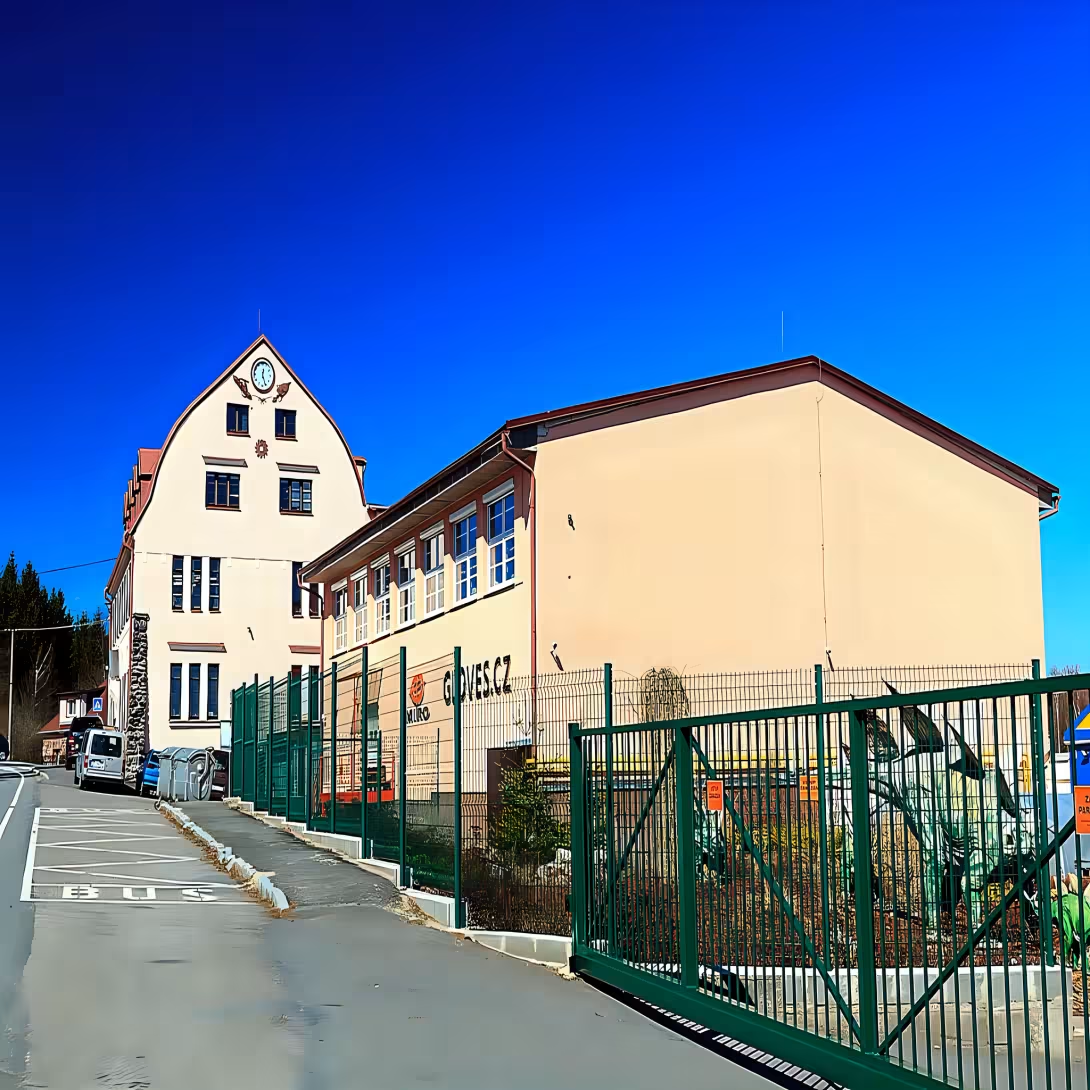
Dům čp. 275 in Štramberk in Nové Jicin district is a valuable grafted building from the end of the 18th century, located on Lower Bašta street. This protected building belongs to the city monument reserve and represents an important document of folk construction and original suburban buildings in the region. The building is uniquely set in the slope terrain between the streets of Upper and Lower Bašta.
The historical context of the creation of the building at the end of the 18th century relates to the period of expansion of folk construction in Czech countries under the rule of the Habsburg monarchy. The then rural and suburban architecture adapted its layout to local climatic and geographical conditions. During this period there was a gradual replacement of purely wooden structures with walled elements, which also illustrates the construction of the first walled house on the Štramberg Square in 1799. From the wider history of the site, there were records that according to the urban authorities from 1558, there were originally 22 houses in the square with a wooden arch and a moor law and seven residents in the suburbs, and a brewery in the middle. In 1614 28 farms, rectory, church, school and behind the walls of 19 houses are listed, while for the reign of Jesuits in 1656 there were 53 houses. In the 1930s, twelve wooden houses stood near the square. In 1855, Štramberk caught a big fire, burning down 40 houses and two barns.
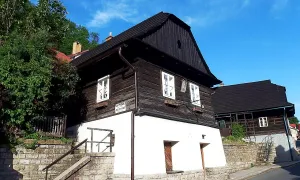
The building is a ground-floor grafted structure on a rectangular plan. The house is oriented by the gagged gouge side in parallel with the street Lower Bašta, while the side of the street Upper Bašta is walled. There is an entrance in the western front. The layout is two-piece and includes a hall and a scar. The grafting is made of cored balls with exceeding bond in corners; The building stands on a stone suspect that equalizes the slope inequality. The south front is two axes. Shields are triangular, vertically lined with slats, with two windows and a shear in the shield heel. The saddle roof covers the shindle.
More detailed records of individual owners and property fates of this house have not been preserved in available sources.
Among the key events in the modern history of the building are the construction and reconstruction of 1953. The original grafted house was registered in the Central List of Cultural Monuments of the Czech Republic before 1988.
Today, this monument serves as a representative of the original suburban development and is part of the city conservation in Štramberk. The visit to the site offers a view of the preserved form of folk construction and historical arrangement of the building between the streets of Lower and Upper Bašta.
Historical milestones
- 1558
- According to the urbarian, there were 22 houses and seven residents in the suburbs.
- End of the 18th Century
- Construction of valuable grafted building in Lower Bašta Street.
- 1855
- The Štramberk hit a big fire and burned down 40 houses.
- 1953
- Construction renewal and reconstruction of the building was carried out.
- before 1988
- House entry to the Central List of Cultural Monuments.
Architectural development
It is a ground-floor grafted structure on a rectangular floor plan, oriented by the grazed gutted side in parallel with the street Lower Bašta. The side parallel to the street of Upper Bašta is walled and the entrance to the house is located in the west front. The layout of the object is a two-piece hall with a scar, and the grafting is made of carved balls with more than a bond in the corners. The saddle roof is covered with shingles and is supplemented by triangular vertically boxed shields with slats and breaks.
Points of interest
- It is a valuable grafted structure from the end of the 18th century, which is uniquely set in the slope terrain between the streets of Upper and Lower Bašta. - The gearing of the house is made of carved balls with exceeding ties in corners and the whole building stands on a stone suspect balancing the slope inequality. - The side of the house near Upper Bašta Street is walled, while the drape side near Lower Bašta Street is grafted. - Among the key events in the modern history of the building are its construction and reconstruction from 1953.
Guide
Show guide text
This text was created by artificial intelligence and has not been editorially reviewed. It may contain inaccuracies.
Welcome to Štramberk. Right now, you're standing on Lower Bašta Street and there's a house in front of you with a descriptive number of two hundred seventy-five. Look around you and let yourself breathe the atmosphere of this unique place. This valuable monument-protected object is an integral part of the urban monument reservation and represents a wonderful example of the original suburban development which resisted the time trials.
Let's look deeper into history and imagine what it looked like here in the past. The history of this territory goes deep into the past, as evidenced by written sources. In the year 155,75, the town hall said that twenty-two houses stood in the square and seven settled lived in the suburbs. The very house you are now facing was built at the end of the eighteenth century. He grew up in space between today's Upper and Lower Bašta street, in the field, which had to be cleverly and carefully aligned.
Now, when you look straight ahead, pay attention to the unique architecture of this building. It is a valuable grafted structure, the grafting of which is made of carved balls. Note the exceeding ties in the corners, which is a typical feature of the ancient carpentry craft. This whole magnificent building is firmly on a stone suspect. It was this suspicion that was necessary to balance the significant slope inequality between the two streets in which the house's grip lies securely.
Now try to think about what this place has experienced. Štramberk has witnessed many dramatic events over the centuries. Remember, for example, the year of eighteen hundred and fifty-five, when the whole city was hit by a great and devastating fire, in which the ashes lay on forty houses. But our house resisted and remained preserved for generations to come.
The interesting thing is that although the names of creators and builders have fallen into oblivion over the centuries and remain unknown, the construction itself speaks a clear language. The house underwent the necessary reconstruction and reconstruction in nineteen hundred and fifty-three, which kept its authentic form. Its historical value was officially confirmed before the year nineteen hundred eighty eight, when it was entered into the Central List of Cultural Monuments of the Czech Republic.
We hope that stopping at this house has enriched you and brought you closer to the life of our ancestors in this formidable region. Now you can go on another discovery of the crooked streets of Strutber and perceive other magical corners of this city. We thank you for your attention and wish you a wonderful rest of the day.
Tips for visitors
The best time to visit the house number descriptive 275 and the entire street of the Lower Bašta is early morning or late afternoon. In these hours, the narrow historical streets are quieter and the sunlight beautifully highlights the structure of ancient grafted buildings. For transport to Štramberka, you can choose both car and public transport, and check the current connection in the normal connection search engine. Parking is possible on reserved weaning areas on the edge of the historical centre, from where it is a pleasant short walk up the hill. Take with you first of all comfortable fixed shoes, as the historic streets and slopes around you have uneven surface and tiles. Also remember the camera, the best shots of the grafted house can be obtained from the opposite slope of the Upper Bašta street, from where the unique folk architecture will stand out in full beauty. In the immediate vicinity within 30 minutes' walk, do not forget to visit the entire City Monument Reservation in Štramberk, which is surrounded by Lower Bašta and Upper Bašta. For families with children, this location is a great goal thanks to the adventurous nature of crooked alleys, but it is necessary to take care of the walkways and adjust the pace of walking to smaller visitors, because the terrain is sometimes steep.
Businesses nearby
Do you run a restaurant, accommodation, shop, museum, rental, wellness or other visitor service near this monument? Show yourself directly to the people heading to it — this is how they will see you in the app and on the web:
Nearby
City Monument Reservation in Štramberk, Lower Bašta street and Upper Bašta.
Accommodation nearby
Themed route
I propose a thematic cruise route that will guide you through the picturesque historical core of Štramberka.
1.Dům čp. 275 Main objective This historic house represents a unique example of popular architecture in the region and is an integral part of the picturesque character of the city. With its location and construction design it attracts admiration for traditional construction.
2. City Monument Reservation in Štramberk Ambient interest The entire historical reservation keeps a collection of rare historical buildings and curved streets with an unmistakable atmosphere. The walk through this area offers a unique view of the preserved folk development.
3. Lower Bastion Street Ambient interest This historic street is the backbone part of the monument reservation and is lined with a number of valuable grafted houses. Her visit will take you back to the past and allow you to perceive the authentic character of the old Štramberk.
4. Upper Bastion Street Ambient interest The street is connected to the ancient building of the city and offers breathtaking views of surrounding historic houses planted in the slope. Walk through this picturesque location is the ideal ending of the whole trip.
Seasonal recommendations
Spring on Štramberk awakens the surrounding nature into fresh green tones, which in combination with the historical architecture of house No. 275 create a picturesque background for peaceful walks. The sun's rays are slowly gaining strength, and early in the morning they are drawing on the facades of the fine shadows of the waking city. During this period you will not yet meet crowds of tourists, which allows you to enjoy the atmosphere without disturbing influences. Layer clothes and solid waterproof shoes are suitable for the spring discovery of monuments, as local stone pavements can be slippery after spring rains. The best time to visit is in the morning, when the city is still alive and light is ideally illuminated by the details of the building.
Summer brings to Štramberk the main tourist season full of sun, which during the day radiates the house no. 275 and creates a high contrast between light and shadow in narrow alleys. The surrounding nature is in full bloom, the air smells warm and the ancient walls emit accumulated daily energy even during lukewarm evenings. Due to the large number of visitors, early morning or late afternoon, when the sun is softening its intensity and the crowds are already thinning. For the summer tour, choose light breathable clothes, headgear and don't forget enough fluids, because climbing to the monument will check your physical condition.
Autumn transforms the entire surrounding area of house No. 275 into a colorful palette of warm colours from yellow to dark red, which gives the whole place a deep and melancholic atmosphere. The low sun creates soft side lighting during the day, which highlights the structure of the masonry and underlines the historical character of the building. The number of tourists is falling significantly, so you can enjoy quiet walks in complete peace. With the coming colder weather it is necessary to wear a warm jacket or coat, scarf and comfortable shoes in wet leaves. The ideal time for visiting is the right noon, when the temperature reaches its daily maximum and the fog from the valley is already scattered.
Winter covers the Štramberk into silence and the snow cover gives the house No. 275 a fabulous look, which stands out especially with the shortened daylight and early twilight. The lighting in the streets lights up early in the afternoon and creates warm reflections on snowy roofs and surrounding slopes. In this period you will meet only the minimum visitors, which guarantees an intimate experience of the whole location. Quality winter clothes, hats, gloves and shoes with anti-slip soles are essential because of frozen terrain. The best time for a winter trip is around noon, when the outside is warmer and daylight allows safe movement of historic stairs and slopes.
Visualizations and artistic views


The visualisations are generated by artificial intelligence and serve as inspiration.
Photos from the area
Real photos taken near the monument


Zdroj a licence jsou uvedeny u každého snímku.
Tips from visitors
No tips yet. Be the first!
Log in and add your tip.
Sources and literature
Faktickým podkladem tohoto textu byl článek na Wikipedii, jehož autory jsou přispěvatelé Wikipedie. Článek je dostupný pod licencí CC BY-SA 4.0.
Location on the map
More monuments – Štramberk
Show all in the municipality
Příběhy a pověsti
Legendy, pověsti a příběhy spjaté s touto památkou
Fotografie návštěvníků
Zatím žádné fotografie. Buďte první, kdo přidá fotografii z návštěvy!
Přihlaste se a přidejte svou fotografii nebo hodnoťte.
Za ověřenou návštěvu v aplikaci získáte víc bodů — poznáme podle GPS, že jste na místě.
Reviews and comments