






Dům čp. 411 House
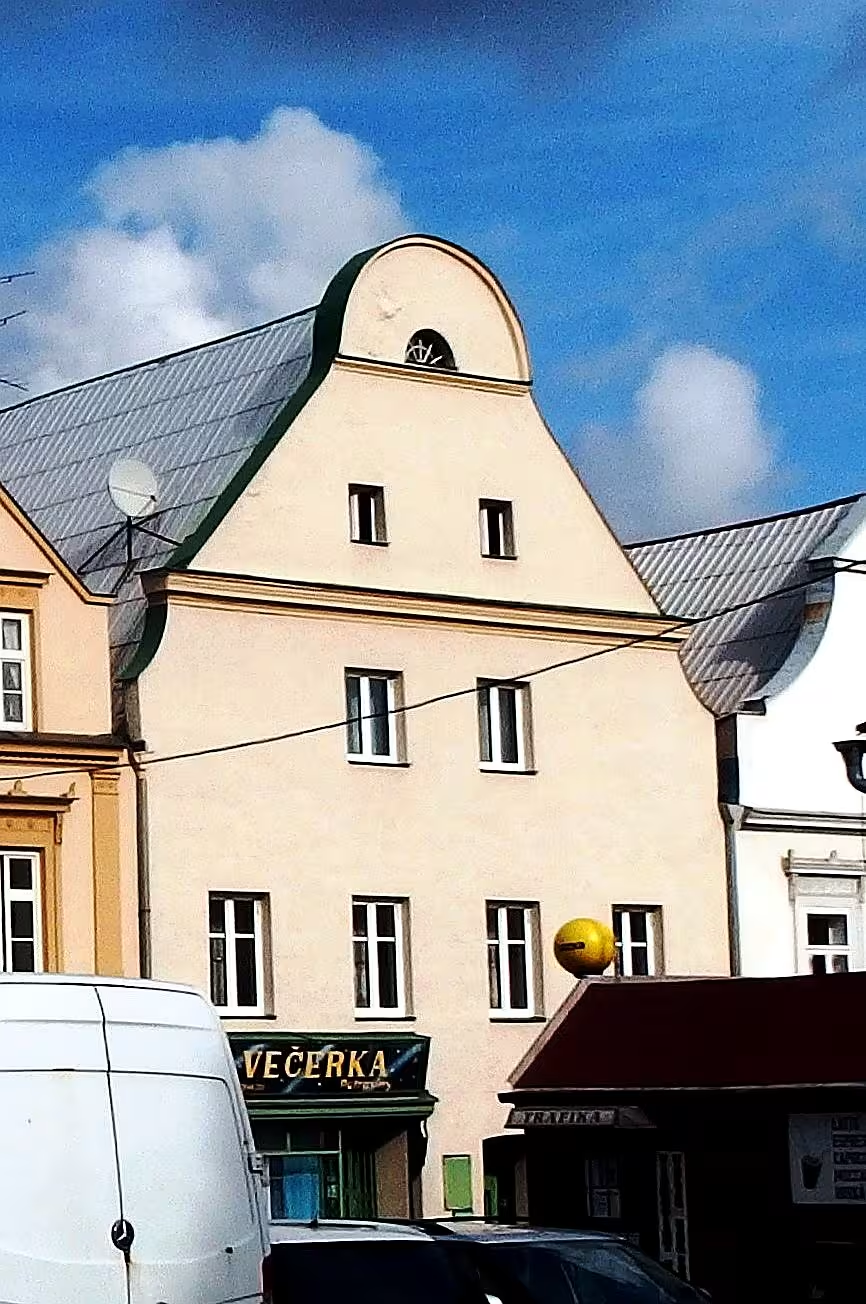
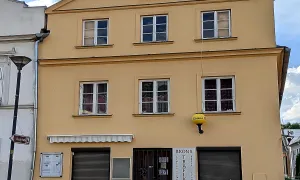
The city house no. 411 in Javorník is an empirical two-storey building registered as a cultural monument of the Czech Republic and part of the urban monument zone. The object has a very long history; It is mentioned for the first time before 1373 as part of a medieval urban development.
The history of the house was accompanied by a number of challenging events. In 1428, the building was damaged during the conquest of the city of Hussite. The building had to be gradually rebuilt after several fires between 1576 and 1603. Another big test was the fire in 1825, when 104 houses were destroyed in Javorník.
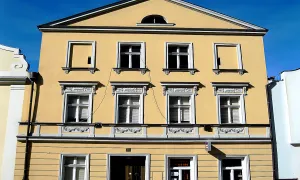
The architectural appearance of the house corresponds to a reconstruction from the second quarter of the 19th century. It is a four-axis, undercut structure on a rectangular plan with a saddle roof. The facade has a smooth plaster and is finished with a trapezoidal shield with a triangular tympanone and a ledge. There are two windows in the shield, while there is a semi-circular thermal window in the tympanone. On the ground floor there is an entrance with a segment key accompanied by shops on the sides. The first floor has four windows and the second floor has two windows. The entrance hall and the narrow corridor to the courtyard are situated in the interior, while the other rooms on the ground floor and on the floor have flat ceilings.
The fate of the house was closely linked to locals and disasters. In 1945, the building belonged to Rudolf Nierlo and the building had a shoe shop. A significant change of appearance occurred around 1980 when the original facade was destroyed and all decorative elements removed. This was originally broken down by the cordon ledge and the windows on the floors connected the lizens. There were also parapets under the windows of the second floor with plastic diamond squares decorated with masks. From these details, the atician shield with semicircular tympanone and thermal window is now preserved.
Dům čp. 411 in the district of Jeseník is a witness to the medieval and modern development of the city. Despite the loss of some details, it remains an important part of the historical core of Javorník. It is advisable to visit it as part of a tour of the urban monument zone.
Historical milestones
- before 1373
- First mention of the house as part of the medieval urban building
- 1428
- Damage to the house while conquering the city of Hussite
- 1825
- Fire in Javorník
- 1945
- There was a shoe shop in the house
- 1980
- Destruction of original facade and removal of decorative elements during repair
Architectural development
The originally medieval building was rebuilt into an empirical style in the second half of the 19th century. The original decorative facade elements were lost when repaired around 1980.
Historical events
1428: Damage in the conquest of the city of Hussite; 1825: Fire destroyed 104 houses; 1945: Operation of footwear in the house; 1980: Destroying the original facade during repair.
Owners
Rudolf Nierl (1945)
Points of interest
- First mentioned before 1373 as part of medieval urban development. - In 1428, the object was damaged during the conquest of the city of Hussite. - The building had to be gradually rebuilt after several fires between 1576 and 1603. - In 1945, the building belonged to Rudolf Nierlo and there was a shoe shop in the building. - When repaired around 1980, the original facade was destroyed and all decorative elements removed.
Guide
Show guide text
This text was created by artificial intelligence and has not been editorially reviewed. It may contain inaccuracies.
Welcome to Javorník. You're standing in front of one of those houses that carries a silent but extremely strong echo of centuries. In front of you is townhouse number four hundred eleven. Although at first sight it may seem like part of a normal urban development, its roots extend deep into the dark and golden times of our history. Feel the atmosphere of this place where each cube and each line clashes with the past. Imagine they just stopped in time. This building is not just a cluster of walls and roofs, it is a living witness to events that have shaped the whole city and our entire region.
Let us now look together at how this house came into being and what fate it had to go through. Its existence has been documented a long time ago because the first mention of it dates back to the year thirty-seventy-three. Imagine Javorník at that time, like a medieval city that was just beginning its real era. This house was already a solid part of the urban development. But history wasn't always about calm bloom and stability. This object had to face enormous trials. In a thousand and four hundred twenty-eight, during the stormy times of the religious wars, the house was damaged in the conquest of the city of Hussite. Imagine the chaos, the noise of battle and the constant fear that existed in that city. Then came another period of trials, when the fate of the city was in flames. The fires that broke out in the years one thousand five hundred seventy-six and one thousand six hundred and three were crucial breaking points for this house. Every such fire meant the need to rebuild, replan, and reseek a way to continue this place. This constant transformation, this constant search for stability again, is what gives this place its unrepeatable depth.
Now pay attention to the architecture itself, which you are now observing. What you see in front of you is the result of many layers of history that have gradually spread out. The current form of the house is empirical. This style, which dominates the building, has brought order, harmony and some nobility to the urban landscape. Look at the downstairs building. Notice the entrance that ends with a segment wedge. This arch is a very important architectural element, which gives the input elegance while acting robust and stable. Over many years, there have been various shops on this ground floor, which suggests that the house has always been the living center of urban life. It was the space where people met, where the goods were changing and where the connections between the neighbors were formed. Unfortunately, history took part of our original beauty. In the year one thousand nine hundred and eighty, an unfortunate intervention occurred during repairs, when the original facade was damaged and some decorative elements were removed. Despite this loss, the house still carries the dignity that his long history and empirical character gave him.
Let us now move on to the human destinies that are inherent in this house. Every historical building is basically just a shell, but there are people who breathe in her soul. In a thousand and nine hundred forty-five, this object belonged to Mr. Rudolf Nierlo. Imagine the time, the time of great change and uncertainty when the world around us was changing on the greatest possible scale. There was a shoe shop in this house. Imagine the smell of the skin, the sound of the lay and the everyday effort of the craftsman who made his work here. This house was not just a place of residence, it was a place of work, a place of livelihood and a place of everyday effort to make a better tomorrow. It is these small, everyday stories of craftsmen and citizens that are the true nature of this place.
The interesting thing that can make you look at this house in a different way is its incredible ability to survive. Think about how many generations of people have walked through this door. From the medieval people who had to face the dangers of the times of Hussite wars, to the inhabitants of the great fires, to the craftsmen of the mid-twentieth century. This house survived everything. He survived the war, he survived the fiery destruction, and the modern repairs that took away some details, but they didn't help his essence. It's a fascinating continuum that teaches us how fleeting human life is compared to the stone matter that remains and that watches us from every century. There's something mysterious about it that even after so many trials, it still stands here as a fixed point in a constantly changing world.
Now that you've learned the basics and stories of this house, I suggest you continue your walk with Javorník. Every building in this city has its own unique speech and every street can lead to another secret. Don't forget to stop by the other sights and see every clue left in this town last century. Thank you for spending this moment at house number four and eleven. We wish you a beautiful and inspiring journey along the historic paths of our city.
Tips for visitors
The best time to visit the City Monument Zone Javorník, including the townhouse No. 411, is the period from spring to autumn. In these months, pleasant temperatures and beautiful lighting conditions are used to photograph historic buildings in optimal sunlight.
Parking can be found near the sights, but we recommend the use of public transport for easier access to the city centre. Check the current connection and availability of parking lots before visiting the online search engine.
When planning a visit, remember a suitable suit, especially if you visit a monument in winter. It is also important to have a camera or mobile phone with you to capture the beauty of historical buildings and surrounding environments.
Photography of the City Monument Zone offers several interesting perspectives. The best light for photos appears in early morning or late afternoon, when the sun is lower in the sky and illuminates buildings with fine shadows.
In the vicinity of the City Monument Zone Javorník there are several interesting places that can be visited within one day. We recommend exploring other historical buildings and architectural monuments in the city centre, which are easily accessible by foot.
Businesses nearby
Do you run a restaurant, accommodation, shop, museum, rental, wellness or other visitor service near this monument? Show yourself directly to the people heading to it — this is how they will see you in the app and on the web:
Nearby
City monument zone Javorník.
Accommodation nearby
Themed route
Thematic cruise route Urban monument zone Javorník
1.Dům čp. 411 - Type: Historical residential houses - Why is it worth visiting: This house is a typical example of architecture from when the city of Javorník developed. Its history and construction reflect the lifestyle of people in the past.
2. Old Town Hall - Type: Historical administrative object - Why is it worth visiting: Old Town Hall is one of the oldest and most important historical buildings in Javorník. It is interesting in its architecture and rich history, which is reflected in building elements.
3. Church of the Assumption of the Virgin Mary - Type: Cultural landmark - Why is it worth visiting: This church is the centre of spiritual life in Javorník and attracts attention with its historical value and beautiful interior. It's a place where you can feel the atmosphere of past times.
4. Monument in the Square - Type: Memorial statue - Why is it worth visiting: Visiting the monument offers a view of the historical events that shaped the city. It's a place for quiet reflection and reverence of the past.
5. Historical Brewery - Type: Cultural landmark - Why is it worth a visit: The brewery is not only a historical monument, but also a place to explore the traditions of the beer shop in Javorník. It offers the opportunity to enjoy beer prepared according to ancient recipes.
This route offers visitors a comprehensive view of the historical and cultural richness of the City Monument Zone Javorník.
Seasonal recommendations
Spring in Javorník brings awakening nature, which surrounds house no. 411. The light is softer during this period and longer days allow longer walks around. The atmosphere is calm and full of expectations, ideal for those who seek privacy and silence. Practical advice includes layered clothing because spring weather is usually variable and temperatures may vary significantly during the day. The best time to visit is in the morning when there are fewer people and the light is ideal for photography. Avoid weekends if you want to have a memorial almost to yourself.
Summer is the hottest and most lively period, when the surrounding area of house No. 411 is full of green and flowers. Long days offer maximum time to explore historical details and surrounding paths. The atmosphere is energetic and sunny, which creates a pleasant environment for longer stays outside. Practical advice focuses on sun and thirst protection, so don't forget your hat, sunglasses and enough drinking mode. There are more visitors in the main summer season, so it is best to come as soon as possible in the morning to avoid the biggest crowds and heat.
Autumn at Javorník offers unique colour of leaves, which provides historical building no. 411 romantic and melancholic character. The light is warmer and golden, which highlights the architectural elements of the house. The atmosphere is calmer than summer, and the cooler air brings a sense of freedom. Practical advice includes layered clothes with an emphasis on heat because evenings are rapidly cooling. The best time to visit is the late afternoon when the light is the most beautiful and the crowds are already smaller. This period is ideal for lovers of photography and peaceful walks.
Winter in Javorník brings a quiet and snowy atmosphere that surrounds house no. 411. Short days and low sun create dramatic shadows and cold, sharp light. The atmosphere is intimate and soothing, ideal for those who seek escape from the rush. Practical advice focuses on warm clothing, including gloves and scarf, and on careful behaviour on slippery surfaces. The opening hours may be shorter in winter, so check the current information in advance. The best time to visit is noon, when it is warmer and most light, despite short days.
Visualizations and artistic views


The visualisations are generated by artificial intelligence and serve as inspiration.
Photos from the area
Real photos taken near the monument

Zdroj a licence jsou uvedeny u každého snímku.
Tips from visitors
No tips yet. Be the first!
Log in and add your tip.
Sources and literature
Fotografie: Palickap / CC BY-SA 4.0 — Wikimedia Commons. The author and licence also appear when you hover over the image.
Faktickým podkladem tohoto textu byl článek na Wikipedii, jehož autory jsou přispěvatelé Wikipedie. Článek je dostupný pod licencí CC BY-SA 4.0.
Location on the map
More monuments – Javorník
Show all in the municipality
Příběhy a pověsti
Legendy, pověsti a příběhy spjaté s touto památkou
Fotografie návštěvníků
Zatím žádné fotografie. Buďte první, kdo přidá fotografii z návštěvy!
Přihlaste se a přidejte svou fotografii nebo hodnoťte.
Za ověřenou návštěvu v aplikaci získáte víc bodů — poznáme podle GPS, že jste na místě.
Reviews and comments