






Dům čp. 410 House
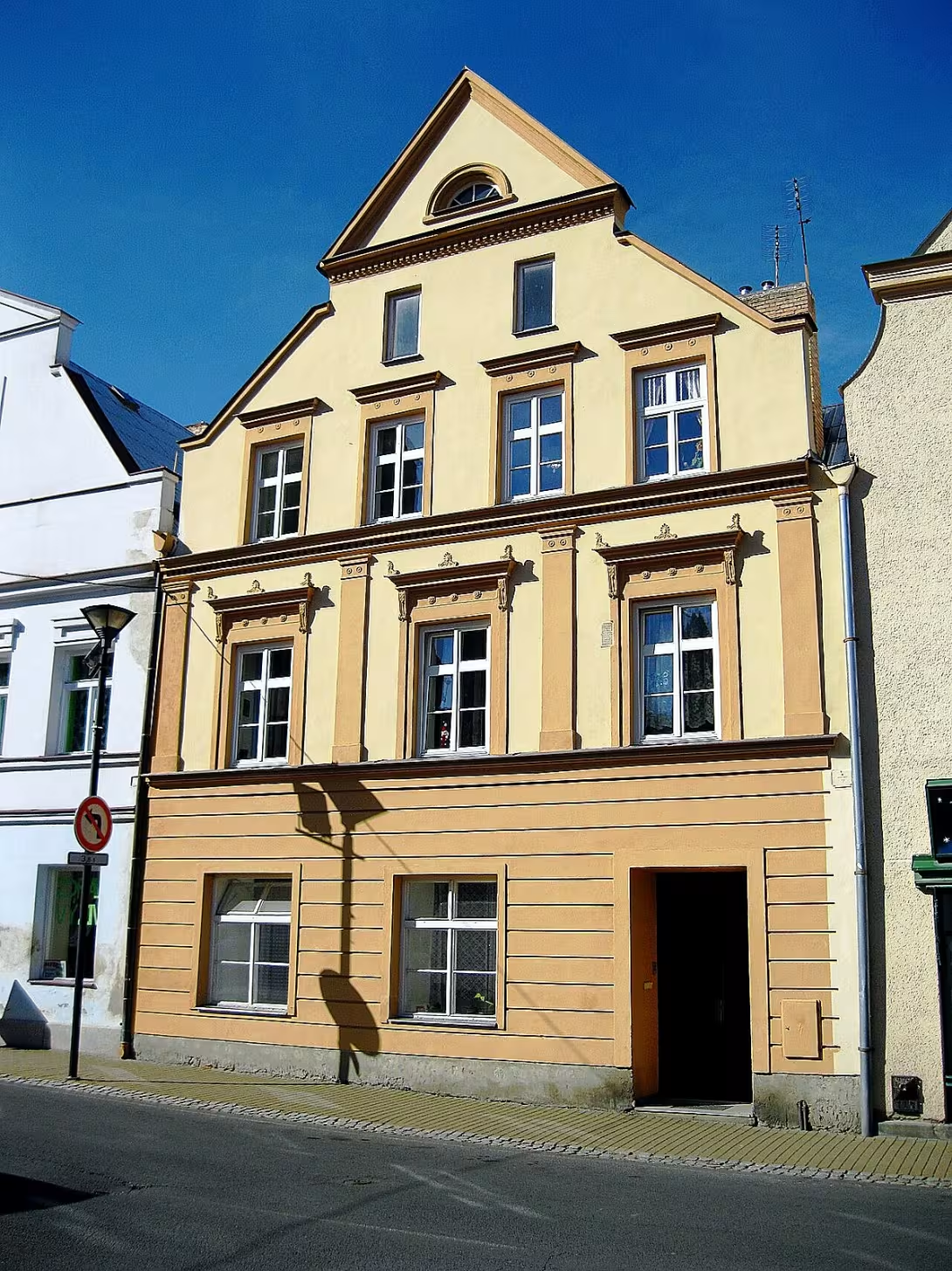
The city house No. 410 in Javorník is an empirical one-story building with a history dating back to the 14th century. It is part of the city monument zone and registered as a cultural monument of the Czech Republic.
The first mention of the house within the city's medieval building dates back to 1373. Over the centuries, it has repeatedly been damaged by various disasters, including the Hussite conquest of the city in 1428. After the fires in 1576 and 1603, as well as after the massive fire in 1825, when 104 houses were destroyed, the house went through several reconstructions. In the second quarter of the 19th century, the Baroque core of the building was rebuilt into the contemporary Empire style.
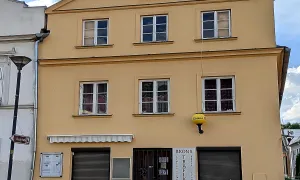
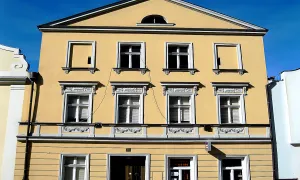
The current form of the construction is single storey with a rectangular ground plan, three axis and underpane. The street shield facade is divided by the cordon and the main profiled ledge, and the ground floor is decorated with belt brass. In the right part of the ground floor there is an entrance and on the left are two rectangular windows. The floor is decorated with pilasters, suprafenstrami and an ongoing ledge. The wall of the building ends with a triangular tympanone with an orbital ledge in which a semi-circular window is located. There are two rows of rectangular windows in the shield; in the first place, four windows with stucco frames and two more above. The roof is saddle.
The interior of the house contains various types of vaults. There are three arches in the entrance corridor on the ground floor. The entrance to the spiral staircase to the floor is covered with a vaulted vault, as well as a corridor leading into the yard. The rooms on the ground floor and on the floor have flat ceilings.
In 1945, the house belonged to the butcher's master Karl Felkel. A reconstruction took place in 1984, which included the reconstruction of the facade.
Dům čp. 410 is an important part of Javorníka in Jeseník county. Its architecture and history reflect the long-term development of the city and its reaction to historical events, making the object an interesting witness of urban life from the Middle Ages to the present.
Historical milestones
- 1373
- First mention within the city medieval building
- 1428
- Damage to the house while conquering the city of Hussite
- 1984
- Reconstruction of the house including facade
Architectural development
Originally a medieval building underwent numerous reconstructions after fires and floods. In the second quarter of the 19th century, the baroque core was rebuilt into the contemporary Empire style.
Historical events
1373: First mention in urban development; 1428: Damage in the conquest of the city of Hussite; 1984: Reconstruction of the house including facade.
Owners
Karel Felkel (1945)
Points of interest
- The townhouse No. 410 in Javorník is an empire one-story building with a history dating back to the 14th century.
- The first mention of the house dates back to 1373 and was repeatedly damaged by various disasters, including Hussite conquest of the city in 1428.
- After the fires in 1576, 1603 and 1825, the house went through several reconstructions. In the second quarter of the 19th century, the Baroque core of the building was rebuilt into the contemporary Empire style.
- The current form of the construction is one-storey with a rectangular plan, three-axis and underglass. The street shield facade is divided by the cordon and main profiled ledge.
- The interior of the house contains various types of vaults, including three fields of cross vaults in the entrance corridor of the ground floor.
Guide
Show guide text
This text was created by artificial intelligence and has not been editorially reviewed. It may contain inaccuracies.
Welcome to Javorník. You're standing in front of one of those houses that carries a lot more than walls, roof and windows. You are in the very heart of the city monument zone, in a place where every alley and every stone tries to tell the story of the people who lived here, worked and dreamed. In front of your eyes is townhouse 410. At first glance, you may be interested in his calm and balanced form. It's a one-story building with a rectangular floor plan that looks very dignified. Its appearance is typical of the style of Empire, which brought to this place a sense of order, elegance and stability. Feel the atmosphere - this house is not only a part of the street, it is a silent witness to hundreds of years of transformation that the city of Javorník has experienced.
But let's move further into time together to understand how deep the roots of this building are. Although it may seem relatively modern to you, its true history dates back to the 14th century. This is an incredible dimension of duration. The first written mention of this place dates back to 1373. Imagine the world back then, the medieval city that was just forming, and this house that was already standing firmly in the city building. Since then, however, the journey of this house has not always been a peaceful course of years. He had to face both uncertainty and tragedy. In 1428, at a time when Europe was shaken in the foundations of religious and political conflicts, the house was damaged in the conquest of the city of Hussite. It was a tough time for every house to survive.
Now that you know his age and his resilience, pay attention to what's right in front of you. Look at his facade. Although the construction is easier, its architecture is rich in details that give the house character. Notice the vertical elements that decorate the wall. They're pilasters that look like columns and give the facade rhythm and grandeur. Then look at the windows. Above them you will find interesting decorative elements, so called suprafenstra. These decorations above window openings are not only an aesthetic element, but create the impression of richness and careful processing. And if you raise your sight even higher, to the top of the shield, you'll see a triangle tympanone. This geometric element is a typical feature of classical style and gives the house its final, balanced form.
Even though you are now looking at the outer walls, the house also contains internal treasures, which can only be seen by looking at its structure. On the ground floor there are cross vaults which are a symbol of strength and historical continuity. Imagine the spaces that were made up of these vaults, and a spiral staircase that probably connected the different levels of this house in elegant and smooth motion. This whole look that we see today is the result of many processes. The house was going through constant changes so that it could still serve its inhabitants. One of the important stages was the reconstruction in 1984, which included the reconstruction of the facade, which makes you look forward to its present, beautiful appearance today.
However, each such house is also associated with specific names. The name Karl Felkla appears in the history of this object. Although it may not seem at first sight how closely it is connected to this building, it is the human destinies and personalities that have worked or been associated with these premises that give the place real life. The house is not just a sum of stone and mortar, it is a vessel for human lives, their joy and their misfortune.
If we're looking for something that might really interest you, it's this incredible ability to survive this house. History is full of disasters that have repeatedly tried to destroy this object in Javorník. The house had to face the devastating fires that have hit the city several times in the past. This happened in 1576, 1603 and again in 1825. Imagine the power of fire and the fear it must have caused in humans. Yet, every time, the house was raised again, repaired again, and offered refuge to its inhabitants. This ability to resist time, wars and elements is perhaps the greatest mystery and at the same time the greatest force in this place. It's a symbol of endurance that you still feel in him.
Now that you've been through his history and architectural details, I suggest you continue your walk around the city's monument zone. Javorník has many other secrets and beauty waiting for you. Let yourself drift through the atmosphere of these streets and look around you with the same interest you've been looking at this house with. Thank you for spending this moment with us. We will brighten you with a pleasant further discovery of this historic city.
Tips for visitors
The best time to visit the city monument zone Javorník, including Dům čp. 410, is spring and autumn. In these months, the shadows of the building are projected on the street in the most beautiful light, which increases the aesthetic value of the photograph. Moreover, the temperature is pleasant and usually not too many tourists.
Parking for visitors Dům čp. 410 can be found near the sights, especially on the streets of the surrounding area. For those who prefer public transport, it is possible to use bus or train connections up to the nearest station in Javorník. We recommend checking the current route information before departure.
When visiting the city monument zone, it is advisable to bring with you shoes or shoes suitable for walking on stone sidewalks. You could also bring a camera, especially if you like architectural details and historical buildings. Don't forget about the sun protection if you plan to be out longer.
For shooting Dům čp. 410 is the best place from the street, especially at noon when light illuminates the pillars and suprafensters. If you have the option, try shooting in the afternoon when the light is softer and the shadows have different dynamics.
In the vicinity of Dům čp. 410 you can visit other historical monuments within the city monument zone Javorník. For families with children it is suitable to visit nearby parks where children can play and explore nature. In addition, there is a restaurant nearby where you can relax and restore your strength after the tour.
Businesses nearby
Do you run a restaurant, accommodation, shop, museum, rental, wellness or other visitor service near this monument? Show yourself directly to the people heading to it — this is how they will see you in the app and on the web:
Nearby
City monument zone Javorník.
Accommodation nearby
Themed route
1. City Monument Zone Javorník (Type: Historical Territory) - The beginning of the route in an environment that surrounds you with its historic construction. 2. City Monument Zone Javorník (Type: Architectural Space) - Exploration of details and alleys that define the character of this monument area. 3. Dům čp. 410 (Type: Building) - The main destination of the trip, which represents a particular example of the built-up territory in this zone.
Seasonal recommendations
Spring - After winter sleep House No. 410 will be wrapped in a fine dawn when the sun's rays penetrate between blooming willows and the first petals. The air is fresh, the smell of flowers and humidity underlines the historic atmosphere. We recommend arriving early in the morning when fewer visitors and light best highlight architectural details. Dress in a layer - a light jacket or sweater will protect you from a colder morning, but it will not overheat you during the afternoon sun.
Summer - In the summer months House No. 410 spreads out in the light of the high sun, creating contrasts between the shadow of stone walls and the golden light on the terrace. The surrounding forests are lush green and the birds accompany the walk with their singing. The main summer season is the biggest attendance, therefore it is convenient to arrive after noon or after the evening when the crowds disperse. Light clothing, sunglasses and sunscreen are essential; Remember the comfortable shoes, because the roads to the monument are partly rocky.
Autumn - Autumn light in House No. 410 has a golden touch, the leaves of trees turn into orange and red tones, which gives the place nostalgic character. Colder weather brings a quieter atmosphere and smaller crowds. It is ideal to plan a visit during afternoon hours when the sun still illuminates the facade, but temperatures are pleasant. We recommend layered clothing - sweater or light jacket, or scarf, and firm shoes, because the leaves can be slippery on the paths.
Winter - In winter House No. 410 will turn into a quiet hiding place under the snow cover; The weakening sunlight creates soft shadows and stone walls gain cool shine. The opening hours are shorter and the visitors are less, which allows you to focus on the interior details. Come during the morning when there is still enough light, but the crowds are minimal. Dress warm - winter coat, hat, gloves and waterproof shoes as the pavement can be snowy or icy.
Visualizations and artistic views


The visualisations are generated by artificial intelligence and serve as inspiration.
Photos from the area
Real photos taken near the monument

Zdroj a licence jsou uvedeny u každého snímku.
Tips from visitors
No tips yet. Be the first!
Log in and add your tip.
Sources and literature
Fotografie: Lehotsky / CC BY-SA 3.0 — Wikimedia Commons. The author and licence also appear when you hover over the image.
Faktickým podkladem tohoto textu byl článek na Wikipedii, jehož autory jsou přispěvatelé Wikipedie. Článek je dostupný pod licencí CC BY-SA 4.0.
Location on the map
More monuments – Javorník
Show all in the municipality
Příběhy a pověsti
Legendy, pověsti a příběhy spjaté s touto památkou
Fotografie návštěvníků
Zatím žádné fotografie. Buďte první, kdo přidá fotografii z návštěvy!
Přihlaste se a přidejte svou fotografii nebo hodnoťte.
Za ověřenou návštěvu v aplikaci získáte víc bodů — poznáme podle GPS, že jste na místě.
Reviews and comments