



Dům čp. 5 House
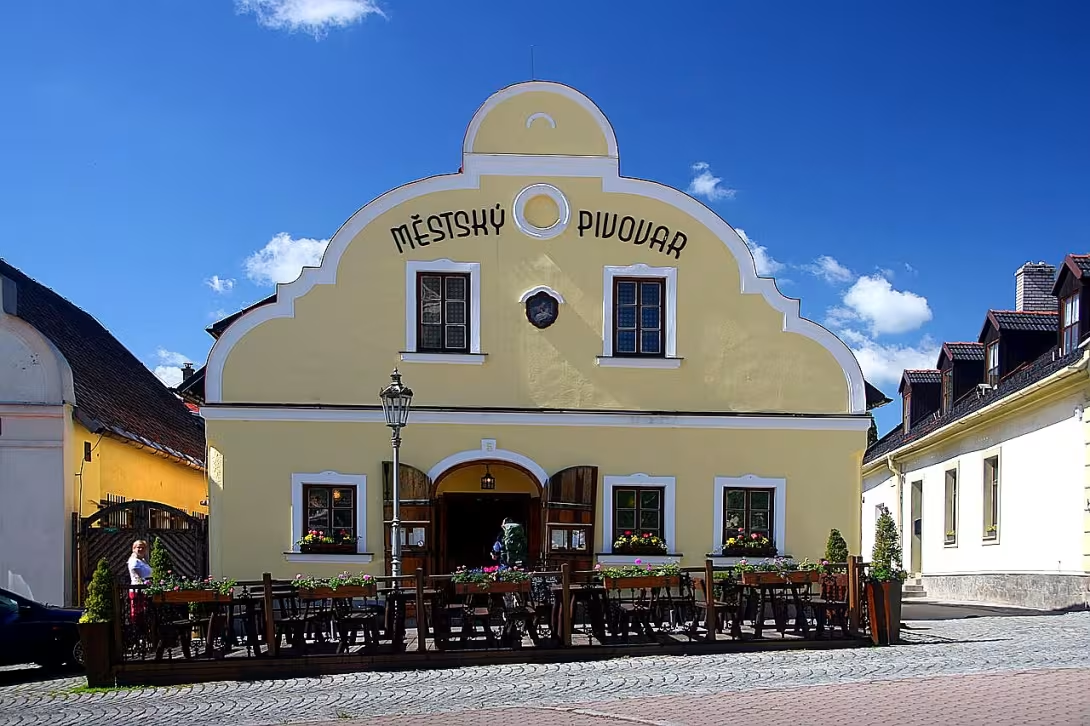
Dům čp. 5 is an object in the style of historism, which serves as a city brewery. Located on the square in the village Štramberk in the district of Nové Jicin. The building is registered in the Central List of Cultural Monuments of the Czech Republic and forms part of the monument reservation.
The first written record of the construction dates back to 1614, when it is listed as the property of Pavel Honko. Originally, it was a grafted house, which was rebuilt into a brick at the end of the 18th century. Since 1771, he was held by the township Martin Baar. His family owned the property until the early 19th century when Tomas Prosek bought it. Later, a branch of Raiffeisen Bank set up several apartments. Since the nineties of the 20th century, the house was owned by the husband and wife of Jiříček, who ran the restaurant there. At the beginning of the 21st century, it was acquired by the husband and wife of Šmír.
The building design of the building has undergone some major changes. In the middle of the 19th century, the house was connected to the neighbouring house no. 6 using the empirical attics floor. The conundrum between the buildings connected the wall with the doors, and there was a blind window on the floor. The front facing the square was four-axis with a profiled cordon and a post-date ledge. There were three tile windows and an entrance on the ground floor. The atic floor showed two pairs of blind windows with shutters and mantelpiece.
In the twentieth years of the 20th century, there was the opening of the catwalk and the reconstruction of the facade into the style of Czech novobarok. The basic structure was preserved, but the shield was modified into a baroque form. It is divided by two rectangular windows in the shambles and at the highest point by one oval blind window. The Volute Shield is surrounded by a line and carried a stucco inscription of the City PIVOVAR. The roof is saddled with skylights. In the building are preserved stone vaulted cellars and two wells carved directly in the rock.
The house is currently located in a small home brewery after reconstruction. The building represents an important element of the architecture of the Šmberg Square and a demonstration of the layering of different styles from the Empire to the Novobaroko. Visiting this place offers the opportunity to see authentic elements of historical buildings and unique rock wells.
Historical milestones
- 1614
- First written record of the owner of Pavel Honko's house.
- 1771
- Martin Baar became the owner of the house.
- 1920
- Modification of the facade of the house into the form of a Czech novobarok.
Architectural development
The originally grafted house was walled at the end of the 18th century and in the middle of the 19th century it was supplemented with an empirical atic floor. In the 1920s, the facade and shield were adapted to the style of Czech novobarok. In the building are preserved stone vaulted cellars and two wells carved in the rock.
Historical events
1614: first written record of the house, 1771: taking over the house Martin Baar, 20th century: setting up the home brewery after reconstruction
Owners
Pavel Honek (1614), Martin Baar (from 1771), Tomáš Prosek (early 19th century), Bank Raiffeisen, married to Jiříček (since the 1990s), married to Šmír (early 21st century)
Points of interest
- The building serves as a city brewery and is listed in the list of cultural monuments. - The first record of the construction is from 1614, when it was grafted, and later it was rebuilt into a masonry. - In the middle of the 19th century, the house was connected to the neighboring house using an empirical-style floor. - The facade was later modified into the style of Czech novobaroka with a volute shield. - In the building are preserved stone vaulted cellars and two wells carved in the rock.
Guide
Show guide text
This text was created by artificial intelligence and has not been editorially reviewed. It may contain inaccuracies.
Welcome to Štramberk, where history is inserted into every stone and every wooden beam. Right now, you're standing in front of a house with number five, which is a solid and important part of the local monument reservation. If you look at it, you'll see a building that has layers of centuries in it. It's where the craft tradition meets the architectural taste of different times. Currently, there is a small domestic brewery in these walls, which gives the whole place a special, cozy atmosphere. It is a building that is not just an ordinary house, but is officially registered in the Central List of Cultural Monuments of the Czech Republic, which shows its value to all of us.
Now let's go back in time together to understand how this object evolved. Imagine you're standing in this same place, but it's six hundred and fourteen. It is this year that the first written record of the owner of this house, which was a man named Pavel Honka, comes from. At the time, the house looked quite different than you see it today. There were no walls, but there was a typical grafted structure made of wood that was common at the time. The plastered houses spoke of simplicity and proximity to the nature from which the material was taken. Over time, however, the needs of the people have changed and the appearance of the house with them. The wood gradually retreated to stones and bricks, so the construction was converted into a masonry that gave it greater stability and resistance to time.
Now pay attention to the architecture itself and to what you see right in front of you. Look carefully at the front of the house. What you are seeing today is the result of the adjustments of nine hundred and twenty. During this period, the facade was adapted to the appearance of Czech novobarok. Note the details that are typical of this style. Novobaroko tried to revive the pomp and playfulness of an earlier baroque, but with a modern feeling. The facade has thus acquired its specific character, which dominates the entire appearance of the building and gives it some nobility that contrasts with its original grafted history. It is fascinating to think that beneath this elegant brick layer is the memory of an old grafted house from the beginning of the seventeenth century.
When we talk about the people who lived here, we can't miss a year of seven hundred seventy-one. At that time, Martin Baar became the owner of the house, which was known in the town as a beanbag town. Imagine what life was like in this house. The Shenkovnik was a person around whom people gathered to share news from the surroundings and where socialism was cultivated. It is very symbolic that the house that once belonged to the beaner again serves to produce and sell beer as a city brewery. The history of this is closed to the circle and the tradition of hospitality in this house persists for hundreds of years.
Allow me to interest you now in one interesting thing concerning the very layout of the building. If you look at the overall composition, you may not realize that the house has undergone a very interesting change in the mid-nineteenth century. At that time, this house was connected to the neighboring house using a floor. What is truly remarkable, however, is the style of this connecting element. The floor was brought out in empirical style, which was the direction that brought to the architecture a cleaner line and inspiration from the ancient. So imagine this fascinating blend of styles in one place: from the original grafted structure to the Empire connection to the neo-Baroque facade. It's like reading a book about the history of architecture where each chapter is represented by a different building element.
This building shows how the city of Štramberk evolved. It's not just a static object, it's a living organism that's adapted to new times. From Pavel Honka to Martin Baar to today's craft breeders who maintain tradition here. The fact that the house is registered as a cultural monument reminds us that it is important to protect these traces of the past so that they can tell their stories to future generations.
Now that you know the story of house number five, I suggest you take a moment in silence to perceive the atmosphere of this place. Notice how the neo-Baroque elements of the lams with the surrounding environment of the monument reservation. You may be tempted by the smell of the brewery, which reminds you that history is not only in stones, but also in tastes and crafts.
I wish you a pleasant continuation of your trip Štramberk. Explore other narrow streets and discover the secrets that these beautiful little towns hide within themselves. Thank you for your attention and I wish you a beautiful day of new discoveries. This concludes the stop at the city brewery and now you can follow other historical clues.
Tips for visitors
The building serves as a city brewery, so it is pleasant to visit it at a time when there is a lively atmosphere.
You can reach the village Štramberk by car or public transport; Check the exact transport options and the location for vehicle postponement in local guides or search engines. We recommend taking comfortable shoes suitable for walking through the historical centre.
For the best photos we recommend to come in the morning or late afternoon light, which highlights the details of the walled walls and the grafted history of the house. The best angles for images are from the square space, from where the building is seen in the context of the surrounding development.
Families with children appreciate walking through the square and observing architecture.
Frequently asked questions
Can the monument be visited?
This is a residential or farm building, not a museum with opening hours. Please view it from public space and respect the owners' privacy. We have no information about access to the interior.
Where is the monument?
Location: Štramberk. The map on this page shows the exact spot.
Why is the monument protected?
It is listed in the Central List of Cultural Monuments of the Czech Republic as a cultural monument (register no. 1000122539).
Businesses nearby
Do you run a restaurant, accommodation, shop, museum, rental, wellness or other visitor service near this monument? Show yourself directly to the people heading to it — this is how they will see you in the app and on the web:
Nearby
Památka se nachází na Náměstí v obci Štramberk, která je známá svou památkovou rezervací.
Accommodation nearby
Themed route
Here is the design of the thematic route:
1. Square (public) - The starting point of the road where you can perceive the atmosphere of the historical center of the village. 2. Dům čp. 5 (monument) - The main objective of the visit, which represents an important architectural element in the area. 3. Monumental booking (protected zone) ($\ approx $in the immediate surroundings) - Walk through historic streets that are known for their unique character and preserved housing.
Seasonal recommendations
In spring, the surroundings of the house are awakened to live colours and fresh greenery. The soft spring light highlights the details of the facade that looks fresh after winter. We recommend shoes suitable for humid terrain and light jacket because morning and evening air in the hilly Štramberk is still cold.
In the summer months the atmosphere of heat and bright sun dominates the walls of the building at a sharp angle. Everything around the house is in full bloom and the air smells of summer dust and gardens. The best thing is to come in the early hours of the morning when the least people and temperatures are tolerable. Don't forget the hat and plenty of water.
Autumn brings golden and red shades of leaves to the surroundings, creating a nostalgic background to view the house from the outside. Light is golden and milder in this period, which is ideal for photography architecture. It is suitable for layered clothing and fixed footwear that does not slip on wet leaves.
In winter, the construction works calmly and quietly, often accompanied by a cold mist or snow cover. The atmosphere is quiet and raw, typical of mountain areas. Hot winter clothing, gloves and tight shoes with anti-slip soles are essential for the visit to make the movement around the house safe.
Visualizations and artistic views

The visualisations are generated by artificial intelligence and serve as inspiration.
Photos from the area
Real photos taken near the monument


Zdroj a licence jsou uvedeny u každého snímku.
Tips from visitors
No tips yet. Be the first!
Log in and add your tip.
Sources and literature
Photos: Kankovaa / CC BY-SA 4.0 — Wikimedia Commons. The author and licence also appear when you hover over the image.
Faktickým podkladem tohoto textu byl článek na Wikipedii, jehož autory jsou přispěvatelé Wikipedie. Článek je dostupný pod licencí CC BY-SA 4.0.
Location on the map
More monuments – Štramberk
Show all in the municipality
Příběhy a pověsti
Legendy, pověsti a příběhy spjaté s touto památkou
Fotografie návštěvníků
Zatím žádné fotografie. Buďte první, kdo přidá fotografii z návštěvy!
Log in a přidejte svou fotografii nebo hodnoťte.
Za ověřenou návštěvu v aplikaci získáte víc bodů — poznáme podle GPS, že jste na místě.
Reviews and comments