






Dům čp. 75 House
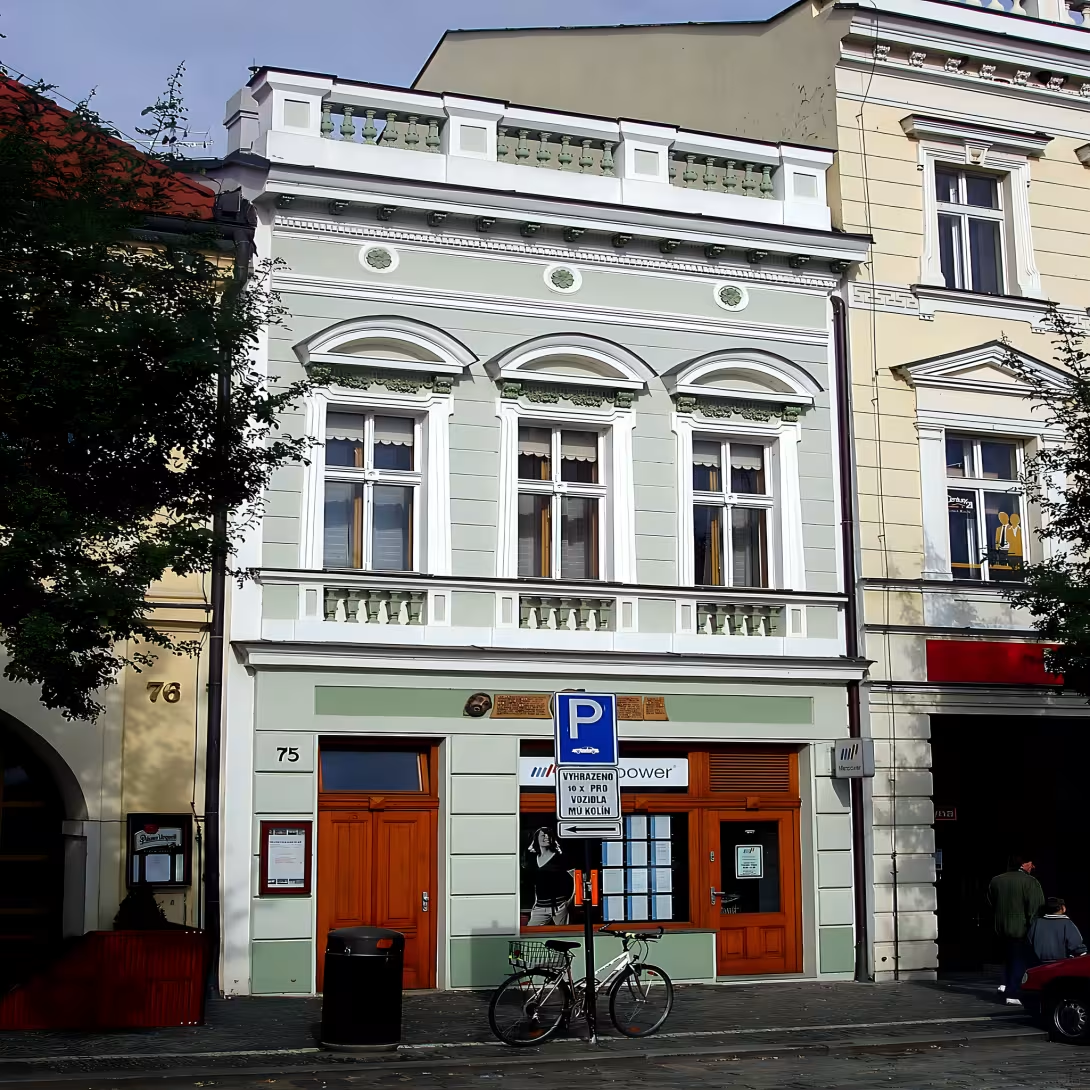
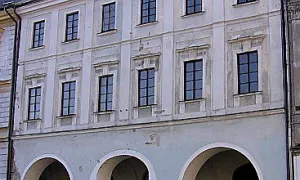
Dům čp. 75 is a one-storey townhouse on the north side of Charles Square in Cologne. The building is registered as a cultural monument and combines Gothic foundations, Baroque adaptations from the 18th century and later eclectic elements.
The original Gothic house was built on a narrow plot. Historical sources demonstrate its existence in the 15th century. In 1494 it was owned by the widow Maruška Kramářka and in 1512 it was inherited by Martin Potřič. Over the centuries the house was often changed by owners, including Jan Herzán, Michal Jiří Salaj of Cifra, miller Marek Skokan or since 1660 Jan Šilhanek of Choustník and his descendants. The basic Baroque reconstruction was initiated after 1749 by the then owner Dominik Tumliř of Borca. He had the facade decorated with a high shield with a niche and a statue of the Virgin Mary. This family held the house until 1858.
The architectural representation of the house today is largely eclectic. The facade on the floor breaks three window axes with profiled shamrans, parapets with blind balustradoes and segmented frontons decorated with stucco consoles and garlands. The upper part of the facade consists of the indicated half-floor with a mould and rosettes. It ends with a plastic-shaped main ledge with a tooth cut and illusory stucco croquets. The whole composition is finished by a bowling ball. The layout includes a front with a saddle roof and a rear wing with a flat roof, surrounded by a narrow rectangular courtyard. In the interior there were preserved rolled and segmented vaults, flat ceilings on the floor and a rolled vaults in one room with two-sided intersections.
The inner spaces reflect a long history of construction. The corridor on the ground floor is encapsulated with a compressed vault and leads to a stone spiral staircase with cast-iron railing of the historic ornament. The basement spaces towards the square are partially cut into a rock and partly lined with quarry stone; The original medieval portal was preserved here. In the 19th century the house went through other modifications. In 1881, for example, a baroque shield with a niche and a statue of the Virgin Mary was demolished. In later decades, the ground floor served various purposes, from Kocver's cafe to the drug trade to the sausage store, which worked here until 1991.
The history of the building is today reminiscent of the ceramic plate from artist Pavel Rajdle, located on the facade in 2004. The 250-by-30 centimeter plate shows the history of the house and refers to the original home sign in the form of the statue of the Virgin Mary.
Dům čp. 75 is a valuable document of the construction development of the Cologne Square, where medieval foundations, Baroque reconstruction and eclectic decoration meet in one matter. Visiting this place offers an opportunity to see the changes of urban architecture, which, despite numerous modifications over the centuries, has preserved its historical essence.
Historical milestones
- 1494
- The widow Maruška Kramařka owned the house
- 1512
- Martin the Butcher inherited the house
- 1621
- Jan Herzán owned the house
- 1660
- Jan Šilhánek from Choustník owned the house
- 1749
- Dominik Tumliř of the Borca had the house rebuilt baroque
- 1881
- Baroque shield with niche and statue of the Virgin Mary was torn down
Architectural development
Originally a Gothic house, built on a narrow parcel, was later rebuilt baroque and its facade decorated with a high shield with a niche with a statue of the Virgin Mary.
Owners
Widow Maruška Kramářka, Martin Pošič, Jan Herzán, Michal Jiří Salaj from Cifra, Marek Skok, Jan Šilhánek from Choustník, Dominik Tumliř from Bork
Points of interest
- The house combines Gothic foundations, Baroque adaptations from the 18th century and later eclectic elements. The existence of the building is documented in the 15th century. - The basement spaces towards the square are partially cut into the rock and partly plastered from the quarry stone while the original medieval portal is preserved. - In 1881 the baroque shield was demolished, which was originally decorated with the niche and statue of the Virgin Mary. - On the ground floor of the house in the past there was a cafe, a drugist shop and a sausage shop that was in operation until 1991. - Since 2004, there is a ceramic plate from artist Pavel Rajdle, which shows the history of the house and refers to the original home sign.
Guide
Show guide text
This text was created by artificial intelligence and has not been editorially reviewed. It may contain inaccuracies.
Welcome to Cologne, a city where history is not only in books, but carved into every stone and written in every facade. Right now, you're standing in front of a house with a number of seven and a half. Stop for a moment, take a breath and just feel the atmosphere of this place. In front of you is a building that acts at first sight as a harmonious whole, but in fact it is a fascinating layered record of several centuries. Look at his facade. What you see is a so-called eclectic style, which means that the house combines elements from different periods and directions. Note how the floor is divided into three window axes that give the facade a certain order and balance. It's a home that has seen the coming of the Renaissance, baroque pomp and later modifications, and it's all today.
Let us now return together in time, deep into the past, so that the house can tell us its story. The existence of this building is documented in the fifth century, which makes it one of the silent witnesses to the early development of the city. The first name that ties to this place is the widow of Maruska Kramařka, who owned the house in the year four hundred and ninety-four. Imagine what Kolín looked like at the time, what sounds were heard in the streets and what the role of such a house was in the community at the time. A little later, in the year three hundred and twelve, the house came into the hands of Martin the Butcher who inherited it. Each of these owners put his mark, his care and his means into the house.
Time passed and the house swapped for its masters. In the year six hundred twenty one here found his place John Herzán and a few decades later, in the year six hundred sixty, he was the owner of Jan Shilhanek of Choustník. Each of these people represented a different era, different social needs and different views of what the house should look like. But a really big change came in the year of tyre seven hundred forty-nine. It was at that time that Dominik Tumlira of Borca, who decided to rebuild the Baroque building. The Baroque has brought dynamism and depth to architecture, and although the house has later undergone further changes, this Baroque foundation remains hidden in it.
Now pay attention to details that you can observe directly in front of you or imagine if you think about the structure of the house. Look at the roof. The front part of the building is covered with a classic saddle roof, which is typical of traditional urban buildings. But if you could look at the back of the house, you would find something else. It was finished later and has a roof straight away, suggesting a change in architectural preferences in later times. The house is not just a simple rectangle. An elongated wing is connected to the street part, surrounded by a narrow rectangular yard. Imagine the contrast between the noisy street and the silence of this inner space, where private family scenes took place over the centuries, where goods were stored or where owners rested from the hustle and bustle of the city.
When we think about what's underneath the surface, the house offers us an even deeper insight into history. The ground floor of the house is surrounded by a Valen or Segment Vault, which was a very firm and practical construction during the construction times. On the floor, the ceilings are flat, which is typical of later modifications, but there is one special room where the original rolling vault is preserved. It's like a little time tunnel that brings us back to a time when houses were built with completely different patience and precision.
But history is not only about building, but sometimes about losing. If we were standing in front of this house a year ago, eight hundred and eighty-one, you'd see something much more spectacular. At that time the house was decorated with a baroque shield in which there was a niche with a statue of the Virgin Mary. It was an expression of faith and aesthetics of his time that dominated the facade. Unfortunately, in the year one thousand eight hundred eighty one this shield was torn down. Today we can only reconstruct in the imagination how this statue guarded the coming and how it supplied the house with a sacral touch. Yet the house did not lose its dignity, only changed its face.
And now I'm going to lead you to what's really fascinating about this place and maybe even a little mysterious. If we could dive deep underground into the basement of the square, we would find something incredible. The basement is a combination of nature and human work. Part of them are cut directly into the rock, which is indicative of the geological subsoil of Cologne, and part of them is plucked from the quarry stone. And this is where the original medieval portal was preserved. Imagine that feeling when you touch a rock that's been standing here for hundreds of years, in areas that were cold, dark and safe. It is precisely this element that links today's eclectic house to its Gothic foundations.
So this house is essentially an architectural palimpsade, a text that has been rewritten many times, but the old layers still remain visible. It combines the Gothic foundations, Baroque adaptations from the eighteenth century and later eclectic elements. It is a fascinating example of how the city evolved, how the tastes of owners changed and how the building adapted to new times, without completely forgetting its origin. From Maruška's widow to Dominic Tumlira to today's days, this house stands as a silent observer of Cologne history.
I hope this short trip in time helped you see more in this house than just walls and windows. Now that you know his story, look at him one last time. Feel the layers of time he hides inside him, from the medieval portal in the deep rocks to the eclectic details of the facade. It's a small piece of a big historical puzzle that makes up the unique character of Cologne.
Now invited to further explore the surroundings. Continue your journey, pay attention to the details and let your curiosity guide you. Every other house you pass can have its own, not less fascinating history. Thank you for stopping by the house number seven and a half. I wish you a pleasant continuation of your walk through the city. Goodbye.
Tips for visitors
The best time to visit is during the day when natural light illuminates the eclectic facade and details of three window axes; the morning lights up on the eastern part, the afternoon to the western, which is ideal for photography. The place is available by car and by public transport to the centre of Cologne, from where there is a short run to Charles Square; Check the specific parking possibilities and current connection in the search engine prepared before departure. Since it is an object with unknown condition and probably a private apartment house, the interior is not accessible to the public - you just need to take the camera or mobile to the facade images, comfortable shoes to walk around and possibly an umbrella. The best places for photography are from Charles Square and the adjacent street, where the overall view of the house is well captured with an elongated wing surrounding a narrow courtyard; The morning light stands out the texture of the facade, the afternoon lights up the courtyard. In the vicinity (within 30 min walk) is worth visiting Charles Square itself and other monuments of the historical centre of Cologne such as the church of St. Bartolomei or the ruins of the castle Kolín. For families with children is a short stop when walking through the centre - children can look for architectural details on the facade and then have fun in the square, just follow the traffic in the streets.
Businesses nearby
Do you run a restaurant, accommodation, shop, museum, rental, wellness or other visitor service near this monument? Show yourself directly to the people heading to it — this is how they will see you in the app and on the web:
Nearby
Charles Square
Accommodation nearby
Trips and activities nearby
Guided tours, tickets and activities nearby from GetYourGuide
Affiliate link: if you buy from the partner, we may receive a commission. The price for you does not change.
Search tours and activities →Themed route
Thematic cruise route around Dům čp. 75, Kolín I
1.Dům čp. 75 - * Type: * Historical House - * Why is it worth visiting: * This house is an example of local architecture and offers a view of the history of the village Kolín I. It is an ideal place for those who are interested in historical buildings and their development in time.
2. Charles Square - * Type: * Square - * Why is it worth visiting: * Charles Square is the centre of the village where history and the present meet. It's a place to relax and explore local buildings with rich history. The square also offers possibilities for social interactions and cultural activities.
3. Municipal Office - * Type: * Public building - * Why is it worth visiting: * The Municipal Office, located in Charles Square, is an important institution for the inhabitants of Cologne I. It is a place where you can get information about the environment and the history of the village, which will help you better understand its development.
4. Church - * Type: * Religious object - * Why is it worth visiting: * The church in Charles Square is not only a spiritual centre but also an architectural monument. Its history and decoration are attractive to those interested in religious architecture and art.
5. Park by the church - * Type: * City park - * Why is it worth a visit: * The park near the church offers a quiet space to relax and walk around Charles Square. It is an ideal place to relax while enjoying the beauty of local architecture.
This route will guide you through the historical and cultural sites of the village Kolín I, where the past and present meet.
Seasonal recommendations
Spring: The historical monument Dům čp. 75 in Cologne is in spring Also revived by flowering gardens and breathtaking fragrant flower perfume, which brings a unique atmosphere of renewal and hope. The sun rays illuminate historic roofs and decorated facades in beautiful colours, which is the perfect time for photography. When visiting remember warm clothes because the morning can be cold and the sun season at noon brings warmth. You visited it in the first days after Easter or May, when opening is traditionally long and crowds are not particularly many.
Summer: For years, Dům čp. 75 will turn into a great hiding place from sunny heat, where the entrances enjoy the peace and sight of medieval architectural elements. The atmosphere is full of vitality and energy, which is reflected in the increased number of visitors during the main summer season. We recommend you arrive early in the morning or late in the afternoon to escape the hottest time of the day and heavier crowds. Don't forget the protective sunglasses, short gloves and plenty of drinking water.
Autumn: In autumn, Dům čp. 75 offers visitors a unique atmosphere with colorful tree leaves that reflect on historical walls and create views full of calm and mild melancholy. Sun rays are less intense and long shadows contribute to a silent wound or afternoon, which is ideal for exploring the sights without excessive heat. In this period you can expect a milder crowd and beautiful autumn sunny days are a great time to visit. Don't forget the warm shirt or skirt, because morning and evening can be colder.
Winter: Winter brings Dům čp. 75 in an atmosphere of calm and quiet, when historical walls decorate snow or dew, which is ideal for photography. Short winter days limit the opening times of the sights, so we recommend planning a visit explicitly according to the available times. Hot clothes are essential - the idea of a toast of sunshine will be overcome by the need to protect against cold air. You visited it in Advent, where you can enjoy a quieter visit without excessive crowds while at the same time looking at the remarkable winter scenes around the monument.
Visualizations and artistic views


The visualisations are generated by artificial intelligence and serve as inspiration.
Photos from the area
Real photos taken near the monument


Zdroj a licence jsou uvedeny u každého snímku.
Tips from visitors
No tips yet. Be the first!
Log in and add your tip.
Sources and literature
Fotografie: Jstojanov / CC BY-SA 3.0, rozlišení zvýšeno umělou inteligencí — Wikimedia Commons. The author and licence also appear when you hover over the image.
Faktickým podkladem tohoto textu byl článek na Wikipedii, jehož autory jsou přispěvatelé Wikipedie. Článek je dostupný pod licencí CC BY-SA 4.0.
Location on the map


Příběhy a pověsti
Legendy, pověsti a příběhy spjaté s touto památkou
Fotografie návštěvníků
Zatím žádné fotografie. Buďte první, kdo přidá fotografii z návštěvy!
Přihlaste se a přidejte svou fotografii nebo hodnoťte.
Za ověřenou návštěvu v aplikaci získáte víc bodů — poznáme podle GPS, že jste na místě.
Reviews and comments