






Dům čp. 46 House
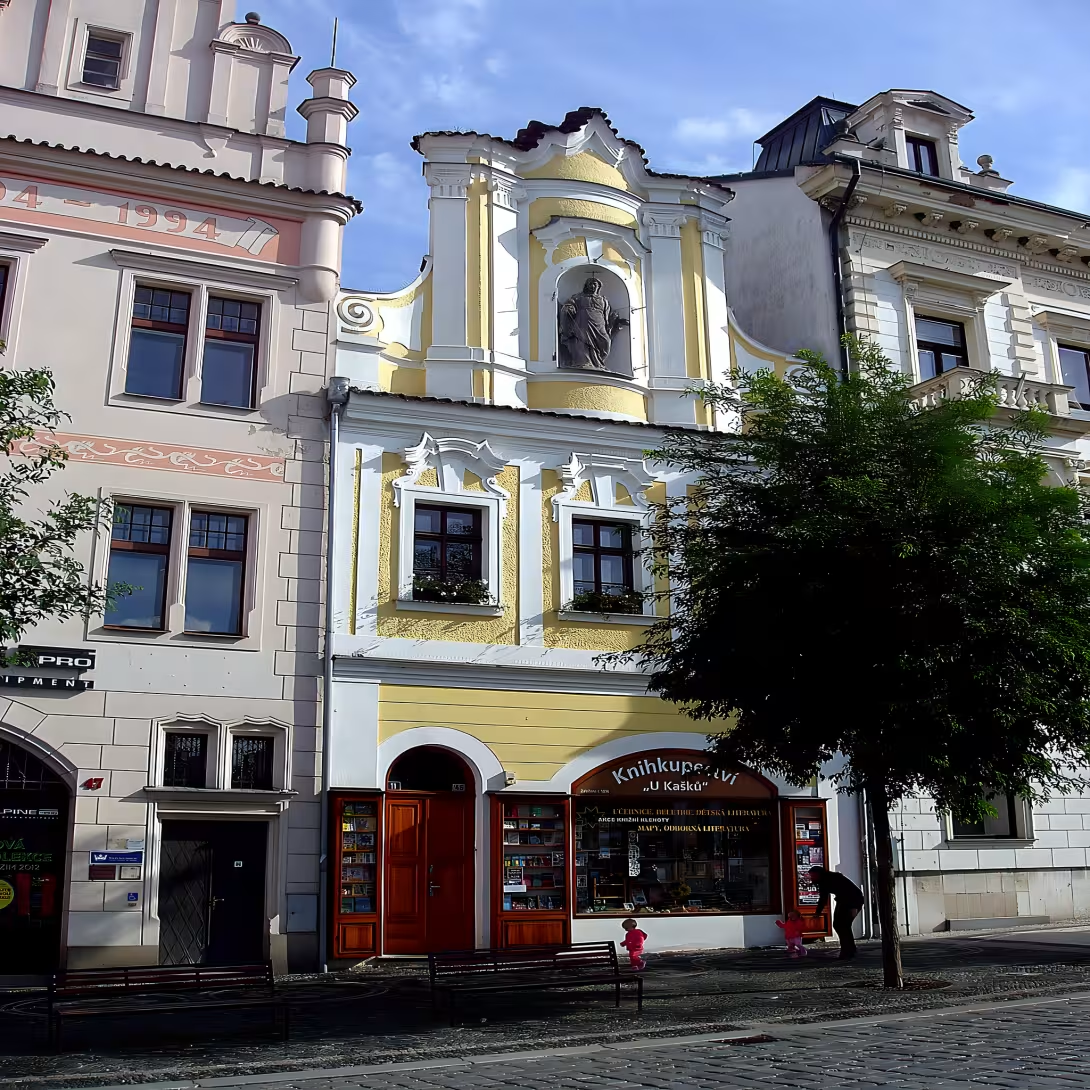
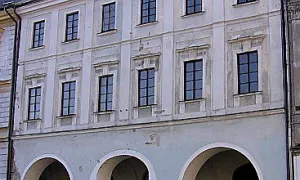
The Dům čp. 46 in Kolín is a well-preserved Baroque building in the historic center of the town. This 18th-century house, originally Gothic, boasts a unique facade and decorated gable, making it a notable landmark in Kolín I. The house has been preserved and is now used as a residential building with a shop on the ground floor.
The house's origins date back to the 13th century, with the first written record from 1494, when Tomáš, a baker, owned it. The house changed hands several times, with notable owners including Martin Bakalář, Jiří Pachta z Rájova, and Josef Tichý. In 1751, architect Josef Jedlička rebuilt the house in the Baroque style, transforming the original Gothic structure into a stunning example of Baroque architecture.
The house's facade is a masterpiece of Baroque design, featuring pilasters, a decorated gable, and a unique facade. The interior boasts a valuted ceiling and a decorated staircase, adding to its charm and historical significance. The house has been preserved and is now used as a residential building with a shop on the ground floor.
The house has a rich history, with several significant events shaping its fate. Fires in 1734 and 1796 damaged the house, leading to changes in its design and layout. In 1909, Josef Kaška converted the underpass into a bookshop. Today, the house remains a testament to the town's rich history and architectural heritage.
Visitors to Kolín can still see the house in its original form, with its unique facade and decorated gable. The house is a must-see for those interested in history, architecture, and the region's cultural heritage. As you walk through the historic center of Kolín, take a moment to admire this stunning example of Baroque architecture and the rich history it holds.
Historical milestones
- 1494
- First written record of the house
- 1525
- House passed to Martin Bakalář
- 1555
- House passed to Jiří Pachta z Rájova
- 1572
- House passed to Daniel Hyttich
- 1573
- House passed back to Jiří Pachta z Rájova
- 1733
- House passed to Martin Podhorský
- 1734
- House damaged by fire
- 1738
- House passed to Josef Tichý
- 1751
- House rebuilt in Baroque style by Josef Jedlička
- 1764
- House passed to Jan Petržilka
- 1796
- House damaged by fire
- 1909
- House passed to Josef Kaška
Architectural development
The house was originally a Gothic building, but it was rebuilt in the Baroque style in the 18th century. The facade is decorated with pilasters and a gable. The interior has a valuted ceiling and a decorated staircase.
Historical events
The house was rebuilt in the Baroque style in the 18th century
The house was damaged by fires in 1734 and 1796
The house was rebuilt again in the 19th century
Owners
Tomáš pekař (1494), Martin Bakalář (1525), Jiří Pachta z Rájova (1555-1582), Mikuláš Alethin (1586), Daniel Hyttich (1572-1573), Martin Podhorský (1733-1738), Josef Tichý (1751), Jan Petržilka (1764), Josef Kaška (1909)
Points of interest
– The house has a rich history, with several significant events shaping its fate. – The house's facade is a masterpiece of Baroque design, featuring pilasters, a decorated gable, and a unique facade. – The interior boasts a valuted ceiling and a decorated staircase, adding to its charm and historical significance. – Fires in 1734 and 1796 damaged the house, leading to changes in its design and layout. – The house is a must-see for those interested in history, architecture, and the region's cultural heritage.
Guide
Show guide text
This text was created by artificial intelligence and has not been editorially reviewed. It may contain inaccuracies.
Welcome to Kolín I. Please, take a moment to settle in, adjust your headphones, and simply look ahead of you. You are standing before Dům čp. 46, a building that serves as a silent witness to centuries of urban evolution. At first glance, you are seeing a beautifully preserved example of Baroque architecture, a style that speaks of elegance, drama, and a certain grandeur. Notice how the building presents itself to the street, blending its historical dignity with the practicalities of modern life, as seen in the shop occupying the ground floor. It is this layering of time—the residential spaces above and the commercial space below—that makes this house feel so alive, rather than just a museum piece.
As you gaze at the structure, let us travel back in time to understand how this place came to be. While the house you see today is defined by its Baroque charm, its roots go much deeper into the earth. The first written record of this property dates all the way back to 1494. Imagine the town of Kolín at the end of the 15th century; the house was originally built in the Gothic style, characterized by different proportions and a much more austere appearance than what we see now. For hundreds of years, it stood as a Gothic residence, weathering the changes of the Renaissance and the early modern era. However, by the 18th century, the tastes of the time had shifted toward the ornate and the theatrical. This led to a significant transformation. The house was rebuilt in the Baroque style by the architect Josef Jedlička, who breathed new life into the old Gothic bones, giving the building the sophisticated silhouette it possesses today.
Now, I invite you to look closer at the architecture, for the beauty of Dům čp. 46 lies in its specific details. Please, lift your eyes and look upward toward the roofline. You will notice the decorated gable, a crowning feature that gives the house its distinct character. This gable is not merely a functional part of the roof but a statement of prestige and artistic intent. Now, shift your attention to the facade. Notice the pilasters—those rectangular, column-like ornaments attached to the wall. These elements create a rhythmic verticality, breaking up the flat surface of the wall and adding a sense of depth and movement to the building. The entire facade is a masterpiece of Baroque design, carefully balanced to impress the passerby while maintaining the harmony of the street. While you are standing here outside, it is worth imagining the interior, which mirrors this external splendor. Inside, the house boasts a vaulted ceiling and a decorated staircase, elements that would have signaled the wealth and status of the owners to any guest entering the home.
A building is more than just stone and mortar; it is the sum of the people who lived, worked, and dreamed within its walls. The history of Dům čp. 46 is a tapestry of diverse personalities. If we look back to the early 16th century, in 1525, the house passed into the hands of Martin Bakalář. Imagine the daily rhythms of life during that period, the sounds of horses on the cobblestones and the bustle of a growing town. Later, in 1555, the property was acquired by Jiří Pachta z Rájova, a name associated with nobility and influence. Interestingly, the house seems to have a memory of its own, as it changed hands several times. In 1572, it passed to Daniel Hyttich, only to return to Jiří Pachta z Rájova just a year later in 1573. This suggests a period of transition and perhaps complex negotiations or family arrangements that shaped the fate of the property.
As the centuries rolled on, other figures left their mark here. We find mentions of individuals such as Tomáš pekař, Mikuláš Alethin, and later, in 1733, the house passed to Martin Podhorský. The list of names associated with this address—including Josef Tichý, Jan Petržilka, and Josef Kaška—represents a cross-section of the community of Kolín. From tradespeople to landowners, each of these individuals contributed to the living history of the house. When you look at the walls today, you are not just looking at a facade designed by Josef Jedlička, but at a vessel that held the lives of all these people across five hundred years.
What makes Dům čp. 46 truly fascinating is how it managed to survive and remain so well-preserved. In many cities, Baroque buildings were either demolished to make way for modern blocks or stripped of their ornamentation during various waves of architectural fashion. Yet, this house retained its unique facade and its decorated gable, allowing us to see exactly what Josef Jedlička intended in the 18th century. There is a certain mystery in the continuity of the place—the way a Gothic house from 1494 evolved into a Baroque gem and now functions as a home and a shop in the 21st century. It is a reminder that architecture is not static; it is a living organism that adapts to the needs of each generation.
Take one last look at the building. Try to see past the current shop window and the residential curtains. Try to visualize the transition from the sharp lines of the Gothic era to the flowing, ornate curves of the Baroque. Feel the weight of the centuries and the legacy of the architects and owners who ensured that this piece of Kolín’s heritage remained intact for you to see today. The harmony of the pilasters, the elegance of the gable, and the hidden beauty of the vaulted ceilings all tell a story of ambition, art, and endurance.
Thank you for stopping here to appreciate the history of Dům čp. 46. As you prepare to move on, I encourage you to keep this sense of layering in mind as you explore the rest of the town. Every street and every stone in Kolín I has a story to tell, often hidden in plain sight. Please, take your time, enjoy the atmosphere of the neighborhood, and continue your journey through the winding paths of history. We wish you a wonderful and inspiring walk. Goodbye for now.
Businesses nearby
Nearby
The house is located in the historic center of Kolín, surrounded by other Baroque buildings.
Accommodation nearby
Trips and activities nearby
Guided tours, tickets and activities nearby from GetYourGuide
Affiliate link: if you buy from the partner, we may receive a commission. The price for you does not change.
Search tours and activities →Themed route
1. Dům čp. 46 (Historic House) – Start your tour at this central landmark to appreciate its unique architectural character. 2. Baroque buildings (Architectural landmarks) – Walk through the immediate vicinity to admire the ornate facades that surround the house. 3. Historic center of Kolín (Historical district) – Conclude your walk by immersing yourself in the atmosphere of the old town.
Seasonal recommendations
Spring
As spring awakens, the historic landmark, Dům čp. 46, takes on a charming atmosphere. The soft sunlight and blooming flowers create a serene ambiance. Visitors can enjoy the gentle breeze and vibrant colors of nature.
Practical tips: Be prepared for moderate crowds during peak hours. Wear comfortable shoes and layers for unpredictable spring weather. The best time to visit is early morning or late afternoon when the sun is not too harsh.
Summer
In the summer, the historic landmark transforms into a lively hub. Warm sunshine illuminates the area, and lush greenery surrounds the building. The atmosphere is lively, with people enjoying outdoor activities and events.
Practical tips: Arrive early to beat the crowds, especially on weekends. Wear light, breathable clothing and bring sunscreen for protection from the sun. The best time to visit is during the morning or late evening when it's less crowded.
Autumn
As autumn arrives, the historic landmark takes on a cozy atmosphere. The golden foliage and warm sunlight create a sense of nostalgia. Visitors can enjoy the crisp air and vibrant colors of nature.
Practical tips: Be prepared for cooler temperatures and potential rain showers. Wear layers and bring an umbrella as needed. The best time to visit is during the late morning or early afternoon when the sun is not too harsh.
Winter
In the winter, the historic landmark takes on a magical atmosphere. Soft snowflakes fall gently, and twinkling lights illuminate the area. Visitors can enjoy the peaceful atmosphere and cozy warmth of the building.
Practical tips: Be prepared for shorter opening hours due to cold weather. Wear warm, layered clothing and bring gloves for protection from the cold. The best time to visit is during the late morning or early afternoon when it's less crowded.
Visualizations and artistic views


The visualisations are generated by artificial intelligence and serve as inspiration.
Photos from the area
Real photos taken near the monument


Zdroj a licence jsou uvedeny u každého snímku.
Tips from visitors
No tips yet. Be the first!
Log in and add your tip.
Sources and literature
Fotografie: Jstojanov / CC BY-SA 3.0, rozlišení zvýšeno umělou inteligencí — Wikimedia Commons. The author and licence also appear when you hover over the image.
Faktickým podkladem tohoto textu byl článek na Wikipedii, jehož autory jsou přispěvatelé Wikipedie. Článek je dostupný pod licencí CC BY-SA 4.0.
Location on the map


Příběhy a pověsti
Legendy, pověsti a příběhy spjaté s touto památkou
Fotografie návštěvníků
Zatím žádné fotografie. Buďte první, kdo přidá fotografii z návštěvy!
Přihlaste se a přidejte svou fotografii nebo hodnoťte.
Za ověřenou návštěvu v aplikaci získáte víc bodů — poznáme podle GPS, že jste na místě.
Reviews and comments