



dům Romance Other
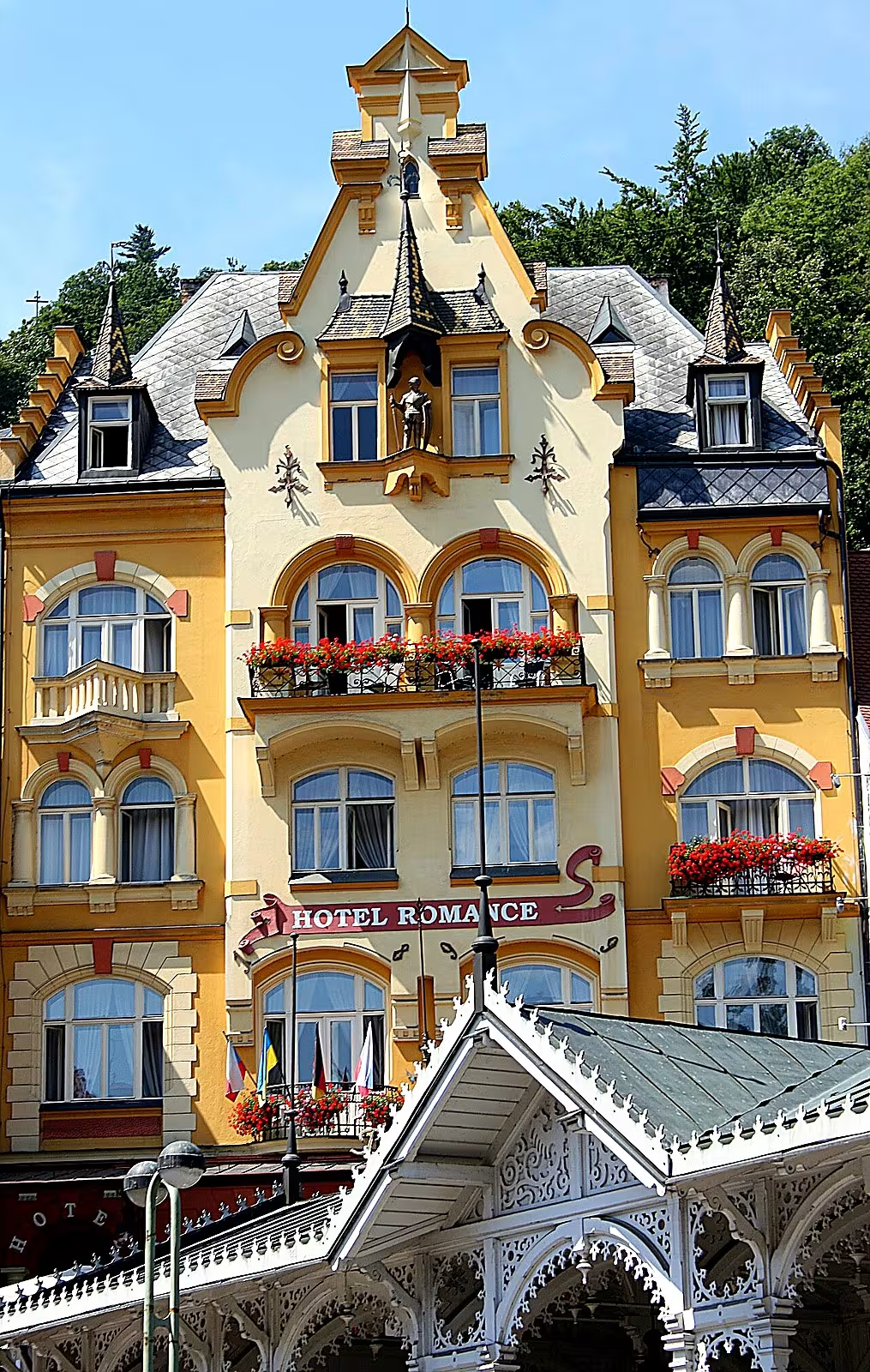
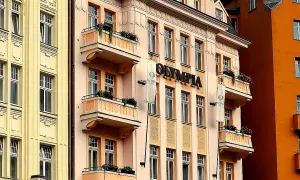
House Romance is a historic building in the centre of the spa part of Karlovy Vary in the street Trzni, built in 1898. The construction is remarkable by its anachronistic style of late German Gothic and Renaissance and is registered as a cultural monument.
The building was built on the site of two baroque houses Blumenkranz and Stadt Annaberg, which were built after the great Karlovy Vary fire of 1759. In 1898 their owners, Arthur and Emma Danzer, together with Julius Stadler decided to build a hotel that originally carried the name Württemberger Hof. The project was developed by the Vienna architect Karl Haybäck and the construction was carried out by the Karlovy Vary construction company Josef Waldert.
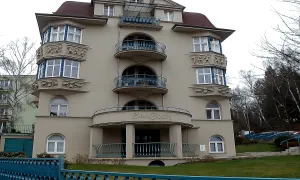
Architecturally, it's a four-story terraced house with a living attic. The facade is four-axis and the wall is fitted on the ground floor. The entrance area consists of arches and two wide segment windows. Above the terrace, located in a sloping terrain, there is a glass roof on forged iron spiral consoles. This awning came from the workshop of Karlovy Vary producer Josef Bohe and was installed in 1900.
The facade shows a variety of windows. On the first floor there are segmental windows, with two inner ones having segmented balconies with forged bars. The second floor combines a double arc window with arches in the outer left axis and segmented windows in the other axes; The right window has a balcony with a forged grate. The third floor contains an arc window with a small triangle balcony on the left, two connected arc windows with a rectangular balcony in the middle and a double arc window on the right. From the second floor, risalite outputs on the consoles are preset in the inner axes. The whole object is completed by a high volt shield with a triangular front, in which there are two rectangular windows and a gotifying canopy with a pointed bag cap and a statue. On the sides of the shield are placed a skylight with similar tower roofs.
The specific property of the building is the internal layout. At the request of the contracting authorities, the project was designed to consistently separate space for two owners. This led to the creation of two mirrored positions with separate entrances, internal staircases, elevators and corridor corridors around the central court.
Over the years, the name of the Pushkin spa house was also carried by the object. Since 8. April 1991 it has been officially declared a cultural monument. The building is currently situated in the property of FIBRO, spol. s r.o. and the Romance Hotel is operated here.
The House of Romance presents a unique example of historical architecture within the town monument zone of Karlovy Vary. The detailed facade and unusual internal divisions make it an important point when searching the city centre.
Then and now
Drag the slider to compare how the landmark may have looked when it was built with the view today.
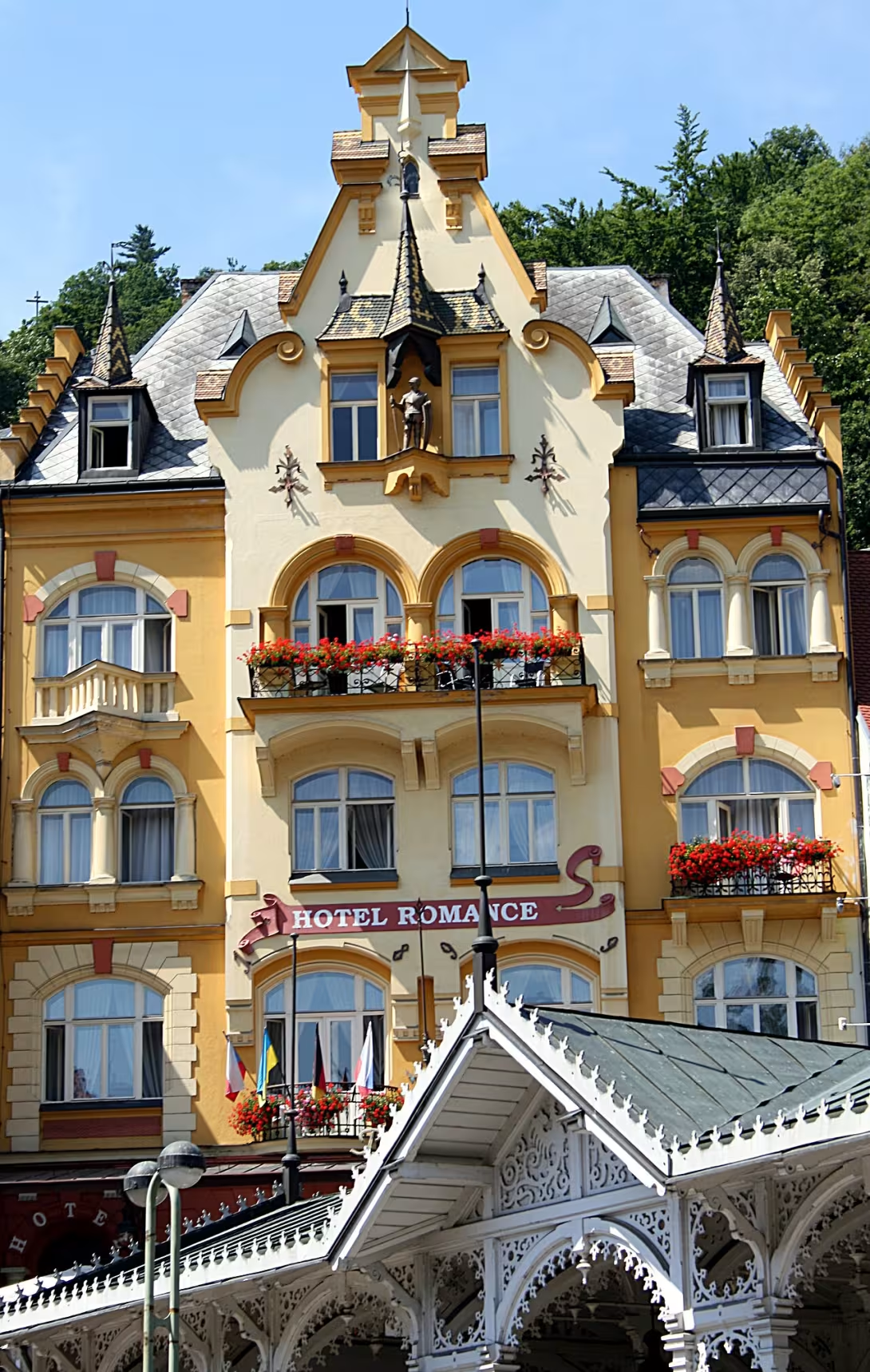
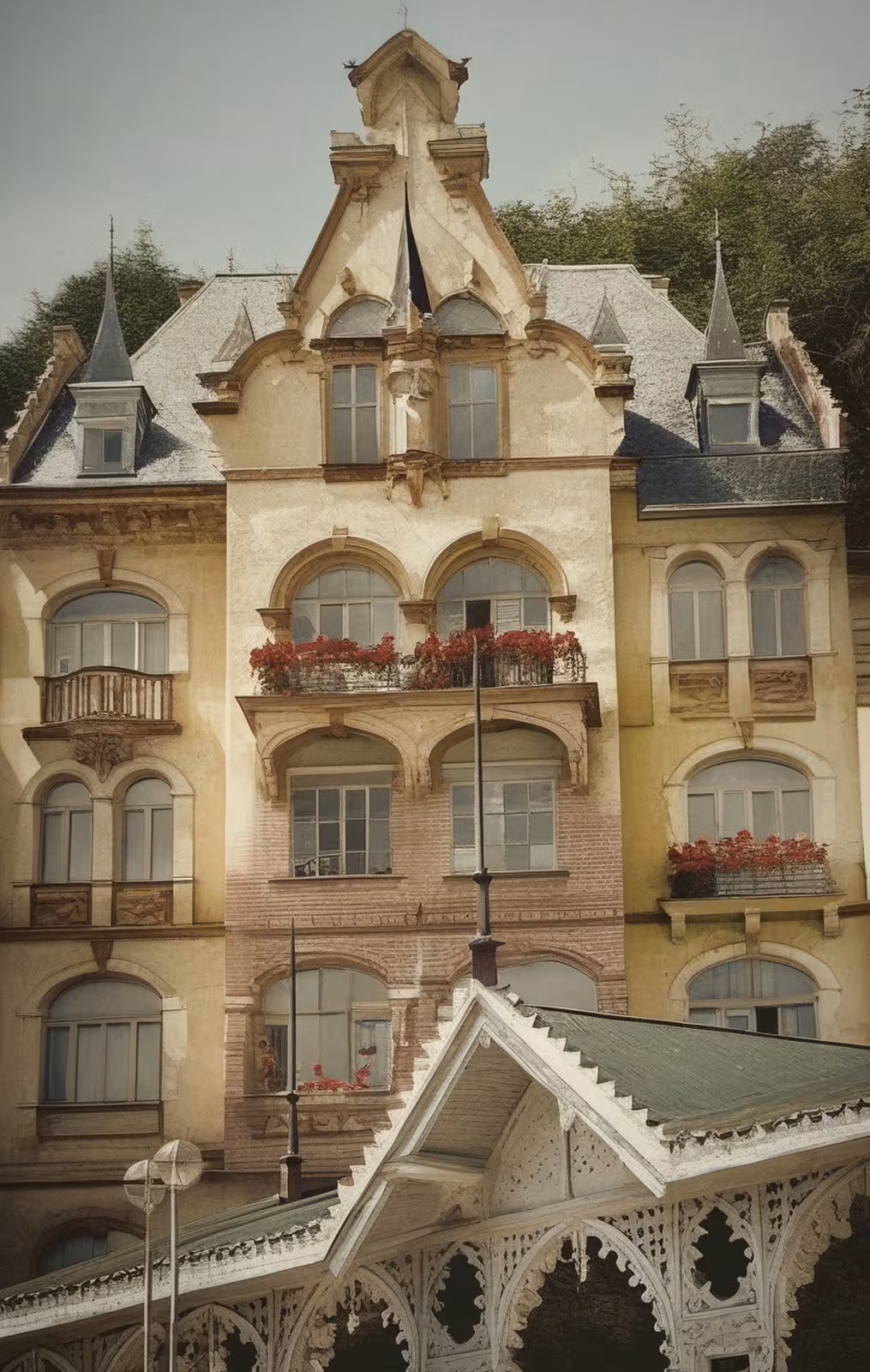
The historical appearance on the left is an AI-generated visualisation and serves as inspiration only.
Historical milestones
- 1898
- building the hotel Württemberger Hof according to the Karl Haybäck project
- 1900
- installation of iron awning above the terrace at main entrances
- 1991
- declaration of the building as a cultural monument
Architectural development
The building was built at the site of two baroque houses Blumenkranz and Stadt Annaberg. The four-storey facade has a risalite outlet, a volute shield and a gotifying canopy with a statue. In 1900, an iron awning from Josef Bohe was placed above the terrace at the entrance.
Historical events
1898 - construction of hotel Württemberger Hof, 1991 - declaration of the building for cultural monument
Owners
Arthur and Emma Danzer and Julius Stadler (1898), FIBRO, spol. s r.o. (present)
Points of interest
- The construction from 1898 is remarkable in its style of late German Gothic and Renaissance. - The building was built on the site of two baroque houses that were built after a large fire in 1759. - Glass canopy on forged consoles comes from the workshop of the manufacturer Josef Bohe and was installed in 1900. - The interior layout is unique because the space is mirror-separated for two owners with separate entrances and staircases. The object in the past also carried the name of Pushkin Spa House.
Guide
Show guide text
This text was created by artificial intelligence and has not been editorially reviewed. It may contain inaccuracies.
Welcome to the heart of Karlovy Vary. Right now, you're standing in front of a building that, with its appearance, stands out from the surrounding pit and immediately transmits you to another time. Look at this impressive house we now know as Romance. It is a building that tells a story with its face about the desire for beauty and how architecture was perceived in times long past. When you look at it, you may feel that you are in some ancient city of northern Europe, and that is exactly the impression that should have been made.
Let us now stop at how this building was created and why it is standing here. The House of Romance, which was called Württemberger Hof at the time of its creation, saw the light of the world in a thousand eight hundred ninety-eight. At that time, this spa area was in full bloom and there were buildings to celebrate wealth and prestige. The author of the project was architect Karl Haybäck, who decided to take a very bold and unusual approach. Instead of following fashion trends back then, he decided on a style that was already considered old-fashioned, or rather a return to tradition.
Now pay attention to the architecture itself. If you look at the facade details, you will notice that the building combines elements of late German Gothic and Renaissance. It's a very interesting contrast, because by the year one thousand eight hundred ninety-eight these periods were long gone, but the architect deliberately chose this ancient style to give the building the character of historical stability and nobility. Look at the facade and see the atmosphere these shapes create. It's an architecture that's not just supposed to be functional, but it's supposed to be particularly flowery and impressive.
When you look down at the main inputs, notice one very specific detail, which is the real jewel of this building. You see that iron awning above the terrace? This glass roof, which lies on forged consoles, was set in the year of a thousand nine hundred. It comes from the shop of the manufacturer Josef Both. At the time, it was the peak of craft art. Imagine how this awning protected the hotel's guests from rain or bright sun while they observed the excitement in Karlovy Vary streets. It's a fine connection between a heavy stone structure and the lightness of metal and glass.
But this house was not in empty space. It's fascinating to realize what was in this place before. The Romance building was built on the site of two older houses in Baroque style. These former houses were built here after a major disaster, namely the great fire of a thousand seven hundred fifty-nine, which destroyed a large part of the city. This shows us how the city gradually changed and how each new generation of builders brought different visions of beauty. From baroque simplicity and renewal after the fire we moved to a monumental hotel, which was supposed to be a symbol of luxury.
The key is also to know that the building has changed its functions and names over the years. It served primarily as a hotel, a place where visitors from all over the world sought rest and health. At a later time it was called Pushkin Spa House, which only confirms that this place attracted people from different parts of Europe and was associated with the names of prominent personalities, although specific stories of individual guests were lost in oblivion over time.
One of the biggest attractions is the contrast of time. Imagine that in the year one thousand eight hundred ninety-eight, this building was perceived as something that deliberately looked old. It's called anachronism, something that's placed outside of its time. Architect Haybäck wanted to create a sense of continuity as if the building had been standing here for hundreds of years, even though it was brand new at the time. This uniqueness was awarded much later, namely in the year one thousand nine hundred ninety one, when the building was officially declared a cultural monument. This step recognised her artistic and historical contribution to the whole region of Karlovy Vary.
Today, a tradition continues in the building that goes back to the time of its creation. When you look at a building, don't just remember it as a pile of stone and glass, but as a living organism that survived regime changes, war and economic crises. It is a testament to the time when the soul entered the architecture and every detail, from the designed holder to the shape of the window, was carefully thought through.
Now that you've learned about the origin and details of the House of Romance, I suggest you stay for a while and let your eyes discover other nuances. Try to imagine what Karlovy Vary looked like in the year of a thousand devistset, when the glass roof was just planted and the hotel welcomed its first guests. Feel the contrast between the silent rock and the dynamic of the city around you.
Let's close this stop slowly now. I hope you are interested in this short trip to history and that you are now seeing dům Romance in a new light. It is a place where Gothic, Renaissance and industrial art meet in the late nineteenth century in one harmonious whole.
I'm asking you to explore the area again. Karlovy Vary has another story hidden in every corner and every other building you meet can be as fascinating as this one. We wish you a pleasant continuation of your journey along our spa streets. Look forward to another discovery of the beauty of this city. Goodbye.
Tips for visitors
The best time to visit is late autumn or winter when the building with elements of late Gothic and Renaissance act in accompanied by rainfall or fog very atmospheric. You can reach the centre of the spa area by car and public transport; Check the current connection in the search engine.
To visit we recommend to take shoes suitable for walking through the historical centre, so that it is possible to walk comfortably around the building and admire its facade. Photography is recommended in the morning or late afternoon light, when shadows highlight details of the anachronistic style of construction.
Get out of the building for a short walk along the town monument zone of Karlovy Vary, which surrounds the whole spa area. It is the ideal path for those who want to perceive the historical context of the surroundings.
For families with children it is advisable to focus on searching for architectural details on the facade, which can be a fun game in observing elements of old buildings in the city centre.
Frequently asked questions
Can the monument be visited?
We have not verified whether this monument is accessible. Please ask the owner or operator, or the local municipal office.
Where is the monument?
Location: Karlovy Vary. The map on this page shows the exact spot.
Why is the monument protected?
It is listed in the Central List of Cultural Monuments of the Czech Republic as a cultural monument (register no. 1000149318).
Businesses nearby
Do you run a restaurant, accommodation, shop, museum, rental, wellness or other visitor service near this monument? Show yourself directly to the people heading to it — this is how they will see you in the app and on the web:
Nearby
Městská památková zóna Karlových Varů, centrum lázeňské části.
Accommodation nearby
Trips and activities nearby
Guided tours, tickets and activities nearby from GetYourGuide
Affiliate link: if you buy from the partner, we may receive a commission. The price for you does not change.
Search tours and activities →Themed route
Here is the design of the cruise route:
1. Center of the spa part - Starting point. A place where a feeling begins from the unique atmosphere of the city. 2. City Monument Zone of Karlovy Vary - Walk between historical buildings. It offers a view of beautiful architecture and a unique look of the entire street network. 3. House Romance - Main Target. A significant building that attracts visitors by its form and history.
Seasonal recommendations
In the spring the city wakes up into the world and the surrounding greenery begins to tajeć. The light is soft and pleasant, which helps to observe the facade details. We recommend light coating of clothing and visiting in the morning when the air is the cleanest.
Summer brings bright sun and rich colors. The atmosphere is full of energy, but there are most people on the streets. It is advisable to choose breathable substances, a hat against heat and search for a shadow near the building during the greatest noon heat.
In autumn, the surroundings are colored in golden and brown shades, creating a nostalgic mood. The lighting is softer and the shadows are longer. It is practical to carry a waterproof jacket and fixed shoes, because the weather in this area can be variable.
In winter, calm and cold air rule. The building in the snowy environment looks very noble and mysterious. It is necessary to wear warm clothes, gloves and hat, while the best time to visit is a short time of the day before dark.
Visualizations and artistic views


The visualisations are generated by artificial intelligence and serve as inspiration.
Photos from the area
Real photos taken near the monument


Zdroj a licence jsou uvedeny u každého snímku.
Tips from visitors
No tips yet. Be the first!
Log in and add your tip.
Sources and literature
Photos: Hedwig Storch / CC BY-SA 3.0 — Wikimedia Commons. The author and licence also appear when you hover over the image.
Faktickým podkladem tohoto textu byl článek na Wikipedii, jehož autory jsou přispěvatelé Wikipedie. Článek je dostupný pod licencí CC BY-SA 4.0.
Location on the map
More monuments – Karlovy Vary
Show all in the municipality
Příběhy a pověsti
Legendy, pověsti a příběhy spjaté s touto památkou
Fotografie návštěvníků
Zatím žádné fotografie. Buďte první, kdo přidá fotografii z návštěvy!
Log in a přidejte svou fotografii nebo hodnoťte.
Za ověřenou návštěvu v aplikaci získáte víc bodů — poznáme podle GPS, že jste na místě.
Reviews and comments