



dům U Starých Šedivých House
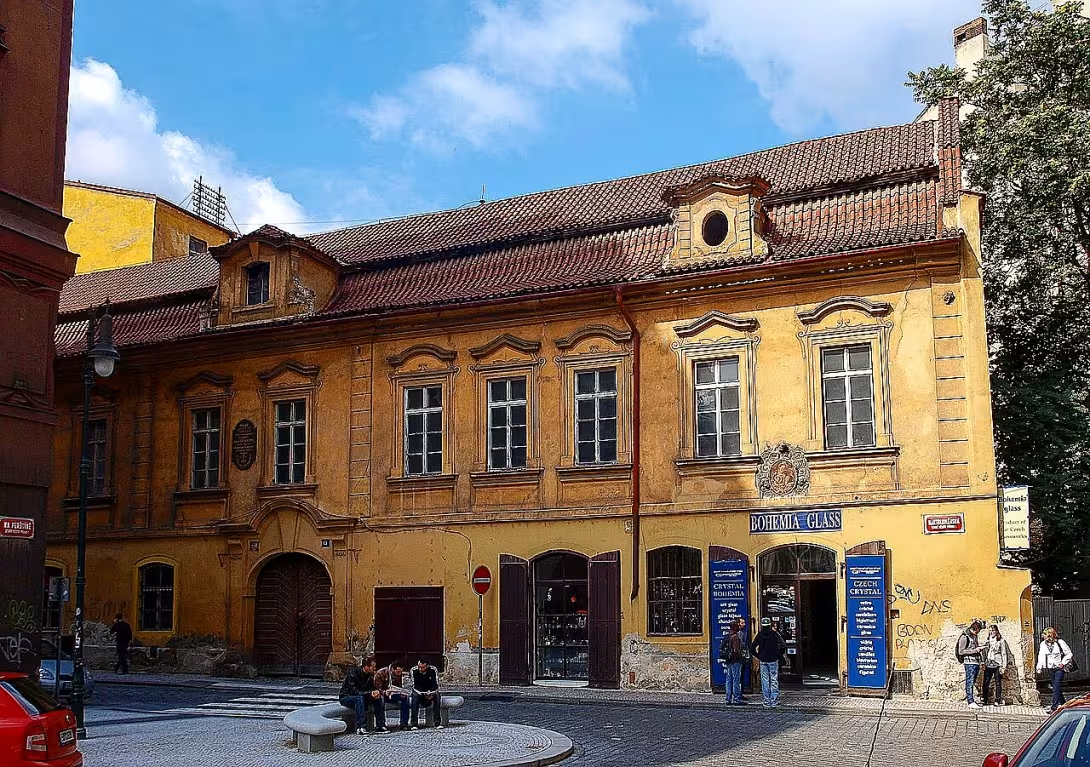
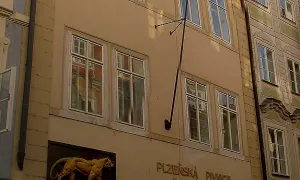
The House of the Old Greys, also known as the House of the Kasir, is a Baroque building in Bartholomew Street in Prague's Old Town. It is located at the intersection with the Transit and the Perstín near the Convikt next to the Golden Grape house. The house is a cultural monument, listed in 1964. The original structures on the site date back to the Middle Ages, but today's Baroque form dates back to the 17th century.
The Old Grey House has a long history dating back to the Middle Ages. At the site of the present house, there were originally four houses with defensive functions. After the fire in 1678 the house was rebuilt in Baroque style, which meant the beginning of its present form. However, the development of the buildings at this place is poorly documented because the remains of the original buildings were removed during the rendering process in 1842-1843.
The house is an example of a baroque style that appeared after the fire in 1678. At that time the house was rebuilt into this rich and decorative architectural style, characteristic of the Baroque period. Other modifications took place in the 3rd quarter of the 18th century. During the rendering in 1842- 1843 some modifications were made in the classical style, but the house was not demolished.
The House of Old Greys is connected to the personality of Jan Podlipný. Jan Podlipný lived and died in this house; a commemorative plaque was placed in 1924 by the Czechoslovak village of Sokol, which resembles an important personality associated with this location.
The House of Old Greys is a cultural monument at the intersection of Bartholomew Street and Transit. Located near other historical monuments such as the Convikt and the House of the Golden Grape. The house is located in Old Town, famous for its cultural and historical monuments.
During the Baroque period when the house was rebuilt, art and architecture under the influence of the Habsburg Monarchy developed in the Czech Republic. This period is characterized by rich decorations and complex architectural forms.
Today, dům U Starých Šedivých stands as a witness to the history of Prague and its Baroque period. It's a place that attracts visitors from all over the world who want to explore the rich history and architecture of Old Town. The house is an important cultural monument and is worth visiting anyone who is interested in the history and architecture of Prague.
The House of the Old Greys recalls the importance of preserving cultural monuments for future generations. It's a place that allows us to feel connected to the past and understand the history of our city. The house is an important cultural monument and is worth visiting anyone who is interested in the history and architecture of Prague.
Historical milestones
- 1924
- A commemorative plaque dedicated to Jan Podlipný Czechoslovak village was placed on the house.
Architectural development
Originally, there were four houses with defensive functions. After the fire in 1678, the house was rebuilt into a baroque style, which meant the beginning of its present form. In the 18th century there were further modifications and during the rendering in 1842- 1843 classical changes were made.
Historical events
- 1678
- After the fire, the house was rebuilt in Baroque style.
- 1726
- The house could already be in its present form.
- 1842
- During the rendering were made modifications in classical style.
Points of interest
- The Old Grey House is a cultural monument listed in 1964. - The original structures on the site date back to the Middle Ages, but today's Baroque form dates back to the 17th century. - The house is connected with the personality of Jan Podlipný; a commemorative plaque was placed in his memory in 1924 by the Czechoslovak village of Sokol. - During the Baroque period when the house was rebuilt, the art and architecture under the influence of the Habsburg Monarchy developed in Bohemia.
Guide
Show guide text
This text was created by artificial intelligence and has not been editorially reviewed. It may contain inaccuracies.
Welcome, honourable visitors, to the very heart of Prague Old Town. Please stop for a moment and feel the atmosphere of this place. You're standing in front of a building called dům U Starých Šedivých. Look around you, you are in Bartholomew Street, in an area where history in every step touches the present. It is at this point, where the streets of Transcendent and Perštín are crossed, that the story of one of the many silent witnesses of Prague's historical development opens up before you. Notice that you are in close proximity to the Convikt and right next door you see the Golden Grape house. These surroundings are filled with hidden details and old stories waiting to be revealed.
Now let's think together about what you see in front of you. This building, which now welcomes you, is not just an ordinary house in the city centre. It is an important cultural monument whose value was officially recognised and included in the list of protected buildings in the year one thousand nine hundred sixty-four. But her real story began much before the house was put on any list. If you try to go back in time in spirit, you'll find that the original buildings in this place go back to the deep Middle Ages. Imagine how many generations of people went through here, how many craftsmen, merchants and residents lived here when Prague was one of the most important centres in the European world.
But the house you see today is no longer a medieval creature. What you see now is the baroque face of a building dating back to the seventeenth century. This was the time of great change when new dynamics, elegance and desire for representativeness entered urban architecture. It was in the seventeenth century that the house acquired its present form, which made it a harmonious part of the Prague picture. It is fascinating to realize that under the Baroque layer there are still traces of much older foundations that form the invisible root of this building.
Now pay attention to the architecture itself. Look carefully at the front of the building. Although we do not know the names of the particular architects who designed and built this house, their work gives us a sense of stability and tradition. Feel the overall composition of the house and think about how the needs of the people who lived and worked here changed over the centuries. Follow the lines of the facade and see how the Baroque style manifests itself in this particular place. It's an architecture that's not just supposed to be practical, it's supposed to give a certain impression of its appearance. It is this lastiness of history, when the medieval base has merged with the baroque perception of space, that makes this house a silent but talkative testament to the development of Prague's urbanism.
Now let's move on to the people who were connected to this place. History is not only made up of stones and mortar, but mainly by people and their actions. Now I'd like to ask you to look for one particular detail on the facade. Note the commemorative plate that is placed here. This board was added to the house in a thousand nine hundred twenty-four. He's dedicated to Jan Podlipný. Who was this man and why did he deserve his name to remain engraved in stone? Jan Podlipný was a person whose memory was so valuable that the Czechoslovak village of Sokol decided to worship his memory here permanently.
Think about what time this record was created. The year one thousand nine hundred twenty-four was a period of construction of a new state, a time of optimism and the bloom of national confidence. At that time, the falcons who were promoting the ideals of a healthy body and a healthy mind combined physical education with moral and national integrity. By placing a plaque on this very house, they expressed their profound respect for Jan Podlipný and at the same time linked his life path to this particular place in Prague. It is so strongly connected to this house that even after many decades it still reminds all passers-by that behind every facade is the human fate and story that was behind the creation of a certain value.
Now that you know the basic history and personality, let's think about something that might interest you and that carries a certain element of mystery. Have you noticed that this house basically has two identities? We know him as dům U Starých Šedivých, but he also appears in the historical records under the name of the Kasir house. Why was that? Why was one house carrying two different names?
To understand this, we need to go back to a time when houses in Prague did not have the numbers we know today. Imagine a city where there were no street and home numbers tables. People have different directions. Houses were given names according to their owners, according to the crafts that were used in them, or some distinctive sign that was placed on the house, for example in the form of a painting or sculpture. The fact that the house carried the names of the Old Greys and of the Caseurs may suggest a change in owners over time or how the house perceived different layers of the people of the Old Town. Maybe it was for one house of casinos, that is, people associated with a certain type of administration or finance, while it was associated with another group of people. It's kind of a little historical mystery that encourages us to think about how in the past people agreed, how they were oriented in urban space and how the identity of individual buildings formed.
So this house is much more than a baroque building on Bartholomew Street. It is a place where the medieval past meets the Baroque elegance, where the national pride of the Sokol movement from the beginning of the twentieth century meets the silent memory of Jan Podlipný and where two different names are taken by attention over centuries. It's a little piece of the Prague puzzle that helps us understand how the city, its people and its values have changed.
Now that you know the story of the Old Greys' house, I suggest you feel the silence of this alley and let your thoughts float. Take one last look at the Baroque face of the building, perceive its stability and look at the commemorative plaque, which is a silent witness to the centuries ago. This construction is just one of many pieces of the puzzle that Prague makes up, and each such stop reveals to us a new layer of truth about who we were and who we became.
I ask you now to continue to explore the area. You can go towards the nearby Convikt, or just be guided by the random permitted roads of Prague's Old Town, where there is a new, unexpected story waiting around every corner, every yard and every door. Let yourself be surprised by what you see and look for details that others may overlook. Thank you for stopping by this beautiful house with me and for paying attention. I wish you a pleasant continuing journey, many new discoveries and unforgettable experiences in our beautiful city. Goodbye.
Tips for visitors
The best time to visit Dom's Old Greys is early morning or evening when the light is softer and ideal for photography. This house is located in the historical centre of Prague, which makes it a perfect place for lovers of architecture.
It is advisable to use public transport or walking to access Dom U Old Greys.
When visiting, take with you a quality camera to capture details of baroque architecture. The house offers interesting background and angles that are ideal for photography.
There are other historical monuments such as the Convikt and the Golden Grape House. These places offer a rich cultural experience that is suitable for a full day tour.
For families with children it is advisable to visit Old Town where children can enjoy a view of historical buildings and possibly visit nearby museums or parks.
Frequently asked questions
Can the monument be visited?
This is a residential or farm building, not a museum with opening hours. Please view it from public space and respect the owners' privacy. We have no information about access to the interior.
Where is the monument?
Location: Praha 1. The map on this page shows the exact spot.
Why is the monument protected?
It is listed in the Central List of Cultural Monuments of the Czech Republic as a cultural monument (register no. 1000156877).
Businesses nearby
Do you run a restaurant, accommodation, shop, museum, rental, wellness or other visitor service near this monument? Show yourself directly to the people heading to it — this is how they will see you in the app and on the web:
Events nearby

Zdroj akcí: otevřená data měst a obcí ČR (Národní katalog otevřených dat) a kalendář akcí Národního památkového ústavu.
Nearby
Dům je umístěn blízko Konviktu a domu U Zlatého hroznu, což jsou další historické památky v Praze.
Nachází se na Starém Městě, známém svými kulturními a historickými památkami.
Accommodation nearby
Trips and activities nearby
Guided tours, tickets and activities nearby from GetYourGuide
Affiliate link: if you buy from the partner, we may receive a commission. The price for you does not change.
Search tours and activities →Themed route
Thematic cruise route "Old Town and its historical monuments"
1. The Old Grey House - Type: Historical House - Why is it worth a visit: This Baroque house is one of the oldest buildings in Old Town and commemorates the rich history of the area. It is advisable to explore its architectural details and realize how the city has evolved.
2. Convikt - Type: Historical object - Why it is worth a visit: Convikt is one of the oldest buildings in Prague Castle and today serves as a cultural centre. Its history dates back to the 13th century, making its facade and interiors fascinating to explore.
3. The Golden Grape House - Type: Historical House - Why is it worth a visit: This Gothic house is one of the oldest buildings in Old Town and its unique architecture makes you astonished. It is an ideal place to know the history of the area and its development.
4. Old Town Square - Type: Historical Square - Why is it worth visiting: Even if it is not directly mentioned in the surroundings, it is a logical next step to understand the context. The square is the heart of the Old Town and its history is closely linked to all the surrounding monuments.
5. Church of St. Nicholas - Type: Historical church - Why is it worth a visit: This Gothic church is the oldest in Old Town and its important architecture, especially internal frescos, makes it necessary to explore. It's close to other destinations.
This route offers a view of the rich history and architecture of Old Town, each point full of attractions for history lovers.
Seasonal recommendations
Spring: In the spring period the dům U Starých Šedivých monument is fertilized by a new life, when flowering gardens and trees around the building offer lively colors. The sun illuminates the architectural details of the house in the most beautiful light, making it ideal for photos. It is advisable to come early or late in the afternoon when temperatures are mild and the crowds are less burdensome. It is recommended to wear clothes with the possibility of layering, because the morning is often colder, while on Wednesday the temperature may increase significantly.
Summer: In the summer period, dům U Starých Šedivých is surrounded by hot sun rays that decorate architecture with bright shadow effects. Summer brings long hours of daylight and warm noon can be difficult to walk, therefore it is preferable to visit the memory of morning or evening. It is important to prepare yourself with sun protection and to wear light clothes. Moreover, it may be useful to have water because warm summer days can lead to exhaustion.
Autumn: In the autumn period the memory of dům U Starých Šedivých melancholic beauty grows when tree leaves colour and fall. The sun is soon behind the horizon, creating a peaceful atmosphere for visitors. The temperature is usually pleasant, so it is advisable to visit the memorial at noon or afternoon. It is recommended to wear clothes with the possibility of layering and protection against moisture because it can be colder and rain.
Winter: During winter dům U Starých Šedivých is surrounded by snow surfaces or ice bark, which adds magic to the memory. Sun rays light the building more gently and create dramatic shading. Visit her in the morning or in the evening when the temperature is lighter, because the noon can be cold. It is important to prepare for a visit with clothes suitable for winter conditions, including warm coat and protective pockets against moisture.
Visualizations and artistic views

The visualisations are generated by artificial intelligence and serve as inspiration.
Photos from the area
Real photos taken near the monument


Zdroj a licence jsou uvedeny u každého snímku.
Tips from visitors
No tips yet. Be the first!
Log in and add your tip.
Sources and literature
Photos: VitVit / CC BY-SA 4.0 — Wikimedia Commons. The author and licence also appear when you hover over the image.
Faktickým podkladem tohoto textu byl článek na Wikipedii, jehož autory jsou přispěvatelé Wikipedie. Článek je dostupný pod licencí CC BY-SA 4.0.
Location on the map
Příběhy a pověsti
Legendy, pověsti a příběhy spjaté s touto památkou
Fotografie návštěvníků
Zatím žádné fotografie. Buďte první, kdo přidá fotografii z návštěvy!
Log in a přidejte svou fotografii nebo hodnoťte.
Za ověřenou návštěvu v aplikaci získáte víc bodů — poznáme podle GPS, že jste na místě.
Reviews and comments