



dům U Zlatého melounu House
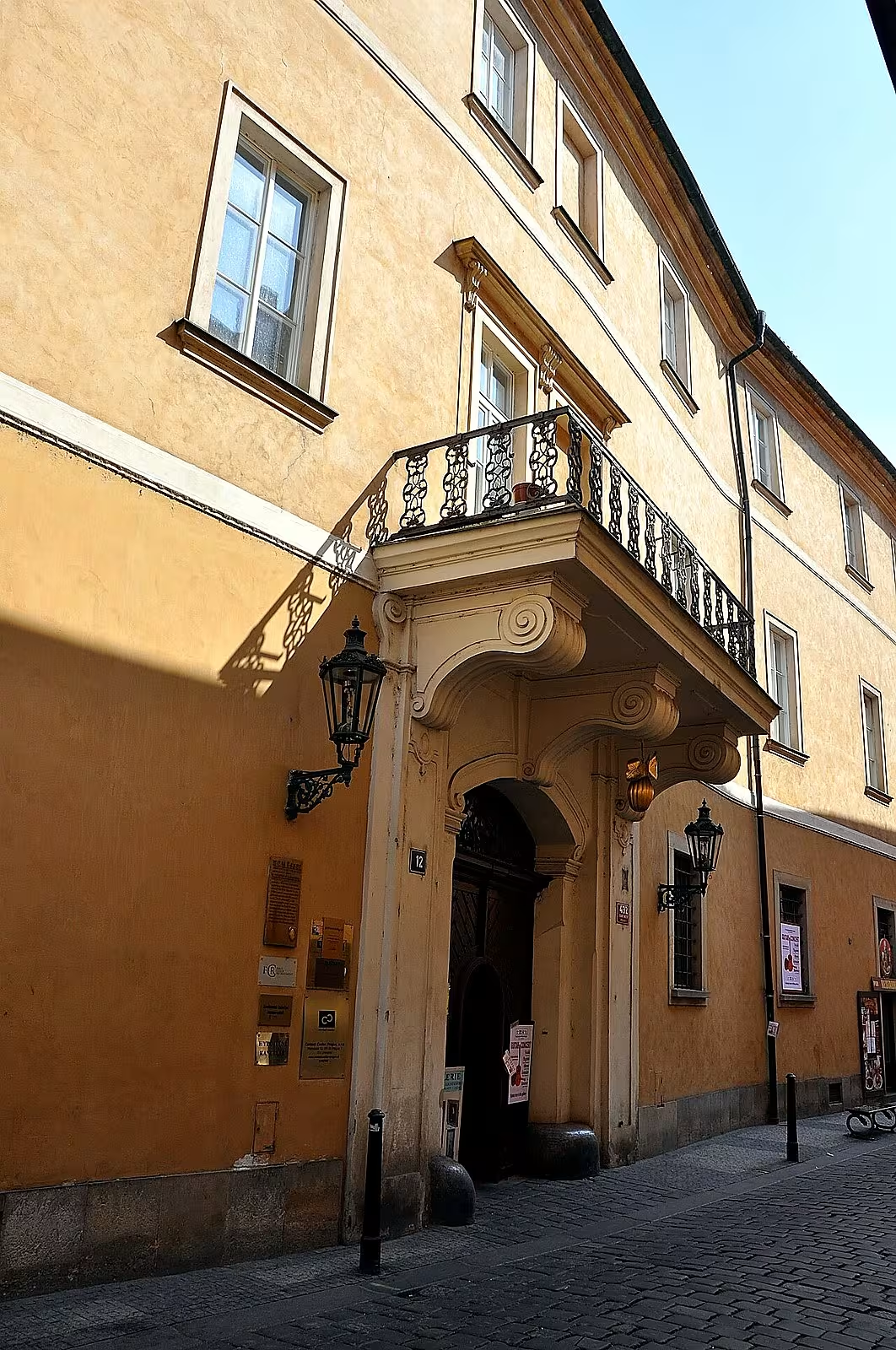
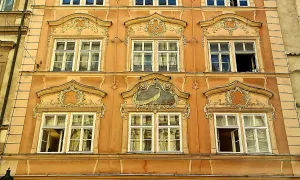
The Golden Watermelon House, also known as Chotkovsky, is a Baroque palace in Michal Street, Prague. The building has been protected as a cultural monument of the Czech Republic since 1964. It is remarkable in particular by unifying two medieval houses and unique home signs.
The history of the building dates back to the 13th century, when there were two separate buildings. The North House of Melon is first mentioned in 1401; underwent late Gothic and Renaissance reconstruction. The South House U Kryštofora, later called Reinhart, is documented from 1407. It was also rebuilt during the Renaissance and Baroque period.
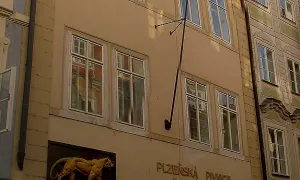
The present form of the palace was created after 1760 when Rudolf Chotek united both houses. This created an irregular disposition with two doors surrounded by two-story four-wing objects. The south part of the building forms a corner in Michal Street with a short side facade. From the time of unification comes a large representation vestibule, staircase and late Baroque editorial portal with massive volute heads. These elements support the balcony with cast iron railing. Below it is a gold melon-shaped home sign, which is documented from the 15th century. In the 19th century, the western street facade was united and a neo-Renaissance painting was created in the halls of the north building.
Throughout history, the palace served for various purposes. Since 1828 Hynek Link started a dance school here. Later in the building there were shops, apartments and warehouses. In the 1960s, there was a piano rental company. It was allegedly played by recognized composers and musicians such as Petr Iljič Čajkovskij, Edvard Grieg, Sergej Rachmaninov, Anton Rubinstein and Hans von Bülow.
From 1977 to 1982, the building underwent a landmark reconstruction, in which the exhibition hall U Zlatý watermelon was established. After 1990, these premises served as a sales exhibition of art. Since December 2014, the palace has been housed by a representative of Bavaria in Prague.
The Golden Watermelon House is a valuable example of the urban development of Old Town and the unification of historical plots. Visitors are advised to focus on the detail of the Baroque portal and look for ancient home signs.
Historical milestones
- 1401
- first mention of the Melon house
- 1407
- first mention of the house U Kryštofora
- 1964
- declaration of cultural monument
Architectural development
Originally two separate houses from the 13th century, which underwent Gothic, Renaissance and Baroque reconstruction. After 1760, they were united into one whole with a Baroque portal and cast iron railing balcony. In the 19th century, the western facade was united and a neo-Renaissance painting of the halls was created.
Historical events
1828: the establishment of Hynek Link Dance School; 1977-1982: monument reconstruction of the building; 2014: establishment of a representation of Bavaria in Prague.
Owners
Rudolf Chotek (after 1760)
Points of interest
- The palace was created by unifying two medieval houses and is remarkable for its unique home signs. - The gold melon-shaped home sign is already from the 15th century. - Since 1828 Hynek Link started a dance school here. - In the 1960s, there was a piano rental company, in which renowned composers and musicians allegedly played. - From December 2014 in the building is a representation of Bavaria in Prague.
Guide
Show guide text
This text was created by artificial intelligence and has not been editorially reviewed. It may contain inaccuracies.
Welcome to the heart of Prague's Old Town. Right now you're standing in front of a building that carries layers of many centuries of history. Look ahead at dům U Zlatého melounu. At first glance, it may seem like one united palace, but if you think about its history, you will find that there is a real monument to Prague's urbanism before you. Feel the atmosphere of this place where the medieval past meets with a later Baroque attraction.
Now let's stop at how this house actually came into being. What you see is not the work of one architect from one period, but the result of a long process. This building was created by a combination of two original houses that stood here in the 13th century. The first of them, known as the Melon house, is mentioned in the records in the year one thousand four hundred and one. The second, the Christopher House, appears in the documents a few years later, namely in the year one thousand four hundred and seven. So imagine, over the centuries, these two separate medieval buildings were gradually unifying, until one large entity was created.
Now pay attention to the architecture itself and to what you can see right in front of you. Notice the facade of the building. Even though the foundations are deep in the Middle Ages, the current form of the house you see has formed after a thousand seven hundred sixty. It is fascinating that despite the unification, the building has retained some irregularities in its availability, making it a unique piece of Prague architecture. Look carefully at the entrance. Your eyes should now find a late Baroque portal that gives the house its noble character.
And here comes the moment that is absolutely crucial to this house. Look up and look for home signs. Do you see him? It's the golden melon. At a time when people could not read and houses had no numbers, such signs served as landmarks. This particular golden melon sign is documented from the 15th century, which makes it one of the oldest and most remarkable symbols in the city centre. It's a small but very important detail that gives the house his name and identity.
Now that you know the look of the house, let's move on to the people who left their trail. This palace, also known as Chotkovsky, was a home and sanctuary for many prominent personalities. Among them was Rudolf Chotek. But dům U Zlatého melounu is mainly associated with music and art. Imagine how these walls in the nineteenth century became silent and replaced by the sounds of dance and music. Since the year one thousand eight hundred twenty eight here Hynek Link founded a dance school.
In the 1960s, the house became an even more important centre for musicians, because the piano house worked here. This is the place where famous composers and virtuosos of their time met and moved. Imagine there were masters like Anton Rubinstein, Hans von Bülow or Edvard Grieg walking these halls. Petr Iljič Čajkovskij or Sergej Rachmaninov could move in these areas. It is incredible to think how many musical geniuses people in one house in Prague at one time. The atmosphere of this place was thus filled with a tone of pianos and a passion for music.
It's remarkable how the function of the house changed over time. From medieval dwellings to aristocratic palace functions to center music education and rental tools. This constancy of history is exactly what makes Prague so special. That is why dům U Zlatého melounu was declared a cultural monument of the Czech Republic in the year one thousand nine hundred sixty-four. This step was to ensure its development and protection for future generations so that we could look at the golden melon and the Baroque portal today.
Stay at this house a little longer and let's try to imagine the mystery surrounding the unification of two houses. When you looked at the building, you may have noticed that its disposition is not entirely symmetrical. This is precisely the result of two doors left inside the palace. Imagine whispering in these inner courtyards, how the pianos were drawn here and how the students of the dance school trained their steps here. It's like a hidden world that can't be seen from the street right away, but that creates the true soul of this place.
If we were to summarize, you are standing in front of a building that is a bridge between different ages. From the 13th century to the Baroque to the golden age of the 19th century musicians. It's a place where practical architecture meets an artistic spirit. The golden melon watching over you is a silent witness to all these changes.
Now you can slowly continue your journey around Old Town. I suggest you look around and try to find other home signs that can tell you similar stories. Note how dům U Zlatého melounu is harmonically written into the bypass even though it carries such a unique history.
Thank you for accompanying me on this short trip in time. I hope you enjoyed the view of this beautiful palace and that you were interested in stories about music masters and gold melon. I wish you a pleasant continuation in discovering the secrets of Prague. Goodbye.
Tips for visitors
The best time to visit is early morning or late afternoon, when fewer people are in the narrow streets of Old Town and the building stands out in peace. Transportation to the centre of Prague is possible by car and public funds; verify specific routes in maps.
When you arrive, we recommend having fun with a soft sole because the surrounding streets have historic pavement. The best places for photo lovers are the views from Michal Street, where natural light falls so that the facade of this united palace excels beautifully.
In the nearby area, within short walks, you can explore the Old Town and the nearby Michal Street. Families with children appreciate the story of how these buildings were created by combining two old houses from the 13th century, which helps children imagine the ancient form of the city.
Frequently asked questions
Can the monument be visited?
Some buildings of this kind are open for guided tours, others serve another purpose or are privately owned. We have not verified whether and when this monument is open – please ask the operator.
What are the opening hours and admission?
We have not verified the opening hours or admission. Current information is published by the operator.
Where is the monument?
Location: Praha 1. The map on this page shows the exact spot.
Why is the monument protected?
It is listed in the Central List of Cultural Monuments of the Czech Republic as a cultural monument (register no. 1000150485).
Businesses nearby
Do you run a restaurant, accommodation, shop, museum, rental, wellness or other visitor service near this monument? Show yourself directly to the people heading to it — this is how they will see you in the app and on the web:
Events nearby

Zdroj akcí: otevřená data měst a obcí ČR (Národní katalog otevřených dat) a kalendář akcí Národního památkového ústavu.
Nearby
Staré Město v Praze, Michalská ulice.
Accommodation nearby
Trips and activities nearby
Guided tours, tickets and activities nearby from GetYourGuide
Affiliate link: if you buy from the partner, we may receive a commission. The price for you does not change.
Search tours and activities →Themed route
Here is the design of the thematic route:
1. Michal Street (street) - This narrow walk offers the atmosphere of old times and leads directly to the main destination. 2. Golden Watermelon House (Palace) - The main point of the visit, which will capture its architecture and history in the heart of the city. 3. Old Town in Prague (city district) - A walk through the surrounding streets allows you to feel the spirit of the oldest part of the capital.
Seasonal recommendations
In spring, the surrounding buildings in the city centre awaken to life and air fills the scent of the first flowers. The light is fine and brings a feeling of renewal, which makes the negotiate tour of the facade pleasant. We recommend a light coating of clothing and a visit in the morning when there are fewer people on the streets.
Summer brings intense sun and hot air that is reflected from stone walls. The atmosphere is full of energy and dynamics, typical of the main travel period. It is advisable to choose breathable clothes, hat and search for shadow in narrow alleys at the time of the greatest heat.
The city is covered in golden tones by autumn and light becomes softer and nostalgic. The air is fresh, which is ideal for longer walks through the historical core. It is practical to carry a waterproof jacket and visit a place in the afternoon when the sun illuminates the details of the buildings beautifully.
Zimą rules in the streets peace and expectation accompanying advent time Freezing air and possible snow give the monument a cozy and mysterious look. Hot clothes, tight shoes and gloves are essential, and the best thing is to go out at a time when the lit lights in the surroundings create a magical mood.
Visualizations and artistic views

The visualisations are generated by artificial intelligence and serve as inspiration.
Photos from the area
Real photos taken near the monument


Zdroj a licence jsou uvedeny u každého snímku.
Tips from visitors
No tips yet. Be the first!
Log in and add your tip.
Sources and literature
Photos: Ben Skála / CC BY-SA 3.0 — Wikimedia Commons. The author and licence also appear when you hover over the image.
Faktickým podkladem tohoto textu byl článek na Wikipedii, jehož autory jsou přispěvatelé Wikipedie. Článek je dostupný pod licencí CC BY-SA 4.0.
Location on the map
More monuments – Praha 1
Show all in the municipality
Příběhy a pověsti
Legendy, pověsti a příběhy spjaté s touto památkou
Fotografie návštěvníků
Zatím žádné fotografie. Buďte první, kdo přidá fotografii z návštěvy!
Log in a přidejte svou fotografii nebo hodnoťte.
Za ověřenou návštěvu v aplikaci získáte víc bodů — poznáme podle GPS, že jste na místě.
Reviews and comments